
Everyday objects
SKILLS
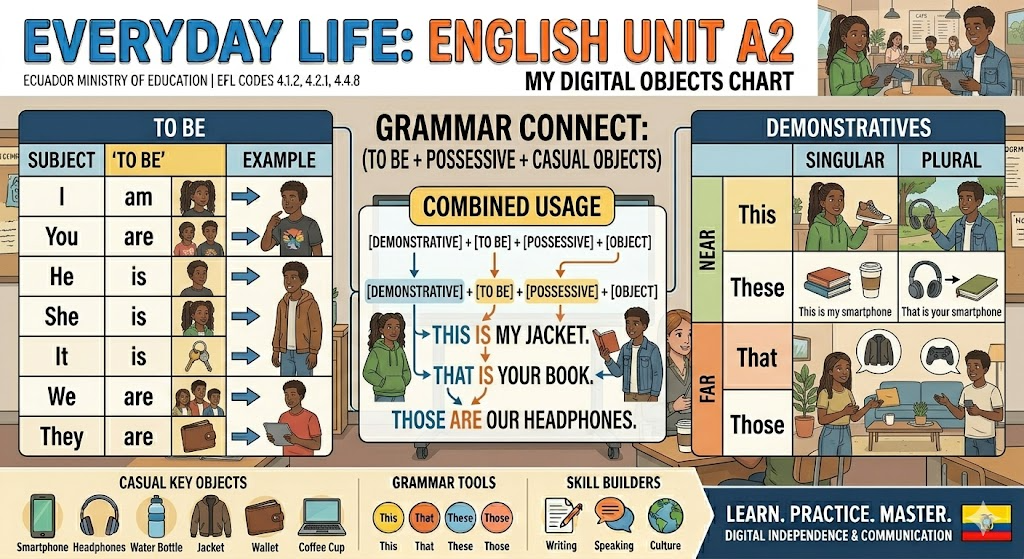
(EFL 4.1.2) Understand that some cultural artifacts (objects) are common across different countries.
(EFL 4.2.1) Use everyday objects to describe personal possessions in simple conversations.
(EFL 4.4.8) Write short, simple sentences about personal belongings using correct grammar.
REAL-LIFE APPLICATION
In the real world, being able to identify and describe everyday objects is essential for basic survival and independence. Whether a student is reporting a lost item (like a phone or wallet), shopping in a foreign country, or simply asking a roommate where the keys are, these nouns and the grammar of “possession” form the backbone of functional daily communication..
LEARNING ACTIVITIES
SESSION 1 (80 min) ANTICIPATION
Part 1 (10 -15min)
“The Digital Backpack” (15 min)
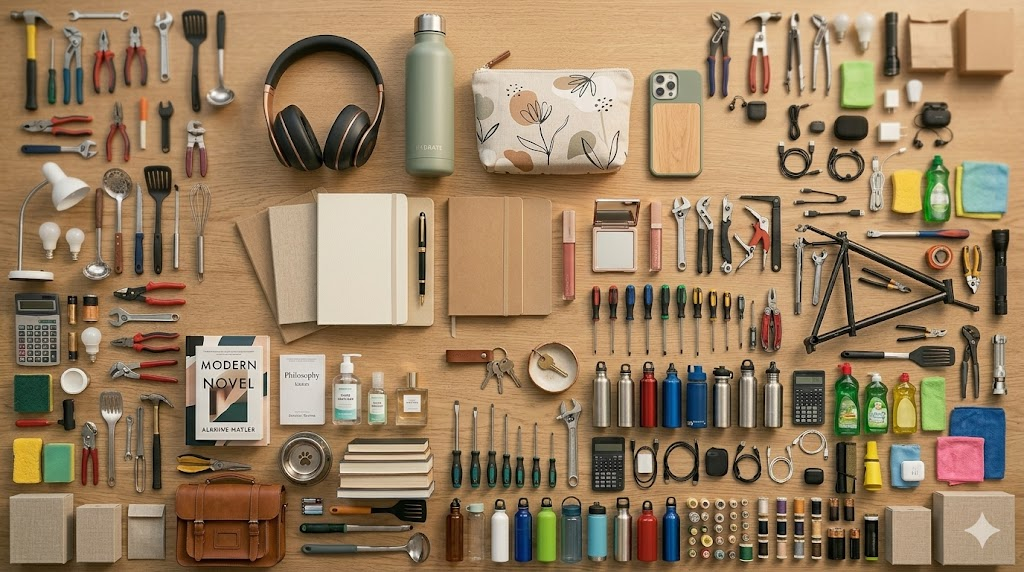
- Instruction: Students look at a zoomed-in “mystery photo” on the screen showing a texture or small part of an object (e.g., a phone lens, a key ring).
- Task: Students guess what it is in English. Use this to introduce the core concept: “What is it? It is a…”
CONSTRUCTION
Part 2: Vocabulary Development (15-20 min)
The teacher explicitly introduces key vocabulary needed for the lesson, ensuring students clearly understand meaning and use. The words include:
Smartphone (Essential for digital natives)
Headphones (Used daily in class/commutes)
Wallet / Purse (Important for money/identity)
Keyring/ Key chain (For house/locker keys)
Charger (A modern “must-have”)
Backpack (Their primary “everyday” container)
Part 3: Grammar Introduction (20 min)
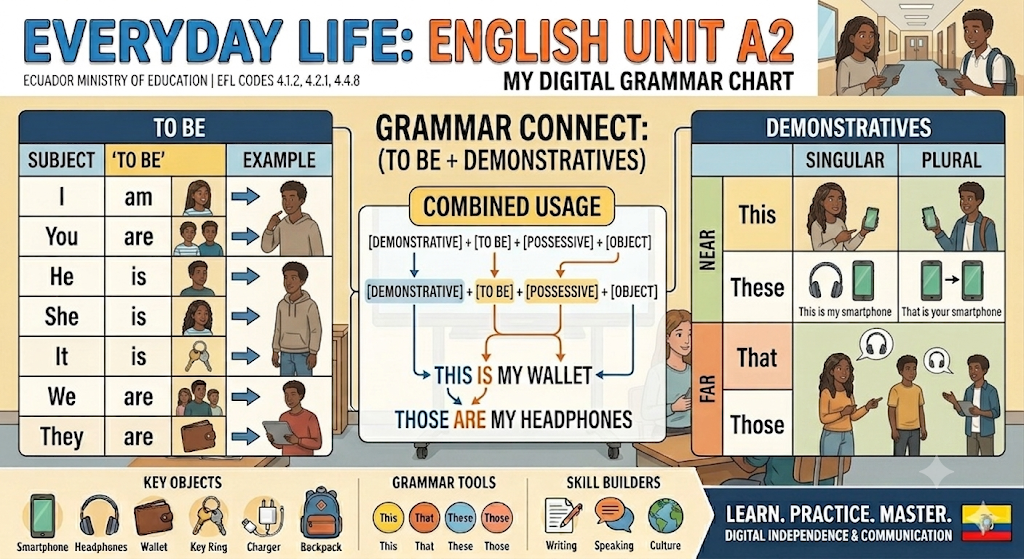
Grammar Introduction: “This/That & These/Those” (20 min)
- Concept: Use This/These for things nearby and That/Those for things far away.
- Instruction: Draw a 2×2 grid on the board.
- Singular: This (near) / That (far)
- Plural: These (near) / Those (far)
- Task: Teacher points to objects in the room (e.g., “This is my pen. That is your backpack.”) and students repeat the pattern.
“Distance Dictation” (25 min)
- Instruction: In pairs, one student sits, and one stands far away.
- Task: The standing student holds up items. The sitting student must write a sentence using the correct demonstrative: “That is a charger” or “Those are keys.” Then they switch.
SESSION 2: CONSTRUCTION – REINFORCEMENT (40 min)
“My Digital Survival Kit” (40 min)
- Instruction: Students take a photo of 3-5 items in their actual backpack.
- Task: Create a “Digital Survival Kit” slide. They must label each item using the grammar from Day 1: “This is my lucky keyring,” “These are my favorite headphones.”
- Creative Twist: They must explain why they carry it.
SESSION 3: CONSOLIDATION (80 min)
“The Lost & Found Desk” (80 min)
Part 1: The Writing (40 min)
- Students receive a “Lost Item Form.” They must write a detailed paragraph describing a missing object (Appearance, size, color) and its importance using the verb “to be” and demonstratives.
Part 2: The Interview (40 min)
- Students role-play: One is the “Found Office Agent,” and the other is the “Owner.”
- The Agent asks: “Is this your wallet?” The Owner describes it to prove possession: “No, my wallet is blue. Those are my keys, though!”
- Grading Focus: Correct use of plural vs. singular and “To Be” agreement.
NEE – Agregar el tipo de adaptaciones curriculares
Principio II: Pautas 6.1 – 6.3 – 6.4
Principio III: Pautas 7.1 – 8.1 – 9.1
ALUMNO 1: Constante monitoreo. Dar tiempo adicional para el desarrollo de la actividad y se reduce el número de ejercicios o se modifican los ejercicios con un nivel de dificultad reducido, de acuerdo con sus necesidades académicas.
ALUMNO 2: Constante monitoreo, Dar tiempo adicional para el desarrollo de la actividad y se reduce el número de ejercicios o se modifican los ejercicios con un nivel de dificultad reducido, de acuerdo con sus necesidades académicas.
ALUMNO 3: Constante monitoreo. Corroborar que el contenido entregado en clase haya sido comprendido por la estudiante mediante retroalimentación.