
Hobbies and Interests
SKILLS
(EFL 4.1.2)Highlighting that hobbies vary across cultures while sharing universal appeals.
(EFL 4.2.1) Engaging in short dialogues about personal interests and weekend activities.
(EFL 4.4.8) Producing simple paragraphs describing what they and their friends like to do.
REAL-LIFE APPLICATION
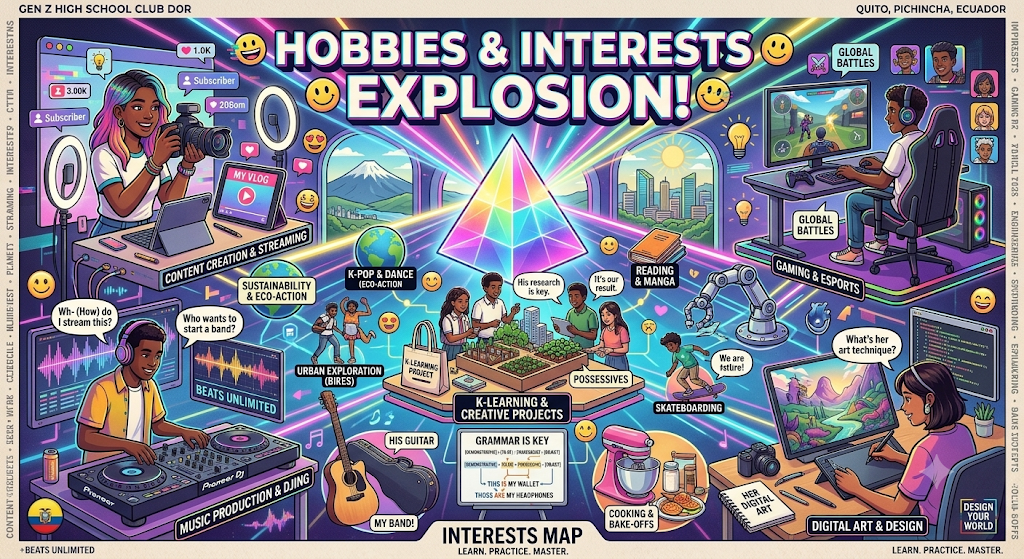
Hobbies are the “social glue” of human interaction. In the real world, being able to talk about interests is how we make friends, join clubs, and find common ground in new environments. Whether it is discussing a favorite sport, a gaming habit, or a creative passion like painting, this vocabulary allows students to move beyond basic survival and start building meaningful personal relationships.
LEARNING ACTIVITIES
SESSION 1 (80 min) ANTICIPATION
Part 1 (10 -15min)
“The Hobby Charades” (15 min)
- Instruction: The teacher performs a silent action representing a hobby (e.g., dribbling a ball, playing a guitar).
- Task: Students shout out the hobby in English. Use this to bridge from “What is this object?” to “What is he/she doing?”.
CONSTRUCTION
Part 2: Vocabulary Development (15-20 min)
The teacher explicitly introduces key vocabulary needed for the lesson, ensuring students clearly understand meaning and use. The words include:
- Gaming (Extremely relevant for digital-age teens)
- Photography/Content Creation (TikTok, Instagram trends)
- Playing an instrument (Creative expression)
- Team sports (Soccer, basketball)
- Cooking/Baking (Daily life skills)
- Drawing/Painting (Individual artistic interests)
Part 3: Grammar Introduction (20 min)
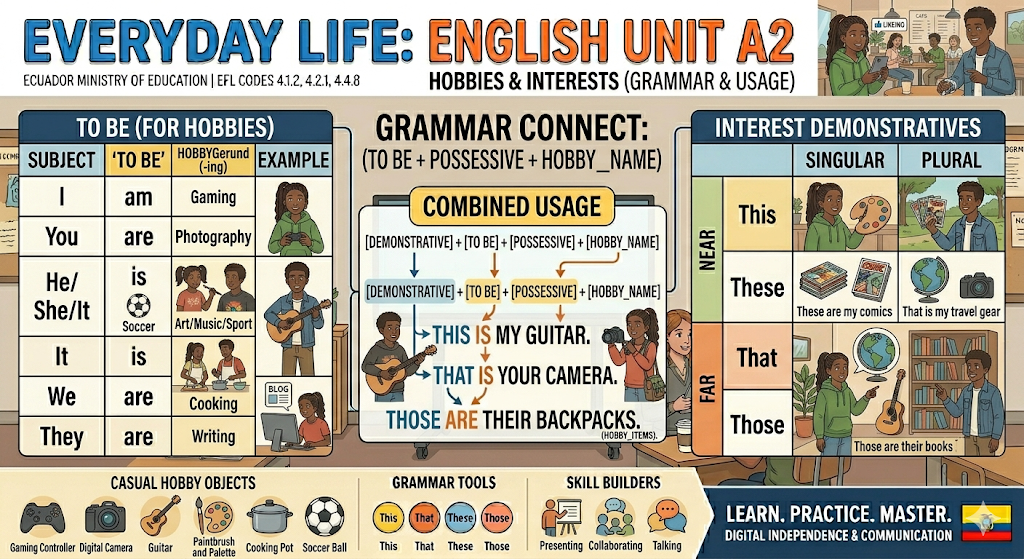
Grammar Introduction: “Verb To Be + Gerund (-ing)” (20 min)
- Concept: Using the verb “to be” to describe current states and interests.
- Instruction: Focus on the structure [Subject] + [Verb\ To\ Be] + [Interested\ In / Good\ At]
- Examples: “I am interested in gaming.” / “They are good at soccer.”.
- Task: Students write three “I am…” sentences about their own skills.
PRESENTATION: https://docs.google.com/presentation/d/12yRlpr04-r3e9ng0RwXNlvhCIwjgPuPKOHzddp6MZ04/edit?usp=sharing
SESSION 2: CONSTRUCTION – REINFORCEMENT (40 min)
“The Hobby Influencer” (40 min)
- Instruction: Students act as a “Social Media Influencer” for a specific hobby.
- Task: They create a short “Story” or script (3-5 sentences) using “normal clothes” visuals to describe their passion.
- Example: “Hi! I am Mateo. My favorite hobby is hiking. My friends are also hikers. We are very happy in the mountains!”.
SESSION 3: CONSOLIDATION (80 min)
Assessment: “The Club Fair” (80 min)
Part 1: The Poster (40 min)
- Students design a digital or paper flyer for a “School Club” based on a hobby. The flyer must use the verb “to be” to describe the club’s members and activities (e.g., “We are the Art Club. We are creative.”).
Part 2: The Interview (40 min)
- Students role-play a “Club Interview.” One student is the Club Leader, and the other is a potential member.
- Questions: “Are you good at drawing?” “Is your friend interested in joining too?”
- Grading Focus: Correct usage of am/is/are and subject-verb agreement.
NEE – Agregar el tipo de adaptaciones curriculares
Principio II: Pautas 6.1 – 6.3 – 6.4
Principio III: Pautas 7.1 – 8.1 – 9.1
ALUMNO 1: Constante monitoreo. Dar tiempo adicional para el desarrollo de la actividad y se reduce el número de ejercicios o se modifican los ejercicios con un nivel de dificultad reducido, de acuerdo con sus necesidades académicas.
ALUMNO 2: Constante monitoreo, Dar tiempo adicional para el desarrollo de la actividad y se reduce el número de ejercicios o se modifican los ejercicios con un nivel de dificultad reducido, de acuerdo con sus necesidades académicas.
ALUMNO 3: Constante monitoreo. Corroborar que el contenido entregado en clase haya sido comprendido por la estudiante mediante retroalimentación.