
Tourist SPOTS
SKILLS
EFL 5.2.1: Request and provide information about familiar topics or specific context-related areas (e.g., local tourist attractions) using clear and precise language.
EFL 5.3.2: Identify and use specific functional language structures (prepositions of place/direction) to understand short, contextualized descriptive texts.
REAL-LIFE APPLICATION
When visiting or promoting a city, using precise language prevents tourists from getting lost and helps highlight the unique locations of landmarks. Whether writing an online review, reading a travel brochure, or giving directions to a foreigner in Ecuador (like navigating Quito’s Centro Histórico or Baños), precision in vocabulary and grammar ensures seamless, clear intercultural communication.
LEARNING ACTIVITIES
SESSION 1 (80 min) ANTICIPATION
Part 1 – ( 10-15 minutes)
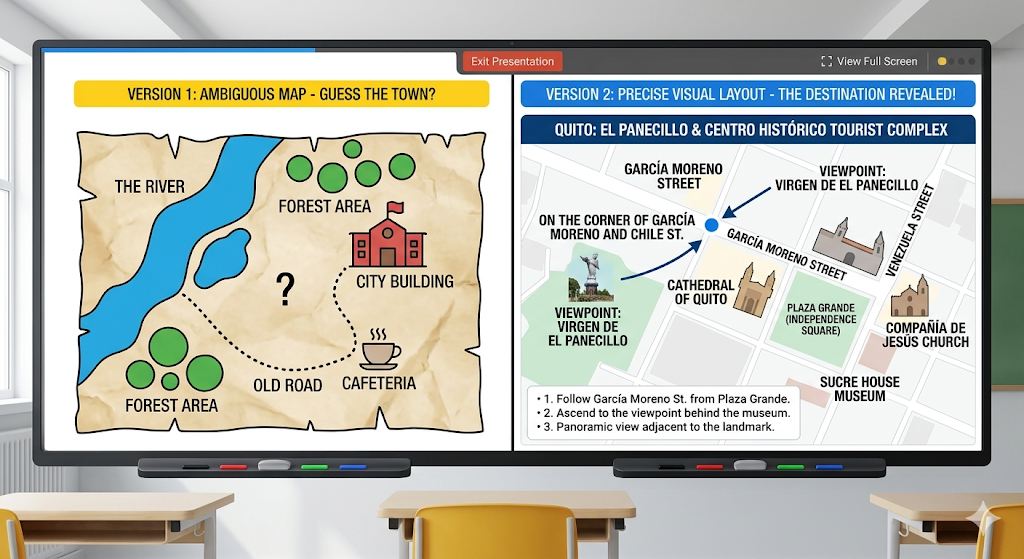
Anticipation Learning Activity (10–15 mins)
Objective: Activate prior knowledge and introduce the concept of “precision” visually.
- Instruction: Display a digital projection or shared screen showing a chaotic tourist map with generic labels (e.g., “The Building,” “The Place”). Ask students in pairs to guide a virtual avatar to the “good spot.” Students will quickly realize they cannot without precise words.
- The Blueprint: Transition to a clean, digital slide displaying 4 distinct Ecuadorian tourist spots labeled with exact coordinates and structural relationships.
CONSTRUCTION
Part 2: Vocabulary Development (15 min)
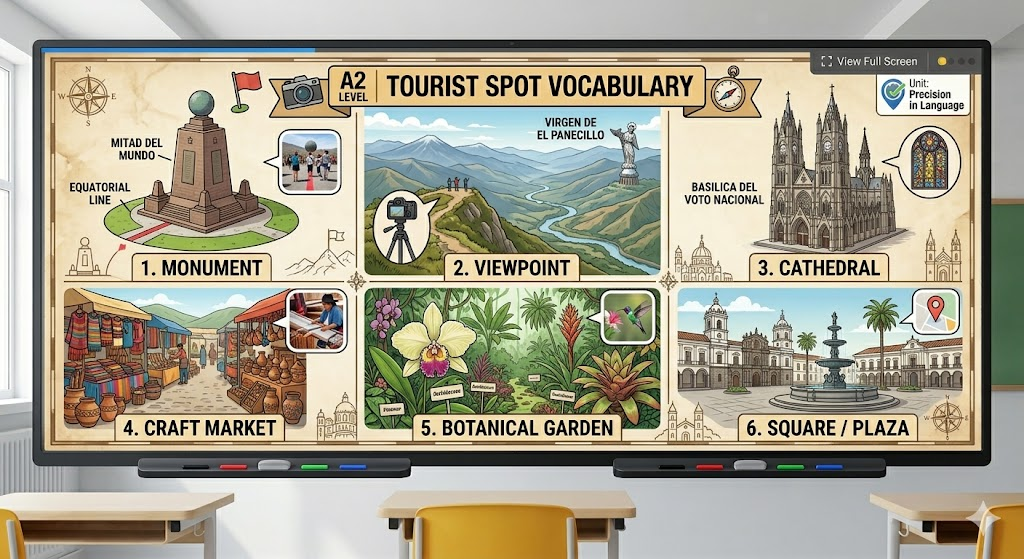
The teacher explicitly introduces key vocabulary needed for the lesson, ensuring students clearly understand meaning and use. The words include:
Monument – A statue or structure built to honor a famous person or event (e.g., Mitad del Mundo).
Viewpoint – A high place where people can look at a beautiful landscape (e.g., El Panecillo).
Cathedral – A large, principal, and historically significant church building.
Craft Market – A place where local artisans sell handmade goods and traditional souvenirs.
Botanical Garden – A dedicated park exhibiting a wide variety of plants and flowers labeled with their scientific names.
Square / Plaza – An open public space in the center of a town, usually surrounded by historic buildings.
Part 3: Grammar Introduction using Presentation (20 min)
Grammar Introduction:
Prepositions of Precision (20 mins)
To describe tourist layouts accurately, students need exact spatial prepositions. Introduce the target grammar structures using clear geometric relationships.
https://drive.google.com/file/d/1sbOWS6ISEDHWF_MinWUcWvV5Vt3_2Odt/view?usp=drive_link
- Opposite / Across from: Facing someone or something on the other side of a street or space.
- Adjacent to: Right next to; sharing a common border or wall.
- On the corner of: At the exact point where two streets meet.
- In the foreground of / background of: Specifying if an attraction is up front or in the distance within a landscape.
Grammar Practice Activity (25 mins)
Activity Name: “The Travel Agent’s Instructions”
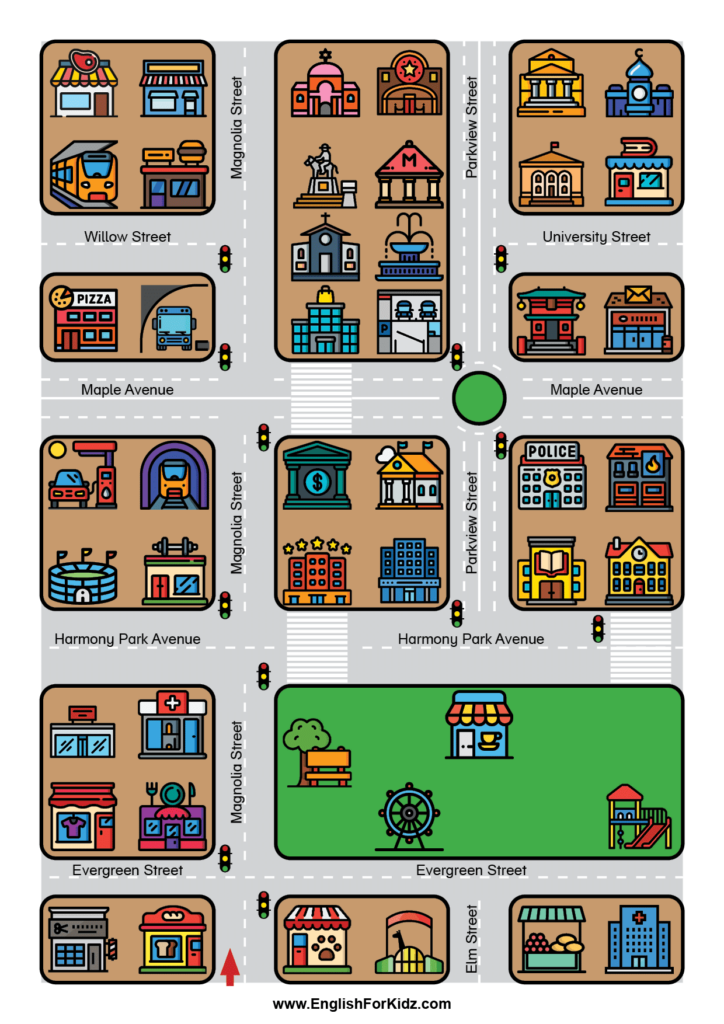
- Instructions: Provide students with a digital map worksheet. The map displays a generic town layout populated by the 6 new vocabulary items. Students must complete a fill-in-the-blank descriptive paragraph written by a travel guide, choosing the most precise preposition from a word bank.
- Resource Needed: A downloadable or interactive PDF worksheet featuring a simple, clear block map layout.Example Question: “The historic Cathedral is located directly ____________ [adjacent to / across from] the Square, right next to the grand hotel.”
SESSION 2: CONSTRUCTION – REINFORCEMENT (40 min)
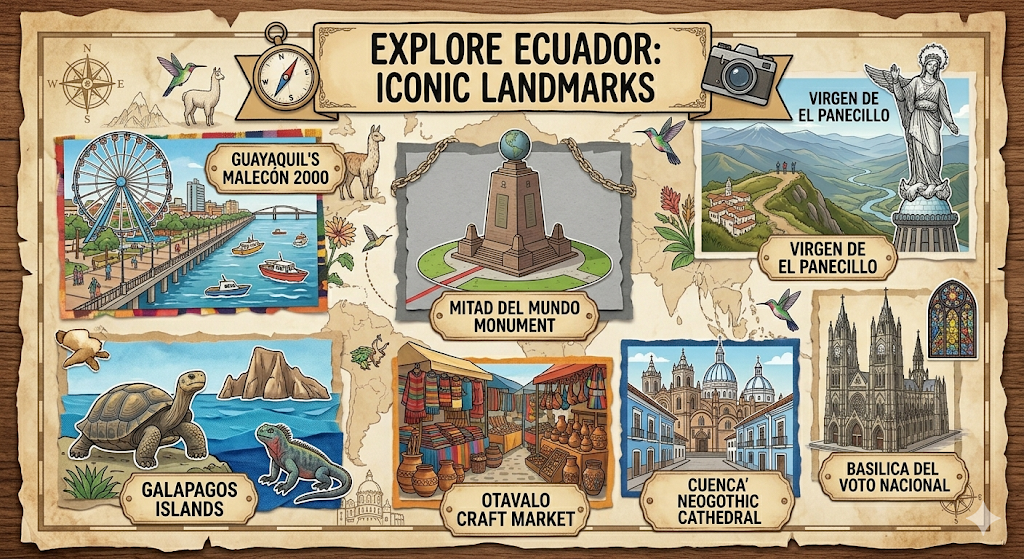
Activity Name: “Create Your Digital Travel Postcard”
- Instructions: Students select their favorite real-life tourist spot in Ecuador or the world. They must find an image of it and write a short, 5-sentence travel postcard caption using at least 3 vocabulary words and 3 prepositions of precision learned the day prior.
- Resource Needed: A shared collaborative digital board (such as Padlet or Google Slides) where every student creates one slide containing their postcard photo and description.
https://padlet.com/
SESSION 3: CONSOLIDATION (80 min)
Part 1 – ( 2 x 40min)
Assessment Activity
Period 1: The Detective Challenge (40 Minutes)
Focus: Reading comprehension, peer collaboration, and structural identification.
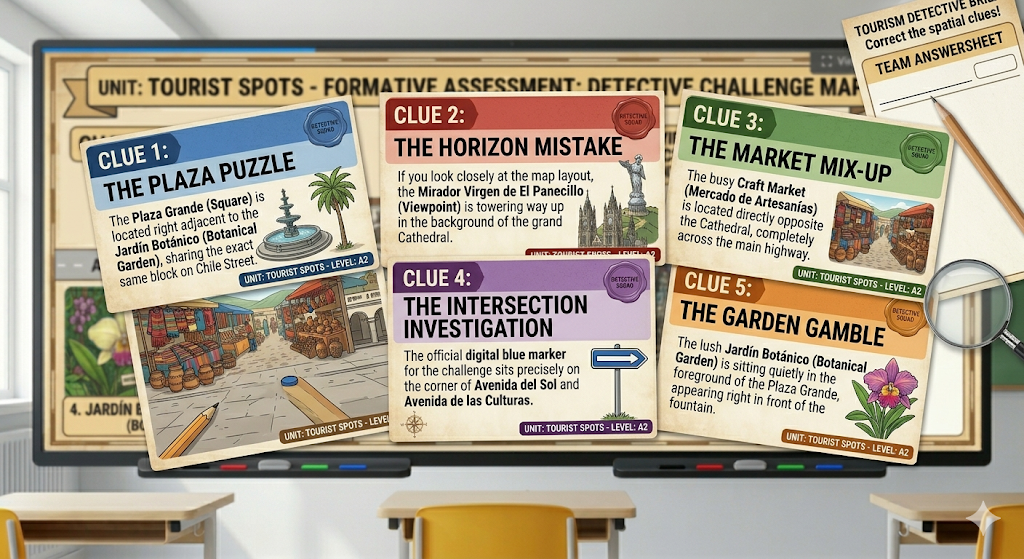
Phase 1: Team Setup & Briefing (10 minutes)
- Activity: Divide the class into small groups of 3–4 students. Hand out or digitally share a modified version of the Ecuadorian Tourist Complex Map
- Instructions: Inform students that they are “Tourism Detectives.” A fictional travel influencer lost their itinerary clues around the Centro Histórico of Quito. The teams must decode the clues using absolute precision.
Phase 2: The Map Clue Hunt (20 minutes)
- Activity: Provide each group with 5 descriptive text cards. Each card contains a mix of accurate and intentionally inaccurate statements using the target prepositions (adjacent to, opposite, on the corner of, foreground/background).
- Task: Students must work together to analyze the map, verify if the statements on the cards are true or false, and correct any false statements on a team answer sheet.
- Sample Clue Card: “The Basilica del Voto Nacional is located directly adjacent to the Malecón 2000.”
- Student Correction Required: “False. The Basilica is in Quito, while the Malecón 2000 is far away in Guayaquil. The Basilica is actually located opposite the small plaza on Venezuela Street.”
Phase 3: Team Cross-Check (10 minutes)
- Activity: Pair Group A with Group B. Have them swap their corrected clue sheets to grade each other’s work and discuss any disagreements about the spatial precision.
Period 2: Role Play (40 Minutes)
Activity: Tour guide and tourist role play. Divide the class into small groups of 3–4 students.
In a cup or bag, include cut up pieces of paper with different situations they need to act out infront of the class.
EX: Lost tourist comes up to a group of friends where only one person knows english and helps them with directions.
They only have 15 minutes to set everything up and create an idea of how their role play is going to go.
The last 25 minutes of class they present and are graded with a corresponding rubric.
NEE – Agregar el tipo de adaptaciones curriculares
Principio II: Pautas 6.1 – 6.3 – 6.4
Principio III: Pautas 7.1 – 8.1 – 9.1
ALUMNO 1: Constante monitoreo. Dar tiempo adicional para el desarrollo de la actividad y se reduce el número de ejercicios o se modifican los ejercicios con un nivel de dificultad reducido, de acuerdo con sus necesidades académicas.
ALUMNO 2: Constante monitoreo, Dar tiempo adicional para el desarrollo de la actividad y se reduce el número de ejercicios o se modifican los ejercicios con un nivel de dificultad reducido, de acuerdo con sus necesidades académicas.
ALUMNO 3: Constante monitoreo. Corroborar que el contenido entregado en clase haya sido comprendido por la estudiante mediante retroalimentación.