
Singular and plural
SKILLS
EFL 3.3.1 Understand most details of the content of a short simple text when something is familiar and supported by visuals.
EFL 3.4.1 Complete simple forms and write basic information using familiar vocabulary and grammatical structures.
EFL 3.4.2 Write short simple sentences and phrases about everyday topics using basic grammar accurately.
EFL 3.1.1: Use singular and plural nouns in short oral interactions.
REAL-LIFE APPLICATION
In an interconnected world, reading a map and giving directions precisely is a critical survival and professional skill. Whether a student is helping a lost tourist navigate the transit lines of Guayaquil, reading an evacuation map during an emergency drill, or using a digital delivery app to direct a driver to their exact coordinates, language precision eliminates confusion, saves time, and ensures safety..
LEARNING ACTIVITIES
SESSION 1 (80 min) ANTICIPATION
Part 1 – ( 10-15 minutes)

Anticipation Activity (10–15 minutes)
Activity: “What’s in My Backpack?”
Instructions:
- Show pictures of school items:
- 1 pencil / 4 pencils
- 1 book / 3 books
- 1 eraser / 2 erasers
- Ask:
- What do you see?
- Is it one or many?
- Students classify images into:
- Singular
- Plural
Mini Theory
Explain:
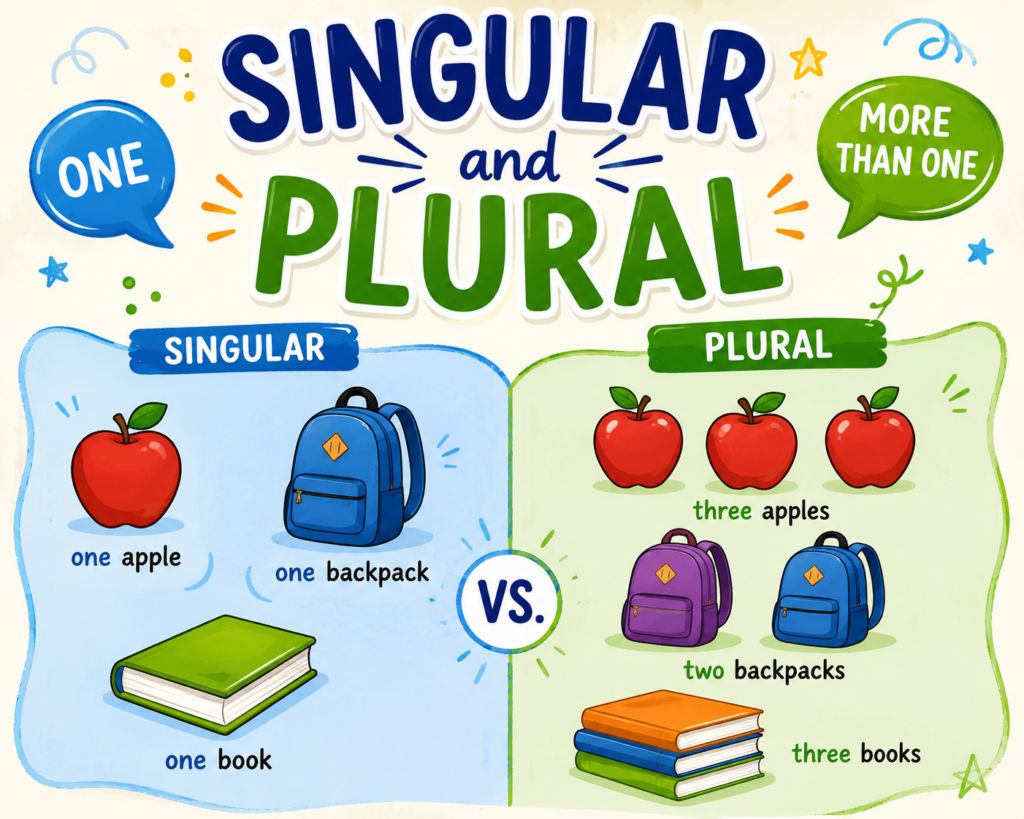
- Singular = one person, place, animal, or thing.
- book
- student
- pencil
- Plural = more than one.
- books
- students
- pencils
Most nouns add -s.
CONSTRUCTION
Part 2: Vocabulary Development (15 min)
The teacher explicitly introduces key vocabulary needed for the lesson, ensuring students clearly understand meaning and use. The words include:
| Word | Meaning |
|---|---|
| Book | A set of pages for reading |
| Pencil | Used for writing |
| Student | A learner |
| Teacher | A person who teaches |
| Desk | School furniture |
| Backpack | A bag for school items |
Quick Vocabulary Practice
Students write:
- One book → Two books
- One desk → Three desks
Part 3: Grammar Introduction: Singular and Plural Nouns (20 mins)
| Singular | Plural |
|---|---|
| book | books |
| pen | pens |
| desk | desks |
| student | students |
For nouns ending in:
s
sh
ch
x
z
| Singular | Plural |
|---|---|
| bus | buses |
| box | boxes |
| watch | watches |
Rule 3: Change y → ies
If there is a consonant before y:
| Singular | Plural |
|---|---|
| baby | babies |
| city | cities |
Rule 4: Irregular Plurals
| Singular | Plural |
|---|---|
| child | children |
| man | men |
| woman | women |
| mouse | mice |
Guided Practice
Teacher says singular nouns.
Students say plural forms aloud.
Example:
Teacher: “Book”
Students: “Books”
4. Grammar Practice Activity (25 mins)
Grammar Practice Activity (25 Minutes)
Activity: Complete the Table
Write the plural form.
| Singular | Plural |
|---|---|
| cat | ______ |
| bus | ______ |
| baby | ______ |
| teacher | ______ |
| box | ______ |
| student | ______ |
| child | ______ |
| city | ______ |
Activity 2: Choose the Correct Answer
- Two ______
- a) book
- b) books
- Three ______
- a) buses
- b) bus
- Five ______
- a) city
- b) cities
- Four ______
- a) teachers
- b) teacher
SESSION 2: CONSTRUCTION – REINFORCEMENT (40 min)
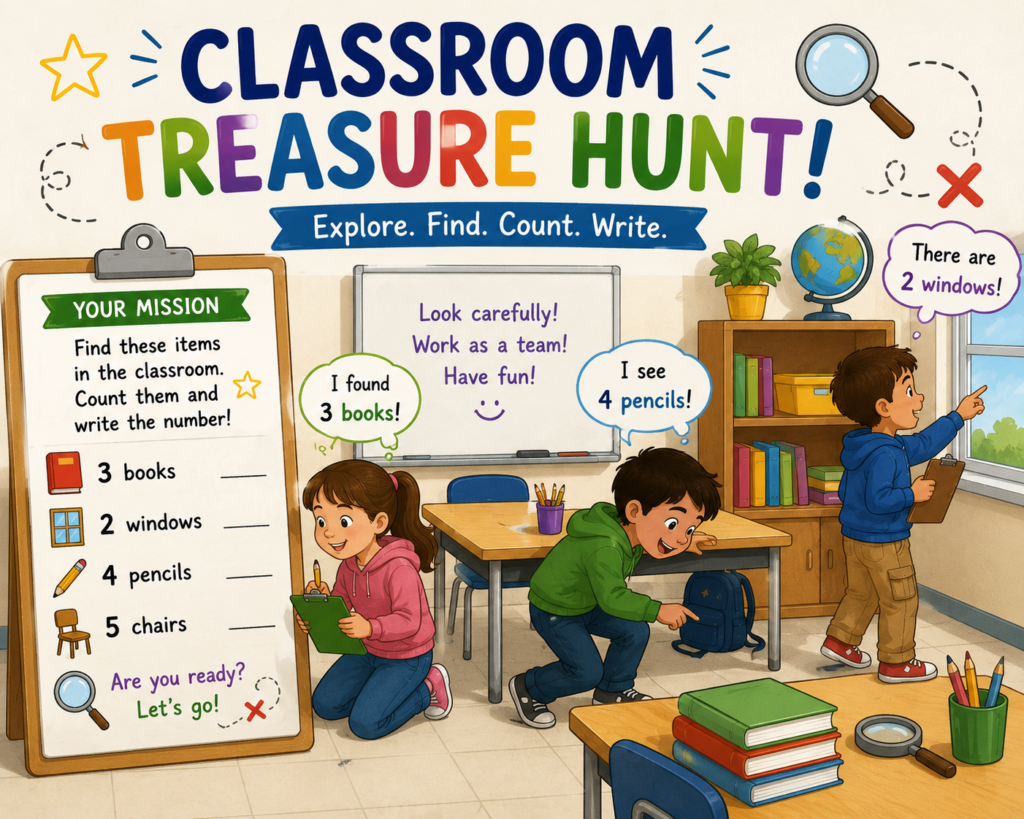
“Classroom Treasure Hunt”
Part 1 (15 min)
Students walk around the classroom and find:
- 3 books
- 2 windows
- 4 pencils
- 5 chairs
They write sentences:
Example:
- I see three books.
- I see five chairs.
Part 2 (15 min)
Draw and Label
Students draw:
- One classroom object
- Many classroom objects
Example:
- One pencil
- Five pencils
Part 3 (10 min)
Pair Work
Student A asks:
- How many books do you see?
Student B answers:
- I see three books.
Switch roles.
SESSION 3: CONSOLIDATION (80 min)
Part 1 – ( 2 x 40min)
Assessment Activity
TEST:
https://docs.google.com/document/d/1lIViobY2l12UkBytmm5draP6v47jUo6SUf2k0fcOM2E/edit?usp=sharing
NEE – Agregar el tipo de adaptaciones curriculares
Principio II: Pautas 6.1 – 6.3 – 6.4
Principio III: Pautas 7.1 – 8.1 – 9.1
ALUMNO 1: Constante monitoreo. Dar tiempo adicional para el desarrollo de la actividad y se reduce el número de ejercicios o se modifican los ejercicios con un nivel de dificultad reducido, de acuerdo con sus necesidades académicas.
ALUMNO 2: Constante monitoreo, Dar tiempo adicional para el desarrollo de la actividad y se reduce el número de ejercicios o se modifican los ejercicios con un nivel de dificultad reducido, de acuerdo con sus necesidades académicas.
ALUMNO 3: Constante monitoreo. Corroborar que el contenido entregado en clase haya sido comprendido por la estudiante mediante retroalimentación.