
K-LEARNING PROJECT
SKILLS
Communication & Cultural Awareness (EFL 4.1.1): Compare and contrast aspects of self and family.
Oral Communication (EFL 4.2.2): Use simple phrases and sentences to describe family members and their relationships.
Reading (EFL 4.3.4): Understand the main points in short, simple texts on familiar topics
REAL-LIFE APPLICATION
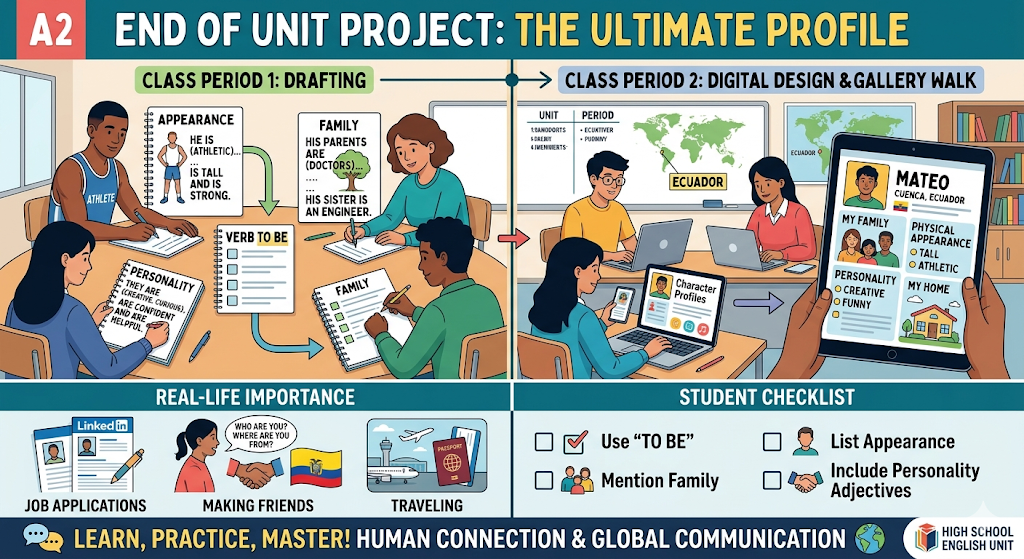
Mastering these sub-topics is the foundation of human connection in a second language. In the real world, the ability to describe who we are, what we look like, and where we come from is the “social currency” of first meetings. Whether a student is filling out a job application, creating a professional LinkedIn summary, or simply making a new friend while traveling, they must accurately use the Verb To Be to establish their identity. By connecting physical traits with personality, students learn to move beyond basic facts and begin to express the nuances of human character, which is essential for effective communication and empathy in global environments.
LEARNING ACTIVITIES
SESSION 1 (80 min)
Project: “The Ultimate Profile”
Objective: Students create a digital poster or short presentation (using Canva, PowerPoint, or Instagram-style layouts) for a character—either a fictional hero, a famous celebrity, or a “new” student.
Class Period 1: Drafting & Grammar (40 min)
- 0-10 min: Introduction of the project and rubric. Show an example profile (e.g., “This is Peter. He is from New York. He is tall and has brown hair…”).
- 10-30 min: Students choose their subject and draft their descriptions. They must include:
- Family: “He is an only child” or “His parents are doctors.”
- Appearance: “She is athletic and is quite tall.”
- Personality: “They are very creative but are sometimes shy.”
- 30-40 min: Peer Review. Students swap drafts to check if the Verb To Be ($am, is, are$) matches the subjects correctly.
Class Period 2: Digital Design & Gallery Walk (40 min)
- 0-25 min: Students use their devices to create the visual profile. They add photos or icons that represent the physical traits and family members mentioned in their text.
- 25-40 min: The Digital Gallery Walk. Students leave their screens open or upload their work to a shared padlet. Classmates walk around and find one person who “is” similar to them (e.g., “We are both funny”).
NEE – Agregar el tipo de adaptaciones curriculares
Principio II: Pautas 6.1 – 6.3 – 6.4
Principio III: Pautas 7.1 – 8.1 – 9.1
ALUMNO 1: Constante monitoreo. Dar tiempo adicional para el desarrollo de la actividad y se reduce el número de ejercicios o se modifican los ejercicios con un nivel de dificultad reducido, de acuerdo con sus necesidades académicas.
ALUMNO 2: Constante monitoreo, Dar tiempo adicional para el desarrollo de la actividad y se reduce el número de ejercicios o se modifican los ejercicios con un nivel de dificultad reducido, de acuerdo con sus necesidades académicas.
ALUMNO 3: Constante monitoreo. Corroborar que el contenido entregado en clase haya sido comprendido por la estudiante mediante retroalimentación.