
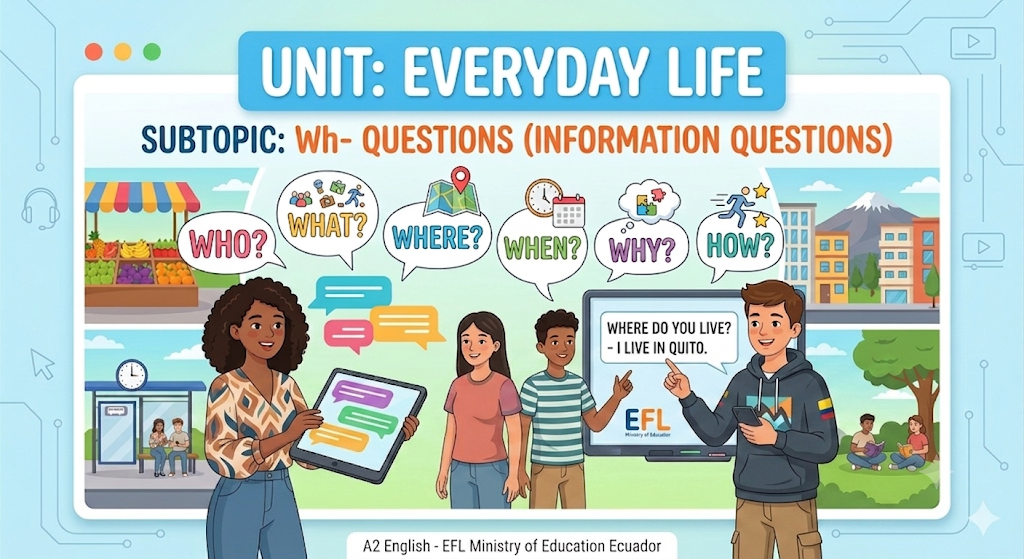
Wh- Questions
SKILLS
EFL 4.3.4: Find specific predictable information in short, simple texts over everyday use.
EFL 4.4.1: Convey meaning on very familiar topics using a basic range of vocabulary and expressions.
EFL 4.4.2: Use a limited range of simple grammatical structures (Wh- questions) to describe personal information.
REAL-LIFE APPLICATION
Wh- questions are the “keys” to conversation. In everyday life, we use them to meet new people, find directions, ask for prices, or learn about a friend’s weekend. Without them, communication is limited to “yes” or “no” answers, which prevents meaningful social connection.
LEARNING ACTIVITIES
SESSION 1 (80 min) ANTICIPATION
Part 1 – The Mystery Bag( 15- 20 min)
Anticipation Activity:
The “Mystery Bag” Interview
- Instruction: Show an image of a famous celebrity or a mysterious backpack.
- Task: Students must guess what is inside or where the person is going.
- Prompt: Ask: “If you could ask this person anything, what do you need to know?” Write their messy questions on the board/screen and highlight the starting words (Who, What, Where).
CONSTRUCTION
Part 2: Vocabulary Development (15 min)
The teacher explicitly introduces key vocabulary needed for the lesson, ensuring students clearly understand meaning and use. The words include:
“What is your name?”
“Where do you live?”
“How old are you?”
“When is your birthday?”
“Who do you live with?”
“What is your favorite [subject/food/movie]?”
Part 3: Grammar Introduction using Presentation (20 min)
Grammar Introduction:
Theory:
The 6 W’s Structure Focus on the formula: Wh- word + Auxiliary (do/does) + Subject + Verb?
- Who: People
- What: Things/Actions
- Where: Places
- When: Time
- Why: Reasons (Answer with “Because”)
- How: Manner or “How often” (Frequency)
Part 4: Guided Practice (25 min)
“Find Someone Who…” (Digital Version)
- Instruction: Give students a digital list of 5 facts (e.g., …likes pizza, …wakes up at 6 AM).
- Task: Students must transform these into Wh- questions (e.g., “What do you like to eat?” or “When do you wake up?”).
- Interaction: They use the chat or breakout rooms to ask classmates and record names.
SESSION 2: CONSTRUCTION – REINFORCEMENT (40 min)
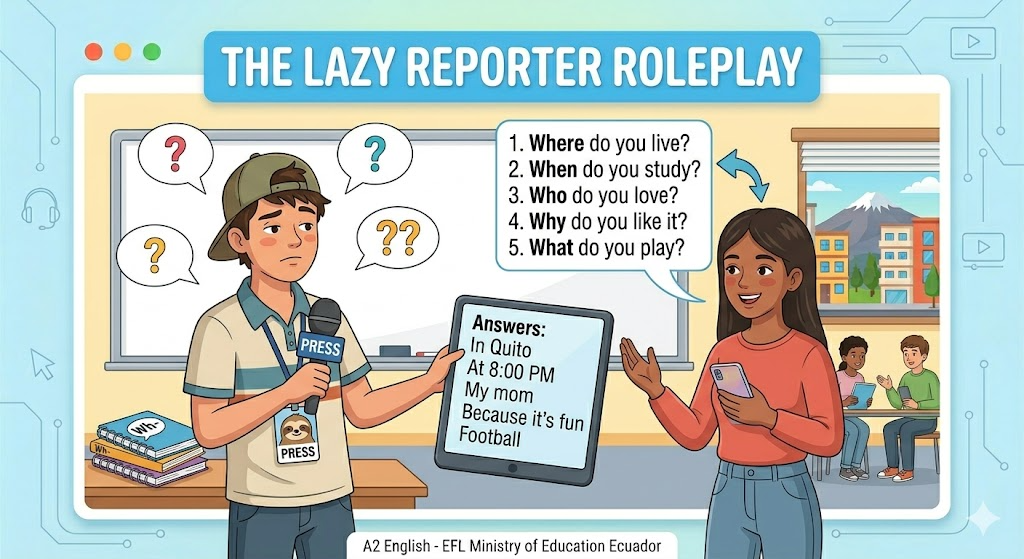
The “Lazy Reporter” Roleplay
- Setup: Pair students. One is a “Famous Influencer,” the other is a “Reporter.”
- Task: The reporter is given a list of answers (e.g., “In Guayaquil,” “At 8:00 PM,” “My mom”).
- Goal: The reporter must figure out the correct Wh- questions to get those specific answers.
- Presentation: Pairs record a 1-minute “interview” using Flipgrid or a similar tool.
SESSION 3: CONSOLIDATION (80 min)
Part 1 – ( 2 x 40min)
Period 1: The “Digital Scavenger Hunt” (40 min)
- Students receive a short text about a teenager’s daily life in a different country.
- They must answer 10 Wh- questions based on the text.
- Bonus: They must write 3 original Wh- questions they would ask the person in the text.
Period 2: Interactive Oral Interview (40 min)
- Teacher-Student or Peer-to-Peer: Using a digital spinning wheel with Wh- words.
- Action: Spin the wheel. Whatever word it lands on (e.g., “Where”), the student must ask the teacher or a peer a grammatically correct question about their “Everyday Life.”
- Rubric: Focus on Grammar Accuracy (Auxiliary use), Vocabulary, and Fluency.
NEE – Agregar el tipo de adaptaciones curriculares
Principio II: Pautas 6.1 – 6.3 – 6.4
Principio III: Pautas 7.1 – 8.1 – 9.1
ALUMNO 1: Constante monitoreo. Dar tiempo adicional para el desarrollo de la actividad y se reduce el número de ejercicios o se modifican los ejercicios con un nivel de dificultad reducido, de acuerdo con sus necesidades académicas.
ALUMNO 2: Constante monitoreo, Dar tiempo adicional para el desarrollo de la actividad y se reduce el número de ejercicios o se modifican los ejercicios con un nivel de dificultad reducido, de acuerdo con sus necesidades académicas.
ALUMNO 3: Constante monitoreo. Corroborar que el contenido entregado en clase haya sido comprendido por la estudiante mediante retroalimentación.