
Physical appearance
SKILLS
EFL 3.1.9: Follow short, simple instructions for performing an action.
EFL 3.2.1: Understand some simple words and phrases in listening texts on common topics.
EFL 3.3.4: Interact in very simple, short exchanges on personal matters.
REAL-LIFE APPLICATION
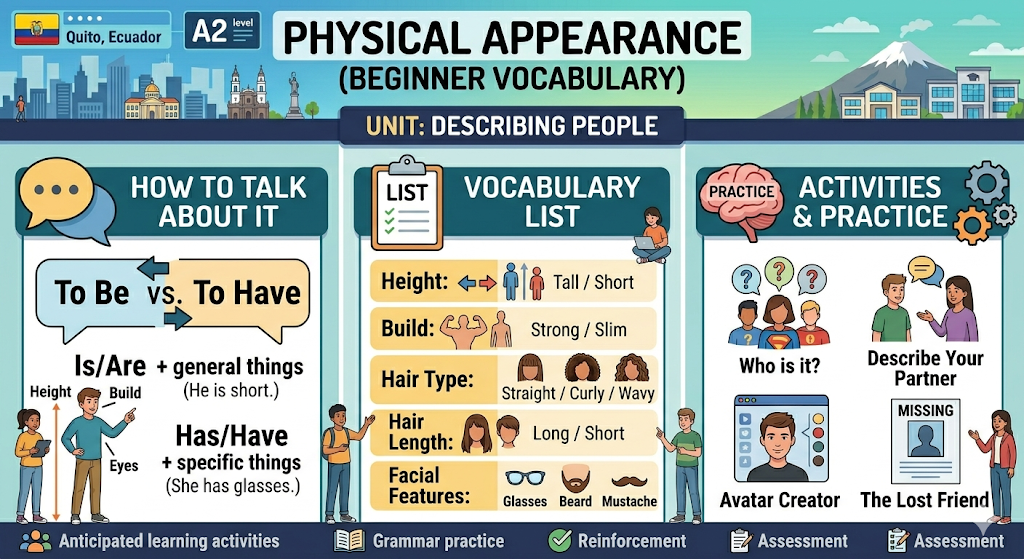
Students will focus on essential vocabulary for height, build, hair, and simple facial features to help students describe themselves and their friends.
LEARNING ACTIVITIES
SESSION 1 (80 min) ANTICIPATION
Part 1 (10-15 min)
“Who is it?”
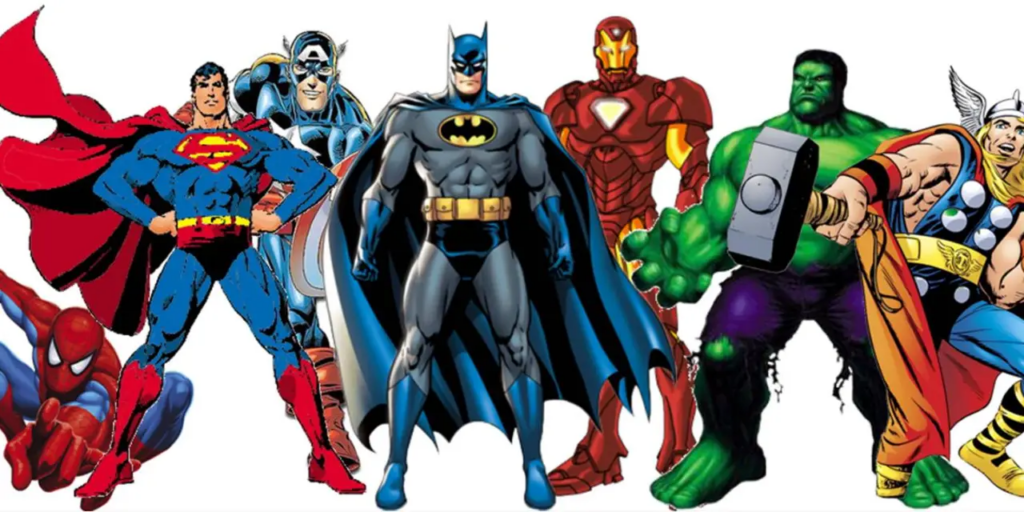
- Instruction: Show the class 3 simple cartoon pictures of famous, recognizable characters (e.g., a superhero, a cartoon character, a famous athlete).
- Task: Say simple descriptions like: “This person is very tall and has dark hair.” Students have to raise their hand and guess who you are describing. This instantly shows them why we need appearance words.
CONSTRUCTION
Part 2: Vocabulary Development (15 min)
The teacher explicitly introduces key vocabulary needed for the lesson, ensuring students clearly understand meaning and use. The words include:
- Height: Tall / Short/ Average
- Build: Slim / Strong /Chubby (explain skinny and fat are not the most polite)
- Hair Type: Straight / Curly / Wavy
- Hair Length: Long / Short
- Facial Features: Beard / Mustache / Glasses
Quick game to go over the vocabulary: Bamboozle or Kahoot with IMAGES
Part 3: Grammar Introduction using Presentation (20 min)
To Be vs. To Have (20 min)
- Theory: Focus on the two main structures we use for physical descriptions:
- To Be: We use it for general adjectives (height, build, age).
- To Have: We use it for specific features (hair, eyes, facial hair).
- Instruction: Draw a simplified rule on the board/digital screen:
- “Is/Are” + Adjective (He is short.)
- “Has/Have” + Noun (She has curly hair.)
- Examples:
- He is strong.
- They are tall.
- She has got brown eyes. (Present got can be simplified to has)
Part 4: Guided Practice (25 min)
“Describe Your Partner” (25 min)
- Instruction: In pairs, students must write three sentences about their partner using the new vocabulary.
- Task: They must use at least one “Is” sentence and one “Has” sentence. Then, they share with the class.
- Example: “My partner is slim.” and “She has wavy hair.“
SESSION 2: CONSTRUCTION – REINFORCEMENT (40 min)
Part 1 – “Avatar Creator” (40 min)
- Instruction: Students work individually, using a simple digital character creator (or drawing on paper).
- Task: They design an avatar. They must complete a simple worksheet with three sections:
- Avatar’s Height: (Check a box: Tall / Short)
- Avatar’s Hair: (Check boxes: Curly / Straight / Blond / Dark)
- Avatar’s Feature: (Check a box: Glasses / Beard / Mustache)
- This activity is fun and confirms they understand the visual labels.
SESSION 3: CONSOLIDATION (80 min)
“The Lost Friend” (80 min)
“The Lost Friend” (80 min / 2 Periods)
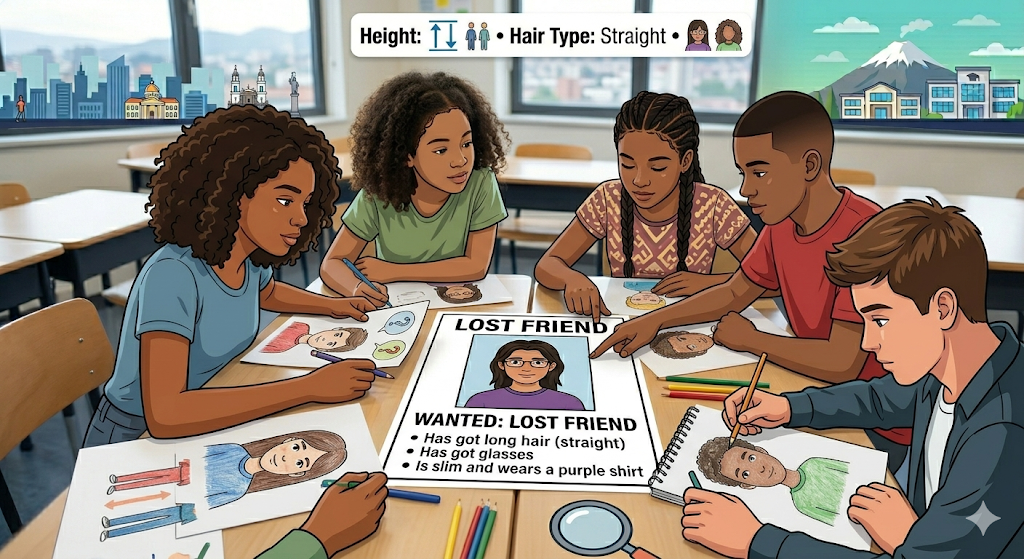
- Period 1 (Preparation): Students write a simple “Lost Friend” notice. They imagine a friend is lost and provide a 3-sentence description using “is” and “has” to describe height, hair, and one facial feature. They also draw a small picture of the friend.
- Period 2 (Presentation & Match):
- Task: In small groups, one student reads their notice. The others must identify which friend the notice describes by looking at the drawings.
- Grading: Based on clarity, proper usage of “Is/Has”, and correct application of vocabulary from the main unit.
NEE – Agregar el tipo de adaptaciones curriculares
Principio II: Pautas 6.1 – 6.3 – 6.4
Principio III: Pautas 7.1 – 8.1 – 9.1
ALUMNO 1: Constante monitoreo. Dar tiempo adicional para el desarrollo de la actividad y se reduce el número de ejercicios o se modifican los ejercicios con un nivel de dificultad reducido, de acuerdo con sus necesidades académicas.
ALUMNO 2: Constante monitoreo, Dar tiempo adicional para el desarrollo de la actividad y se reduce el número de ejercicios o se modifican los ejercicios con un nivel de dificultad reducido, de acuerdo con sus necesidades académicas.
ALUMNO 3: Constante monitoreo. Corroborar que el contenido entregado en clase haya sido comprendido por la estudiante mediante retroalimentación.