
Personality TRAITS
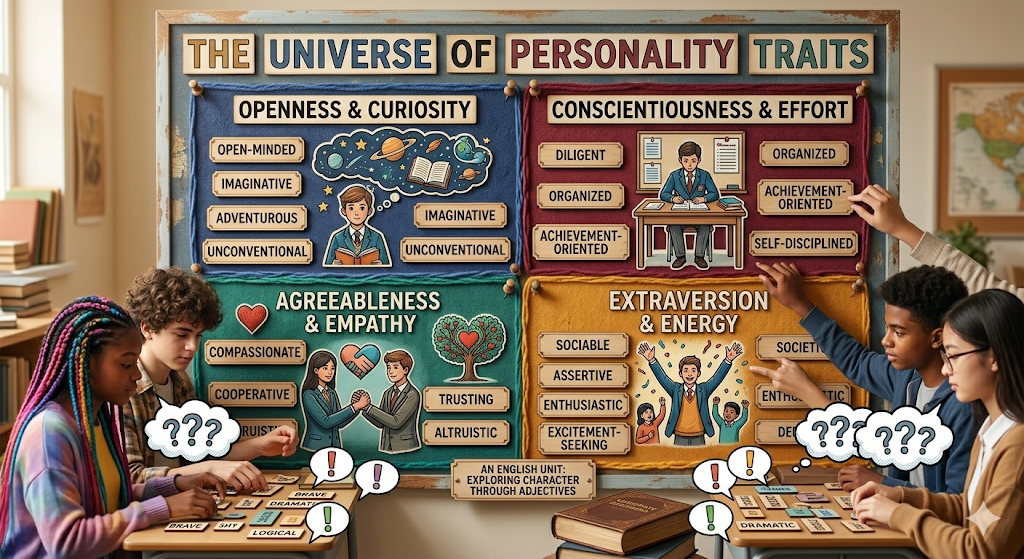
SKILLS
EFL 3.1.9: Follow short, simple instructions for performing an action.
EFL 3.2.1: Understand some simple words and phrases in listening texts on common topics.
EFL 3.3.4: Interact in very simple, short exchanges on personal matters
REAL-LIFE APPLICATION
Students learn to describe their friends, family, and classmates accurately. This skill is crucial for introductions, making social connections, and understanding others, moving beyond simple descriptions to meaningful expression.
LEARNING ACTIVITIES
SESSION 1 (80 min) ANTICIPATION
Part 1 (10-15 min)”
“The Character Guess” (10–15 min)
- Instruction: Display pictures of three very different, famous fictional or real-life teenagers (e.g., a studious bookworm character, a very athletic/outgoing character, and a very creative/shy character).
- Task: Read three simple sentences: “One person is very hard-working. One is very active. One is creative and shy.” Students raise their hands and point to which description matches which character. This immediately links visual characters to personality words.

- Instruction: Show the class 3 simple cartoon pictures of famous, recognizable characters (e.g., a superhero, a cartoon character, a famous athlete).
- Task: Say simple descriptions like: “This person is very tall and has dark hair.” Students have to raise their hand and guess who you are describing. This instantly shows them why we need appearance words.
CONSTRUCTION
Part 2: Vocabulary Development (15 min)
The teacher explicitly introduces key vocabulary needed for the lesson, ensuring students clearly understand meaning and use. The words include:
Friendly: Kind and pleasant towards others.
Shy: Nervous or uncomfortable around other people.
Active: Always busy or doing things; not sitting still.
Quiet: Makes little or no noise; peaceful.
Funny: Makes people laugh.
Hard-working: Puts a lot of effort into a job or study.
Creative: Uses imagination to make new ideas or things.
Helpful: Willing to give assistance or help.
Patient: Calm, does not become easily annoyed.
Tidy: Neat and organized.
Messy: Disorganized; not neat.
Brave: Willing to do dangerous or difficult things.
Quick game to go over the vocabulary: Students describe a classmate using the vocab without saying the name. Everyone else guesses who it could be.
Part 3: Grammar Introduction using Presentation (20 min)
Simple Subject-Verb-Adjective (20 min)
- Theory: For A2, focus on the absolute standard: “To Be” + Adjective. At this level, students generally only need to understand that the verb conjugated must match the subject.
- Instruction: Draw a simple map on the digital screen/board. Explain that personality words usually follow the verb ‘to be’.
- I am friendly. / You are brave. / She is creative.
- Examples:
- Our teacher is very helpful.
- My cat is lazy. (Include animals!)
- They are shy, but helpful.
Part 4: Guided Practice (25 min)
“Classmate Compliment Circle” (25 min)
- Instruction: In small groups (4-5 students), each student writes their name at the top of a piece of paper. The papers are rotated within the group.
- Task: When a classmate’s paper reaches them, they must write one sentence complimenting that person using a positive personality word and the correct “is” or “are” structure.
- Example: “Sofia, you are very creative.“
This activity reinforces the grammar in a positive, social way.
- Example: “Sofia, you are very creative.“
SESSION 2: CONSTRUCTION – REINFORCEMENT (40 min)
“The Definitional Maze” (40 min)
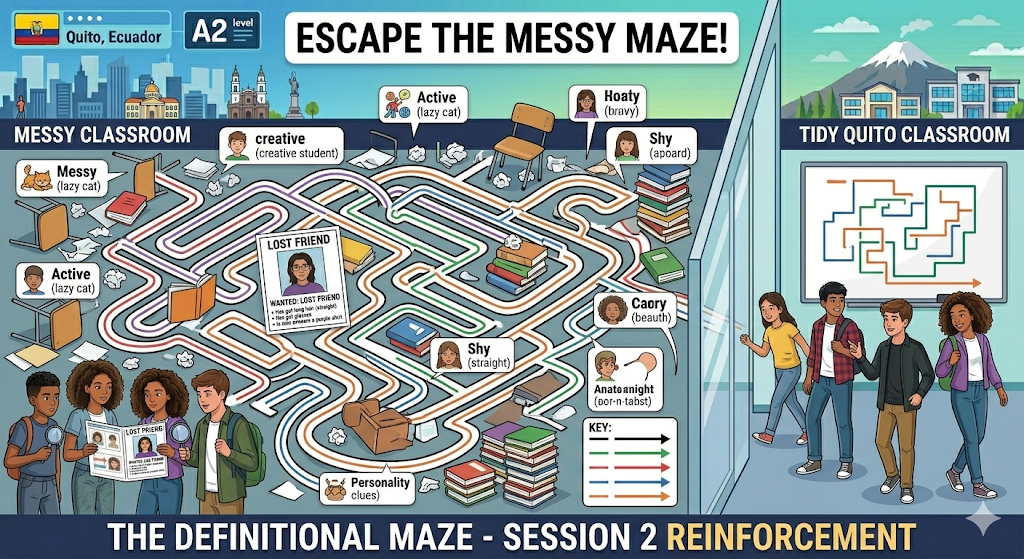
- Instruction: Provide a visual worksheet designed like a maze. Students are “trapped” in the messy room from image_10.png.
- Task: To escape the maze and reach the tidy, organized exit (like the Quito classroom), students must solve 8 visual clues. For each clue, they must write the correct adjective from the vocabulary list.
- Clue Example (Visual): A simple illustration of a student doing homework late at night, exhausted. (They write: Hard-working).
- Clue Example (Definition): “Someone who makes you laugh.” (They write: Funny).
- This activity confirms they are ready for the final assessment.
SESSION 3: CONSOLIDATION (80 min)
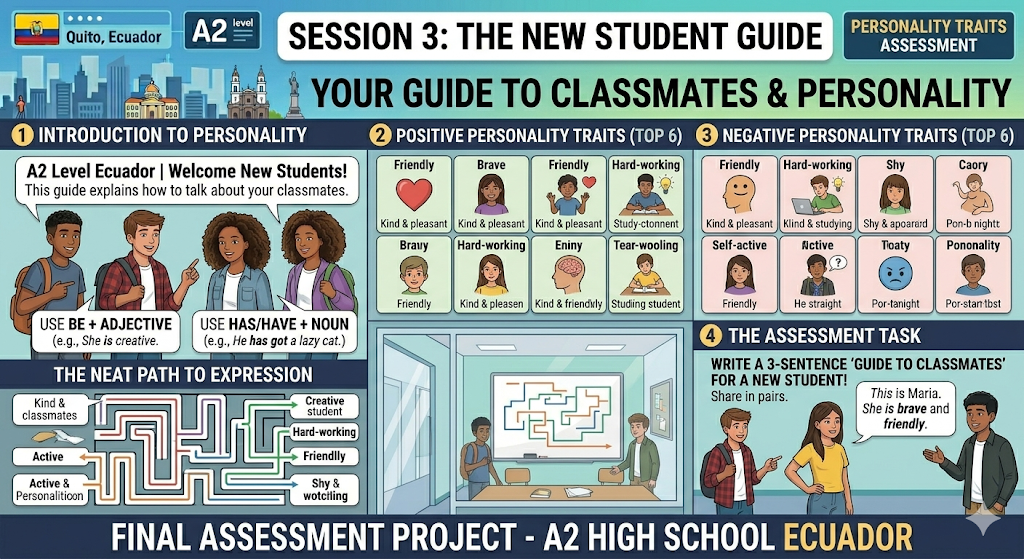
“The New Student Guide” (80 min / 2 Periods)
- Period 1 (Preparation): Students imagine a new student is joining the class. They work in pairs to write a short, 3-sentence “Guide to Our Classmates.”
- Period 2 (Presentation & Role-Play):
- Task: Student A introduces three distinct classmates (or teachers) in the presentation area, using the guide they wrote. For example: “This is Maria. She is very messy but very helpful.”
- Activity: One student reads the description while the others try to guess which student (or even teacher!) they are describing.
- Grading: Based on clarity, accuracy of “is/are” usage, and correct application of vocabulary (both positive and negative traits used effectively).
NEE – Agregar el tipo de adaptaciones curriculares
Principio II: Pautas 6.1 – 6.3 – 6.4
Principio III: Pautas 7.1 – 8.1 – 9.1
ALUMNO 1: Constante monitoreo. Dar tiempo adicional para el desarrollo de la actividad y se reduce el número de ejercicios o se modifican los ejercicios con un nivel de dificultad reducido, de acuerdo con sus necesidades académicas.
ALUMNO 2: Constante monitoreo, Dar tiempo adicional para el desarrollo de la actividad y se reduce el número de ejercicios o se modifican los ejercicios con un nivel de dificultad reducido, de acuerdo con sus necesidades académicas.
ALUMNO 3: Constante monitoreo. Corroborar que el contenido entregado en clase haya sido comprendido por la estudiante mediante retroalimentación.