
K-LEARNING PROJECT
SKILLS
EFL 4.2.1 Be able to give short, basic descriptions of everyday topics (hobbies, interests, everyday objects, etc.) using simple language.
EFL 4.4.1 Write short, everyday texts (labels, cards, simple messages) to describe personal experiences, hobbies, and everyday objects using basic sentence structures.
EFL 4.1.1 Acknowledge and respect individual differences, hobbies, and everyday backgrounds by interacting respectfully in pairs and small groups.
REAL-LIFE APPLICATION
The “Time Capsule Swap” mirrors real-world communication by shifting language learning from passive memorization to authentic social interaction. In everyday life, we rarely use grammar in isolation; instead, we use possessives to establish ownership and boundaries (e.g., managing personal belongings at work or school) and Wh- questions to build relationships, network, and navigate daily routines. By interviewing a peer and presenting their hobbies, students practice active listening and cultural empathy—essential soft skills for any modern workplace. Ultimately, describing everyday objects and personal interests trains students to pitch ideas, share their identity, and connect with others in English-speaking environments, transforming a classroom exercise into a practical tool for real-life socialization.
LEARNING ACTIVITIES
SESSION 1 (80 min)
Project Idea: The Time Capsule Swap
The Concept
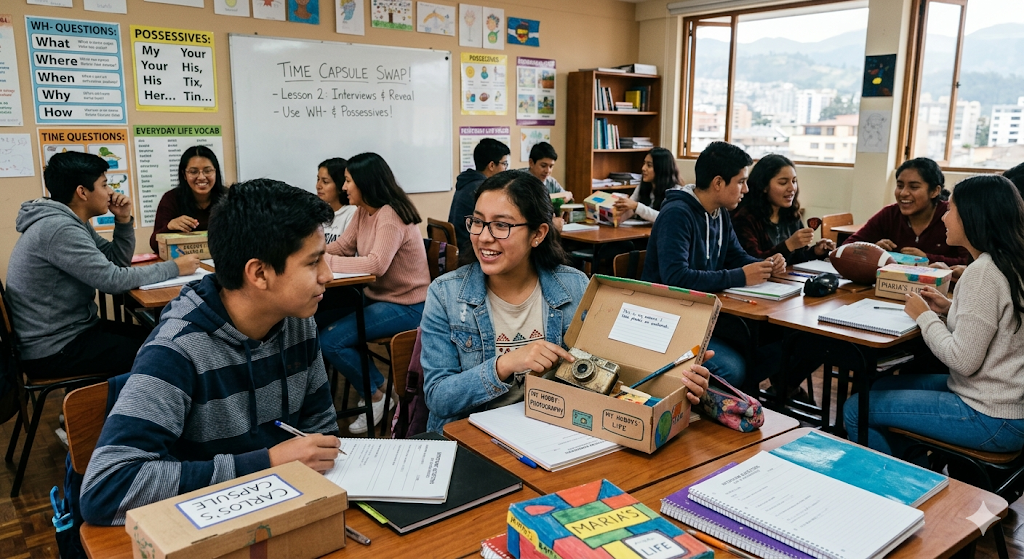
Students will create a mini “Time Capsule” (using a real shoebox/bag or drawing one) containing three everyday objects that represent their daily lives, hobbies, and interests. They will then interview a classmate about their capsule, practicing their Wh- questions and possessives to present their partner’s everyday life to the class.
Breakdown of the 2-Class Timeline (2 x 40 Minutes)
Lesson 1: Packing the Capsule (40 Minutes)
The focus of this first period is vocabulary recall, writing, and practicing possessives.
- Warm-up (5 mins): Quick teacher demo. Show 3 items from your own bag (e.g., “This is my coffee mug because I drink coffee every day. These are my running shoes because my hobby is running.”).
- Brainstorm & Design (15 mins): Students choose 3 objects (real or drawn) that represent their everyday life and hobbies. On a index card for each item, they write 1–2 simple A2 sentences using possessives.Example: “This is my guitar. It is my favorite hobby.” or “This is my brother’s video game controller. We play it everyday.”
- Peer Review (15 mins): In pairs, students check each other’s cards specifically looking for correct possessive adjectives (my, your, his, her, our, their) and possessive ‘s.
- Wrap-up (5 mins): Students “seal” their capsules (put their drawings/items into a folder or bag) ready for the next class.
Lesson 2: The Interview & Reveal (40 Minutes)
The focus of this second period is speaking, listening, and mastering Wh- questions.
- Warm-up (5 mins): Quick grammar refresher on the board. Remind them how to structure Wh- questions (What is…? Who do you…? Where do you…? When do you…?).
- The Capsule Swap & Interview (15 mins): Students pair up with a new partner. They swap capsules. Students must interview their partner about the objects inside using at least three different Wh- questions. They take brief notes.
- “What is this?” —>“It’s my paint brush.”
- “When do you paint?” —>“I paint on weekends.”
- “Where do you buy your paints?” —>At the store near my house.”
- The Mini-Presentations (15 mins): Pairs team up with another pair (groups of 4). Each student introduces their partner’s everyday life to the small group using what they learned. Example: “This is Carlos’s capsule. This is his camera. His hobby is photography. He takes photos where there are parks.”
- Exit Ticket (5 mins): Students hand in their partner’s interview notes to you for a quick formative assessment.
NEE – Agregar el tipo de adaptaciones curriculares
Principio II: Pautas 6.1 – 6.3 – 6.4
Principio III: Pautas 7.1 – 8.1 – 9.1
ALUMNO 1: Constante monitoreo. Dar tiempo adicional para el desarrollo de la actividad y se reduce el número de ejercicios o se modifican los ejercicios con un nivel de dificultad reducido, de acuerdo con sus necesidades académicas.
ALUMNO 2: Constante monitoreo, Dar tiempo adicional para el desarrollo de la actividad y se reduce el número de ejercicios o se modifican los ejercicios con un nivel de dificultad reducido, de acuerdo con sus necesidades académicas.
ALUMNO 3: Constante monitoreo. Corroborar que el contenido entregado en clase haya sido comprendido por la estudiante mediante retroalimentación.