
Places in town
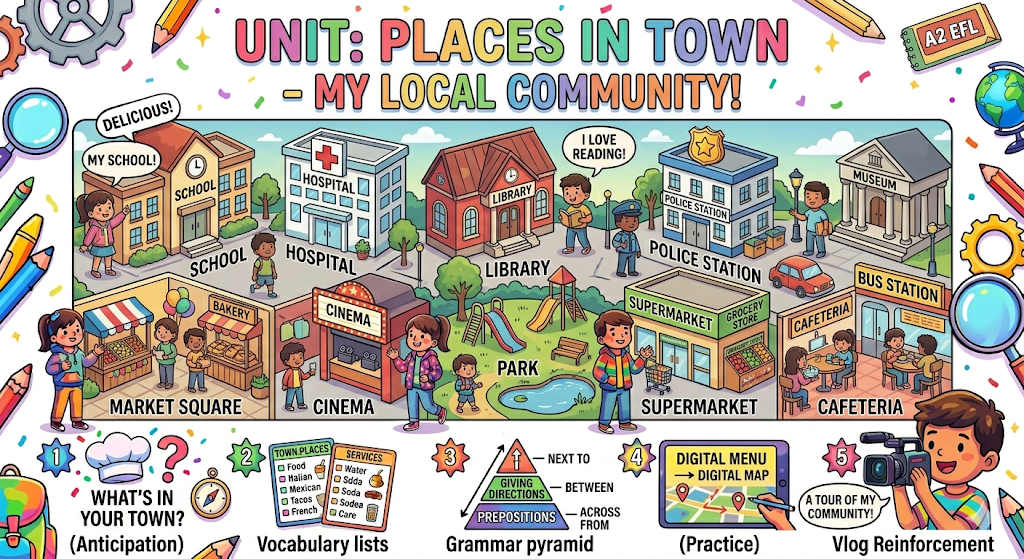
SKILLS
EFL 3.1.2 Ask and answer questions about immediate surroundings and identify key places in the local community (e.g., school, hospital, park).
EFL 3.2.14 Express locations and ask for simple information about where places are using basic phrases.
EFL 3.3.1 Understand short, simple texts describing a neighborhood or a community map.
EFL 3.4.2 Write a short paragraph describing a town or neighborhood layout using prepositions of place.
REAL-LIFE APPLICATION
Knowing the names of neighborhood places is essential for community life. Whether students are telling a delivery rider how to find their house, describing their favorite hangout spots to an online friend, or figuring out where the nearest pharmacy or bus station is, this unit connects language directly to their immediate surroundings.
LEARNING ACTIVITIES
SESSION 1 (80 min) ANTICIPATION
Part 1 – ( 10-15 minutes)
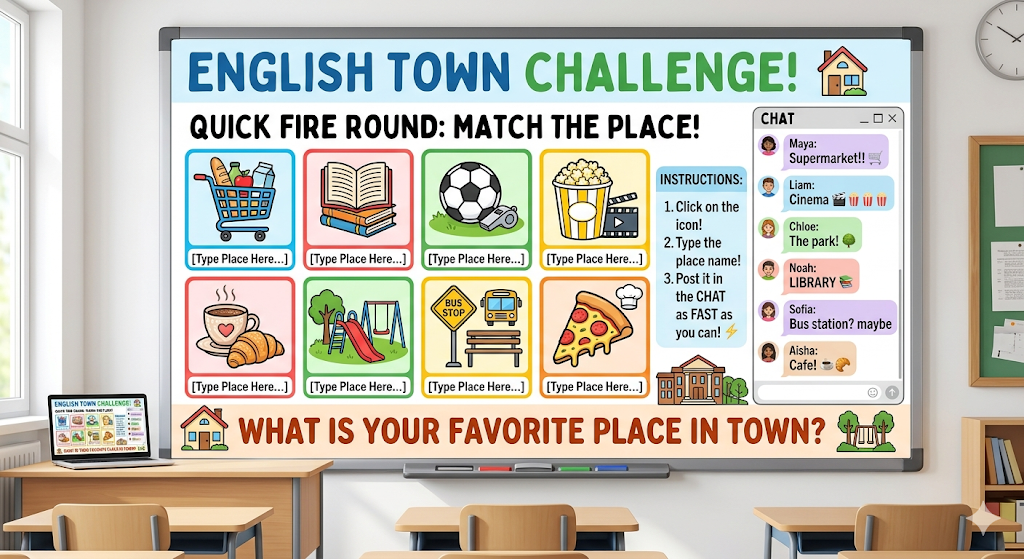
Anticipation Activity:
- Objective: Brainstorm town locations and activate prior vocabulary.
- Instructions:
- Display an interactive collage of popular town icons (e.g., a shopping cart, a book, a soccer ball, a popcorn bucket) on a digital board.
- Challenge students to type the name of the place matching the icon in the chat as fast as they can (e.g., Shopping cart = Supermarket, Book = Library).
- Introduce the core question: “What is your favorite place in town?”
CONSTRUCTION
Part 2: Vocabulary Development (15 min)
The teacher explicitly introduces key vocabulary needed for the lesson, ensuring students clearly understand meaning and use. The words include:
School / Library (Education spaces)
Hospital / Police Station (Essential services)
Supermarket / Market Square (Shopping)
Cinema / Park (Recreation)
Bus Station (Transportation)
Cafeteria / Bakery (Food spaces)
Part 3: Grammar Introduction using Presentation (20 min)
Grammar Introduction:
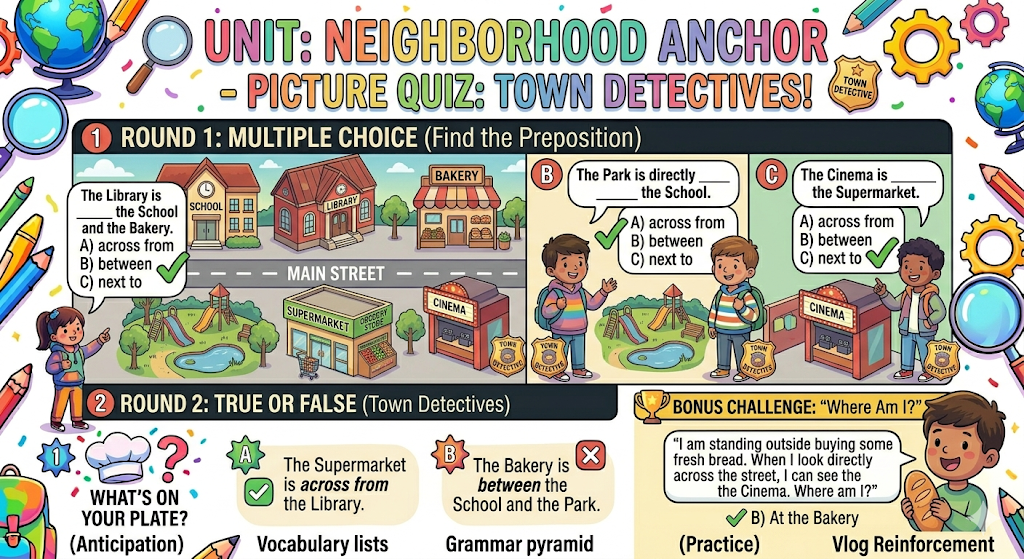
“The Neighborhood Anchor” (20 mins)
- Focus: Prepositions of Place (next to, between, across from, behind).
- Instructions:
- Direct Instruction (10 mins): Present a clear visual grammar pyramid. Show how buildings anchor each other’s positions: Next to (side by side), Between (one building in the middle of two), and Across from (facing each other on opposite sides of the street).
- Concept Check (10 mins): Run a quick digital picture-quiz (using Kahoot or Google Slides). Show a mini neighborhood layout and ask: “Where is the Bakery? It is ________ the School and the Cinema.” (Answer: Between).
Grammar Practice Activity (25 mins)
“Build My Dream Block”
- Activity: Creating and describing a custom community block.
- Instructions:
- Working in pairs on a collaborative Canva template, students drag and drop 4 different “Place in Town” stickers onto a blank street layout.
- Together, they must write 3 descriptive sentences explaining their layout using the target prepositions (e.g., “In our town, the Cinema is next to the Bakery. The Park is across from the Hospital.”).
- Pairs post their dream blocks on a shared padlet wall.
SESSION 2: CONSTRUCTION – REINFORCEMENT (40 min)
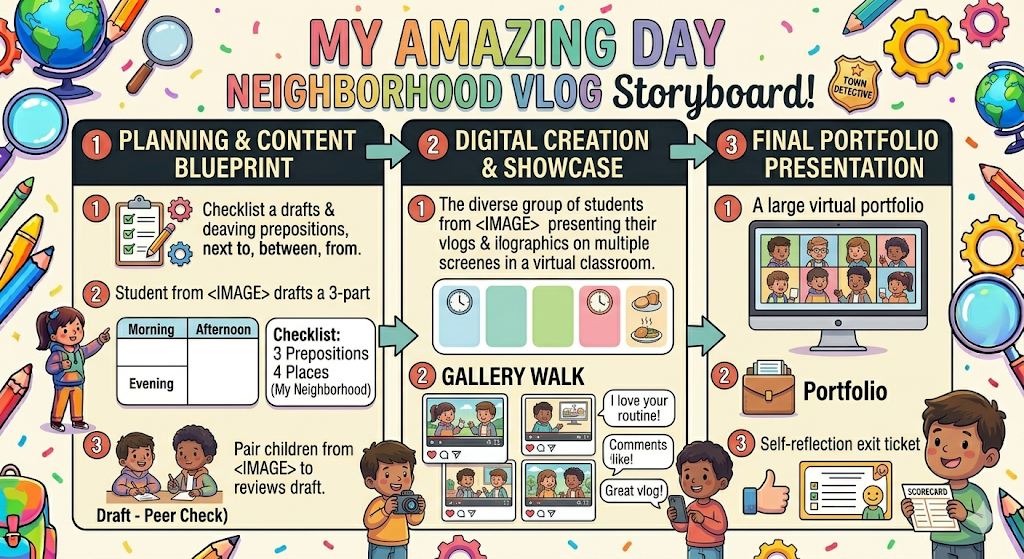
Creative Reinforcement: “Welcome to My Neighborhood Vlog” (40 mins)
- Activity: Recording a neighborhood introductory vlog.
- Instructions:
- Setup (10 mins): Students act as local town ambassadors recording a welcome video for a new student moving to their neighborhood.
- Drafting (15 mins): They write a short 5-sentence script introducing their neighborhood’s key spots. (“Welcome to my neighborhood! My school is next to a big library. Across from the school, there is a great cafeteria. On weekends, I visit the park behind the supermarket.”)
- Production (15 mins): Students record a 45-second video clip using Flip (Flipgrid). They can use a drawing of their Canva block from yesterday as a virtual background to point at the places as they speak!
https://flipgridapp.com/
SESSION 3: CONSOLIDATION (80 min)
Part 1 – ( 2 x 40min)
Assessment Activity
- Period 1: The Community Map Challenge (40 mins)
- Part A (20 mins): Digital Reading Quiz (Google Forms). Students read a short paragraph written by a teenager describing their hometown layout. Students answer 5 true/false questions about the map and 5 multiple-choice grammar questions filling in missing prepositions.
https://docs.google.com/forms/d/e/1FAIpQLSdnLix3iZwgp3FNHehe883GMFYXAefGrz9mTlYa7mEVS-jIKA/viewform?usp=publish-editor - Part B (20 mins): Neighborhood Portfolio Writing. Students write a short descriptive paragraph (40–50 words) about their actual neighborhood or their school’s surroundings. The text must accurately use at least 4 town vocabulary words and 3 different prepositions of place.
- Part A (20 mins): Digital Reading Quiz (Google Forms). Students read a short paragraph written by a teenager describing their hometown layout. Students answer 5 true/false questions about the map and 5 multiple-choice grammar questions filling in missing prepositions.
- Period 2: The Town Planner Interview (40 mins)
- Task (25 mins): Live breakout room speaking roleplay. Student A is a “Town Planner” who has a map with labeled buildings. Student B is an “Architect” with a blank grid. Through interactive questions (“Where is the hospital?” -> “The hospital is across from the police station”), Student B must draw/label the town correctly based entirely on Student A’s verbal instructions.
- Wrap-up & Self-Reflection (15 mins): Students compare their final maps together, look at the visual accuracy, and complete a quick exit ticket reflecting on their confidence with community vocabulary.
NEE – Agregar el tipo de adaptaciones curriculares
Principio II: Pautas 6.1 – 6.3 – 6.4
Principio III: Pautas 7.1 – 8.1 – 9.1
ALUMNO 1: Constante monitoreo. Dar tiempo adicional para el desarrollo de la actividad y se reduce el número de ejercicios o se modifican los ejercicios con un nivel de dificultad reducido, de acuerdo con sus necesidades académicas.
ALUMNO 2: Constante monitoreo, Dar tiempo adicional para el desarrollo de la actividad y se reduce el número de ejercicios o se modifican los ejercicios con un nivel de dificultad reducido, de acuerdo con sus necesidades académicas.
ALUMNO 3: Constante monitoreo. Corroborar que el contenido entregado en clase haya sido comprendido por la estudiante mediante retroalimentación.