
Maps
SKILLS
EFL 5.2.1: Request and provide information about familiar topics or specific context-related areas (e.g., giving and following directions on a map) using clear and precise language.
EFL 5.3.2: Identify and use specific functional language structures (imperatives and transition words) to understand short, contextualized directional texts.
REAL-LIFE APPLICATION
In an interconnected world, reading a map and giving directions precisely is a critical survival and professional skill. Whether a student is helping a lost tourist navigate the transit lines of Guayaquil, reading an evacuation map during an emergency drill, or using a digital delivery app to direct a driver to their exact coordinates, language precision eliminates confusion, saves time, and ensures safety..
LEARNING ACTIVITIES
SESSION 1 (80 min) ANTICIPATION
Part 1 – ( 10-15 minutes)
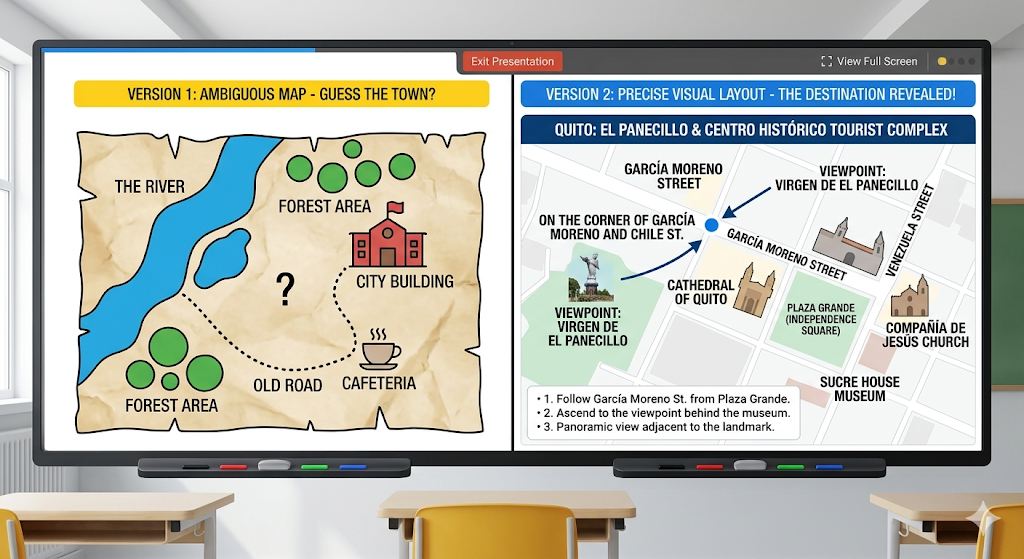
Anticipation Learning Activity (10–15 mins)
Objective: Activate spatial awareness and demonstrate why vague language fails in navigation.
- Instruction: Project a split-screen digital slide. On the left side, show a “Blinded Map” where all roads are blank white lines without names, marked only with a start point and an “X.” Read an intentionally vague direction aloud: “Go down the road, turn at the corner, and it’s near the tree.” Watch students realize it is impossible to solve. Then, reveal the right side: a sharp, high-contrast grid map with distinct street names and cardinal directions.
- Resource Needed: An interactive whiteboard presentation featuring the “Blind Map vs. Precise Grid Map” contrast to instantly gamify the introduction.
CONSTRUCTION
Part 2: Vocabulary Development (15 min)
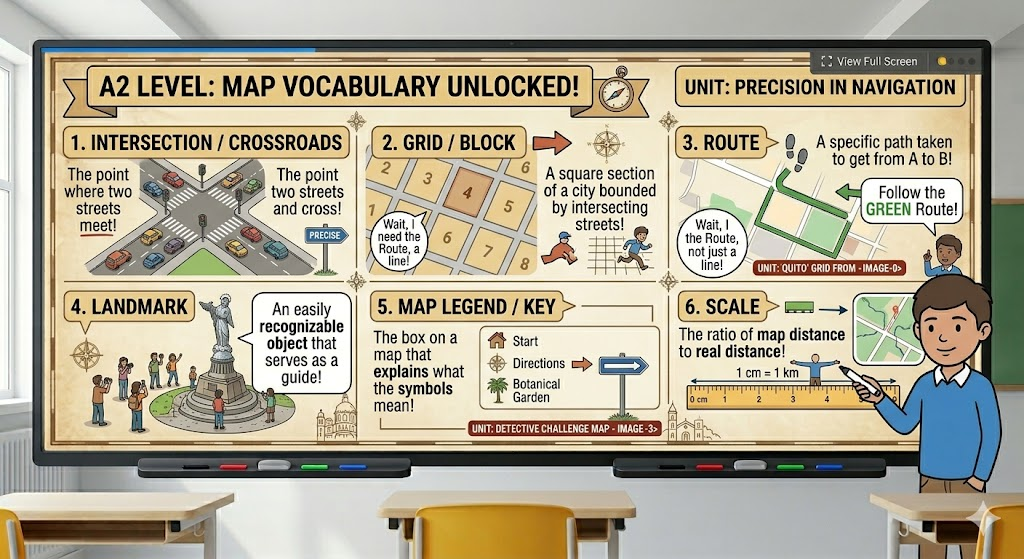
The teacher explicitly introduces key vocabulary needed for the lesson, ensuring students clearly understand meaning and use. The words include:
Intersection / Crossroads – The exact point where two or more streets meet and cross each other.
Grid / Block – The square section of a city enclosed by intersecting streets.
Route – A specific course, way, or road taken to get from a starting point to a destination.
Landmark – An easily recognizable object or building that serves as a guide (e.g., a monument or stadium).
Map Legend / Key – The box on a map that explains what the symbols, shapes, and colors mean.
Scale – The ratio that shows the relationship between a distance on the map and the actual distance on the ground.
Part 3: Grammar Introduction: Imperatives & Sequencers (20 mins)
Precision in navigation requires commanding verbs (Imperatives) and clear chronological order (Sequencers).
- Imperatives for Direction: Direct action verbs without a subject pronoun (e.g., “Turn left,” “Head north,” “Go straight,” “Cross the bridge”).
- Sequencers of Precision: Transitional words that establish exact steps:
- First, head straight for two blocks.
- Then / Next, turn right at the intersection.
- After that, continue past the landmark.
- Finally, your destination will be on your left.
4. Grammar Practice Activity (25 mins)
Activity Name: “The Air Traffic Controller”
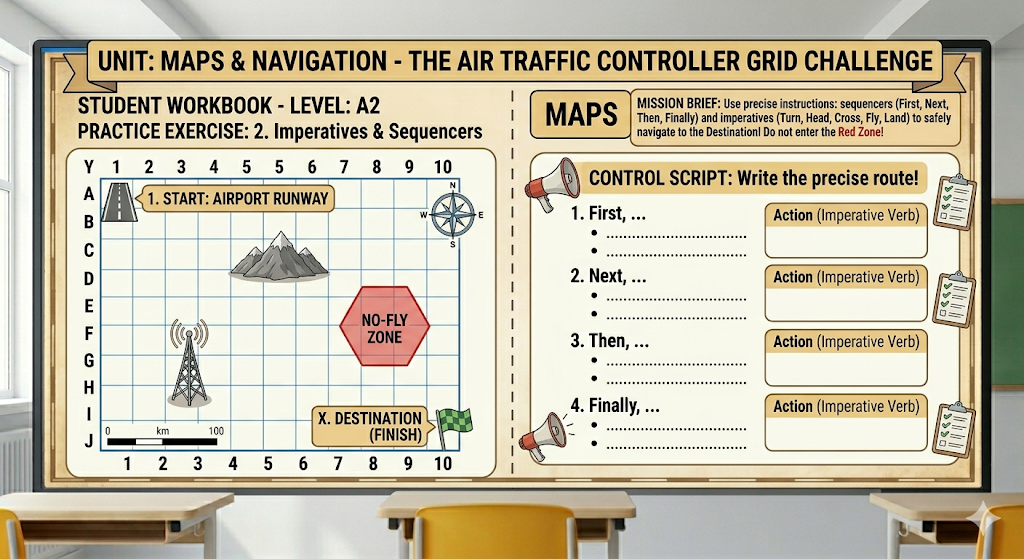
- Instructions: Provide students with a digital map grid populated with a starting point (an airport runway) and several obstacles (mountains, towers, zones). Working in pairs, Student A acts as the “Controller” and writes down a step-by-step path using the target sequencers and imperatives. Student B acts as the “Pilot” and must draw the line across the grid following only the written text instructions.
SESSION 2: CONSTRUCTION – REINFORCEMENT (40 min)
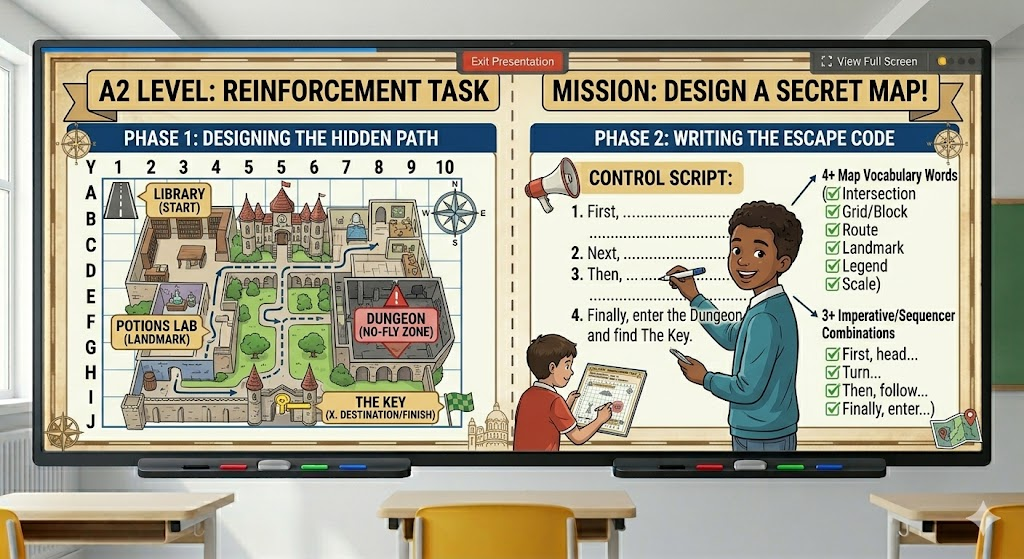
“The Escape Room Map Maker”
- Instructions: Students design a basic 2D floor plan or secret map of a fictional school or castle. They must write a 6-sentence paragraph detailing the exact “escape route” to find a hidden key. The paragraph must explicitly use 4 map vocabulary words and at least 3 distinct imperative/sequencer combinations.
SESSION 3: CONSOLIDATION (80 min)
Part 1 – ( 2 x 40min)
Assessment Activity
Period 1: The Detective Challenge (40 Minutes)
Focus: Reading comprehension, peer collaboration, and structural identification.
Period 1: The GPS Breakdown (40 mins)
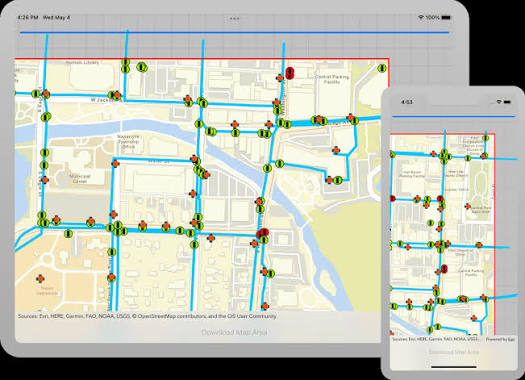
- The Scenario: A delivery driver’s digital GPS app breaks down in the middle of a route. Students receive an offline map layout and 5 written navigation logs.
- The Task: Students work in small teams to trace the written instructions on the map. They must identify exactly where the text instructions made a spatial error (e.g., saying “Turn left” when the map clearly requires a right turn at the crossroads) and rewrite the logs with absolute linguistic precision.
Period 2: The Live Navigation Showdown (40 mins)
- The Task: The class participates in a live interactive challenge. Using their newly created “Escape Room Maps” from the morning reinforcement task, teams swap written texts. One representative must read the instructions aloud live, while their teammate attempts to navigate a physical grid taped onto the classroom floor (or a digital avatar on the screen) in real-time.
- Exit Ticket: A 3-question automated Form asking students to select the most precise directional phrase to solve a map block bottleneck.
NEE – Agregar el tipo de adaptaciones curriculares
Principio II: Pautas 6.1 – 6.3 – 6.4
Principio III: Pautas 7.1 – 8.1 – 9.1
ALUMNO 1: Constante monitoreo. Dar tiempo adicional para el desarrollo de la actividad y se reduce el número de ejercicios o se modifican los ejercicios con un nivel de dificultad reducido, de acuerdo con sus necesidades académicas.
ALUMNO 2: Constante monitoreo, Dar tiempo adicional para el desarrollo de la actividad y se reduce el número de ejercicios o se modifican los ejercicios con un nivel de dificultad reducido, de acuerdo con sus necesidades académicas.
ALUMNO 3: Constante monitoreo. Corroborar que el contenido entregado en clase haya sido comprendido por la estudiante mediante retroalimentación.