
Health and body

SKILLS
EFL 4.1.2: Understand main ideas and details in informational texts about health.
EFL 4.2.3: Use specific vocabulary (body parts, symptoms) to describe personal experiences.
EFL 4.4.1: Write short, simple texts about healthy lifestyle choices.
REAL-LIFE APPLICATION
Understanding health vocabulary is essential for self-advocacy. Students who learn to describe how they feel—and communicate common symptoms—are better equipped to seek assistance, follow medical instructions, and make informed decisions about their well-being. This unit bridges the gap between basic anatomy and the functional language needed to participate in a doctor’s visit or a wellness conversation, fostering personal autonomy and healthy living habits.
LEARNING ACTIVITIES
SESSION 1 (80 min) ANTICIPATION
Part 1 – ( 10-15 minutes)
Anticipation Activity
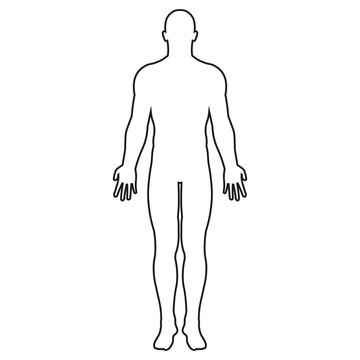
Anticipation Activity (20 min): “The Healthy Body Check-in”
- Goal: Activate prior knowledge of body parts and physical states.
- Instructions: Display a large, blank silhouette of a human body on the digital board. Ask students to shout out body parts they know. Then, introduce “Feeling Cards”—small cards with icons (a thermometer, a bandage, a sleepy person, a muscle).
- Activity: Students place the cards where they think they belong on the silhouette (e.g., placing the thermometer near the mouth/head, the bandage on the arm). Lead a brief discussion: “Why do we need a bandage here?” or “What do you do when you feel this way?”
CONSTRUCTION
Part 2: Vocabulary Development (15 min)
The teacher explicitly introduces key vocabulary needed for the lesson, ensuring students clearly understand meaning and use. The words include:
| Vocabulary | Definition / Context | Example Sentence |
| Headache | Pain in the head. | “I have a terrible headache today.” |
| Sore throat | Pain or irritation in the throat. | “Drink hot tea for your sore throat.” |
| Stomachache | Pain in the stomach area. | “You should lie down if you have a stomachache.” |
| Fever | High body temperature. | “He has a fever, so he should stay home.” |
| Cough | Expelling air from the lungs with a noise. | “Take some syrup for that dry cough.” |
| Flu / Cold | A viral infection causing illness. | “I think I have the flu, I feel very tired.” |
| Dizzy | Feeling like the room is spinning. | “Sit down if you feel dizzy.” |
| Rash | Red, irritated area on the skin. | “Don’t scratch that rash on your arm.” |
Part 3: Grammar Introduction: Giving advice (20 mins)
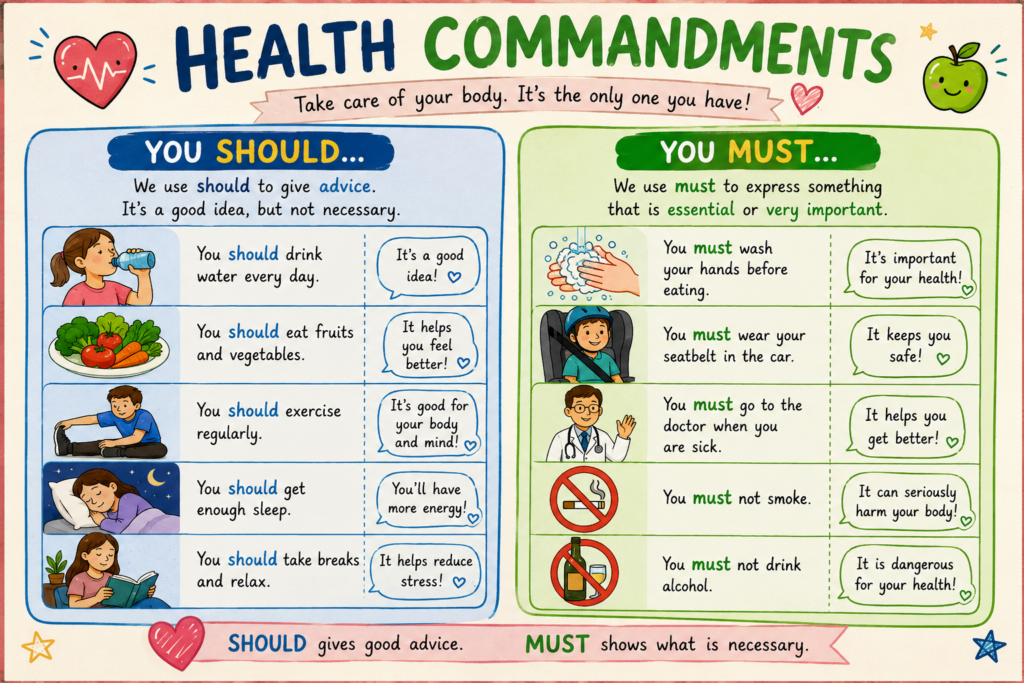
Focus: Imperatives (for advice) and Should/Shouldn’t (for recommendations).
- Imperatives: Direct and clear. Used for giving instructions or quick advice. “Drink more water.” / “Don’t eat too much sugar.”
- Should/Shouldn’t: Used for suggestions. “You should sleep eight hours.” / “You shouldn’t stay up late.”
4. Grammar Practice Activity (25 Minutes)
Activity:
“The Virtual Clinic”:
- Instruction: Set up a “clinic” on a digital platform like Google Slides. Create “Patient Profiles” (e.g., “Juan has a stomachache,” “Maria feels tired”).
- Task: Students work in pairs to act as doctors. They must write three pieces of advice for their assigned patient using the grammar structures.
- Example: “You have a stomachache. Drink herbal tea. You should eat light food.”
SESSION 2: CONSTRUCTION – REINFORCEMENT (40 min)

“Create a Healthy Habit Infographic”:
- Instructions: Using a tool like Canva, students design a digital infographic titled “How to Stay Healthy.”
- Requirements:
- Include at least 4 vocabulary words from the table.
- Write 4-6 sentences using imperatives and should/shouldn’t.
- Add icons or photos representing the healthy habits (e.g., sleeping, exercising, eating vegetables).
- Share the infographics in the class digital gallery.
SESSION 3: CONSOLIDATION (80 min)
Part 1 – ( 2 x 40min)
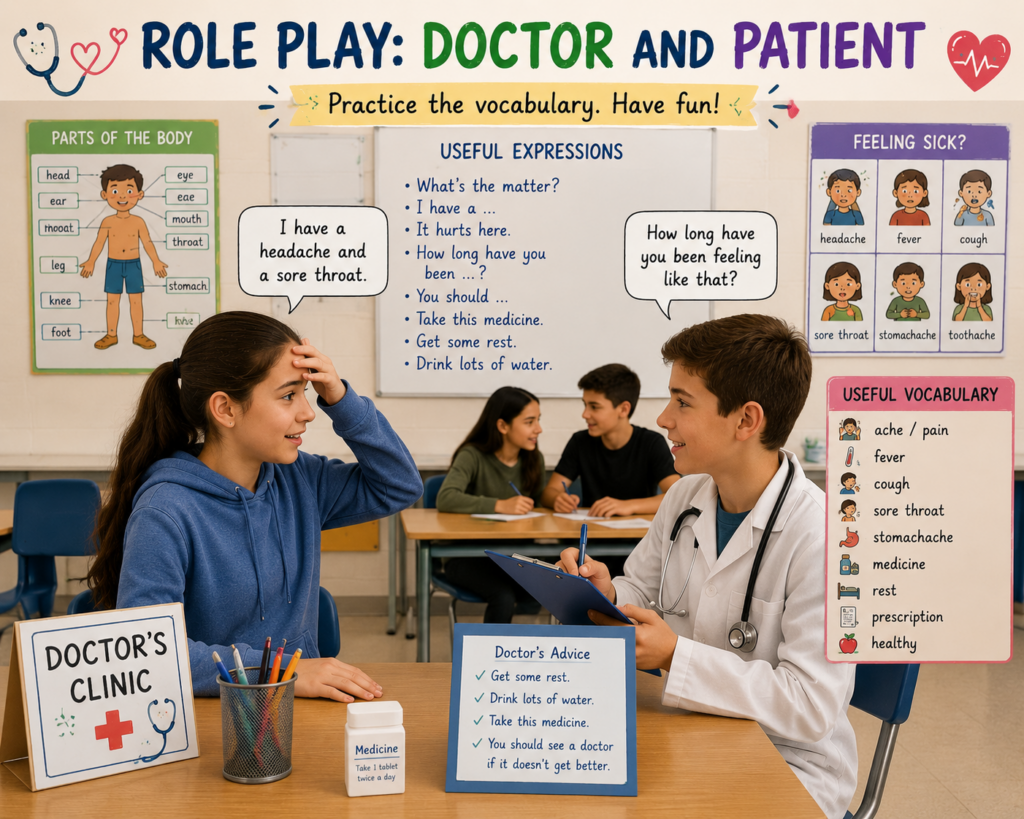
Assessment Activity
https://share.gemini.google/iYjSaSkwCEjF
Period 1 (Writing & Critical Thinking): Students complete a “Health Quiz” and a short reflection. The quiz tests vocabulary and grammar. The reflection asks: “What is one unhealthy habit you have? What should you do to change it?”
Period 2 (Speaking/Simulation): “Doctor’s Visit Role-Play.” In pairs, students perform a 3-minute dialogue. The “Patient” describes symptoms, and the “Doctor” provides a diagnosis and advice. This is assessed on clarity, grammar usage, and the ability to maintain the conversation.
NEE – Agregar el tipo de adaptaciones curriculares
Principio II: Pautas 6.1 – 6.3 – 6.4
Principio III: Pautas 7.1 – 8.1 – 9.1
ALUMNO 1: Constante monitoreo. Dar tiempo adicional para el desarrollo de la actividad y se reduce el número de ejercicios o se modifican los ejercicios con un nivel de dificultad reducido, de acuerdo con sus necesidades académicas.
ALUMNO 2: Constante monitoreo, Dar tiempo adicional para el desarrollo de la actividad y se reduce el número de ejercicios o se modifican los ejercicios con un nivel de dificultad reducido, de acuerdo con sus necesidades académicas.
ALUMNO 3: Constante monitoreo. Corroborar que el contenido entregado en clase haya sido comprendido por la estudiante mediante retroalimentación.