
Stories

SKILLS
EFL 4.2.2: Identify the main idea and key events in a short story.
EFL 4.3.4: Use connecting words (first, then, next, finally) to organize narratives.
EFL 4.4.1: Understand and use past time expressions to sequence events.
REAL-LIFE APPLICATION
Stories are the foundation of human communication. By learning to structure a narrative, students gain the ability to share personal experiences, explain cause-and-effect relationships, and empathize with others’ perspectives—a vital skill for both social interaction and future professional storytelling.
LEARNING ACTIVITIES
SESSION 1 (80 min) ANTICIPATION
Part 1 – ( 10-15 minutes)
Anticipation Activity (10–15 minutes)
“The Mystery Object”
- Instruction: Place a mysterious or common object (e.g., an old key, a broken watch) in the center of the room.
- Activity: Ask students to collaboratively invent a story about the object. One student starts with one sentence (“Once upon a time, a boy found a golden key in the park…”), and the next adds another.
- Objective: Introduce the concept of a plot (Beginning, Middle, End).
CONSTRUCTION
Part 2: Vocabulary Development (15 min)
The teacher explicitly introduces key vocabulary needed for the lesson, ensuring students clearly understand meaning and use. The words include:
| Word | Part of Speech | Definition |
| Character | Noun | A person or creature in a story. |
| Setting | Noun | Where and when a story happens. |
| Plot | Noun | The series of events in a story. |
| Sequence | Verb/Noun | The order in which things happen. |
| Conflict | Noun | A problem the character must face. |
| Resolution | Noun | How the story ends and the problem is fixed. |
Part 3: Grammar Introduction: 20 mins)
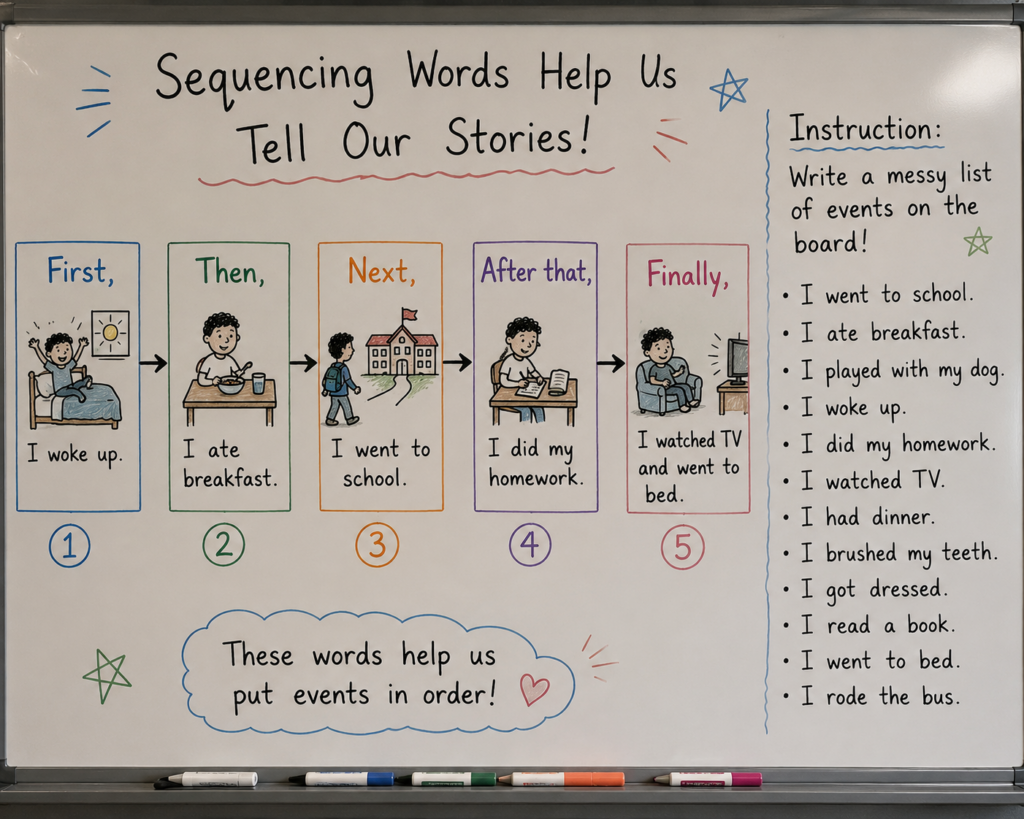
Sequence Connectors
- Focus: Use of First, Then, Next, After that, Finally.
- Instruction: Write a messy list of events on the board (e.g., “I went to school,” “I woke up,” “I ate breakfast”). Ask students to order them.
- Theory: Explain that stories need “signposts” to help the reader follow the action. Show how to link sentences: First, I woke up. Then, I ate breakfast. Next, I went to school.
4. Grammar Practice Activity (25 Minutes)
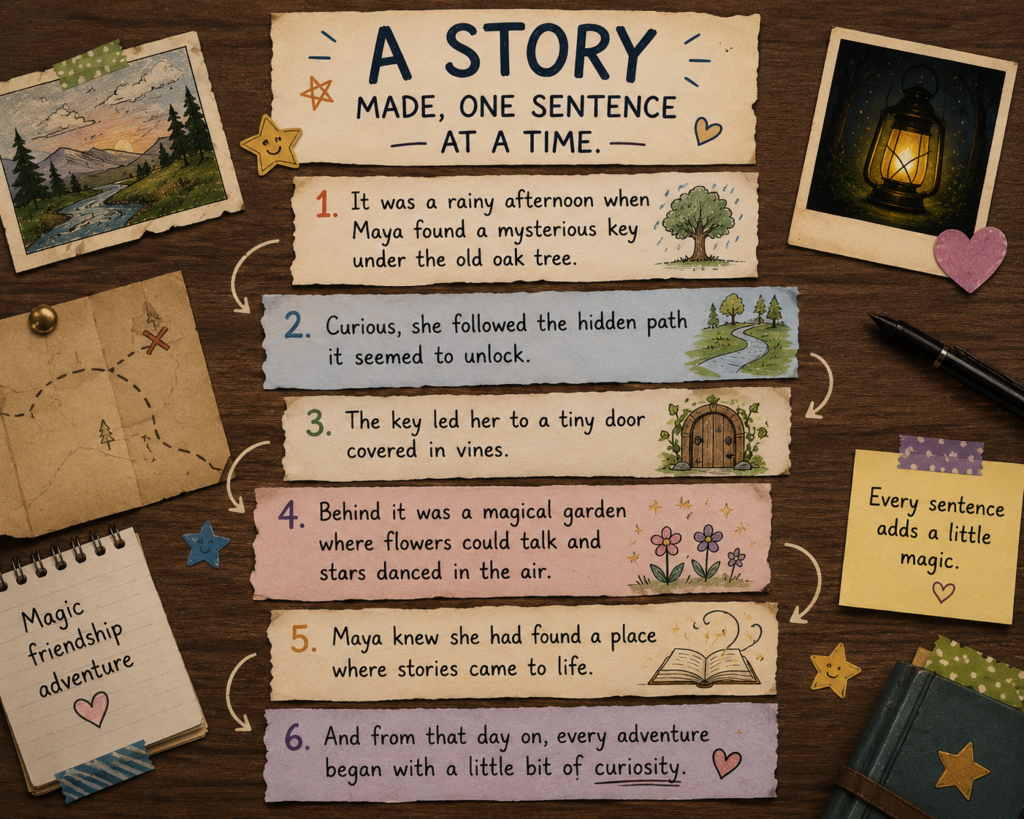
Activity:
Grammar Practice: Scrambled Story”
- Task: Give students a short 5-sentence story cut into individual strips.
- Activity: Students work in pairs to reorder the story strips and glue them onto a sheet of paper. They must circle the sequence connectors they used.
- Goal: Demonstrate how connectors create logical flow.
SESSION 2: CONSTRUCTION – REINFORCEMENT (40 min)
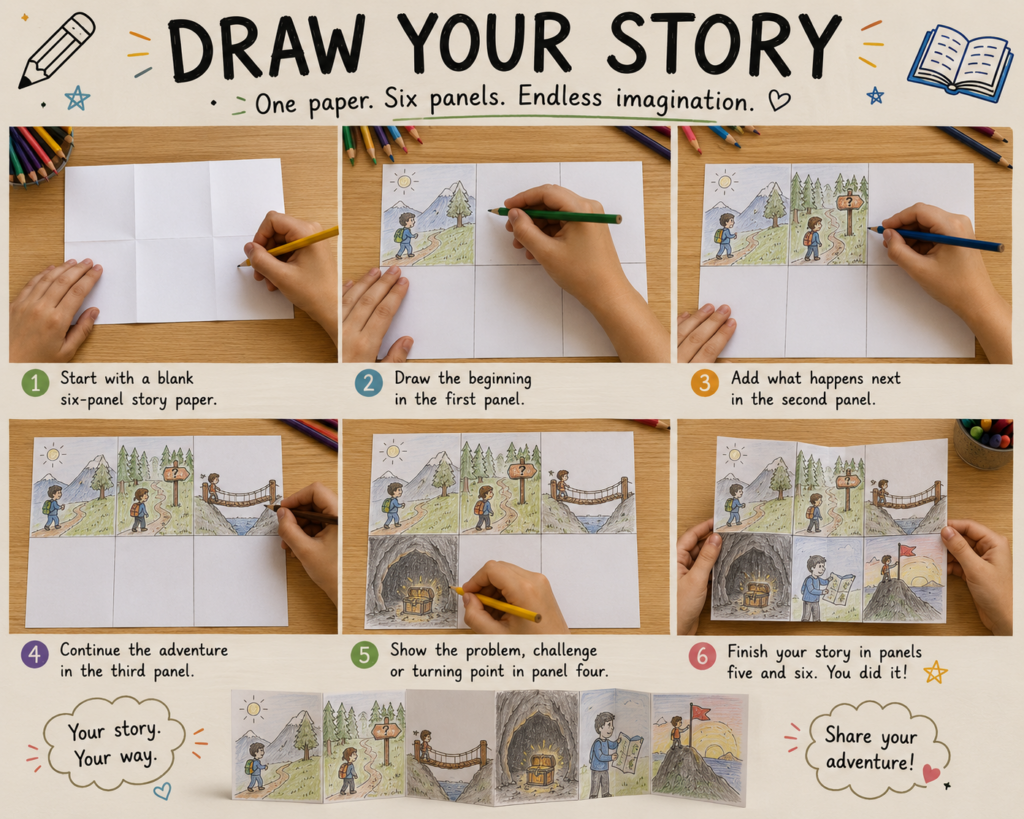
Reinforcement Activity (40 mins): “The Storyboard”
- Task: Students fold a piece of paper into 6 squares (a storyboard).
- Activity: They choose a simple fairy tale or a personal memory. They draw the 6 key scenes and write one sentence per box using a sequence connector (e.g., “Finally, they found the treasure”).
- Creativity: Encourage color and dialogue bubbles.
SESSION 3: CONSOLIDATION (80 min)
Part 1 – ( 2 x 40min)
Assessment Activity
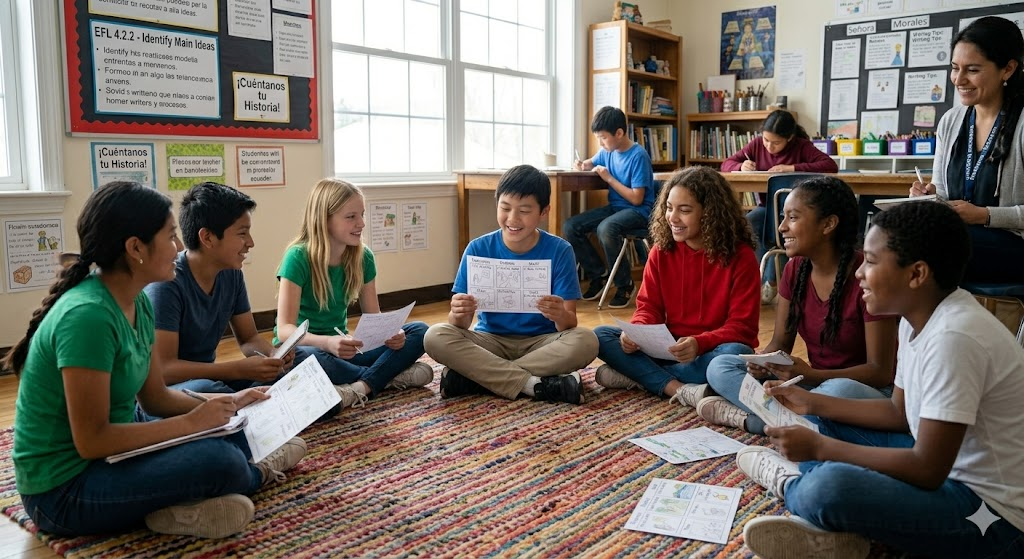
Period 1 (Writing): “My Adventure Story.” Students write a 100-word story about a mystery. They must include:
- One clear Setting and one Character.
- A Conflict (a problem).
- At least 4 Sequence Connectors.
Period 2 (Presentation): “Storytelling Circle.” Students sit in a circle. They read their stories aloud. Classmates must identify the “conflict” and the “resolution” of each peer’s story to ensure active listening.
NEE – Agregar el tipo de adaptaciones curriculares
Principio II: Pautas 6.1 – 6.3 – 6.4
Principio III: Pautas 7.1 – 8.1 – 9.1
ALUMNO 1: Constante monitoreo. Dar tiempo adicional para el desarrollo de la actividad y se reduce el número de ejercicios o se modifican los ejercicios con un nivel de dificultad reducido, de acuerdo con sus necesidades académicas.
ALUMNO 2: Constante monitoreo, Dar tiempo adicional para el desarrollo de la actividad y se reduce el número de ejercicios o se modifican los ejercicios con un nivel de dificultad reducido, de acuerdo con sus necesidades académicas.
ALUMNO 3: Constante monitoreo. Corroborar que el contenido entregado en clase haya sido comprendido por la estudiante mediante retroalimentación.