
Education Systems

SKILLS
EFL 4.4.8 Convey information and ideas through simple transactional or expository texts on familiar subjects using ICT tools and conventions and features of English appropriate to audience and purpose.
EFL 4.1.9 Recognize the consequences of one’s actions by demonstrating responsible decision-making at school, online, at home and in the community.


REAL-LIFE APPLICATION
This topic helps students talk about education choices and learning experiences. They learn how to explain what happened first and what happened later using the Past Perfect Simple. This is useful when students describe how they chose a subject, why they changed an opinion, or what they had learned before making a decision.
LEARNING ACTIVITIES
SESSION 1 (80 min) ANTICIPATION
Part 1 (20 min): Service Fair Walk (20 min)
The teacher divides the room into two spaces: Academic World and Vocational World. On one side, students see images of books, research, exams, essays, and classrooms. On the other side, they see images of workshops, tools, cooking, coding, design, and technical practice. Students walk around and write or say what kind of learning each space represents. The teacher asks: “Which learning style looks more practical? Which one looks more theoretical? Can a student need both?” This prepares students to compare education systems before learning the grammar.


CONSTRUCTION
Part 2: Vocabulary Development (15 min)
The teacher introduces vocabulary students need to talk about education systems and learning styles.
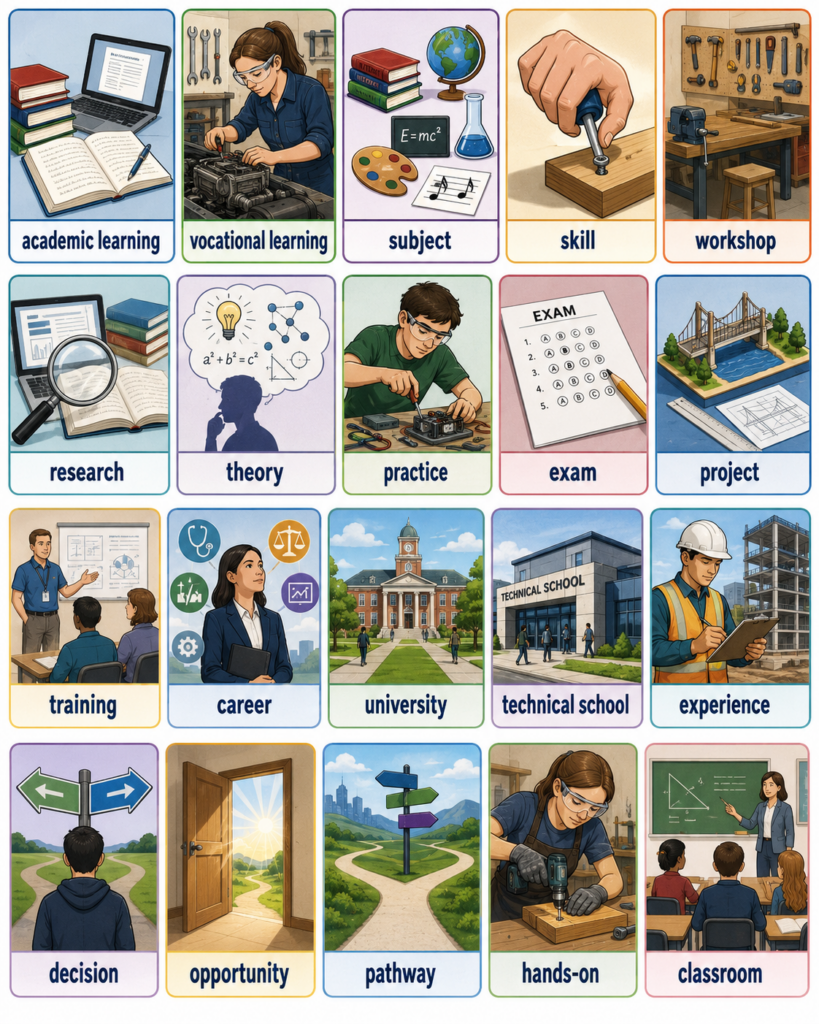
- academic learning
- vocational learning
- subject
- skill
- workshop
- research
- theory
- practice
- exam
- project
- training
- career
- university
- technical school
- experience
- decision
- opportunity
- pathway
- hands-on
- classroom
Model sentences:
“Academic learning often includes theory, reading, and exams.”
“Vocational learning often includes practice, training, and hands-on tasks.”
“Some students choose a pathway after they have discovered their strengths.”
Part 3: Grammar Development(20 min)
Explanation:
Exercise:
Past Perfect Simple
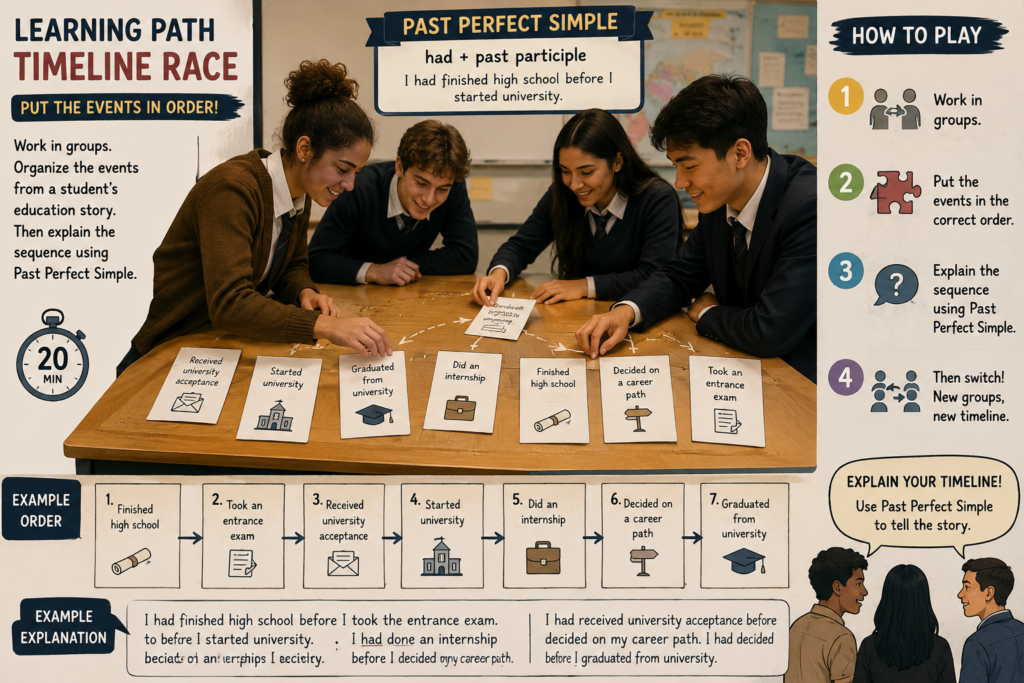
Part 4: Learning Path Timeline Race (20 min)
Students work in groups. Each group receives mixed events from a student’s education story. They must organize the events in the correct order and then explain the sequence using Past Perfect Simple. This is active because students move the event strips physically and then speak.
Event set:
- Sofia visited a technical workshop.
- She talked to a student who studied graphic design.
- She learned about vocational courses.
- She chose a design pathway.
- She created her first digital poster.
Possible explanation:
“Sofia chose a design pathway after she had visited a technical workshop. She created her first digital poster after she had learned about vocational courses.”
SESSION 2: CONSTRUCTION – REINFORCEMENT (40 min)
Part 1 – Before and After Human Timeline (15 min)
Students stand in a line holding event signs. The class must place them in the correct order. Then students create Past Perfect sentences orally. The teacher corrects word order and pronunciation.
Events:
- A student researched careers.
- A student visited a workshop.
- A student spoke with a teacher.
- A student compared two pathways.
- A student chose a vocational course.
- A student studied for an exam.
- A student completed a project.
- A student presented the project.
- A student received feedback.
- A student changed the final version.
Part 2 – Learning Style Corners (15 min)
The teacher reads situations, and students move to one of three corners: Academic, Vocational, or Both. After moving, students explain their choice using one sentence. This keeps the activity oral and physical.
Situations:
- Reading a chapter and answering questions.
- Repairing a computer in a workshop.
- Writing an essay about education.
- Practicing how to cook a recipe.
- Researching a career online.
- Building a small model.
- Taking a written exam.
- Designing a product.
- Studying theory before practice.
- Presenting a project to classmates.
Part 3 – Exit Sequence Sentence (10 min)
Each student writes and says one sentence using Past Perfect Simple.
Examples:
“I chose the project after I had learned about vocational careers.”
“She felt ready because she had practiced in the workshop.”
SESSION 3: CONSOLIDATION (80 min)

Part 1 – Preparation: Learning Path Expo (15 min)
Students choose one education pathway: academic, vocational, or mixed. They prepare notes, not a full script. They must include three events in order and at least two Past Perfect sentences.
Part 2 – Learning Path Expo (50 min)
Students create a small learning path station. Half of the class becomes presenters and half becomes visitors. Presenters explain their pathway and sequence of events. Visitors ask one question. Then roles switch. This is like a mini education fair, not a written test.
Required structure:
- Name the pathway.
- Explain what students learn there.
- Describe three events in sequence.
- Use at least two Past Perfect sentences.
- Answer one visitor question.
Visitor questions:
- Why did you choose this pathway?
- What had you learned before choosing it?
- What skills does this pathway develop?
- Is it more academic or vocational?
- What career could it connect to?
- What had the student done before making the decision?
- What is the most useful skill?
- What is the biggest challenge?
- Can this pathway include both theory and practice?
- Would you choose this pathway? Why?
Part 3 – Pathway Reflection Vote (15 min)
Students vote for the pathway that seemed most useful for real life. They must explain their vote using one Past Perfect sentence or one education vocabulary word.
 RUBRIC:
Education Systems
NEE – Agregar el tipo de adaptaciones curriculares
Principio II: Pautas 6.1 – 6.3 – 6.4
Principio III: Pautas 7.1 – 8.1 – 9.1
ALUMNO 1: Constante monitoreo. Dar tiempo adicional para el desarrollo de la actividad y se reduce el número de ejercicios o se modifican los ejercicios con un nivel de dificultad reducido, de acuerdo con sus necesidades académicas.
ALUMNO 2: Constante monitoreo, Dar tiempo adicional para el desarrollo de la actividad y se reduce el número de ejercicios o se modifican los ejercicios con un nivel de dificultad reducido, de acuerdo con sus necesidades académicas.
ALUMNO 3: Constante monitoreo. Corroborar que el contenido entregado en clase haya sido comprendido por la estudiante mediante retroalimentación.