
Giving Advice
SKILLS
EFL 4.1.8 Use suitable vocabulary, expressions, language and interaction styles and informal social or academic situations in order to communicate specific intentions in online and face-to-face interactions.
EFL 4.2.13 Interact with reasonable ease in structured situations and short conversations within familiar contexts, provided that speech is given clearly, slowly and directly.
REAL-LIFE APPLICATION

This topic helps students communicate respectfully when they make mistakes, receive help, or give advice. They learn how to apologize without being rude, suggest ideas without sounding bossy, and thank others in a clear way. This is useful in group work, class projects, oral exams, school conflicts, teamwork, and everyday conversations.
LEARNING ACTIVITIES
SESSION 1 (80 min) ANTICIPATION
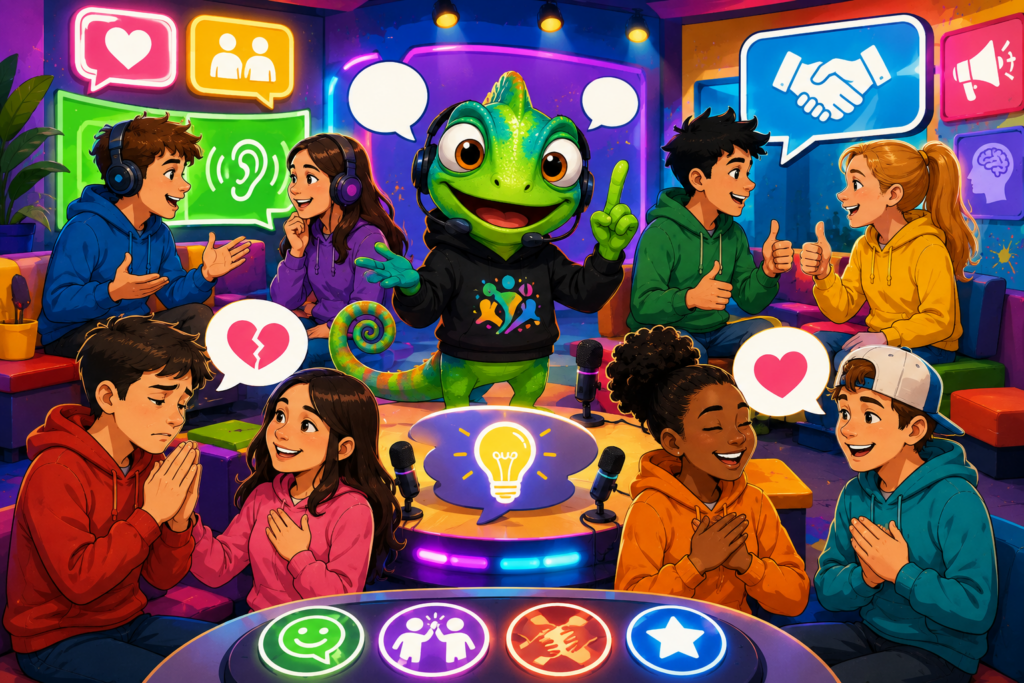
Part 1: Communication Emergency Buttons (20 min)
The teacher projects three large colored buttons or places three physical signs in the room:

The teacher reads short school situations. Students move to the button they think fits the situation.
Situations:
- You forgot your group materials.
- Your classmate explained the homework.
- Your partner feels nervous before speaking.
- You interrupted someone.
- Your group needs a better idea.
- A teacher gave you extra time.
- You arrived late to a meeting.
- Your friend corrected your English sentence.
- Your team is confused.
- You want to invite someone to practice.
Students first give simple answers:
“Sorry.”
“Thank you.”
“You should practice.”
Then the teacher upgrades them:
“I’m sorry I forgot the materials.”
“Thank you for explaining the homework.”
“Maybe you could practice one more time.”
Purpose: students understand that interaction style depends on the situation.
CONSTRUCTION
Part 2: Vocabulary Activation: Politeness Soundboard (15 min)
The teacher shows icons for apology, advice, gratitude, clarification, and teamwork. Students choose an icon and say the phrase with the correct tone.
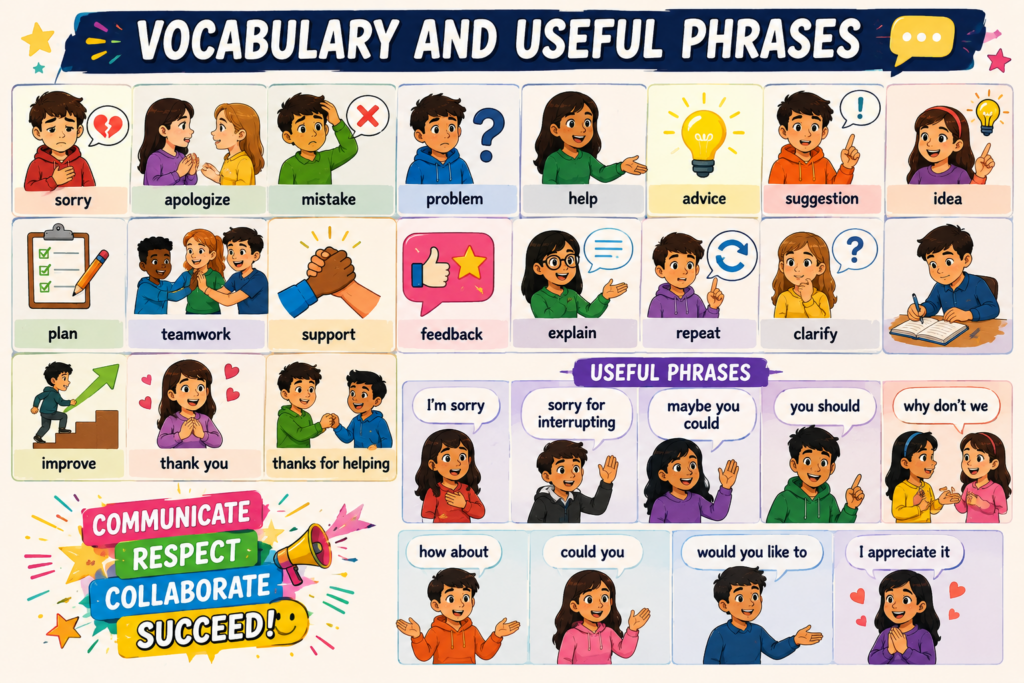
Vocabulary and useful phrases:
- sorry
- apologize
- mistake
- problem
- help
- advice
- suggestion
- idea
- plan
- teamwork
- support
- feedback
- explain
- repeat
- clarify
- practice
- improve
- thank you
- thanks for helping
- I’m sorry
- sorry for interrupting
- maybe you could
- you should
- why don’t we
- how about
- could you
- would you like to
- I appreciate it
Model sentences:
“I’m sorry I arrived late.”
“Sorry for interrupting you.”
“Maybe you could speak more slowly.”
“Why don’t we practice together?”
“Thank you for helping me.”
“I appreciate your idea.”
Part 3: Grammar and Language Input: Dialogue Surgery Method (25 min)
The teacher does not begin with rules. Instead, the class performs “dialogue surgery.” The teacher shows short weak dialogues and students “repair” them.
Weak dialogue:
A: You forgot the poster.
B: Sorry.
A: Do it now.
B: Thanks.
Improved dialogue:
A: You forgot the poster.
B: I’m sorry I forgot it. I will bring it tomorrow.
A: Maybe we could finish the title today and add the pictures tomorrow.
B: Thank you for helping me fix the problem.
The teacher explains that in English, polite interaction often needs more than one word. Students should add context, responsibility, or a solution.
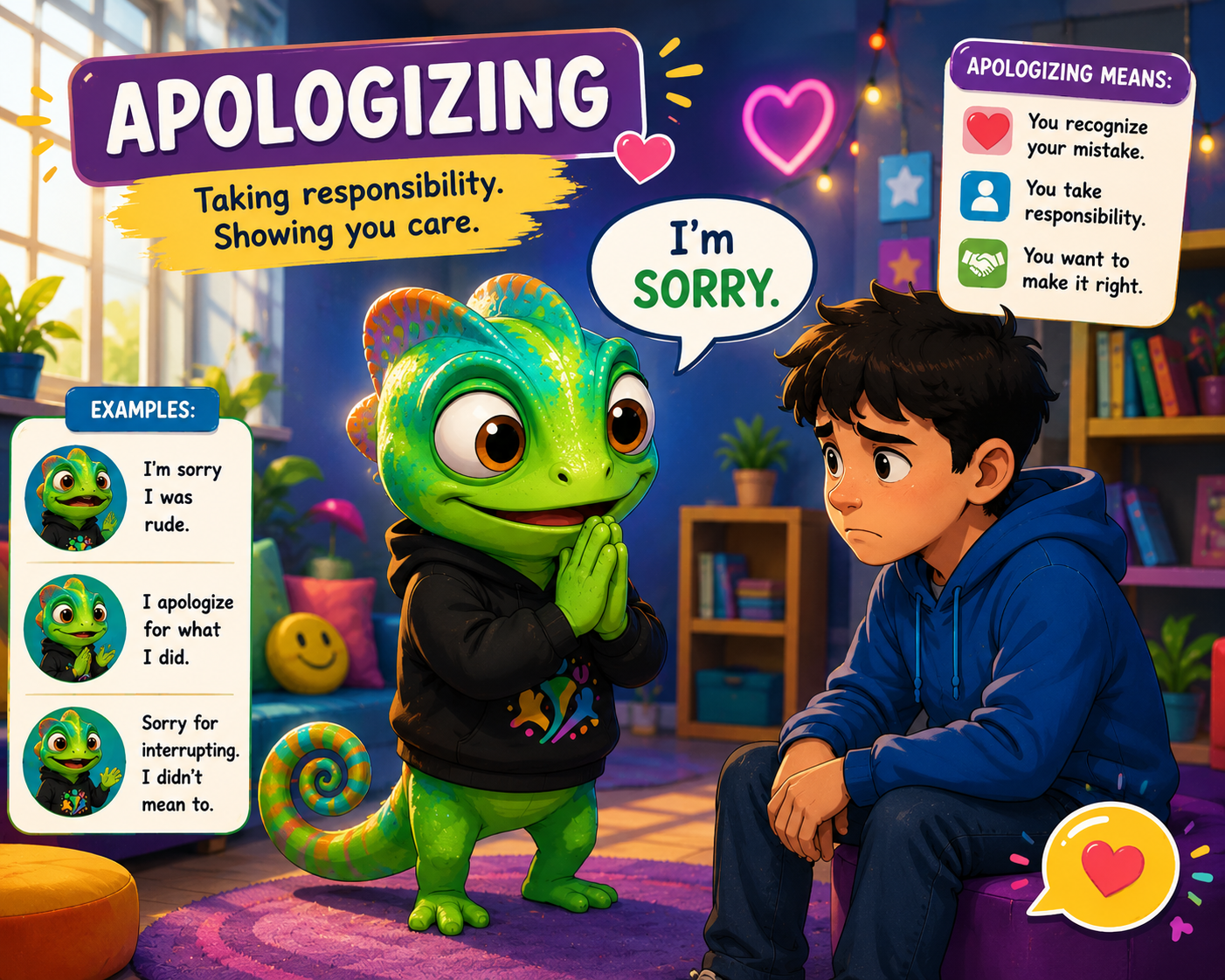
Apologizing:
Use apologies when you made a mistake, interrupted someone, arrived late, forgot something, or caused a problem.
Useful structures:
I’m sorry + reason.
I’m sorry I forgot the homework.
I’m sorry I interrupted you.
Sorry for + noun / verb-ing.
Sorry for the mistake.
Sorry for arriving late.
Sorry for interrupting.
A stronger apology can include a solution:
I’m sorry I forgot the materials. I will bring them tomorrow.
I’m sorry I interrupted you. Please continue.
Suggesting:
Use suggestions when you want to help someone or propose an idea without giving an order.
Useful structures:
You should + base verb.
You should practice before the presentation.
Maybe you could + base verb.
Maybe you could ask the teacher.
Why don’t we + base verb?
Why don’t we divide the work?
How about + verb-ing?
How about practicing together?
Would you like to + base verb?
Would you like to work with me?
Thanking:
Use thanks when someone helps you, explains something, gives feedback, waits for you, shares materials, or gives a useful idea.
Useful structures:
Thank you for + noun / verb-ing.
Thank you for your help.
Thank you for explaining.
Thanks for + noun / verb-ing.
Thanks for the feedback.
Thanks for helping me.
I appreciate + noun.
I appreciate your help.
I appreciate your suggestion.
The teacher explains tone:
“Do this” sounds like an order.
“Maybe you could do this” sounds like a suggestion.
“Sorry” is acceptable, but “I’m sorry I forgot it” is clearer.
“Thanks” is acceptable, but “Thank you for helping me” is more specific.
Part 4: Polite Response Mixer (20 min)
Students stand in two circles: inner circle and outer circle. The teacher reads a situation. The inner-circle student speaks first; the outer-circle student responds politely. Then the outer circle rotates.
Interaction rounds:
- Apologize because you forgot the materials.
- Thank your partner for explaining the task.
- Suggest a better study plan.
- Apologize for interrupting.
- Thank someone for giving feedback.
- Suggest how to improve pronunciation.
- Apologize because you arrived late.
- Suggest how to divide group work.
- Thank your classmate for waiting.
- Suggest how to prepare for an oral exam.
SESSION 2: CONSTRUCTION – REINFORCEMENT (40 min)
Part 1 – Kindness Hotline Challenge (15 min)
Students imagine they are answering a school “kindness hotline.” The teacher plays the caller and gives short problems. Students answer with advice, apologies, or thanks.

Caller problems:
- “I forgot my English notebook.”
- “My group is angry because I arrived late.”
- “I don’t understand the task.”
- “My friend helped me practice.”
- “I interrupted my partner.”
- “I am nervous about speaking.”
- “My team needs a plan.”
- “The teacher explained the activity again.”
- “I made a grammar mistake.”
- “My partner gave me a good idea.”
Students answer orally:
“I’m sorry I forgot my notebook.”
“Maybe you could apologize to your group.”
“Thank you for helping me practice.”
“Why don’t we make a plan?”
Part 2 – Gesture + Tone Challenge (15 min)
The teacher gives students one phrase. They must say it with the correct body language and tone. The class identifies whether the phrase is apologizing, suggesting, or thanking.
Phrases:
- I’m sorry I’m late.
- Thank you for waiting.
- Maybe you could practice more.
- Sorry for interrupting.
- Why don’t we work together?
- I appreciate your help.
- How about asking the teacher?
- Thank you for the feedback.
- I’m sorry I forgot it.
- Would you like to practice?
Students learn that interaction style is not only grammar; voice, face, and body language matter.
Part 3 – Exit Polite Line (10 min)
Each student receives one situation and says one complete polite sentence before leaving.
Examples:
“I’m sorry I interrupted you.”
“Maybe you could speak more slowly.”
“Thank you for explaining the instructions.”
SESSION 3: CONSOLIDATION (80 min)
Part 1 – Preparation: Communication Game Show Studio (15 min)
Students prepare for a game show-style interaction challenge. They do not write full scripts. They prepare useful phrases under three categories:
Apologizing
Suggesting
Thanking

Required language:
“I’m sorry…”
“Sorry for…”
“Maybe you could…”
“Why don’t we…”
“Thank you for…”
“I appreciate…”
Part 2 – Communication Game Show (50 min)
The classroom becomes a communication game show. Teams compete in short spoken rounds. The teacher acts as host, and students respond to live situations.
Round 1: Apology Rescue
Students hear a mistake and must apologize with a reason and repair.
Example:
“I’m sorry I forgot the poster. I will bring it tomorrow.”
Round 2: Suggestion Builder
Students hear a problem and must give two possible suggestions.
Example:
“Maybe you could practice with a partner. Why don’t we rehearse after class?”
Round 3: Thank-You Upgrade
Students receive a basic “thanks” sentence and make it more specific.
Example:
“Thank you for explaining the instructions clearly.”
Round 4: Mini FCE Pair Talk Intro
Pairs receive a simple school problem and talk for 45 seconds. They must include one suggestion and one thank-you expression.
Example problem:
“Your class needs to prepare for an oral exam. What should students do?”
Round 5: Polite Final Boss
Teams receive a complete situation and must use all three interaction styles.
Example:
“You arrived late to group practice. Your partner helped you catch up. Now suggest a way to finish the task.”
Possible answer:
“I’m sorry I arrived late. Thank you for helping me understand the task. Why don’t we divide the final part and finish it together?”
Part 3 – Game Show Reflection (15 min)
Students vote for:
- most polite team
- clearest suggestion
- best apology
- best thank-you phrase
- best teamwork
Students explain their vote orally:
“I voted for this team because their apology was complete.”
“Their suggestion was useful.”
“They thanked their partner clearly.”
RUBRIC:
Giving_Advice
NEE – Agregar el tipo de adaptaciones curriculares
Principio II: Pautas 6.1 – 6.3 – 6.4
Principio III: Pautas 7.1 – 8.1 – 9.1
ALUMNO 1: Constante monitoreo. Dar tiempo adicional para el desarrollo de la actividad y se reduce el número de ejercicios o se modifican los ejercicios con un nivel de dificultad reducido, de acuerdo con sus necesidades académicas.
ALUMNO 2: Constante monitoreo, Dar tiempo adicional para el desarrollo de la actividad y se reduce el número de ejercicios o se modifican los ejercicios con un nivel de dificultad reducido, de acuerdo con sus necesidades académicas.
ALUMNO 3: Constante monitoreo. Corroborar que el contenido entregado en clase haya sido comprendido por la estudiante mediante retroalimentación.