
K-Learning Project
SKILLS
EFL.5.1.3 Find parallels between Ecuadorian cultural and political referents and those of other countries by talking about holidays, symbols, customs and schooling.
EFL.5.2.7 Present information clearly in a variety of oral forms for a range of audiences and purposes.
REAL-LIFE APPLICATION
This project helps students speak about who they are, where they come from, and what cultural elements are important in their lives. Students learn to organize ideas before speaking and use English to describe their identity, family traditions, personality, and cultural heritage. In real life, this helps them introduce themselves with confidence, respect other people’s backgrounds, and communicate personal information clearly in academic and social situations.
LEARNING ACTIVITIES
SESSION 1 (80 min) ANTICIPATION
Part 1: Identity Objects (20 min)

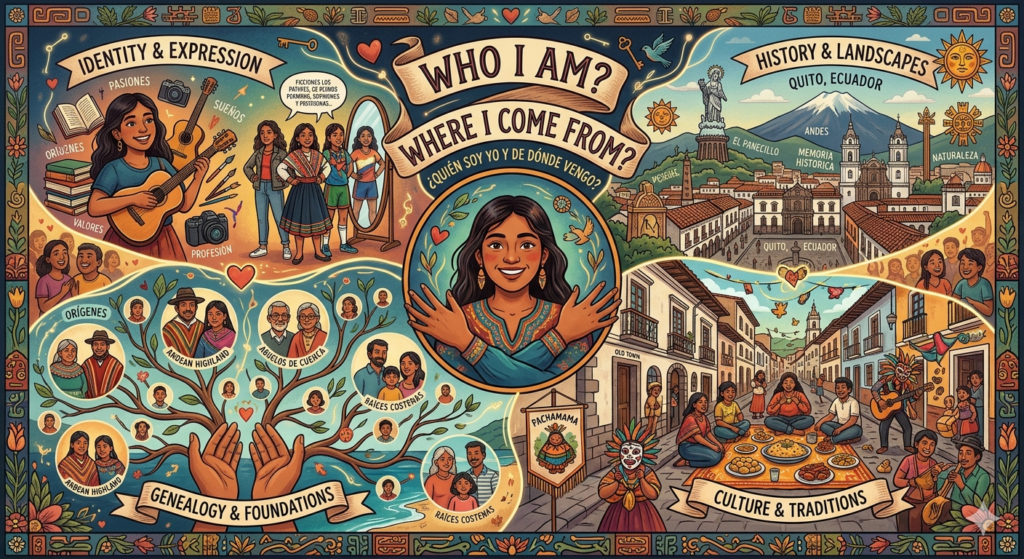
The teacher begins by showing an image of different objects connected to identity, such as food, music, clothes, flags, books, sports items, or family photos. Students answer the question: What objects, traditions, or experiences represent who you are? They first write three ideas individually and then share them in small groups. The teacher guides the discussion by explaining that identity is built from personality, emotions, experiences, family, culture, and traditions.
CONSTRUCTION
Part 2: Vocabulary Bank for Speaking (15 min)
The teacher introduces useful vocabulary for the project:
- identity
- heritage
- tradition
- family
- personality
- culture
- background
- values
- language
- food
- music
- celebration
- memory
- community
- proud
- meaningful
- important
- connected
- respectful
- unique
The teacher models pronunciation and gives short examples such as: My cultural heritage is important to me. I feel connected to my family traditions. Students choose five words that they want to use in their final speech.
Part 3: Speech Structure: The 3-Part Plan (20 min)
The teacher explains that a 45–60 second speech needs a clear structure. Students learn to organize their speech in three parts: introduction, identity, and cultural heritage. The teacher models a simple structure: First, I will introduce myself. Then, I will describe my personality. Finally, I will explain one tradition or cultural element that represents me. Students do not write the whole speech yet; they only complete a planning organizer with short notes.
Example: 3-Part Speech Structure
1. Introduction
My name is Ana. I am from Ecuador, and today I will talk about who I am and one tradition that represents me.
2. Identity
I am a friendly and creative person. I enjoy learning new things and spending time with my family. One important part of my identity is that I feel proud of my culture.
3. Cultural heritage
One tradition that represents me is Día de los Difuntos. In my family, we eat guaguas de pan and drink colada morada. This tradition is meaningful because it brings my family together and helps us remember people we love.
Planning Organizer Example
Introduction:
Name, country, topic.
Identity:
Friendly, creative, proud of my culture.
Cultural heritage:
Día de los Difuntos, guaguas de pan, colada morada, family, memory.
Part 4: Guided Speaking Notes (25 min)
Students complete a speech planning template: Speech Planning Template
They write short ideas, not full paragraphs, so they can practice speaking naturally.
The teacher provides sentence starters:
– My name is… I am a… person.
– One important part of my identity is…
– A tradition in my family is…
– This is meaningful because…
Students practice saying their ideas with a partner while the teacher monitors pronunciation, clarity, and confidence.
SESSION 2: CONSTRUCTION – REINFORCEMENT
(40 min)
Part 1 – Voice and Timing Practice (10 min)
The teacher explains that sustained speech is not reading quickly. Students practice speaking for 30 seconds using only their notes. The teacher reminds them to speak clearly, pause between ideas, and look at the audience. Students time each other and notice whether their speech is too short or too long.
Part 2 – Pronunciation Circle (15 min)
Students form small groups and practice difficult words from the vocabulary bank, such as heritage, tradition, personality, meaningful, and community. Each student reads one sentence from their speech notes, and classmates help identify words that need clearer pronunciation. The teacher gives quick pronunciation support and models correct stress.
Part 3 – Improve Your Speech Card (15 min)
Students receive or copy a simple improvement checklist:
- Does my speech have an introduction?
- Do I describe my personality?
- Do I mention one cultural tradition or family element?
- Do I explain why it is important?
Students revise their notes using the checklist. This reinforces organization before the graded presentation.
SESSION 3: CONSOLIDATION (80 min)
Part 1 – Final Preparation (15 min)
Students review their speech notes and rehearse once with a partner. The teacher reminds them that they should not read a full text word by word. They may use a note card with keywords. The teacher checks that each speech includes identity, personality, and cultural heritage.
Part 2 – Sustained Speech Presentations (50 min)
Students deliver a 45–60 second speech titled Who I Am and Where I Come From. Each student speaks individually in front of the class or in small presentation groups, depending on class size. They must describe their personality, mention one important cultural or family tradition, and explain why it matters to them. The teacher evaluates clarity, organization, vocabulary, pronunciation, and confidence.
Part 3 – Listener Reflection (15 min)
After the presentations, students write one sentence about something they learned from a classmate’s identity or cultural heritage. The teacher closes the session by emphasizing respect, diversity, and the value of speaking clearly about personal identity.
 RUBRIC:
KLearning Speech Rubric
NEE – Agregar el tipo de adaptaciones curriculares
Principio II: Pautas 6.1 – 6.3 – 6.4
Principio III: Pautas 7.1 – 8.1 – 9.1
ALUMNO 1: Constante monitoreo. Dar tiempo adicional para el desarrollo de la actividad y se reduce el número de ejercicios o se modifican los ejercicios con un nivel de dificultad reducido, de acuerdo con sus necesidades académicas.
ALUMNO 2: Constante monitoreo, Dar tiempo adicional para el desarrollo de la actividad y se reduce el número de ejercicios o se modifican los ejercicios con un nivel de dificultad reducido, de acuerdo con sus necesidades académicas.
ALUMNO 3: Constante monitoreo. Corroborar que el contenido entregado en clase haya sido comprendido por la estudiante mediante retroalimentación.