
End-of-Level Review Phase
SKILLS
EFL 4.2.13 Interact with reasonable ease in structured situations and short conversations within familiar contexts, provided that speech is given clearly, slowly and directly.
EFL 4.3.4 Find the most important information in print or online sources in order to support an idea or argument.
REAL-LIFE APPLICATION
This topic helps students understand that English is not only for grammar exercises. At the end of the level, students should be able to use English to understand information, explain ideas, listen to others, write a short message, and propose simple actions. Global citizenship gives the final review a meaningful purpose: students use English to talk about respect, the environment, inclusion, kindness, responsibility, and community action.
LEARNING ACTIVITIES
SESSION 1 (80 min) ANTICIPATION
Part 1: Message from the Future World (20 min)
The teacher shows the opening image or a short global citizenship video. Then the teacher reads a short fictional message:
“Dear students, the future school needs your help. Some students feel excluded. Some classrooms waste paper. Some people forget that small actions matter. You have learned English this year. Now use it to read, listen, speak, write, and propose a solution.”
Students answer orally:
What problem is mentioned?
Which problem happens at school?
Which problem can students solve?
What English skill will help us explain the solution?
This opening works because it gives emotional closure to the year. Students are not reviewing isolated topics; they are preparing to use English for a final mission.
Part 2: Vocabulary Activation: Action Object Swap (15 min)
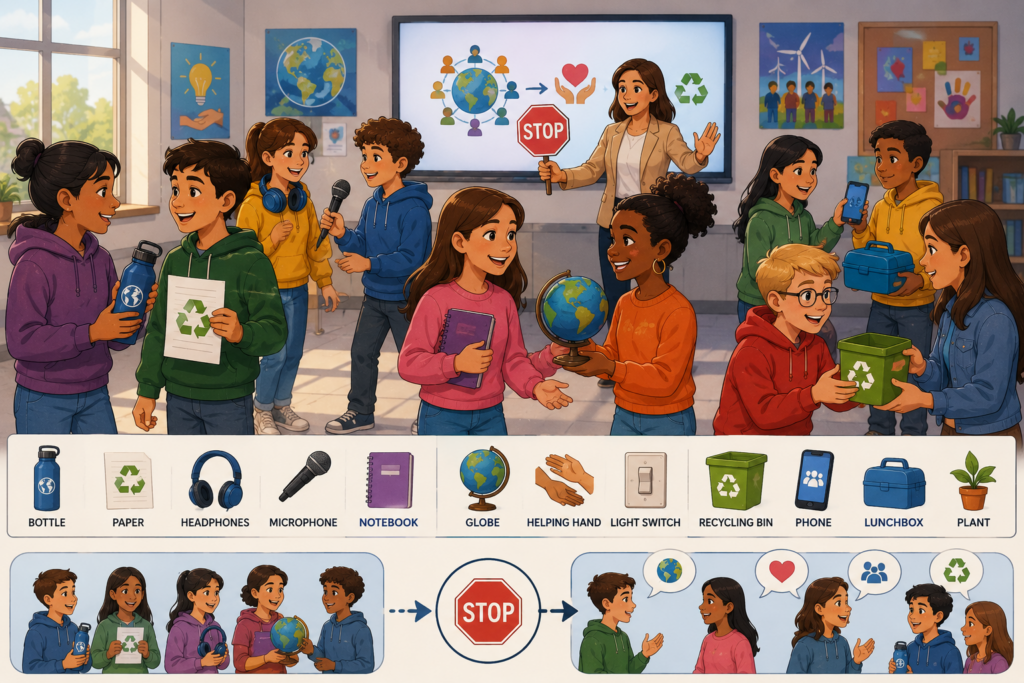
Students receive real objects or images: bottle, paper, headphones, microphone, notebook, globe, helping hand, light switch, recycling bin, phone, lunchbox, and plant. They walk around and swap objects. When the teacher says “stop,” each student must explain how the object connects to global citizenship.Each group receives one lens and must describe a photo only through that lens.
community
respect
responsibility
action
kindness
environment
inclusion
recycling
teamwork
voice
problem
solution
impact
difference
culture
listening
reading
speaking
writing
support
protect
improve
reduce
help
explain
suggest
reflect
cooperate
Part 3: What Is an Integrated Skills Performance? (25 min)
The teacher explains that an integrated skills performance means students use more than one English skill to complete one meaningful task. In real life, people rarely use only one skill. For example, if students want to propose a school environmental action, they may read a short article, listen to a video, discuss with classmates, write a message, and present the idea.
Integrated skills include:
Reading: understanding the main idea and finding useful details.
Listening: identifying the general message and important information.
Speaking: explaining a problem, solution, and reason clearly.
Writing: creating a short message with purpose and organization.
Interaction: asking questions, answering, agreeing, and building ideas with others.
The teacher explains “stamina” as the ability to continue communicating without stopping immediately. In this final topic, stamina means students can speak for about 60 seconds, write a short text, listen more than once, and keep working through a task even when they do not understand every word.
Language focus:
“I think the problem is…”
“This matters because…”
“One solution is…”
“We should…”
“We can…”
“This will help because…”
“I agree because…”
“Can you explain that?”
“My final message is…”
The teacher models a simple integrated response:
“I read about plastic waste at school. The main idea is that students throw away many bottles. In the video, I heard that small actions can help the planet. I think we should bring reusable bottles because this will reduce trash. My final message is: small actions can make our school better.”
Part 4: The 4-Skill Chain Reaction (20 min)
This activity is different from a normal presentation. Students work in teams and complete a chain where each skill activates the next one.
Step 1: Read a short text about a school issue.
Step 2: Listen to a short teacher audio about a similar issue.
Step 3: Speak with a partner and choose one solution.
Step 4: Write one short final message.
Example:
Reading text: students waste paper.
Listening audio: a class created a paper-saving rule.
Speaking: “We should use both sides of paper.”
Writing: “Dear class, let’s save paper this week.”
The team must show visible evidence: one reading detail, one listening detail, one spoken solution, and one written message.
SESSION 2: CONSTRUCTION – REINFORCEMENT (40 min)
Part 1 – Skill Switch Challenge (15 min)
The teacher calls out one skill: reading, listening, speaking, writing, or interaction. Students must immediately do a small action connected to global citizenship.
Reading: find one detail in a short text.
Listening: identify one detail from a 20-second audio.
Speaking: explain one solution.
Writing: write one action sentence.
Interaction: ask a partner one question.
This helps students understand that the final milestone is not one isolated skill. It is the ability to switch between skills with purpose.
Part 2 – Global Citizen Micro-Team Task (15 min)
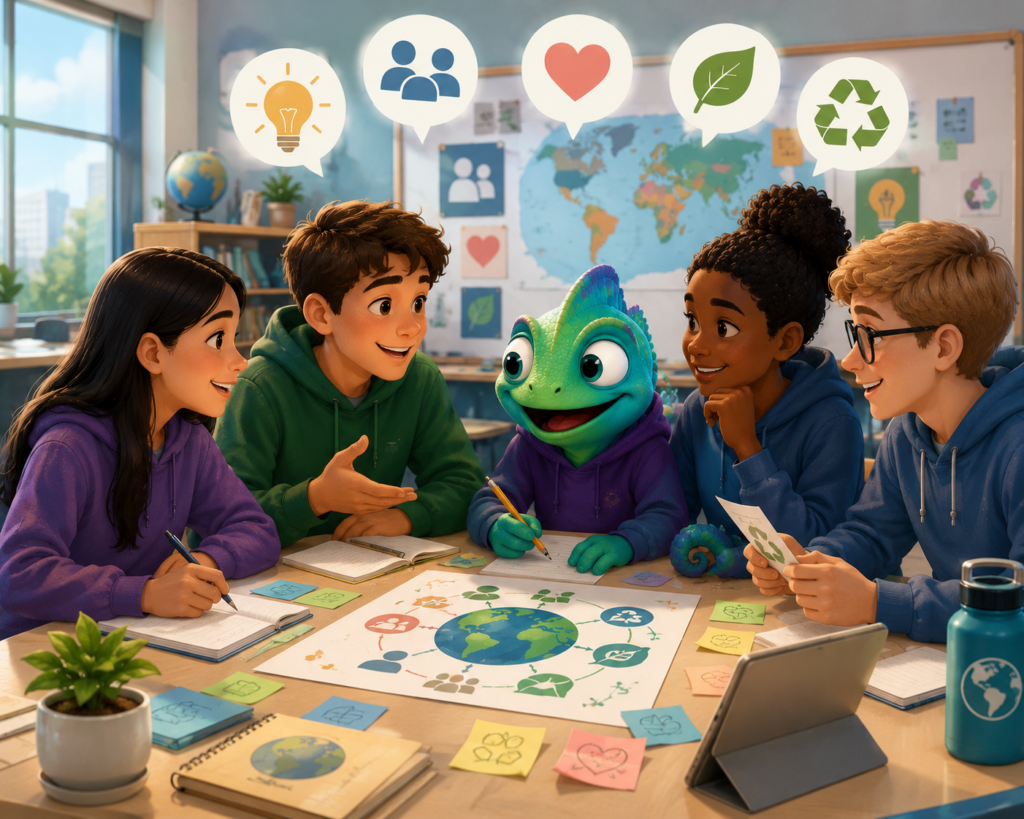
Teams receive one school challenge:
- plastic waste
- students feeling excluded
- water waste
- classroom noise
- paper waste
- food waste
- lack of kindness
- lights left on
- disrespectful online behavior
- dirty playground
Each team must produce:
one sentence about the problem
one sentence about why it matters
one sentence about a solution
one question for another team
Example:
“One problem is food waste. This matters because food is important. We should create a sharing table. What solution does your group suggest?”
Part 3 – Exit Milestone Sentence (10 min)
Each student completes one oral sentence:
“This year, I learned to…”
“One English skill I improved is…”
“One action I can take as a global citizen is…”
SESSION 3: CONSOLIDATION (80 min)
Part 1 – Test Preparation: Five-Keyword Support Card (10 min)
Students prepare only five keywords before the speaking part. They cannot write full sentences. This supports fluency without memorization.
Keywords:
problem
reason
solution
example
final message
Part 2 – Final Integrated Skills Test (55 min)
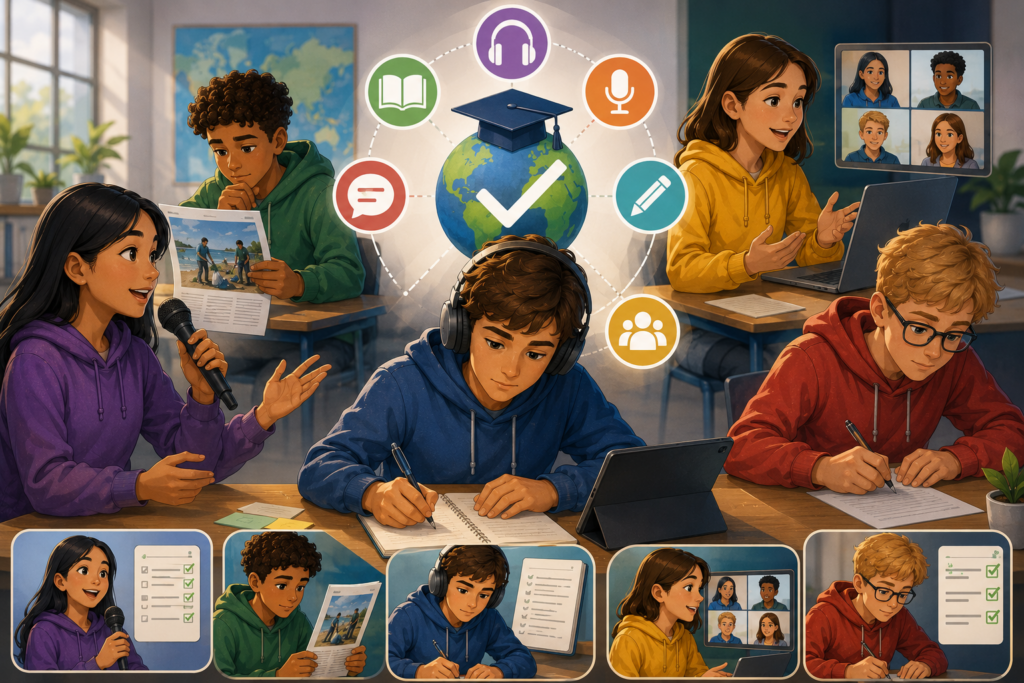
The final test includes reading, listening, speaking, interaction, and writing. The full student-ready version is in the Word document linked below.
Test structure:
Reading: short global citizenship story
Listening: teacher-read audio script
Speaking: 60-second global citizen message
Interaction: pair discussion
Writing: 70–90 word message to a friend
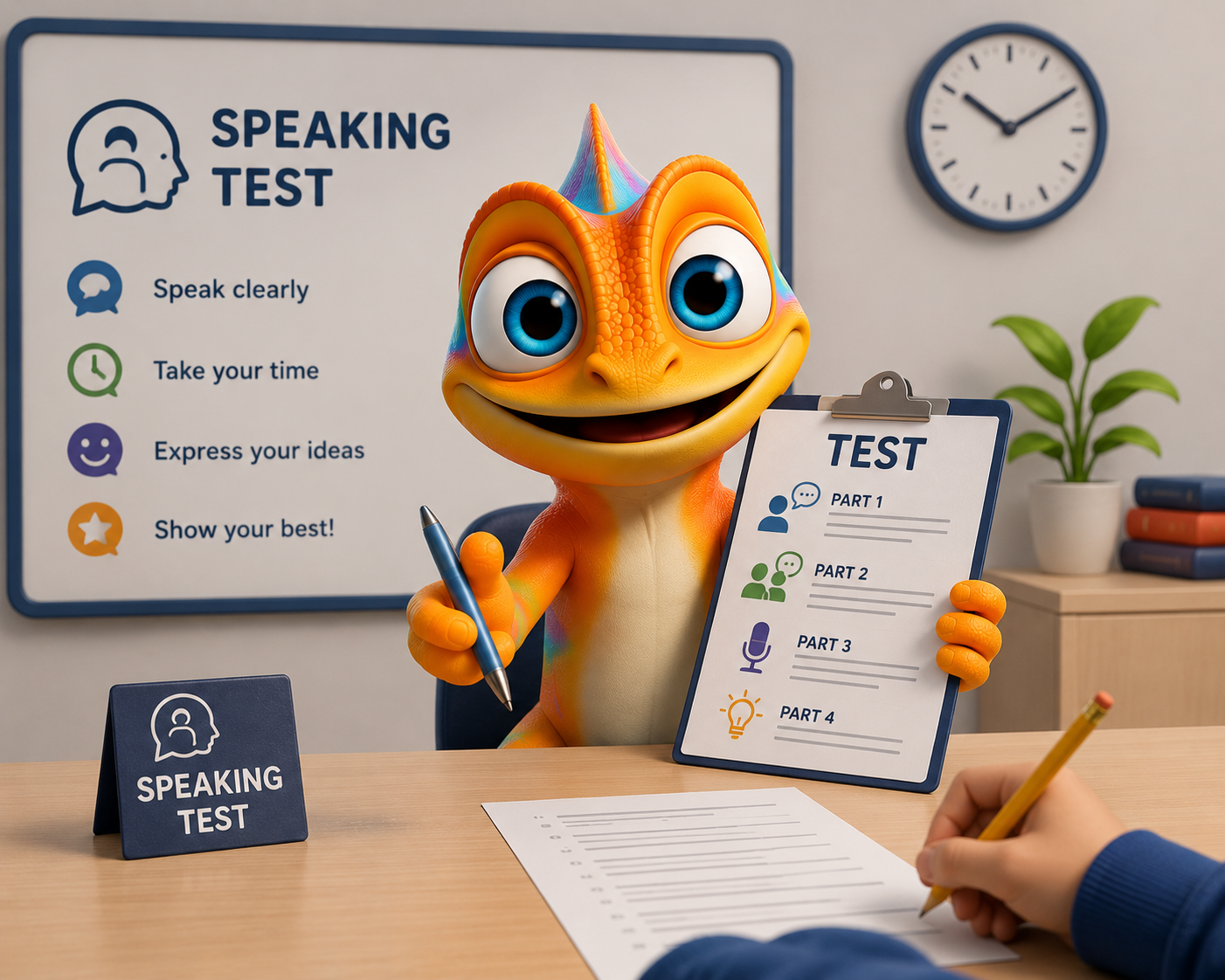
TEST:Global Citizenship Final Test
Part 3 – Closing Reflection: My English Passport Stamp (15 min)
Students choose one final “stamp” for themselves:
Reading Growth
Listening Growth
Speaking Growth
Writing Growth
Confidence Growth
Teamwork Growth
Global Citizen Growth
They explain why they chose it.
Ending motivational phrase:
“Your English is not only something you studied this year; it is a voice you can use to help, include, protect, and connect.”
RUBRIC: Global Citizenship
NEE – Agregar el tipo de adaptaciones curriculares
Principio II: Pautas 6.1 – 6.3 – 6.4
Principio III: Pautas 7.1 – 8.1 – 9.1
ALUMNO 1: Constante monitoreo. Dar tiempo adicional para el desarrollo de la actividad y se reduce el número de ejercicios o se modifican los ejercicios con un nivel de dificultad reducido, de acuerdo con sus necesidades académicas.
ALUMNO 2: Constante monitoreo, Dar tiempo adicional para el desarrollo de la actividad y se reduce el número de ejercicios o se modifican los ejercicios con un nivel de dificultad reducido, de acuerdo con sus necesidades académicas.
ALUMNO 3: Constante monitoreo. Corroborar que el contenido entregado en clase haya sido comprendido por la estudiante mediante retroalimentación.