
Listening Skills
SKILLS
EFL 4.2.3 Follow and understand short, straightforward audio messages and/ or the main idea/dialogue of a movie or cartoon (or other age-appropriate audio-visual presentations) if delivered slowly and visuals provide contextual support.
EFL 4.2.6 Use other students’ contributions in class as models for their own.


REAL-LIFE APPLICATION

This topic helps students understand spoken information without needing every word. They learn to listen for the general idea first, then listen again for important details such as names, places, numbers, times, events, and reasons. This is useful when students watch videos, listen to announcements, follow interviews, understand school news, watch educational content, or prepare for listening sections in English evaluations.
LEARNING ACTIVITIES
SESSION 1 (80 min) ANTICIPATION
Part 1: Silent News Guessing Room (20 min)
The teacher plays a short video without sound. It can show a school event, a weather report, a sports moment, a recycling activity, or a short interview. Students do not listen yet. They only observe.
The teacher asks:
- “What do you see?”
- “Where is this happening?”
- “Who is probably speaking?”
- “What is the video probably about?”
- “What details might we hear when the sound is on?”
- “What emotion can you notice?”
- “What visual clue helped you?”
Students answer orally using short phrases first. Then the teacher helps them expand:
Short answer: “sports”
Expanded answer: “The video might be about a sports competition because I can see students running.”
Short answer: “rain”
Expanded answer: “The report might be about the weather because I can see clouds and umbrellas.”
Purpose: students understand that visuals prepare the brain before listening. They do not start listening blindly.
Part 2: Vocabulary Activation: Sound and Screen Toolbox (15 min)
The teacher shows icons: ear, eye, microphone, camera, clock, map, person, number, question mark, and light bulb. Students choose one icon and connect it to a listening action.
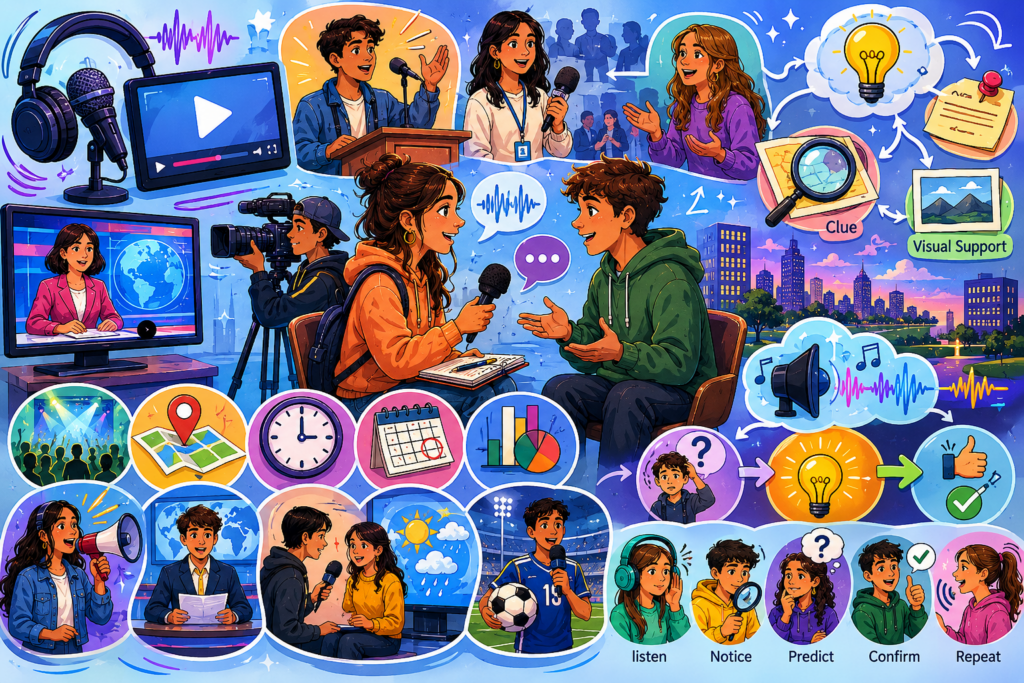
- audio
- video
- speaker
- reporter
- interviewer
- interviewee
- main idea
- detail
- clue
- visual support
- image
- sound
- background
- event
- place
- time
- date
- number
- reason
- result
- problem
- solution
- announcement
- news report
- interview
- weather report
- sports report
- listen
- notice
- predict
- confirm
- repeat
Part 3: Listening Strategy Input: Main Idea First, Details Second (25 min)
The teacher explains that listening is not the same as translating. Good listeners do not try to understand every word the first time. They listen with a purpose.
First listen: main idea
During the first listen, students should answer:
“What is this mostly about?”
“Is it news, an interview, or an announcement?”
“Who is speaking?”
“What is the general situation?”
“What problem or event is mentioned?”
At this stage, students should not worry about every number, every name, or every unknown word. The goal is to understand the “big picture.”
Second listen: details
During the second listen, students listen for specific information:
Who?
Where?
When?
How many?
What happened?
Why did it happen?
What was the result?
What solution was mentioned?
The teacher explains that visual support helps because images give context. If students see a rainy street, they can predict that the report may mention weather. If they see a microphone and two people, they can predict an interview. If they see a scoreboard, the audio may include a sports result.
The teacher models with a short audio:
Audio: “Good morning. Today, students from Green Valley School cleaned the park after last night’s storm. Twenty students collected plastic bottles and paper. Their teacher said the activity helped the community.”
First listen question:
“What is the report mainly about?”
Answer: “Students cleaned a park.”
Second listen questions:
“Where did it happen?”
Answer: “In the park.”
“How many students participated?”
Answer: “Twenty.”
“What did they collect?”
Answer: “Plastic bottles and paper.”
“What was the result?”
Answer: “It helped the community.”
Part 4: Language / Grammar Teaching Idea: Question Word Listening Map (20 min)
For this topic, grammar is taught through listening questions. Students learn that the grammar of a question tells them what kind of information to listen for.
The teacher creates a “question word map”:
Who = person
Where = place
When = time or date
How many = number
What happened = event
Why = reason
How = method or process
What result = consequence
The teacher plays or reads short audio lines. Students raise the correct question word card or point to the correct icon.
Examples:
Audio: “The activity happened in the school gym.”
Students identify: Where
Audio: “Fifteen students joined the interview.”
Students identify: How many
Audio: “The event started at 9:00.”
Students identify: When
Audio: “The teacher explained the rules.”
Students identify: Who / What happened
This teaches students to listen with a target instead of listening randomly.
Active Listening Mini-Input
The purpose is to show that listening is not passive. Students do not only “hear” information; they prepare their minds, observe visual clues, predict the topic, focus on the speaker, identify the main idea, and listen again for key details.
SESSION 2: CONSTRUCTION – REINFORCEMENT (40 min)
Part 1 – Audio Detective Remote Control (15 min)
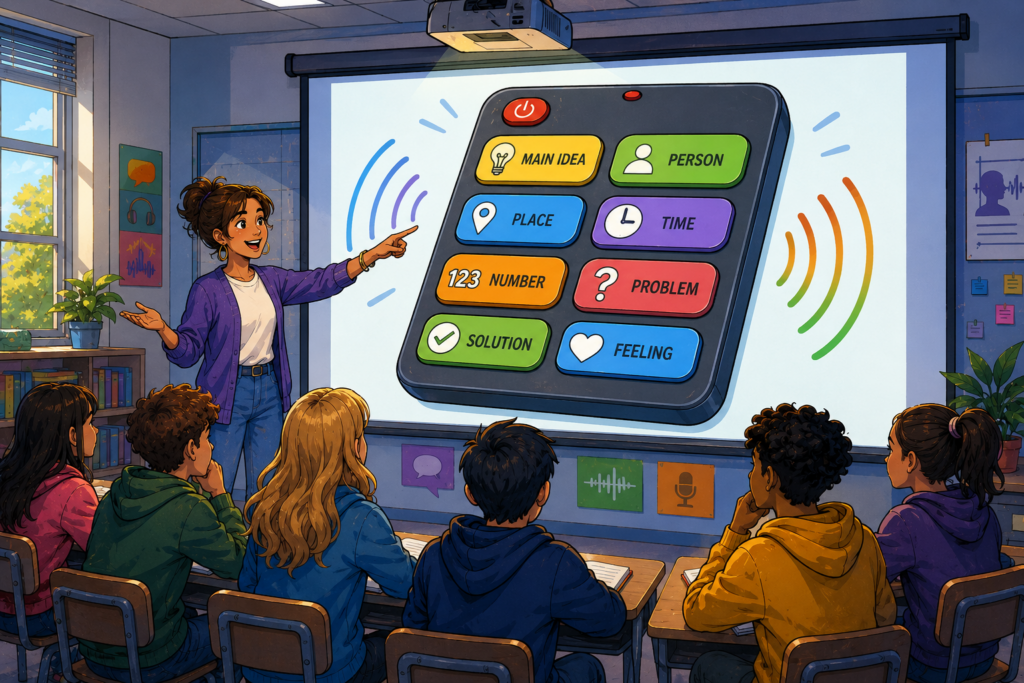
The teacher projects a large remote control with listening buttons:
- Main idea
- Person
- Place
- Time
- Number
- Problem
- Solution
- Feeling
The teacher plays or reads a short clip. Before listening, a student chooses one “button.” That button tells the class what to listen for.
Example:
Button: Number
Audio: “Twenty students participated in the science fair.”
Students answer: “Twenty.”
Button: Feeling
Audio: “The winner said she felt nervous but proud.”
Students answer: “Nervous and proud.”
This makes the listening purpose visible and active.
Part 2 – Video Pause Prediction (15 min)
The teacher plays a short video and pauses it three times.
Pause 1: before the speaker talks
Students predict the topic.
Pause 2: after the first sentence
Students identify the main idea.
Pause 3: before the ending
Students predict one detail or result.
After the full video, students compare:
“What did we predict correctly?”
“What detail did we miss?”
“What visual clue helped us most?”
Part 3 – Exit Listening Line (10 min)
Each student says one listening strategy before leaving.
Examples:
“I listen first for the main idea.”
“I listen again for details.”
“I use images to understand the topic.”
“I listen for numbers when the question asks ‘How many?’”
SESSION 3: CONSOLIDATION (80 min)
Part 1 – Preparation: Listener Control Board (15 min)
Students prepare a listening control board in groups. Each group receives one short video or teacher-read audio. They create a simple board with icons, not long text:
- main idea icon
- speaker icon
- place icon
- time icon
- detail icon
- final result icon
They do not write full answers before listening. They prepare what they will listen for.
Part 2 – Audio Quest Studio (50 min)
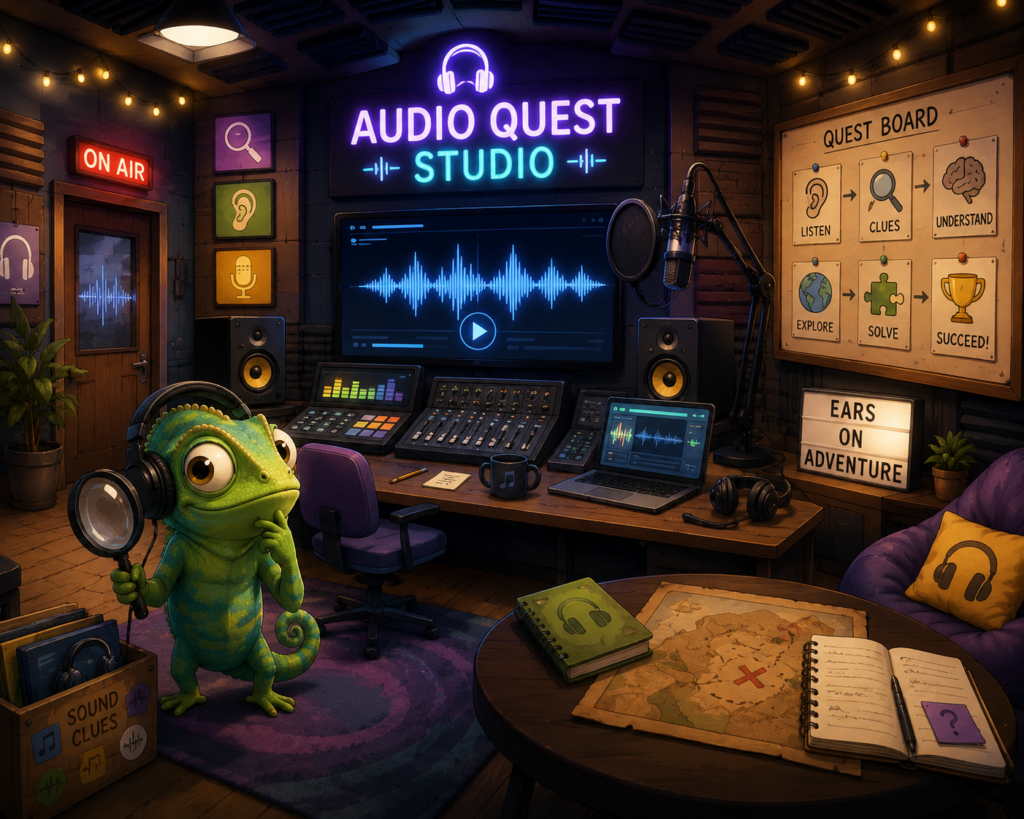
The classroom becomes an audio quest studio. Groups listen to different short clips. Instead of rotating stations, each clip is presented as a “sound challenge” from the teacher’s control screen.
Challenge types:
Sound Challenge 1: Main Idea
Students listen once and say the general topic.
Sound Challenge 2: Detail Capture
Students listen again and find one number, place, or person.
Sound Challenge 3: Visual Evidence
Students explain which image helped them understand the audio.
Sound Challenge 4: Interview Meaning
Students decide what the interviewee mainly said.
Sound Challenge 5: Final Report
Students give a 30-second group summary.
Required language:
- “The report is mainly about…”
- “One detail we heard was…”
- “The speaker said…”
- “The visual helped because…”
- “The final result was…”
This consolidation is interactive because students must explain their writing decisions orally before submitting.
Part 3 – Listener Reflection Circle (15 min)
Students answer orally:
“What was easier: main idea or details?”
“What visual helped you most?”
“What word did you hear more than once?”
“What will you do next time before listening?”
“Why should we listen twice?”
RUBRIC: Listening Skills
NEE – Agregar el tipo de adaptaciones curriculares
Principio II: Pautas 6.1 – 6.3 – 6.4
Principio III: Pautas 7.1 – 8.1 – 9.1
ALUMNO 1: Constante monitoreo. Dar tiempo adicional para el desarrollo de la actividad y se reduce el número de ejercicios o se modifican los ejercicios con un nivel de dificultad reducido, de acuerdo con sus necesidades académicas.
ALUMNO 2: Constante monitoreo, Dar tiempo adicional para el desarrollo de la actividad y se reduce el número de ejercicios o se modifican los ejercicios con un nivel de dificultad reducido, de acuerdo con sus necesidades académicas.
ALUMNO 3: Constante monitoreo. Corroborar que el contenido entregado en clase haya sido comprendido por la estudiante mediante retroalimentación.