
K-Learning Project
SKILLS
EFL 4.1.9 Recognize the consequences of one’s actions by demonstrating responsible decision-making at school, online, at home and in the community, while considering ethical standards, safety concerns, social norms and mutual respect.
EFL 4.2.13 Interact with reasonable ease in structured situations and short conversations within familiar contexts, provided that speech is given clearly, slowly and directly.


REAL-LIFE APPLICATION

This topic helps students explain a real problem and defend a simple solution in English. They learn how to speak for one full minute with a clear idea, instead of giving only short answers. This is useful when students need to propose improvements for their school, explain why an environmental issue matters, participate in group projects, present ideas clearly, and convince others to take action.
LEARNING ACTIVITIES
SESSION 1 (80 min) ANTICIPATION
Part 1: Eco-Problem Camera Roll (20 min)
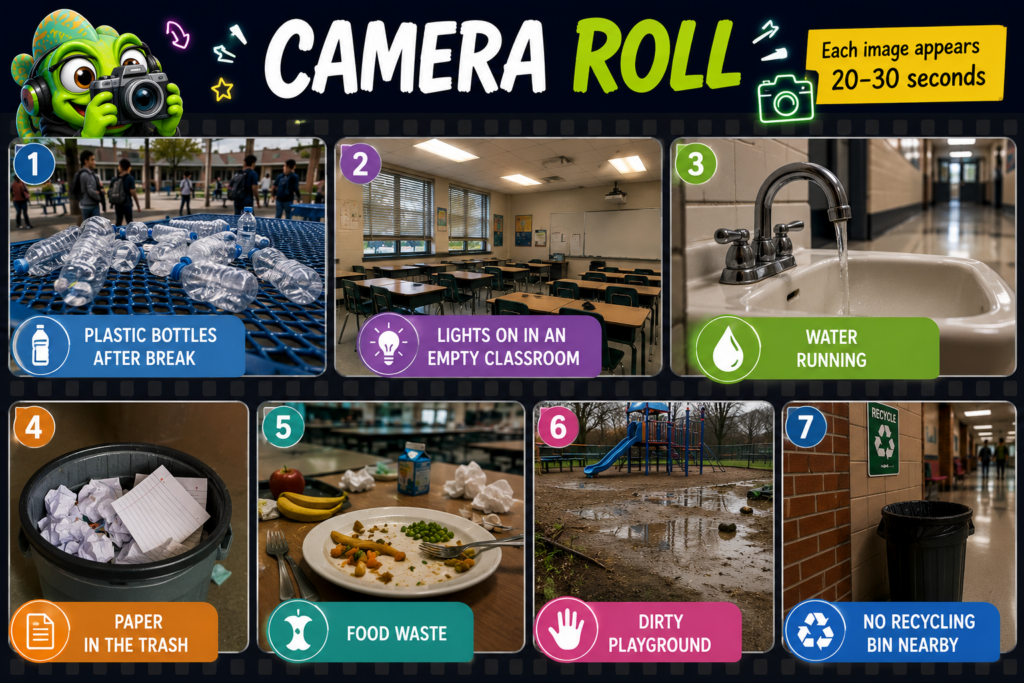
The teacher shows a “camera roll” of school-based environmental problems. Each image appears for 20–30 seconds: plastic bottles after break, lights on in an empty classroom, water running, paper in the trash, food waste, dirty playground, and no recycling bin nearby.
Students stand up when they see a problem they have also noticed at school. The teacher asks:
“What is the problem?”
“Why does it matter?”
“Who is affected?”
“What could students do?”
“What solution would be easy to start?”
Students answer first with short ideas:
“Plastic is a problem.”
“Students waste paper.”
“We should recycle.”
“We could turn off lights.”
The teacher upgrades the responses:
“One problem at school is plastic waste.”
“We should use reusable bottles because they reduce trash.”
“This solution will help because students will throw away fewer bottles.”
Purpose: students see that argumentation begins with real observation.
CONSTRUCTION
Part 2: Vocabulary Activation: Eco-Word Action Props (15 min)
The teacher places objects or images around the room: bottle, paper, light switch, lunchbox, plant, trash bag, water tap, recycling bin, notebook, reusable bag. Students choose one object and say an action connected to it.
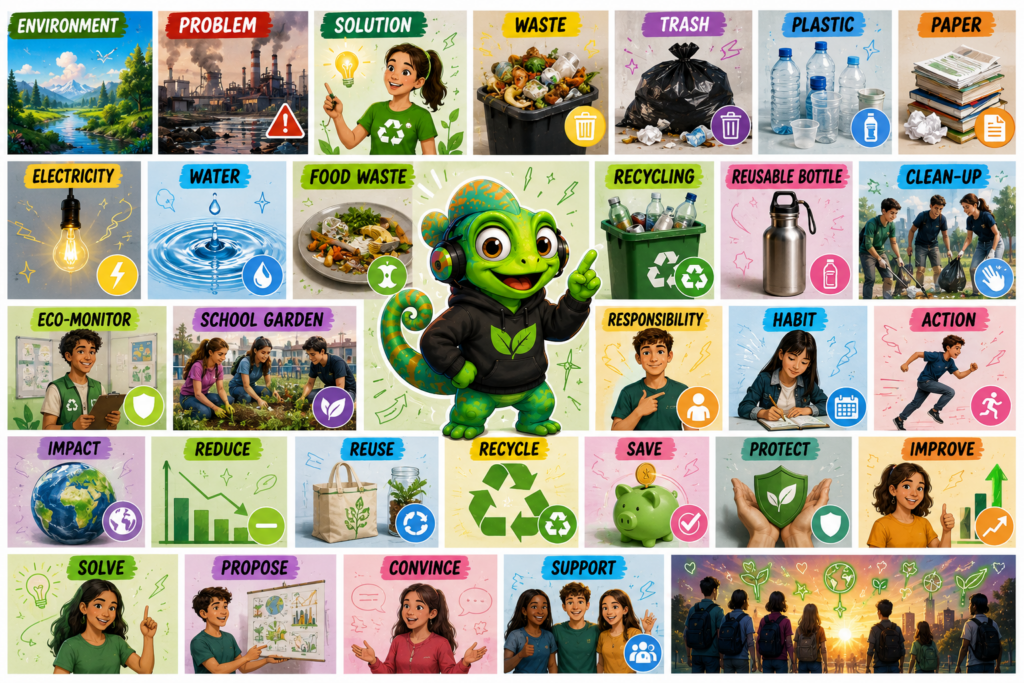
- environment
- problem
- solution
- waste
- trash
- plastic
- paper
- electricity
- water
- food waste
- recycling
- reusable bottle
- clean-up
- eco-monitor
- school garden
- responsibility
- habit
- action
- impact
- reduce
- reuse
- recycle
- save
- protect
- improve
- solve
- propose
- convince
- support
Model sentences:
“We should reduce plastic.”
“We could reuse old paper.”
“This action will protect the environment.”
“Our solution will improve the school.”
Part 3: Language Input: The 60-Second Argument Engine (25 min)
The teacher explains:

Argumentative stamina means speaking with structure for 60 seconds. It does not mean speaking fast. It means keeping one clear argument alive with a problem, solution, reason, example, impact, and final call to action.
A strong 60-second environmental proposal has five parts:
- Problem: What is wrong?
- Reason: Why does it matter?
- Solution: What should students do?
- Impact: How will it help?
- Call to action: What should the audience do next?
Simple structure:
“At our school, one problem is…”
“This is important because…”
“We should…”
“We could also…”
“This will help because…”
“For example…”
“In conclusion, we should…”
The teacher explains useful proposal language:
Use should for strong advice:
“We should turn off the lights after class.”
“Students should bring reusable bottles.”
Use could for possible solutions:
“We could create a recycling corner.”
“We could clean the playground every Friday.”
Use will for expected impact:
“This will reduce trash.”
“This will help students save water.”
Use because to explain reasons:
“We should recycle paper because it reduces waste.”
Use so that to explain purpose:
“We could put signs near the light switch so that students remember to turn off the lights.”
The teacher models a 60-second mini proposal:
“At our school, one problem is plastic waste after break time. Many students bring plastic bottles and throw them away. This is important because plastic creates trash and damages the environment. We should start a reusable bottle challenge. Students could bring their own bottles every day. This will help because the school will produce less plastic waste. For example, each class could count how many students bring reusable bottles. In conclusion, we should start this challenge next week because it is simple and useful.”
Part 4: Argument Engine Wall (20 min)
The teacher places five large signs on the wall:
- Problem
- Reason
- Solution
- Impact
- Call to action
Students receive one school environmental challenge and physically move through the wall. At each sign, they say one sentence.
Challenges:
- plastic waste
- food waste
- lights left on
- water waste
- paper waste
- dirty playground
- no recycling habit
- too many snack packages
- forgotten materials
- plants not cared for
Example:
Problem: “One problem is paper waste.”
Reason: “This is important because students throw away many papers.”
Solution: “We should use both sides of the paper.”
Impact: “This will reduce trash.”
Call to action: “Let’s start today.”
SESSION 2: CONSTRUCTION – REINFORCEMENT (40 min)
Part 1 – Eco-Remote Control Speaking Drill (15 min)
The teacher uses a toy remote, paper remote, or projected remote-control image. Each button changes the speaker’s task.
Buttons:
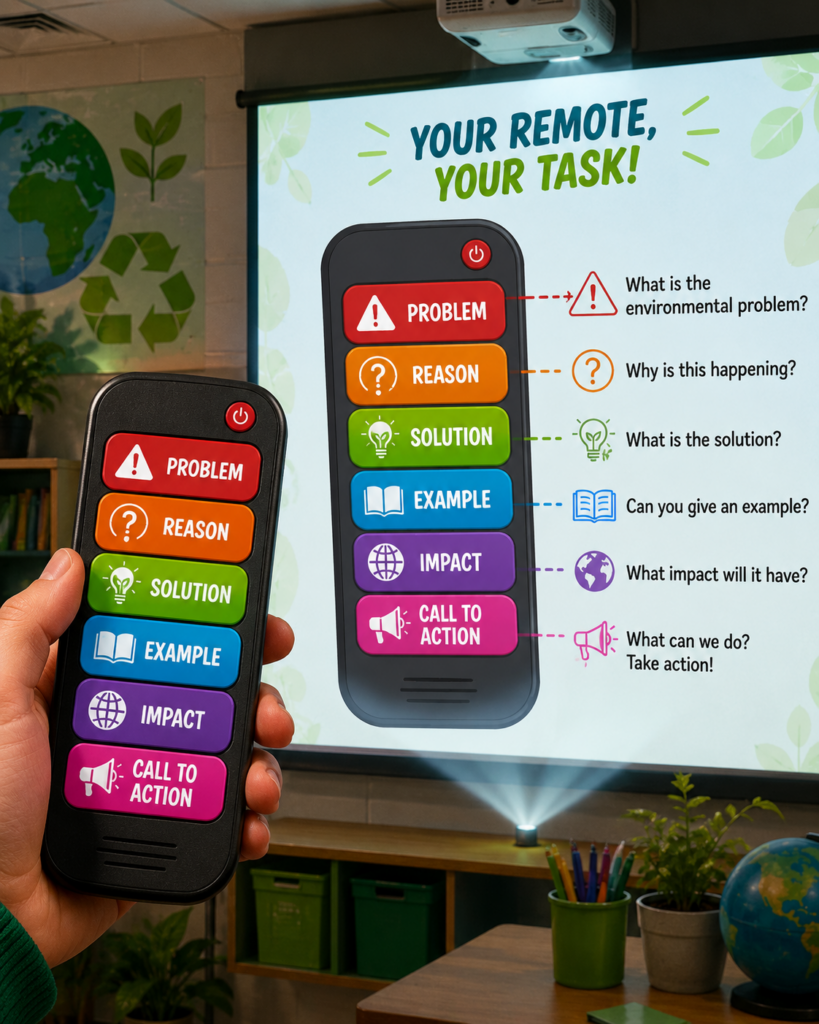
A student begins with one environmental challenge. The teacher presses a “button,” and the student must immediately say that part of the proposal.
Example:
Teacher says: “Plastic waste.”
Button: Problem
Student: “One problem at school is plastic waste.”
Button: Solution
Student: “We should bring reusable bottles.”
Button: Impact
Student: “This will reduce trash.”
This helps students build flexibility before the final 60-second proposal.
Part 2 – Solution Statue Challenge (15 min)
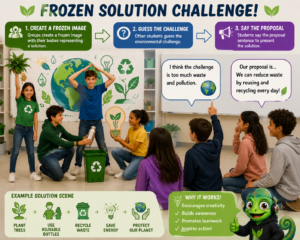
Groups create a frozen image with their bodies representing a solution. Other students guess the environmental challenge and say the proposal sentence.
Examples:
Group freezes as students turning off lights.
Class says: “They should turn off the lights after class.”
Group freezes as students holding reusable bottles.
Class says: “Students could bring reusable bottles to reduce plastic.”
Group freezes as students cleaning the playground.
Class says: “The class should organize a clean-up.”
Part 3 – Exit Mini Story (10 min)
Each student gives a 20-second mini proposal using:
- one problem
- one solution
- one reason
Example:
“One problem is water waste. We should close the taps because water is important. This will help the school save water.”
SESSION 3: CONSOLIDATION (80 min)
Part 1 – Preparation: Eco TV Challenge Planning (15 min)
Students prepare a 60-second live eco-message. They do not write a full script. They prepare a simple visual plan with five icons:
- problem
- cause
- solution
- impact
- call to action
Students can use one prop, one drawing, one object, one projected image, or one mini prototype.
Required language:
- “One problem is…”
- “This matters because…”
- “We should…”
- “We could…”
- “This will help because…”
- “Let’s…”
Part 2 – Eco TV Challenge (50 min)
The classroom becomes a live environmental TV studio. Groups create a 60-second public service announcement about a school environmental challenge. This is not a poster presentation. Students must perform the message as a short live broadcast.
Roles:
- presenter
- problem reporter
- solution demonstrator
- timekeeper
- audience motivator
Broadcast structure:
0–10 seconds: hook
10–20 seconds: school problem
20–35 seconds: solution
35–50 seconds: reason and impact
50–60 seconds: call to action
Example:

Part 3 – Eco TV Awards Reflection (15 min)

Students vote for:
- clearest problem
- most realistic solution
- best 60-second stamina
- best use of voice and props
- strongest call to action
Students explain their vote orally:
“I voted for this group because their solution was realistic.”
“Their proposal will reduce waste.”
“They used a strong call to action.”
RUBRIC: Argumentative Stamina
Exercise Bank – Extra Practice
The Exercise Bank can be used as an additional practice section after the main lesson activities. These exercises are useful for students who finish early, need extra reinforcement, or want more practice before the final task. The teacher may select specific exercises depending on the students’ needs, class time, or level of difficulty.
Argumentative Stamina EGB Exercise Bank
NEE – Agregar el tipo de adaptaciones curriculares
Principio II: Pautas 6.1 – 6.3 – 6.4
Principio III: Pautas 7.1 – 8.1 – 9.1
ALUMNO 1: Constante monitoreo. Dar tiempo adicional para el desarrollo de la actividad y se reduce el número de ejercicios o se modifican los ejercicios con un nivel de dificultad reducido, de acuerdo con sus necesidades académicas.
ALUMNO 2: Constante monitoreo, Dar tiempo adicional para el desarrollo de la actividad y se reduce el número de ejercicios o se modifican los ejercicios con un nivel de dificultad reducido, de acuerdo con sus necesidades académicas.
ALUMNO 3: Constante monitoreo. Corroborar que el contenido entregado en clase haya sido comprendido por la estudiante mediante retroalimentación.