
Global Travel
SKILLS
EFL 5.2.13 Deal with practical, everyday communication demands within familiar contexts, effectively and without undue effort.
EFL 5.2.7 Present information clearly and effectively in a variety of oral forms for a range of audiences and purposes.


REAL-LIFE APPLICATION

This topic helps students navigate real-world travel challenges, such as dealing with lost baggage, flight delays, or security checks, without panicking. In travel logistics, the focus is naturally on what happens to our belongings, flights, and documentation rather than who does it. Learning the Present and Past Passive Voice empowers students to report structural problems to airline personnel professionally (“My bag was damaged” or “Tickets are issued automatically”), keeping the conversation focused on solutions.
LEARNING ACTIVITIES
SESSION 1 (80 min) ANTICIPATION
Part 1: Airport Conveyor Belt Mystery (20 min)
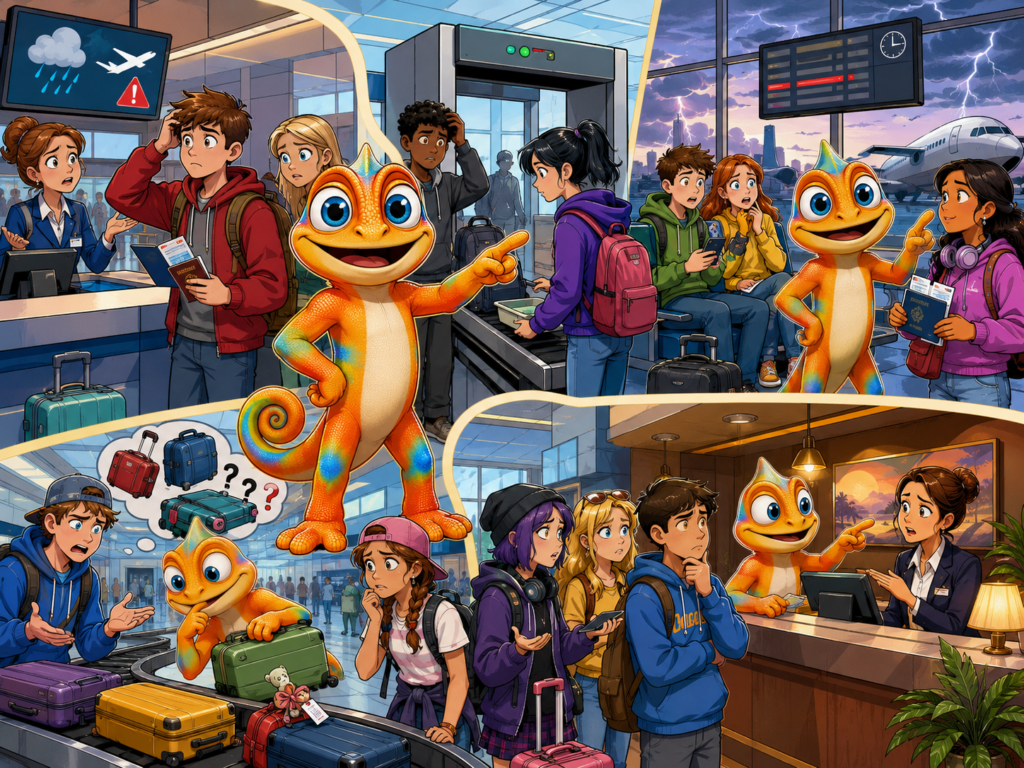
The teacher shows the opening image or projects a moving airport scene with luggage belts, scanners, passengers, and boarding gates. Students work in groups and observe the image like detectives. The teacher asks: “What things are done at an airport?” Students first answer with simple words: “bags,” “tickets,” “passports,” “luggage.” Then the teacher models passive sentences.
Model sentences:
- “The bags are checked.”
- “The tickets are scanned.”
- “The passport is shown.”
- “The luggage is sent to the plane.”
Then the teacher changes the situation: “Yesterday, there was a problem.” Students look at a second image of a delayed flight and lost luggage. The teacher models:
“The flight was delayed.”
“The suitcase was lost.”
“The reservation was cancelled.”
This activates curiosity before the grammar explanation.
CONSTRUCTION
Part 2: Vocabulary Development (15 min)
The teacher introduces essential interactive terminology for international travel operations and emergency logistics.
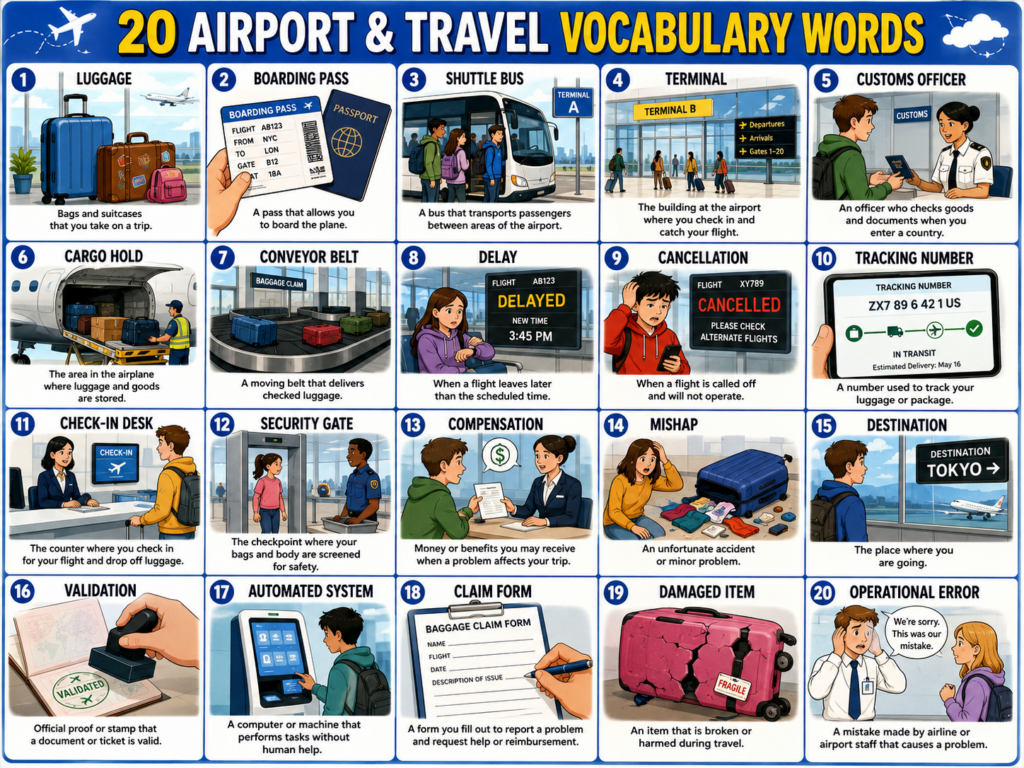
- luggage
- boarding pass
- shuttle bus
- terminal
- customs officer
- cargo hold
- conveyor belt
- delay
- cancellation
- tracking number
- check-in desk
- security gate
- compensation
- mishap
- destination
- validation
- automated system
- claim form
- damaged item
- operational error
Model sentences:
“The boarding pass is scanned at the gate.”
“The suitcase is checked at the counter.”
“The hotel room was booked online.”
“The flight was delayed yesterday.”
Part 3: Grammar/Punctuation Input: Present vs. Past Passive (25 min)
The teacher explains that the Passive Voice is essential in travel because the person performing the action is either obvious, unknown, or unimportant.
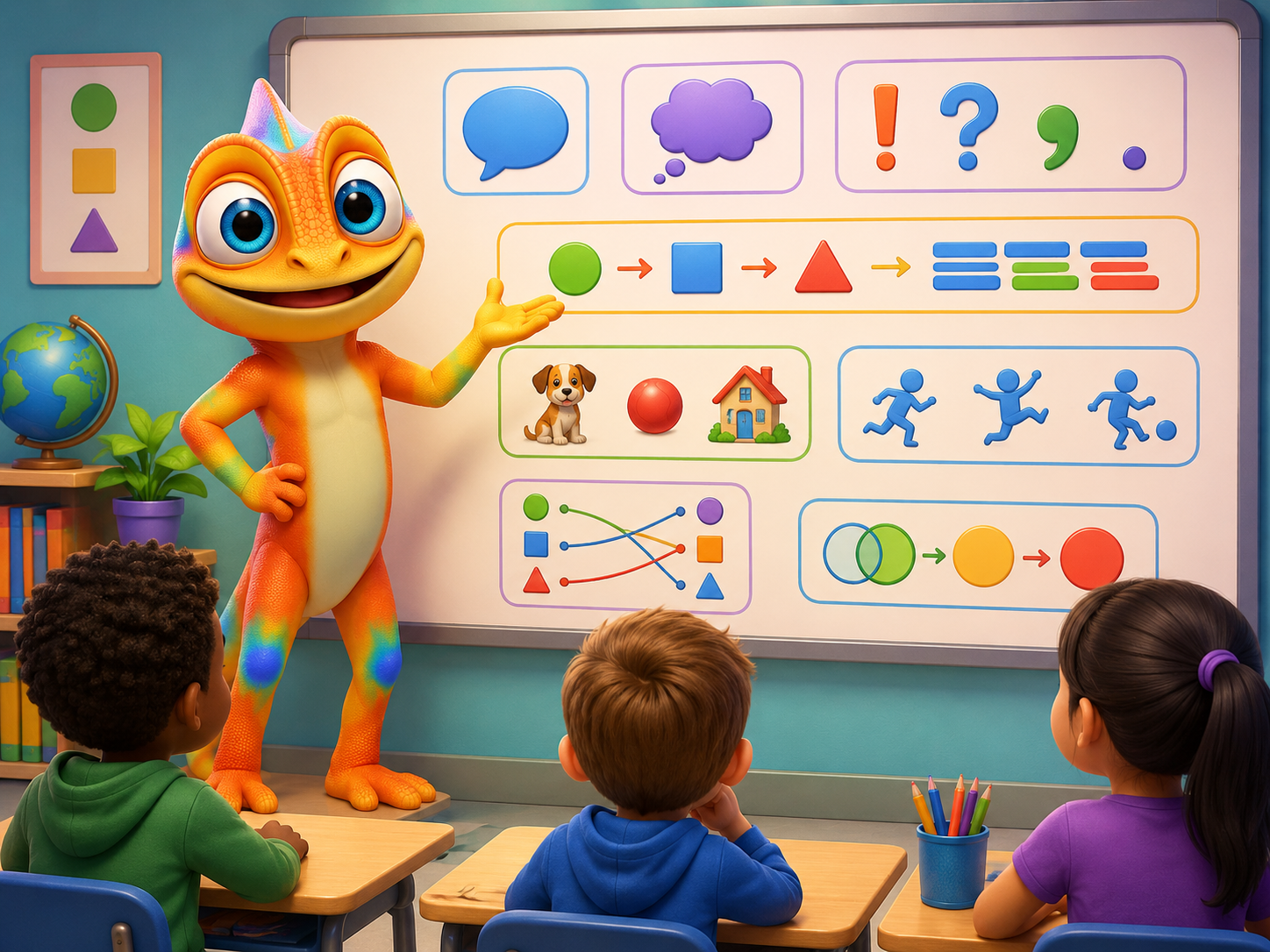
The passive voice
It is used when the action is more important than the person doing the action. In travel situations, we often do not know or do not need to say who does the action. For example, at an airport, many people or machines help with the process, but the important idea is what happens to the ticket, passport, luggage, or flight.
Active voice focuses on the person doing the action:
“The airport worker checks the passport.”
Passive voice focuses on the object or situation:
“The passport is checked.”
Present Simple Passive for regular travel processes.
Structure: subject + am / is / are + past participle
Examples:
“The luggage is checked.”
“The boarding passes are scanned.”
“The hotel room is cleaned.”
“The tickets are sent by email.”
Past Simple Passive for completed travel experiences or travel problems.
Structure: subject + was / were + past participle
Examples:
“The flight was delayed.”
“The bags were lost.”
“The reservation was cancelled.”
“The suitcases were delivered late.”
The teacher clarifies the difference:
Present Simple Passive explains what usually happens.
Past Simple Passive explains what happened before.
Comparison:
“Passports are checked at immigration.”
“My passport was checked yesterday.”
“Tickets are booked online.”
“Our tickets were booked last week.”
Exercise: Complete the sentences with the correct passive form.
- The bags ______ checked at the airport.
- My suitcase ______ lost yesterday.
- The tickets ______ sent by email.
- The flight ______ delayed last night.
- Hotel rooms ______ cleaned every morning.
- The passports ______ checked before boarding.
- The reservation ______ cancelled by mistake.
- The boarding pass ______ scanned at the gate.
- The suitcases ______ delivered to the hotel.
- The luggage ______ weighed at the counter.
Part 4: Boarding Gate Freeze Challenge (20 min)
Students work in teams. The teacher projects or shows different travel scenes: check-in, security, boarding, baggage claim, hotel reception, and lost luggage office. One team creates a frozen pose representing the scene. Another team must guess and say the passive sentence.
Examples:
- “The bag is scanned.”
- “The passport is checked.”
- “The suitcase was lost.”
- “The room was booked.”
- “The flight was cancelled.”
Gamification:
1 correct sentence = 1 travel stamp
1 correct sentence with pronunciation = 2 travel stamps
1 correct sentence plus extra detail = 3 travel stamps
Example with extra detail:
“The suitcase was lost at the airport yesterday.”
SESSION 2: CONSTRUCTION – REINFORCEMENT (40 min)
Part 1 – Travel Object Relay (15 min)
The teacher places travel objects or printed images around the classroom: passport, suitcase, ticket, boarding pass, hotel key, luggage tag, phone reservation, and airport scanner. Students move in teams. One student picks an object, runs back to the team, and says a passive sentence.
Objects and expected sentences:
- passport – “The passport is checked.”
- suitcase – “The suitcase is weighed.”
- ticket – “The ticket is booked.”
- boarding pass – “The boarding pass is scanned.”
- hotel key – “The room was booked.”
- luggage tag – “The bag was identified.”
- phone reservation – “The reservation was confirmed.”
- scanner – “The bag is scanned.”
- delayed plane image – “The flight was delayed.”
- lost suitcase image – “The suitcase was lost.”
Part 2 – Airport Announcement Theater (15 min)
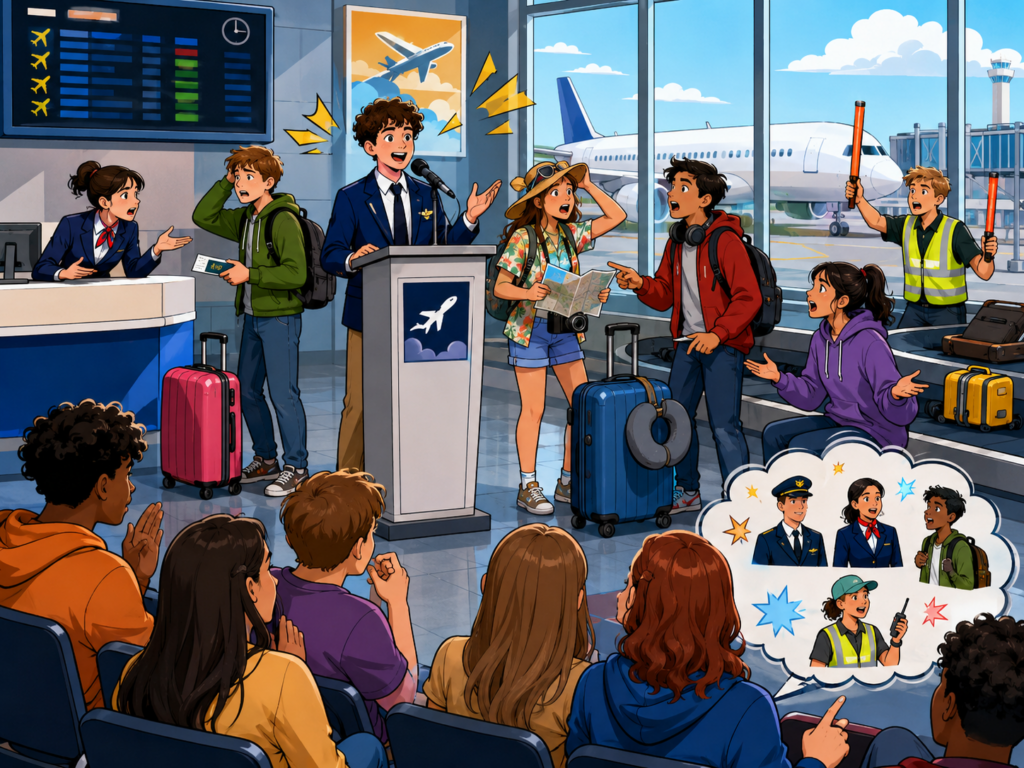
Students listen to short teacher-made airport announcements. They do not write full paragraphs. They listen, identify the problem, and report it using passive voice.
Teacher reads:
- “Attention passengers, Flight 204 will leave two hours later.”
- “A black suitcase was found near Gate 5.”
- “Passengers must show passports before boarding.”
- “Hotel reservations for Group B were changed.”
- “Boarding passes must be scanned before entering.”
Students answer orally:
“The flight was delayed.”
“A suitcase was found.”
“Passports are shown before boarding.”
“The reservations were changed.”
“Boarding passes are scanned.”
Part 3 – Exit Travel Sentence (10 min)
Each student says one passive sentence before leaving. Half of the class must use Present Simple Passive and half must use Past Simple Passive.
Examples:
“Tickets are booked online.”
“The flight was delayed.”
“Bags are checked at the counter.”
“My suitcase was delivered late.”
SESSION 3: CONSOLIDATION (80 min)
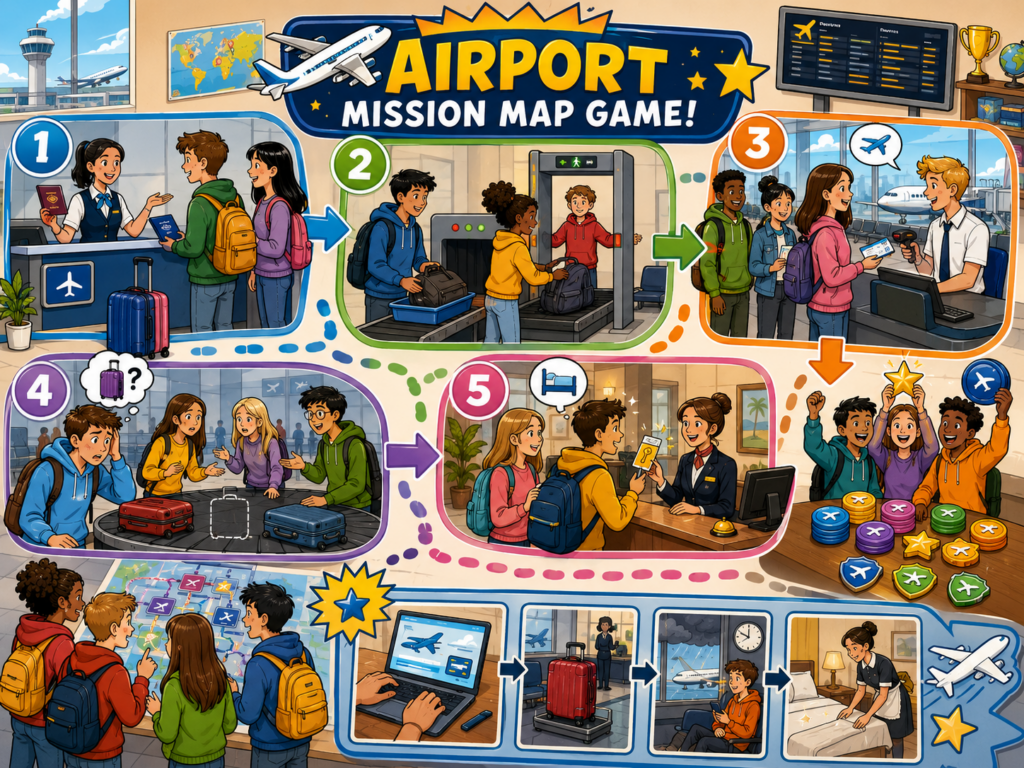
Part 1 – Preparation: Airport Mission Map (15 min)
Students prepare for a gamified airport mission. Each group receives a mission map with five travel zones:
- Check-in
- Security
- Boarding
- Baggage claim
- Hotel reception
They prepare short notes, not a full script. For each zone, they need one passive sentence. They must include at least three Present Simple Passive sentences and two Past Simple Passive sentences.
Required language:
“The luggage is…”
“The tickets are…”
“The flight was…”
“The reservation was…”
“The passports are…”
Part 2 – Airport Mission Map Game (50 min)
Students move through the five travel zones. Each zone has a challenge. They earn “travel miles” for correct answers.
Zone 1: Check-in
Challenge: Explain what is done before a flight.
Example: “The luggage is checked.”
Zone 2: Security
Challenge: Act out and say what is done.
Example: “The bags are scanned.”
Zone 3: Boarding
Challenge: Ask and answer one question.
Example: “Is the boarding pass scanned?” “Yes, it is scanned.”
Zone 4: Baggage Claim
Challenge: Report a problem from the past.
Example: “The suitcase was lost.”
Zone 5: Hotel Reception
Challenge: Solve a hotel problem.
Example: “The reservation was cancelled, but a new room was booked.”

Bonus challenge:
Each team must create one mini travel story using four passive sentences.
Example:
“Our tickets were booked online. At the airport, our bags were checked. Later, the flight was delayed. At the hotel, our room was cleaned.”
Part 3 – Final Travel Miles Vote (15 min)
Groups present their mini travel story orally. The class votes for:
- clearest travel story
- best passive voice use
- most creative travel problem
- best teamwork
The teacher closes by connecting the grammar to real travel situations: airport processes, travel problems, hotel reservations, and communication with staff.
 RUBRIC: Global Travel Passive Voice
NEE – Agregar el tipo de adaptaciones curriculares
Principio II: Pautas 6.1 – 6.3 – 6.4
Principio III: Pautas 7.1 – 8.1 – 9.1
ALUMNO 1: Constante monitoreo. Dar tiempo adicional para el desarrollo de la actividad y se reduce el número de ejercicios o se modifican los ejercicios con un nivel de dificultad reducido, de acuerdo con sus necesidades académicas.
ALUMNO 2: Constante monitoreo, Dar tiempo adicional para el desarrollo de la actividad y se reduce el número de ejercicios o se modifican los ejercicios con un nivel de dificultad reducido, de acuerdo con sus necesidades académicas.
ALUMNO 3: Constante monitoreo. Corroborar que el contenido entregado en clase haya sido comprendido por la estudiante mediante retroalimentación.