
Life-changing Decisions

SKILLS
EFL 4.2.12 Describe habits, routines, past activities and experiences within the personal and educational domains.
EFL 4.2.13 Interact with reasonable ease in structured situations and short conversations within familiar contexts.


REAL-LIFE APPLICATION

This topic helps students talk about imaginary but realistic decisions. They learn how to discuss what they would do if they had to choose between different life paths. This is useful when students think about future studies, careers, travel, hobbies, personal goals, and important choices.
LEARNING ACTIVITIES
SESSION 1 (80 min) ANTICIPATION
Part 1: Life Path Game Board (20 min)

The teacher shows a large board with different life paths: university, technical training, entrepreneurship, sports, arts, volunteering, and travel. Students choose one path and stand near it. The teacher asks: “If you had to choose one path today, which one would you choose and why?” Students share short answers. This introduces the idea of imaginary present situations.
CONSTRUCTION
Part 2: Vocabulary Development (15 min)
The teacher introduces vocabulary for decisions and life paths.
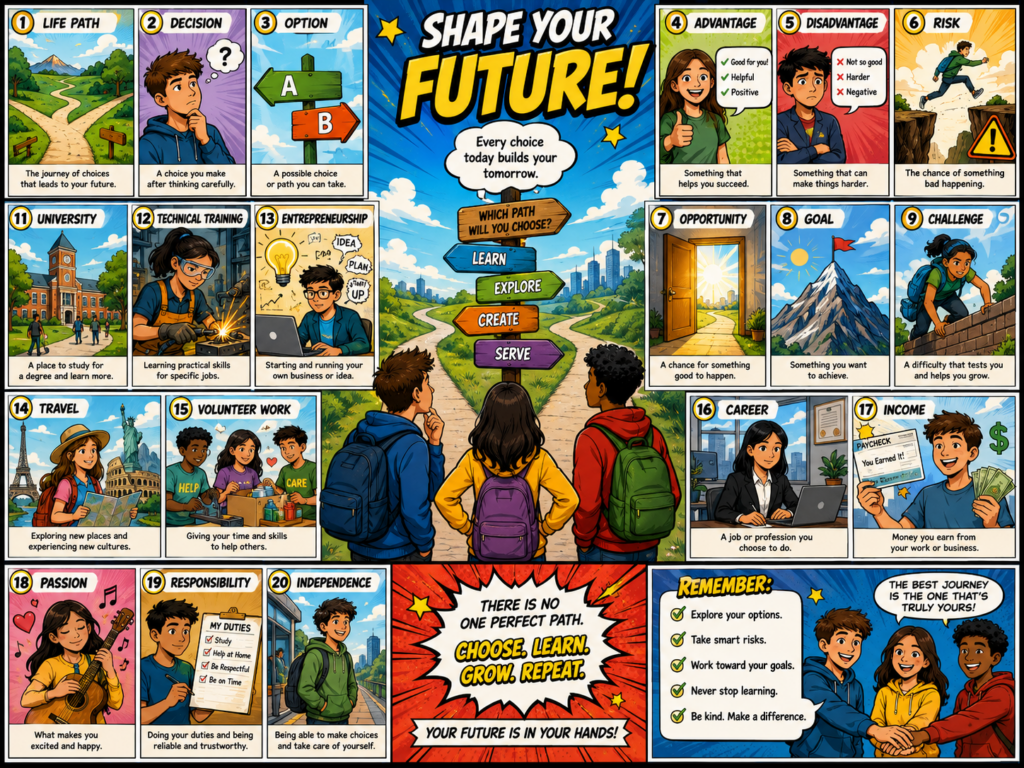
- life path
- decision
- option
- advantage
- disadvantage
- risk
- opportunity
- goal
- challenge
- future
- university
- technical training
- entrepreneurship
- travel
- volunteer work
- career
- income
- passion
- responsibility
- independence
Model sentences:
“If I chose technical training, I would learn practical skills.”
“If I started a business, I would need responsibility.”
“If I studied at university, I would have more academic opportunities.”
Part 3: Grammar Input: Second Conditional (25 min)
The teacher explains that the Second Conditional is used to talk about imaginary or hypothetical situations in the present or future.
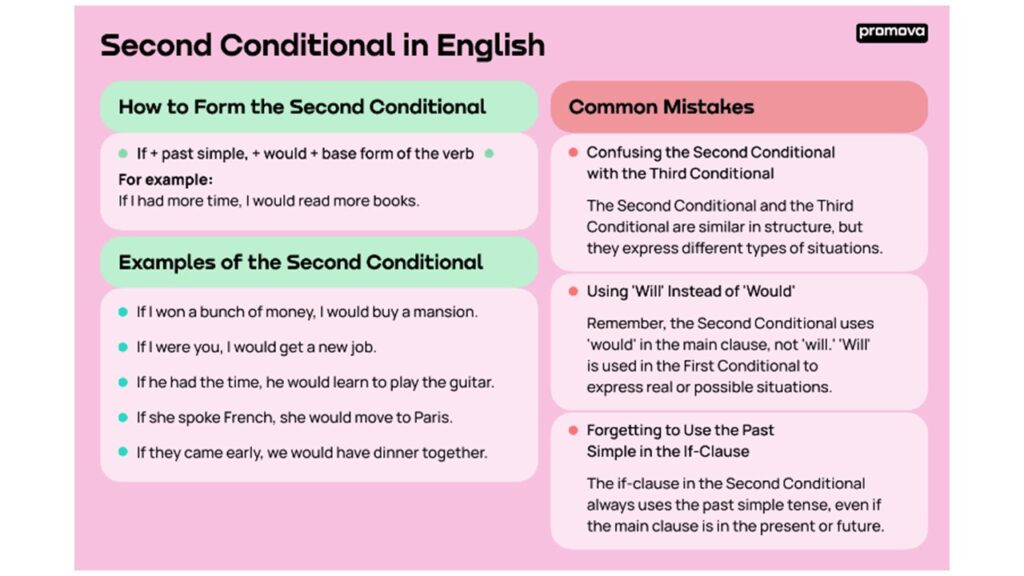
Exercise: Complete the sentences with the correct form.
- If I ______ a technical course, I would learn practical skills.
- If she had more confidence, she ______ apply for the internship.
- If we started a small business, we ______ need a plan.
- If he studied abroad, he ______ learn another culture.
- If they chose university, they ______ develop academic skills.
- If I had more money, I ______ travel for education.
- If she worked part-time, she ______ gain experience.
- If he followed his passion, he ______ feel more motivated.
- If we volunteered, we ______ help the community.
- If I had to choose today, I ______ choose a mixed path.
Part 4: Pros and Cons Dice Challenge (20 min)
Students work in groups with a dice. Each number represents a life path. They roll the dice, receive a path, and must say one pro and one con using the Second Conditional.Students work in pairs and create a short podcast-style interview. One student is the host and the other is a young professional. The guest explains how past habits helped them reach a milestone. Students prepare keywords, not a full script.
Dice options:
- University
- Technical training
- Starting a business
- Studying abroad
- Working part-time
- Volunteering
Example:
“If I studied abroad, I would learn about another culture, but I would miss my family.”
SESSION 2: CONSTRUCTION – REINFORCEMENT (40 min)
Part 1 – Life Path Auction (15 min)
Groups receive 100 imaginary points. The teacher shows life opportunities, and groups “buy” the ones they think are most valuable. To buy an option, they must say a Second Conditional sentence.
Options:
- study abroad
- start a business
- learn a technical skill
- get a scholarship
- volunteer in another city
- work part-time
- join a sports academy
- study arts
- learn programming
- become an apprentice
Example:
“We bought ‘ask for feedback’ because successful interns would ask supervisors how to improve.”
Part 2 – Decision Compass Corners (15 min)

The room has four corners: Passion, Money, Family, and Future Opportunities. The teacher reads a situation, and students move to the corner that matters most for that decision. Students explain their choice using “If I…, I would…”
Situations:
- choosing a university career
- choosing a technical course
- moving to another city
- starting a business
- working while studying
- choosing between art and science
- accepting an internship
- studying abroad
- taking a gap year
- joining a family business
Part 3 – Exit Hypothetical Sentence (10 min)
Each student says one Second Conditional sentence about a life path.
Examples:
“If I started a business, I would sell creative products.”
“If I studied medicine, I would help people.”
SESSION 3: CONSOLIDATION (80 min)

Part 1 – Preparation: Life Path Quest (15 min)
Students prepare for a gamified decision quest. Each student chooses one imaginary life path and prepares notes, not a full script. They must include one decision, two pros, one con, and two Second Conditional sentences.
Part 2 – Life Path Quest Stations (50 min)
Students rotate through “quest stations.” At each station, they receive a challenge and explain what they would do. They earn points for clear reasoning, correct Second Conditional use, and creative solutions. This is oral, active, and game-based.
Quest stations:
- You receive a scholarship in another city.
- You can start a small business with a friend.
- You must choose between university and technical training.
- You can work part-time while studying.
- You are invited to a sports academy.
- You can volunteer for one year.
- You can study arts, but your family prefers science.
- You can take a programming course.
- You can travel for an exchange program.
- You can join a family business.
Required language:
“If I chose this path, I would…”
“One advantage would be…”
“One disadvantage would be…”
“I would decide this because…”
Part 3 – Final Quest Vote (15 min)
Students vote for the most responsible decision. They explain their vote orally using one Second Conditional sentence. The teacher closes by connecting decision-making, pros and cons, and future goals.
 RUBRIC: Life Changing Decisions
Here is presentation to remind you about Zero, First and Second Conditionals:
NEE – Agregar el tipo de adaptaciones curriculares
Principio II: Pautas 6.1 – 6.3 – 6.4
Principio III: Pautas 7.1 – 8.1 – 9.1
ALUMNO 1: Constante monitoreo. Dar tiempo adicional para el desarrollo de la actividad y se reduce el número de ejercicios o se modifican los ejercicios con un nivel de dificultad reducido, de acuerdo con sus necesidades académicas.
ALUMNO 2: Constante monitoreo, Dar tiempo adicional para el desarrollo de la actividad y se reduce el número de ejercicios o se modifican los ejercicios con un nivel de dificultad reducido, de acuerdo con sus necesidades académicas.
ALUMNO 3: Constante monitoreo. Corroborar que el contenido entregado en clase haya sido comprendido por la estudiante mediante retroalimentación.