
K-Learning Project
SKILLS
EFL 4.2.12 Describe habits, routines, past activities and experiences within the personal and educational domains.
EFL 4.2.13 Interact with reasonable ease in structured situations and short conversations within familiar contexts, provided that speech is given clearly, slowly and directly.


REAL-LIFE APPLICATION

This topic helps students speak for a short but complete amount of time without stopping immediately. They learn how to tell a past experience with order, details, emotion, and a clear ending. This is useful when students tell stories to friends, explain what happened in a trip, describe a school experience, participate in oral exams, or introduce themselves through meaningful personal memories.
LEARNING ACTIVITIES
SESSION 1 (80 min) ANTICIPATION
Part 1: Anticipation: Sound Memory Trigger (20 min)
The teacher plays short sound effects or shows silent visual clips: rain, applause, airport sounds, school bell, crowd noise, music, a camera click, footsteps, traffic, and waves.
Students choose one sound or image and answer:
“What past experience does this remind you of?”
Students first answer with short ideas:
“a trip”
“a birthday”
“a football match”
“a school presentation”
“a day at the beach”
Then the teacher models how to expand a short idea into a mini narrative:
Short idea: “a trip”
Expanded idea: “Last year, I traveled with my family. We visited a new city, and I felt very excited because it was my first time there.”
The purpose is to show students that narrative stamina means adding enough details to keep speaking for 45–60 seconds.
CONSTRUCTION
Part 2: Vocabulary for Travel Logistics (15 min)
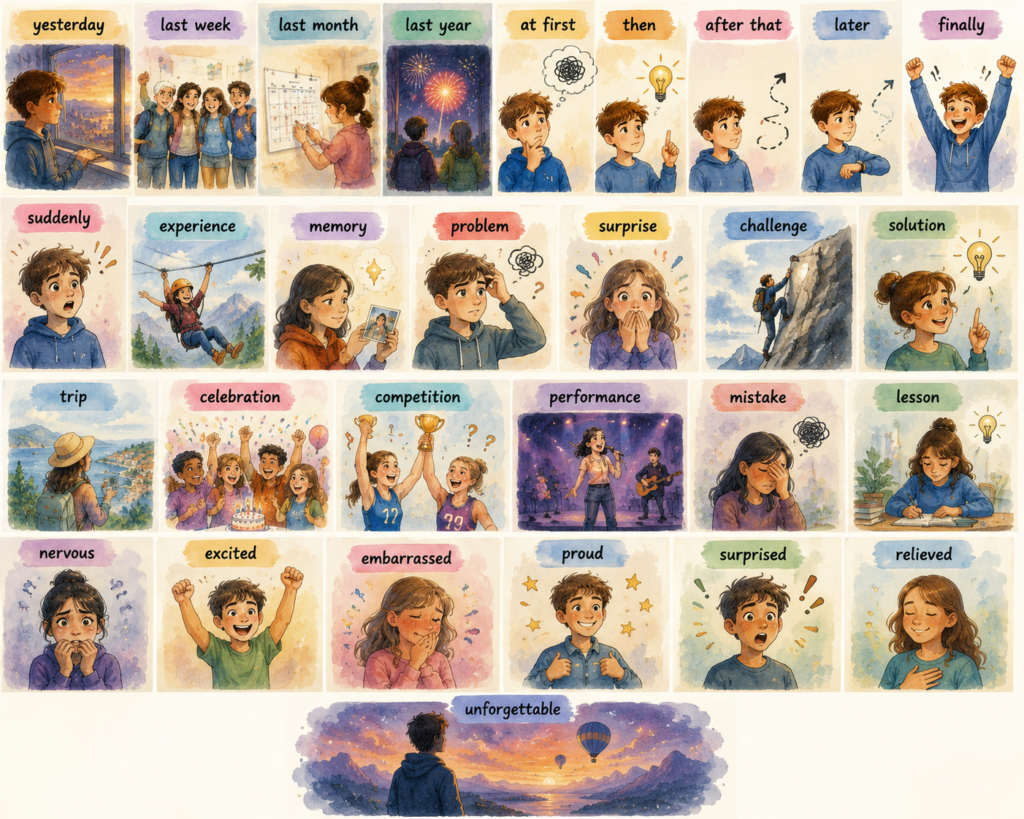
The teacher introduces useful vocabulary for personal stories.
– Students classify the words into “time,” “action,” “emotion,” and “sequence.”
- yesterday
- last week
- last month
- last year
- at first
- then
- after that
- later
- finally
- suddenly
- experience
- memory
- problem
- surprise
- challenge
- solution
- trip
- celebration
- competition
- performance
- mistake
- lesson
- nervous
- excited
- embarrassed
- proud
- surprised
- relieved
- unforgettable
TIME
ACTION
EMOTION
SEQUENCE
Part 3: Explanation: What Is Narrative Stamina? (25 min)
The teacher explains that the Passive Voice is essential in travel because the person performing the action is either obvious, unknown, or unimportant.

Narrative Stamina?
Is the ability to speak for 45–60 seconds with a complete idea. It does not mean speaking very fast. It means keeping the story alive with clear order, details, emotions, and a final idea.
A strong short narrative has four parts:
- Beginning: When and where did it happen?
- Situation: What was happening?
- Main event: What happened?
- Ending: How did it finish and how did you feel?
Basic structure:
“Last year, I…”
“At first, I…”
“Then…”
“After that…”
“Finally…”
“I felt…”
“I learned…”
The teacher explains useful past structures.
Past Simple is used for completed actions:
“I visited my grandparents.”
“We played a final match.”
“She won a prize.”
“They traveled to another city.”
Past Continuous is used to describe the background situation:
“I was walking to school when it started to rain.”
“We were waiting for the bus when my friend called.”
“She was practicing when the teacher arrived.”
Students do not need to overuse many tenses. The goal is to tell a clear story using mostly Past Simple, some Past Continuous, sequence words, and emotion words.
Exercise: Complete the short narrative with the best word.
- ______ year, I traveled with my family.
- At ______, I felt nervous.
- We ______ visiting a museum when it started to rain.
- Then, we ______ a small restaurant.
- After ______, my brother lost his backpack.
- We ______ looking for it for twenty minutes.
- Finally, a worker ______ it near the entrance.
- I felt very ______ because everything was okay.
- That experience was ______ because it was unexpected.
- I ______ that staying calm is important.
Part 4: Story Camera Shots (20 min)
Students work in groups. Each student chooses one personal past experience. The group helps turn each story into four “camera shots.” Students do not draw a full comic. They create four physical poses or quick sketches:
Shot 1: Where the story happened
Shot 2: What was happening
Shot 3: The main problem or surprise
Shot 4: The ending or lesson
Each student practices telling the story while the group shows the four shots.

Example:
- Shot 1: “Last year, I went to the beach.”
- Shot 2: “We were playing soccer near the water.”
- Shot 3: “Suddenly, my shoe disappeared.”
- Shot 4: “Finally, we found it under a towel, and everyone laughed.”
Gamification:
- 1 point for clear beginning
- 1 point for sequence words
- 1 point for past tense accuracy
- 1 point for emotion words
- 1 point for speaking at least 45 seconds
SESSION 2: CONSTRUCTION – REINFORCEMENT (40 min)
Part 1 – Story Time Ladder (15 min)
Students practice the same story three times, but each time they must make it longer and clearer.
Round 1: 15 seconds
Only say what happened.
Round 2: 30 seconds
Add place, people, and sequence words.
Round 3: 45–60 seconds
Add emotions, problem, ending, and lesson.
Example:
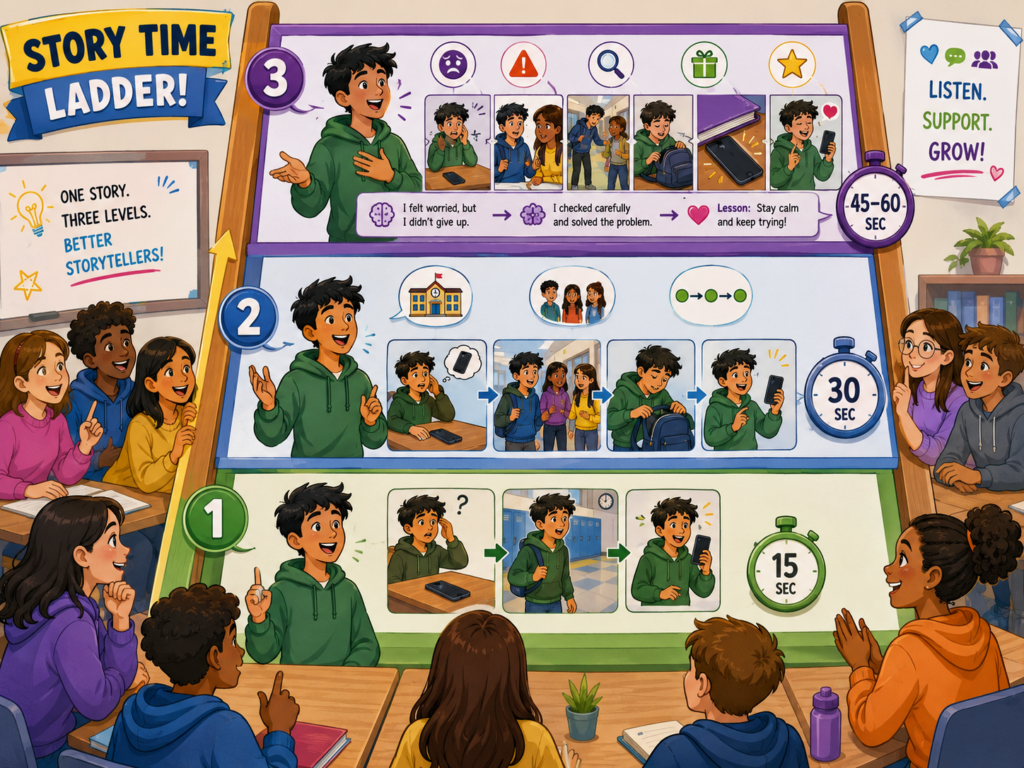
15 seconds: “I lost my phone at school, but I found it later.”
30 seconds: “Last month, I lost my phone at school. At first, I felt nervous. Then, I asked my friends for help. Finally, I found it in my backpack.”
45–60 seconds: “Last month, I had a stressful experience at school. I was leaving the classroom when I noticed that my phone was missing. At first, I felt really nervous because I thought someone had taken it. Then, I asked my friends and checked the classroom. After that, I looked in my backpack again, and finally, I found it under my notebook. I felt relieved, and I learned to organize my things better.”
Part 2 – Emotion Switch Storytelling (15 min)
Students tell one part of their story using different emotions selected by a digital spinner or projected icons: excited, scared, embarrassed, proud, confused, relieved, surprised, worried, happy, and frustrated.
They must use voice, facial expression, and body language. This reinforces oral expression without becoming a memorized speech.
Example:
“I was walking to the stage, and I felt nervous.”
“I was walking to the stage, and I felt proud.”
Part 3 – Exit Mini Story (10 min)
Each student says a 20-second mini story using:
- one time expression
- one past action
- one emotion
- one ending phrase
Example:
“Last week, I played a football match. At first, I was nervous, but then I scored a goal. Finally, I felt proud.”
SESSION 3: CONSOLIDATION (80 min)

Part 1 – Preparation: Memory Reel Studio (15 min)
Students prepare their final 45–60 second story. They cannot write a full script. They prepare a “memory reel” with five icons or drawings:
- time
- place
- people
- problem or surprise
- ending or lesson
Required language:
- “Last…”
- “At first…”
- “Then…”
- “After that…”
- “Finally…”
- “I felt…”
- “I learned…”
Part 2 – 60-Second Story Premiere (50 min)
The classroom becomes a story studio. Students present their 45–60 second past experience in small groups. Each group has roles:
- storyteller
- timer
- voice coach
- sequence checker
- audience supporter
The storyteller presents. The timer checks 45–60 seconds. The voice coach gives feedback about volume and pace. The sequence checker listens for order words. The audience supporter gives one positive comment.
Students may use one object, one drawing, one AI image, one sound effect, or one photo without readable text as visual support.
Gamification:
Students earn “story badges”:
- Clear Timeline Badge
- Strong Voice Badge
- Emotion Badge
- Past Tense Badge
- 60-Second Stamina Badge
Part 3 – Story Spark Reflection (15 min)
Students vote for:
- clearest story
- most expressive storyteller
- best use of sequence words
- best emotional detail
- strongest final lesson
Students explain their vote orally.
Examples:
“I voted for this story because it was clear.”
“I liked it because the ending was surprising.”
“The speaker used good sequence words.”
“The story had emotion and a lesson.”
 RUBRIC: Narrative Stamina
Exercise Bank – Extra Practice
The Exercise Bank can be used as an additional practice section after the main lesson activities. These exercises are useful for students who finish early, need extra reinforcement, or want more practice before the final task. The teacher may select specific exercises depending on the students’ needs, class time, or level of difficulty.
NEE – Agregar el tipo de adaptaciones curriculares
Principio II: Pautas 6.1 – 6.3 – 6.4
Principio III: Pautas 7.1 – 8.1 – 9.1
ALUMNO 1: Constante monitoreo. Dar tiempo adicional para el desarrollo de la actividad y se reduce el número de ejercicios o se modifican los ejercicios con un nivel de dificultad reducido, de acuerdo con sus necesidades académicas.
ALUMNO 2: Constante monitoreo, Dar tiempo adicional para el desarrollo de la actividad y se reduce el número de ejercicios o se modifican los ejercicios con un nivel de dificultad reducido, de acuerdo con sus necesidades académicas.
ALUMNO 3: Constante monitoreo. Corroborar que el contenido entregado en clase haya sido comprendido por la estudiante mediante retroalimentación.