
Sustainability
SKILLS
EFL 4.2.13 Interact with reasonable ease in structured situations and short conversations within familiar contexts, provided that speech is given clearly, slowly and directly.
EFL 4.3.4 Find the most important information in print or online sources in order to support an idea or argument.
REAL-LIFE APPLICATION
This topic helps students talk about future environmental actions. They learn how to explain predictions, personal plans, and fixed arrangements related to sustainability. This is useful when students plan eco-friendly habits, organize school campaigns, discuss recycling, reduce waste, explain future actions, and make simple predictions about the environment.
LEARNING ACTIVITIES
SESSION 1 (80 min) ANTICIPATION
Part 1: Anticipation: Carbon Footprint Footprints Trail (20 min)
The teacher places large footprint shapes around the room. Each footprint has an image, not text: a car, a plastic bottle, a light bulb, a meat burger, a bus, a bicycle, a tree, a reusable bag, a phone charger, and a water bottle.
Students walk around the room and stand next to the footprint they think creates the biggest environmental impact.
The teacher asks:
“Which action will hurt the planet more?”
“Which habit is going to help more?”
“Which action are you changing this week?”
Students answer first with simple ideas:
“Cars will pollute more.”
“I am going to use a reusable bottle.”
“We are recycling paper on Friday.”
The teacher explains that students are already using three future forms for different meanings.
CONSTRUCTION
Part 2: Vocabulary for Travel Logistics (15 min)
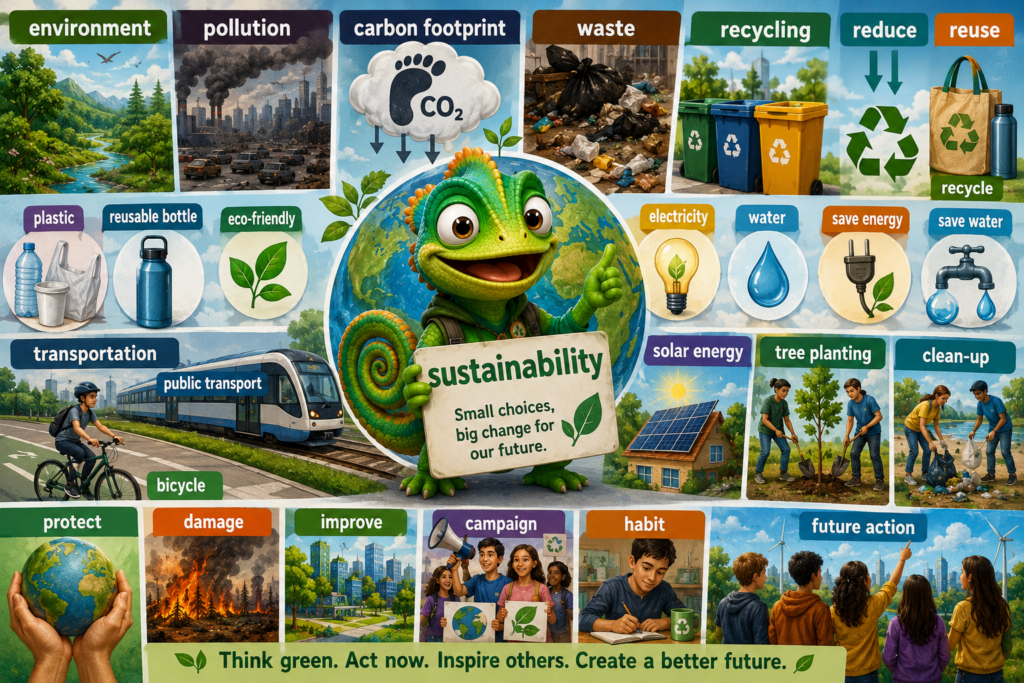
The teacher introduces sustainability vocabulary through images and quick movement. Students classify each word into: problem, action, or solution.
- sustainability
- environment
- pollution
- carbon footprint
- waste
- recycling
- plastic
- reusable bottle
- electricity
- water
- transportation
- bicycle
- public transport
- solar energy
- tree planting
- clean-up
- eco-friendly
- reduce
- reuse
- recycle
- save energy
- save water
- protect
- damage
- improve
- campaign
- habit
- future action
PROBLEM
ACTION
SOLUTION
Part 3: Grammar Input: Future Forms for Sustainability (25 min)
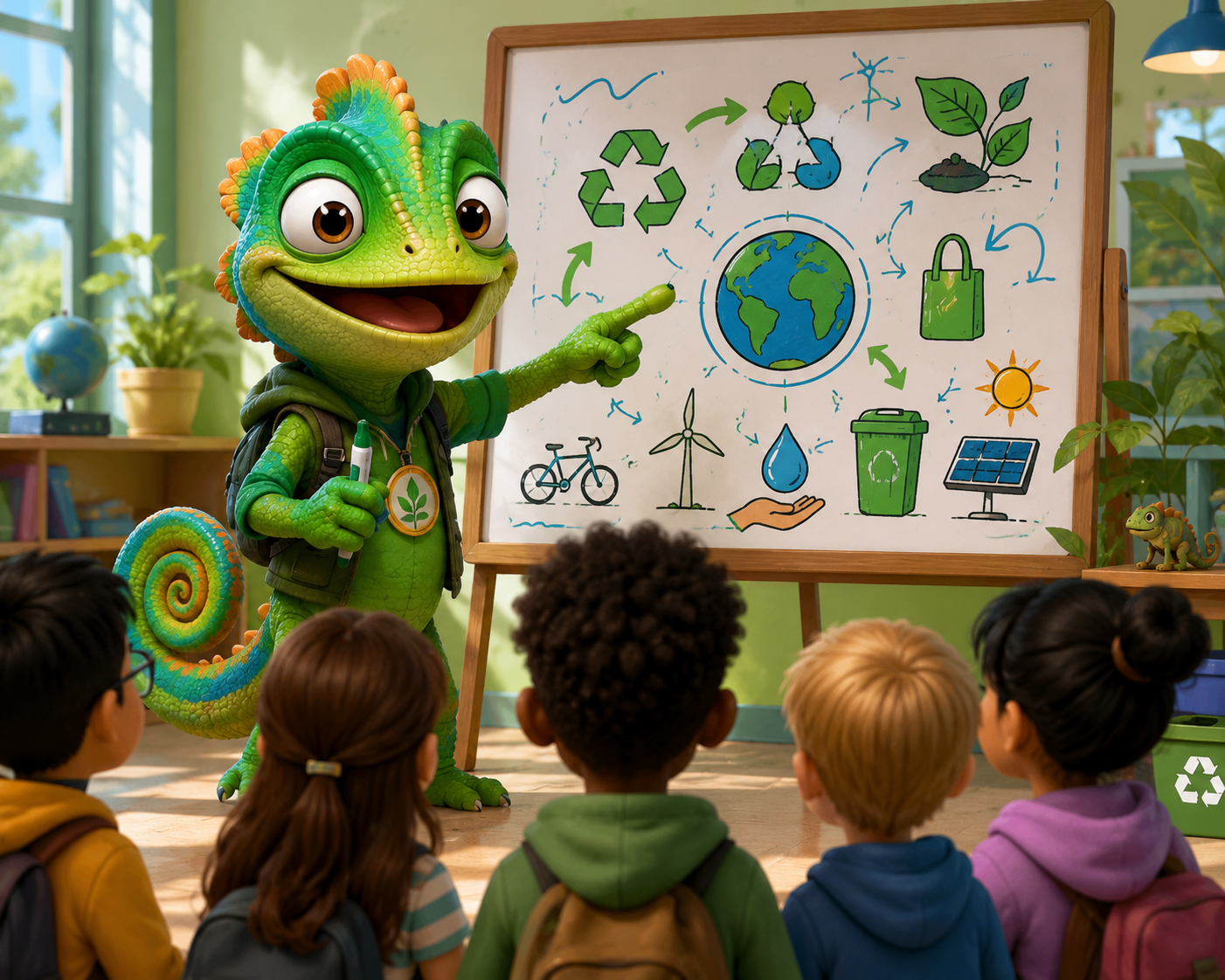
The teacher explains that English has different ways to talk about the future. In this topic, students will use three future forms: will, going to, and Present Continuous.
Will is used for predictions, quick decisions, promises, or general future ideas.
Examples:
“People will use more electric cars in the future.”
“I will turn off the lights.”
“The planet will get hotter if pollution continues.”
“Our class will help with the clean-up.”
Going to is used for intentions or plans that already exist.
Examples:
“I am going to recycle at home.”
“She is going to use less plastic.”
“We are going to create an eco-poster.”
“They are going to measure their carbon footprint.”
Present Continuous is used for fixed future arrangements, especially when there is a clear time, date, or organized plan.
Examples:
“We are planting trees on Friday.”
“Our class is visiting the recycling center next week.”
“They are presenting their eco-campaign tomorrow.”
“I am bringing a reusable bottle on Monday.”
The teacher compares the three forms:
“Will” sounds like a prediction or decision.
“Going to” sounds like an intention or plan.
“Present Continuous” sounds like an arrangement that is already scheduled.
Comparison:
“I will recycle more.”
This sounds like a decision or promise.
“I am going to recycle more.”
This sounds like a personal plan.
“I am recycling bottles with my group tomorrow.”
This sounds like an arranged activity.
Exercise: Choose will, going to, or Present Continuous.
- I think people ______ use less plastic in the future.
- I ______ bring a reusable bottle tomorrow because I already planned it.
- Our class ______ cleaning the park on Friday.
- Look at those dark clouds.
- It ______ rain. I promise I ______ turn off the lights.
- We ______ create an eco-campaign next week.
- She ______ present her carbon footprint poster tomorrow at 10.
- They believe electric buses ______ become more common.
- My group ______ plant a tree after lunch.
- I ______ stop using plastic straws.
Part 4: Eco-Mission Forecast Wheel (20 min)

The teacher creates a physical or digital wheel with environmental missions. Students spin the wheel and must speak using the correct future form.
Wheel missions:
- reduce plastic
- save water
- save electricity
- recycle paper
- plant trees
- use public transport
- organize a clean-up
- create an eco-poster
- bring reusable bottles
- measure carbon footprint
Challenge types:
- Prediction with will: “In the future, people will…”
- Plan with going to: “I am going to…”
- Arrangement with Present Continuous: “We are… tomorrow / next week.”
SESSION 2: CONSTRUCTION – REINFORCEMENT (40 min)
Part 1 – Eco-Promise Line-Up (15 min)
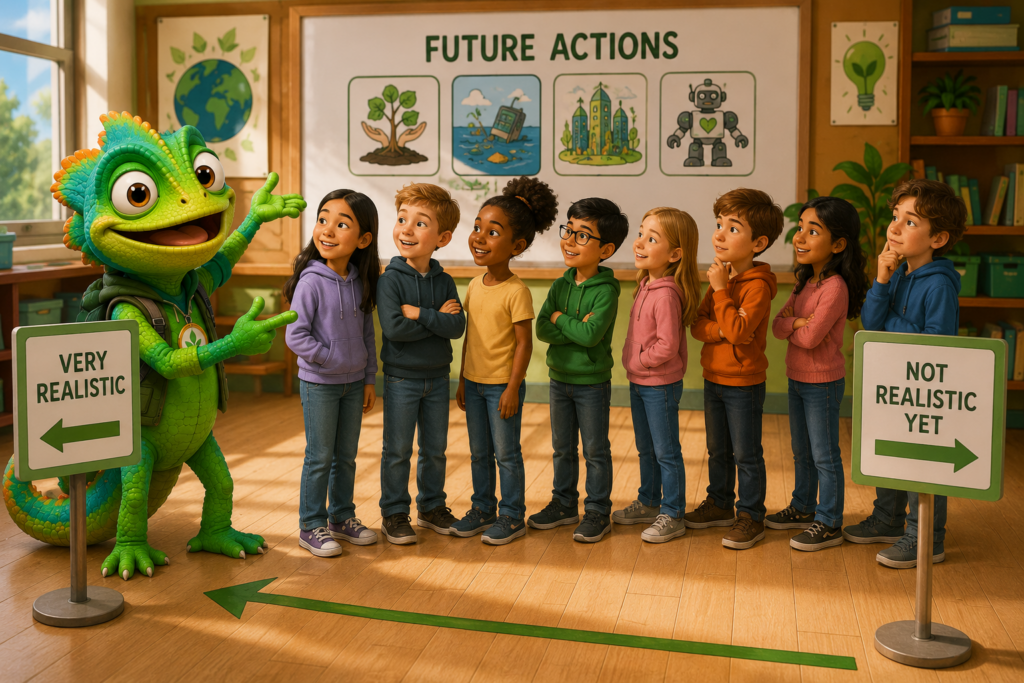
Students form a line according to how realistic they think each future action is. One side of the room means “very realistic,” and the other side means “not realistic yet.”
The teacher reads actions:
- Our school will use only solar energy.
- I am going to use less plastic this week.
- Our class is making recycling signs tomorrow.
- People will stop using cars completely.
- I am going to turn off the lights at home.
- We are presenting eco-tips on Friday.
- Students will protect the planet more in the future.
- I am going to walk more instead of using a car.
- Our group is designing an eco-bin next class.
- The world will produce less waste one day.
Students explain their position orally.
Example:
“I think this is realistic because I am going to do it this week.”
“I think this is difficult because many people still use cars.”
Part 2 – Future Form Freeze Frame (15 min)
Groups receive one environmental action. They create a frozen scene with their bodies, like a silent picture. Another group guesses the action and says a future sentence.
Examples:
A group acts turning off lights.
Guess: “They are going to save energy.”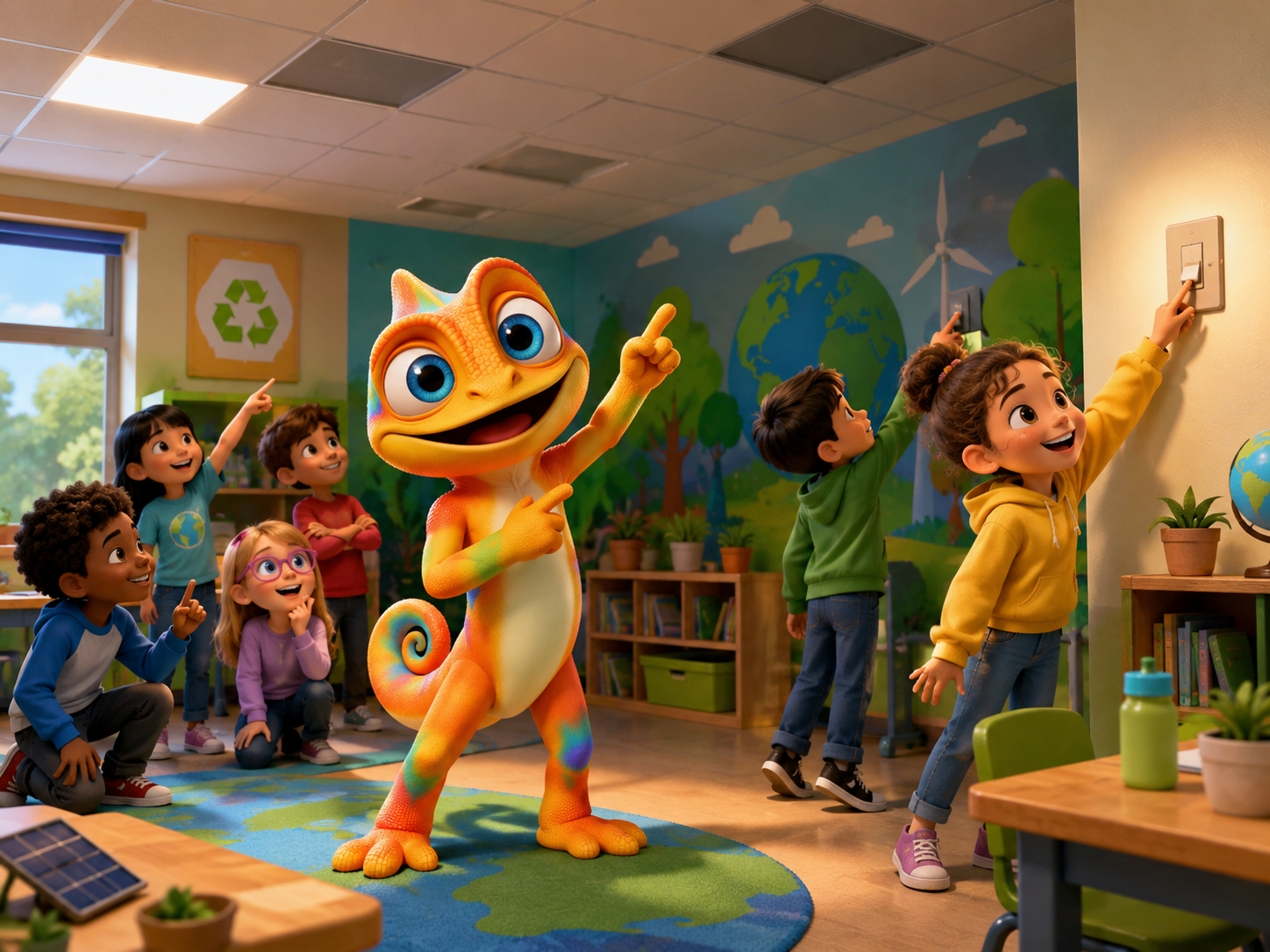
A group acts planting a tree.
Guess: “They are planting trees tomorrow.”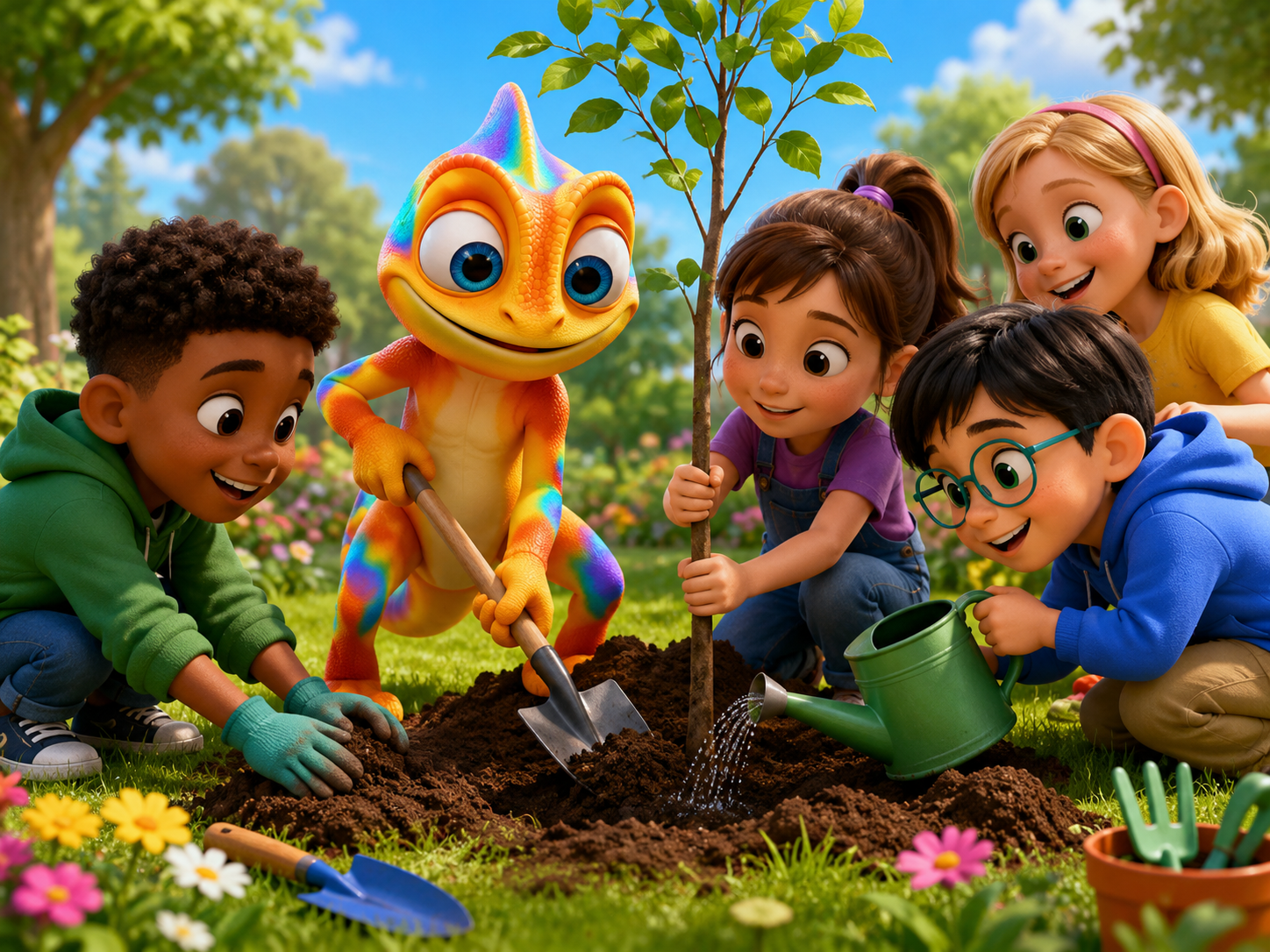
A group acts looking at a polluted city.
Guess: “Cities will have more pollution if people do not change.”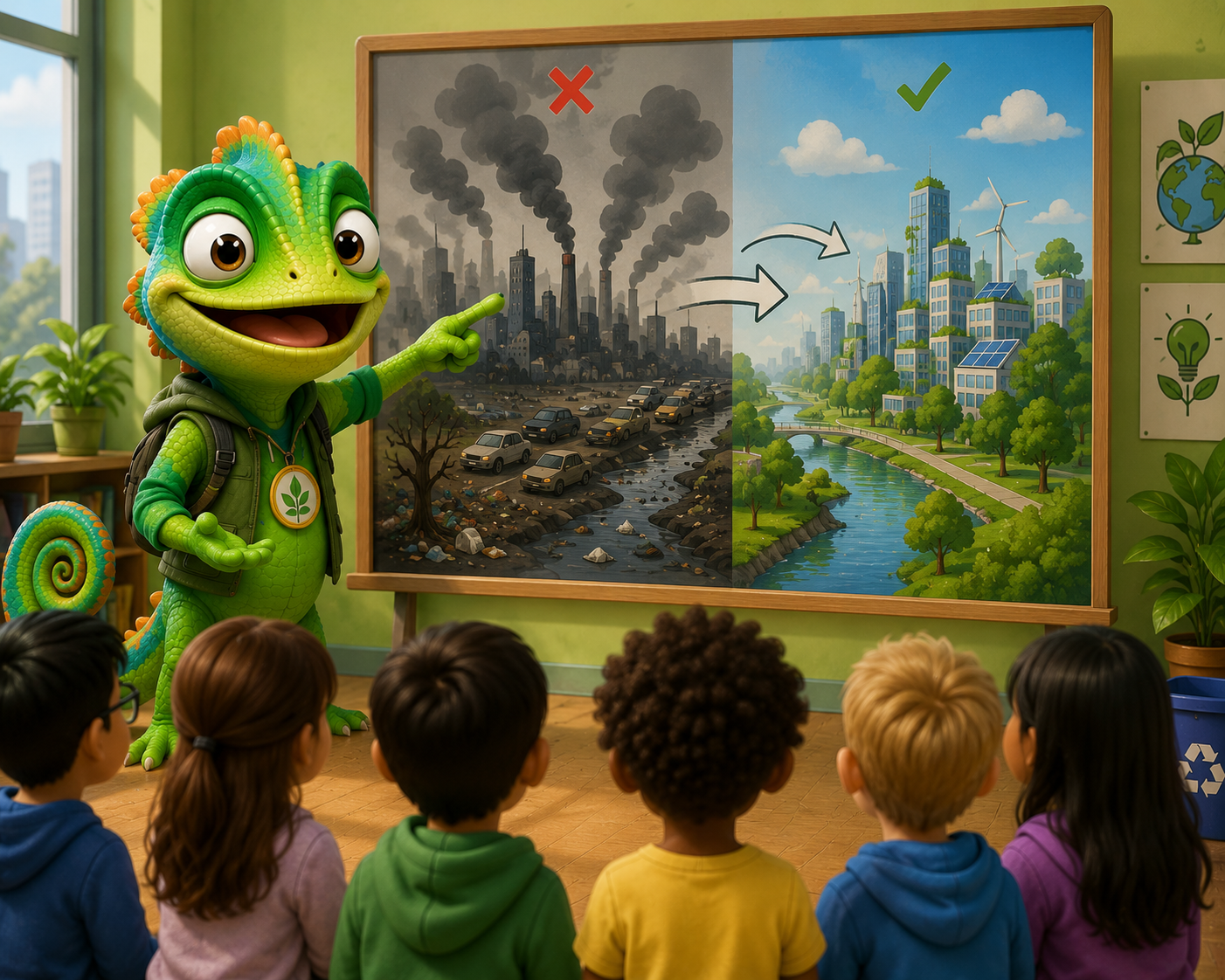
Part 3 – Exit Eco-Sentence (10 min)
Each student says a 20-second mini story using:
- one time expression
- one past action
- one emotion
- one ending phrase
Each student says one sentence before leaving. The teacher assigns the form:
Student 1: will
Student 2: going to
Student 3: Present Continuous
Examples:
“I will use less water.”
“I am going to recycle at home.”
“We are cleaning the classroom tomorrow.”
SESSION 3: CONSOLIDATION (80 min)
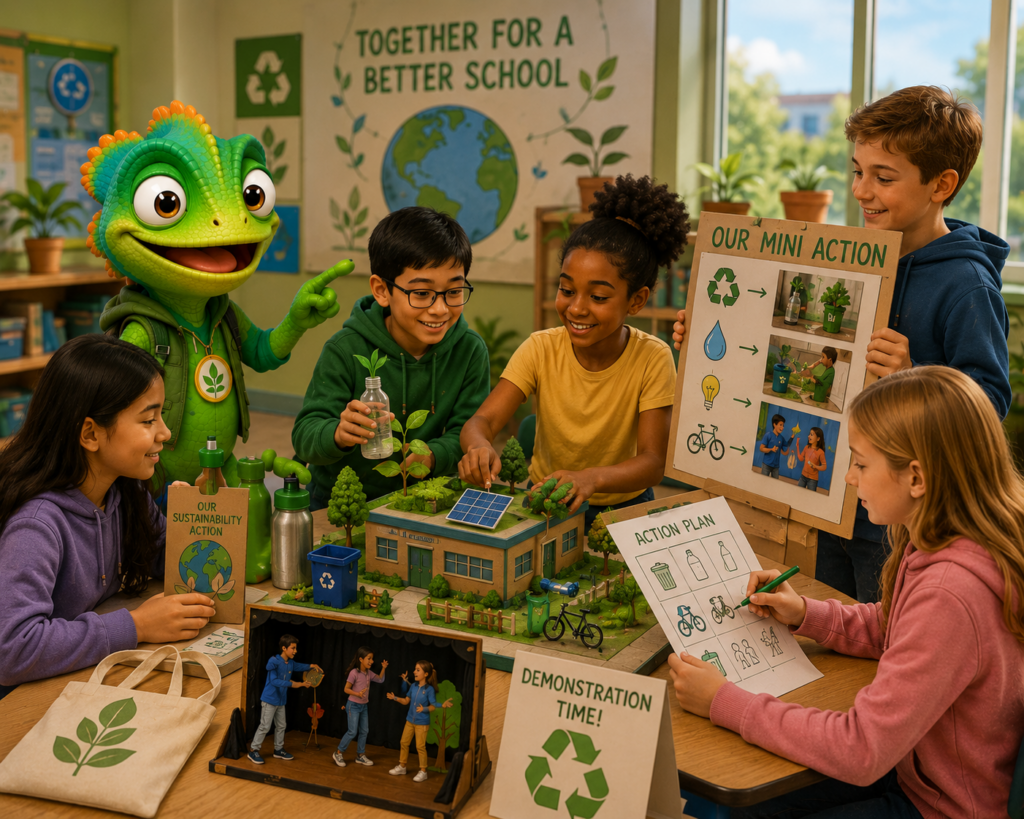
Part 1 – Preparation: Eco-Action Badge Plan (15 min)
Students prepare a simple eco-action plan. They choose one environmental issue and one realistic school action.
Environmental issues:
- plastic waste
- food waste
- water use
- electricity use
- paper waste
- transportation
- pollution
- lack of trees
- fast fashion
- classroom waste
They prepare notes, not full paragraphs.
Required language:
“One problem is…”
“We will…”
“We are going to…”
“We are… on…”
“This will help because…”
Part 2 – Eco-Action Badge Challenge (50 min)
Students work in groups to design a mini sustainability action for the school. This is not a poster-only task. The group must create a small prototype, demonstration, mini performance, or visual action plan.
Options:
- reusable bottle campaign
- classroom lights monitor system
- paper-saving challenge
- recycling corner design
- eco-friendly snack plan
- plastic-free day
- bike or walking challenge
- school clean-up route
- plant-care schedule
- carbon footprint mini-survey
Each group must present:
- the environmental problem
- one prediction with will
- one plan with going to
- one fixed arrangement with Present Continuous
- one reason why the action matters
Example:
“Plastic waste is a problem. Students will create less trash if they use reusable bottles. We are going to make a bottle challenge. We are presenting it next Friday. This will help because students will use fewer plastic bottles.”
Gamification:
Groups earn badges:
Future Forms Badge
Clear Eco-Problem Badge
Creative Solution Badge
Teamwork Badge
Realistic Action Badge
Part 3 – Eco-Gallery Vote and Reflection (15 min)
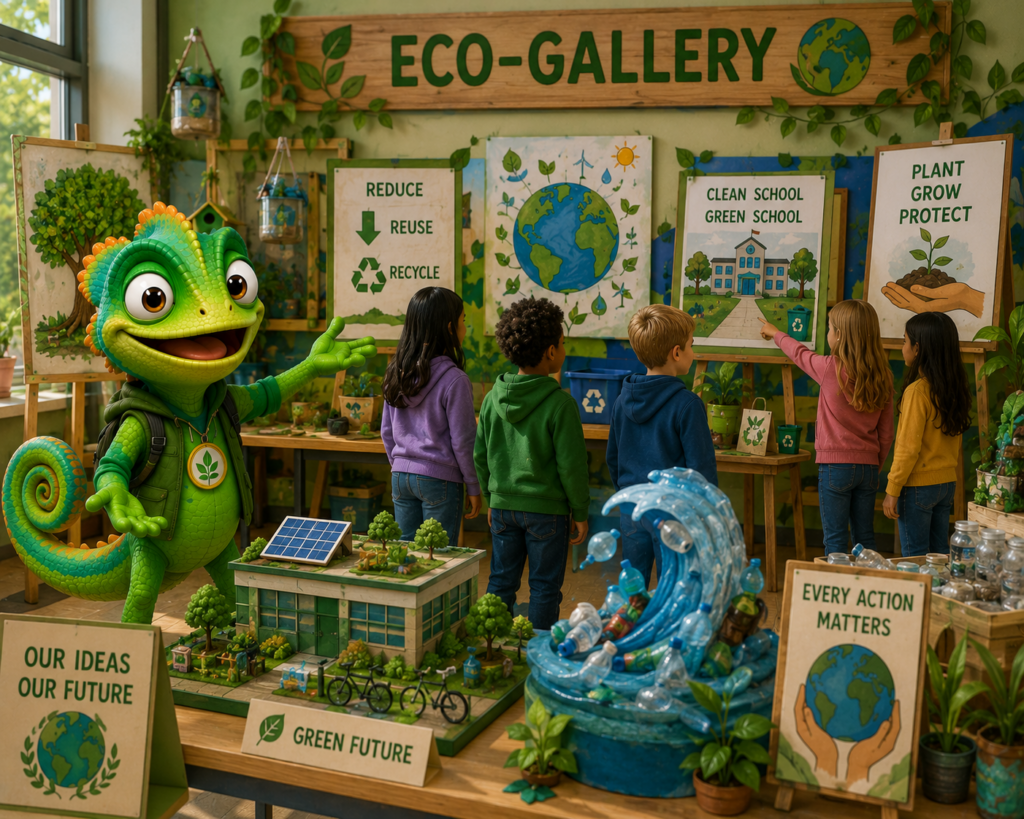
Groups display their prototypes, drawings, or visual plans. Students walk around and vote for:
- most realistic action
- most creative idea
- clearest use of future forms
- best environmental impact
- strongest teamwork
Students explain their vote orally.
Examples:
“I voted for this group because they are going to reduce plastic.”
“Their plan will help students save energy.”
“They are presenting a realistic action next week.”
RUBRIC: Sustainability Future
NEE – Agregar el tipo de adaptaciones curriculares
Principio II: Pautas 6.1 – 6.3 – 6.4
Principio III: Pautas 7.1 – 8.1 – 9.1
ALUMNO 1: Constante monitoreo. Dar tiempo adicional para el desarrollo de la actividad y se reduce el número de ejercicios o se modifican los ejercicios con un nivel de dificultad reducido, de acuerdo con sus necesidades académicas.
ALUMNO 2: Constante monitoreo, Dar tiempo adicional para el desarrollo de la actividad y se reduce el número de ejercicios o se modifican los ejercicios con un nivel de dificultad reducido, de acuerdo con sus necesidades académicas.
ALUMNO 3: Constante monitoreo. Corroborar que el contenido entregado en clase haya sido comprendido por la estudiante mediante retroalimentación.