
Reading Analysis
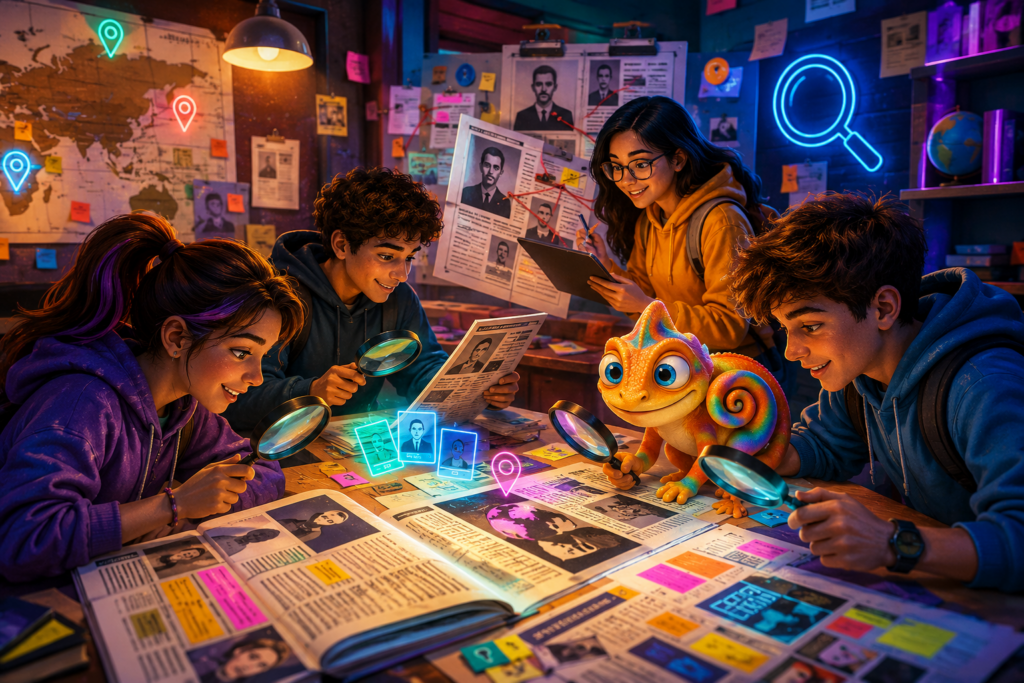
SKILLS
EFL 4.3.1 Understand main points in short simple texts on familiar subjects. (Example: news about sports or famous people, descriptions, etc.)
EFL 4.3.2 Make use of clues such as titles, illustrations, organization, text outline and layout, etc. to identify and understand relevant information in written level-appropriate text types.
REAL-LIFE APPLICATION

This topic helps students read faster and with a purpose. They learn that they do not always need to read every word. Sometimes they read quickly to understand the general idea, and sometimes they search for specific information like names, dates, places, numbers, and key facts. This is useful when students read school instructions, news articles, biographies, websites, posters, event information, or exam texts.
LEARNING ACTIVITIES
SESSION 1 (80 min) ANTICIPATION
Part 1: Text Detective Table (20 min)
The teacher places different printed or projected texts around the room: a short biography, a school news article, an informative paragraph, a sports news extract, and a simple science text. Students are not allowed to read the full text yet.
They can only look at:
- title
- image
- subtitles
- first line
- numbers
- bold words
- layout
The teacher asks:
“What type of text is this?”
“What do you think it is about?”
“What clues helped you?”
“Which text looks like a biography?”
“Which text looks like news?”
“Which text gives information?”
Students answer orally first.
The teacher introduces the idea:
Skimming helps us understand the general idea quickly.
Scanning helps us find specific information quickly.
CONSTRUCTION
Part 2: Vocabulary Activation: Reading Toolbelt Challenge (15 min)
The teacher places vocabulary words on the board. Students choose one word and connect it to an action.
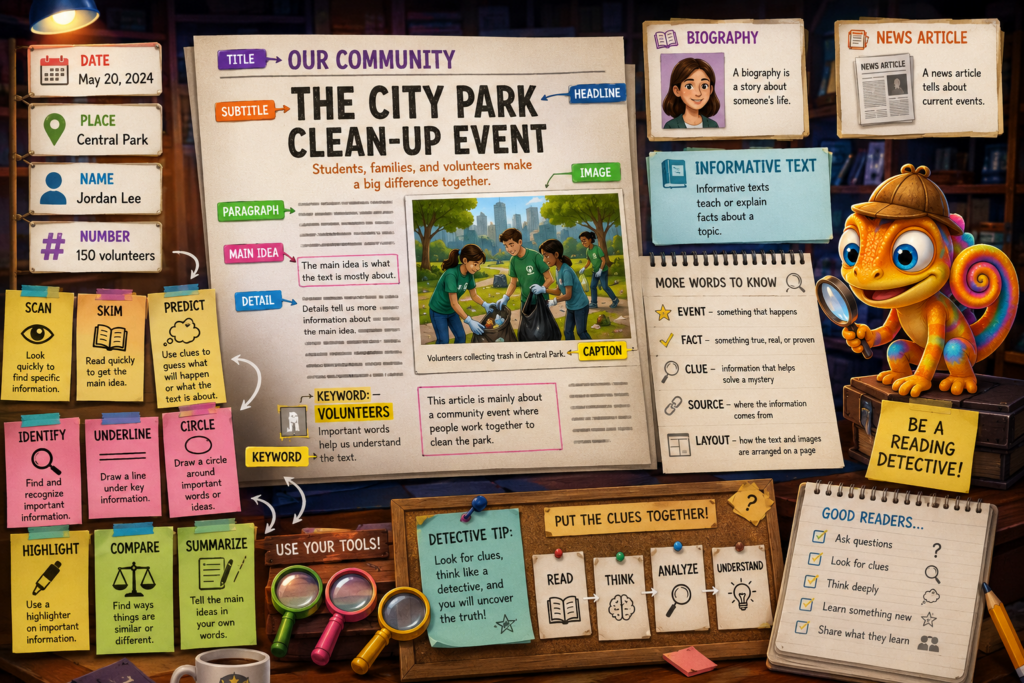
- title
- subtitle
- headline
- paragraph
- image
- caption
- keyword
- main idea
- detail
- date
- place
- name
- number
- biography
- news article
- informative text
- event
- fact
- clue
- source
- layout
- scan
- skim
- predict
- identify
- underline
- circle
- highlight
- compare
- summarize
Part 3: Reading Strategy Input: The Reading Radar Method (25 min)
The teacher explains that strong readers use different strategies depending on the purpose.

Skimming means reading quickly to understand the general idea. When students skim, they should not stop at every unknown word. They should look at the title, images, repeated words, first sentences, subtitles, and general organization.
Students skim when they need to answer:
“What is this text about?”
“What is the main idea?”
“What type of text is it?”
“Should I read this text in more detail?”
Scanning means moving the eyes quickly through the text to find specific information. When students scan, they already know what they are looking for. They may search for names, numbers, dates, places, key words, or answers to specific questions.
Students scan when they need to answer:
“When did it happen?”
“Where did it happen?”
“Who is the text about?”
“How many people participated?”
“What year is mentioned?”
“What is the name of the person?”
The teacher models the difference with one short text:
First reading purpose: “Find the general topic.”
Strategy: Skim.
Second reading purpose: “Find the year.”
Strategy: Scan.
Third reading purpose: “Find the name of the person.”
Strategy: Scan.
Fourth reading purpose: “Say the main idea in one sentence.”
Strategy: Skim + use key details.
Part 4: Strategy Teaching Idea: Reading Radar Colors (20 min)
Instead of teaching reading as silent work, students use a color system.
Color 1: title and image clues
Color 2: names and people
Color 3: dates and numbers
Color 4: places
Color 5: repeated words
Students receive a short article and use the colors to mark the text. Then they answer orally:
“What did you find first?”
“What did the title tell you?”
“What name did you find?”
“What date or number did you find?”
“What repeated word helped you?”
Gamification:
- 1 Krug for finding the text type
- 1 Krug for identifying the main idea
- 1 Krug for finding a name
- 1 Krug for finding a date or number
- 1 Krug for explaining the clue orally
SESSION 2: CONSTRUCTION – REINFORCEMENT (40 min)
Part 1 – Skim or Scan Signal Game (15 min)
The teacher reads a task. Students hold up one hand for skimming and two hands for scanning. Then they explain why.
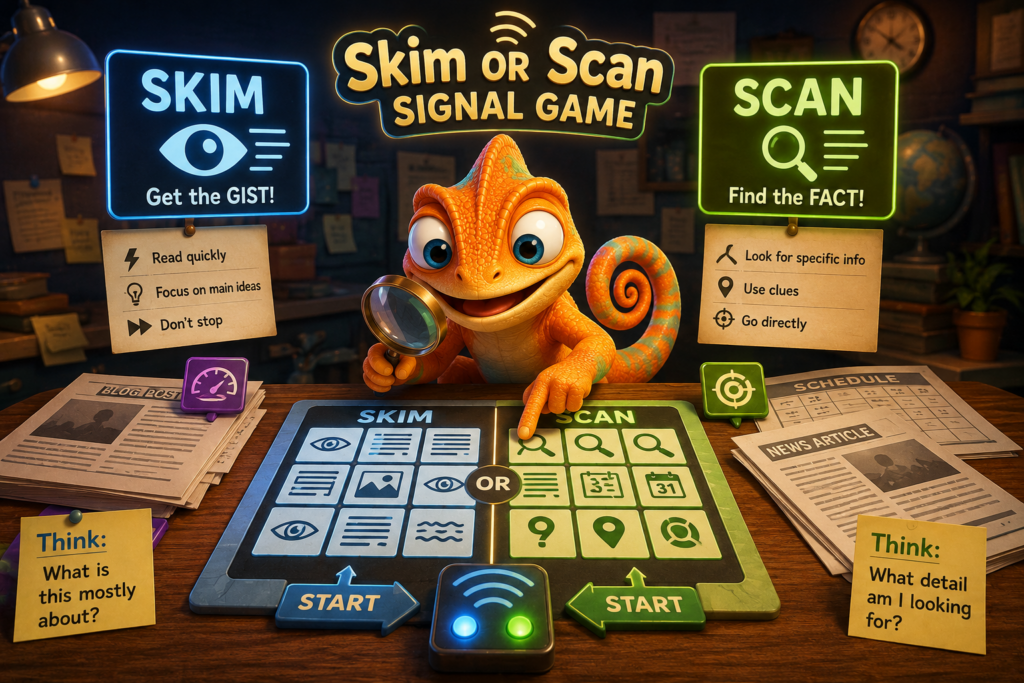
Tasks:
- Find the main idea.
- Find the date.
- Decide if the text is a biography.
- Find the name of a city.
- Understand the general topic.
- Find how many people participated.
- Decide if the article is about health or sports.
- Find the person’s main achievement.
- Find the title.
- Find the final result of an event.
Example:
“I choose scanning because I need a specific date.”
“I choose skimming because I need the general idea.”
Part 2 – Future Form Freeze Frame (15 min)
The teacher projects a short text. Students work in pairs. The teacher says one keyword category, and students must point to it quickly.
Categories:
name
date
number
place
title
repeated word
problem
solution
person
event
Students must say:
“I found a name.”
“I found the date.”
“I found the repeated word.”
“I found the place.”
Part 3 – Exit Reading Strategy Sentence (10 min
Each student says one sentence before leaving.
Examples:
“I skim when I need the main idea.”
“I scan when I need a date.”
“The title helps me predict the topic.”
“Images help me understand the text before reading.”
SESSION 3: CONSOLIDATION (80 min)
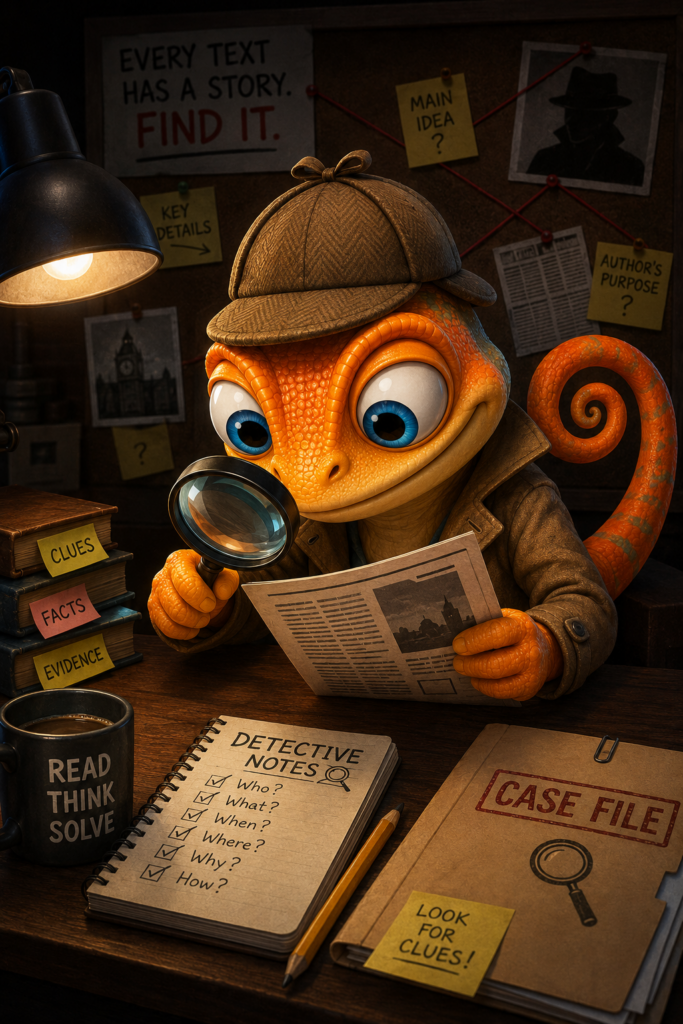
Part 1 – Preparation: Reading Detective Brief (15 min)
Students prepare for a live reading challenge. Each group receives one short text: biography, informative text, or news article. They do not translate the text. They prepare a detective brief with:
- text type
- topic
- main idea
- two details
- one question for another group
Required language:
“This text is about…”
“The main idea is…”
“One important detail is…”
“We found the answer by scanning…”
“We used the title to…”
Part 2 – Reading Detective Broadcast (50 min)
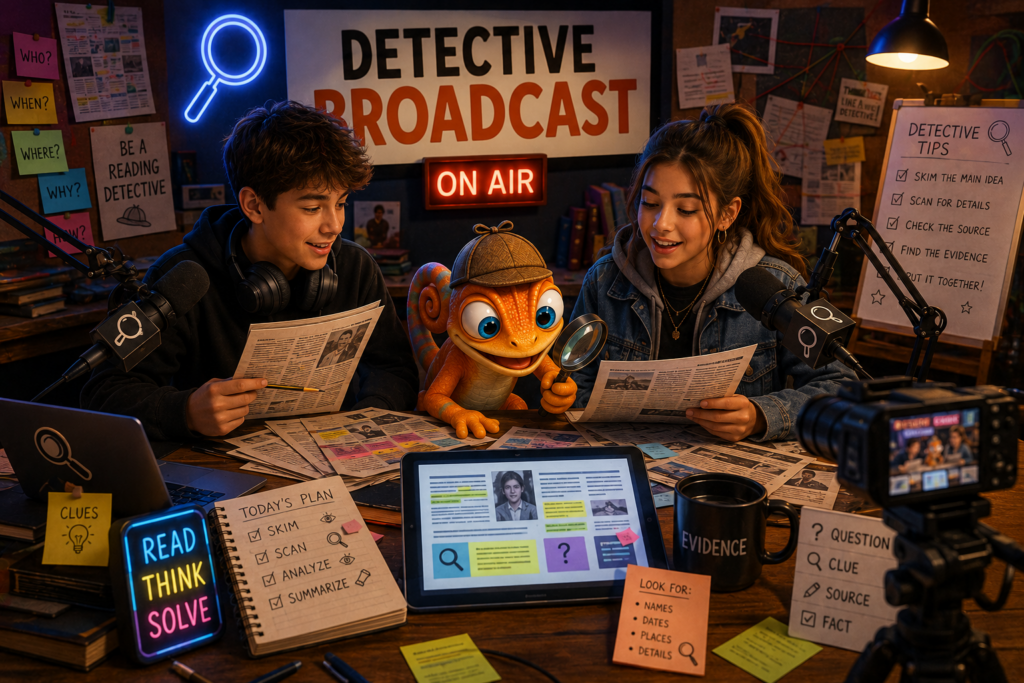
The classroom becomes a reading broadcast room. Each group has a role:
- skimmer
- scanner
- keyword finder
- main idea reporter
- question host
Groups prepare a short “reading broadcast” of their text. They must explain how they understood it, not only what it says.
Broadcast structure:
0–15 seconds: text type and topic
15–30 seconds: main idea
30–45 seconds: two details found by scanning
45–60 seconds: one strategy used
60–75 seconds: one question for the class
Example:
“This is a biography. It is about a young athlete. The main idea is that she worked hard to become successful. We scanned and found the year 2018 and the city Quito. We used the title and the image to predict the topic.”
Part 3 – Reading Badge Reflection (15 min)
Students vote for:
- clearest main idea
- fastest scanning
- best use of title clues
- best oral explanation
- best teamwork
Students explain their vote orally:
“I voted for this group because they explained the main idea clearly.”
“They found specific details quickly.”
“They used the image and title well.”
RUBRIC:
Reading Analysis
NEE – Agregar el tipo de adaptaciones curriculares
Principio II: Pautas 6.1 – 6.3 – 6.4
Principio III: Pautas 7.1 – 8.1 – 9.1
ALUMNO 1: Constante monitoreo. Dar tiempo adicional para el desarrollo de la actividad y se reduce el número de ejercicios o se modifican los ejercicios con un nivel de dificultad reducido, de acuerdo con sus necesidades académicas.
ALUMNO 2: Constante monitoreo, Dar tiempo adicional para el desarrollo de la actividad y se reduce el número de ejercicios o se modifican los ejercicios con un nivel de dificultad reducido, de acuerdo con sus necesidades académicas.
ALUMNO 3: Constante monitoreo. Corroborar que el contenido entregado en clase haya sido comprendido por la estudiante mediante retroalimentación.