
Writing Workshop
SKILLS
EFL 4.4.1 Convey information and ideas through simple transactional or expository texts on familiar subjects using ICT tools and conventions and features of English appropriate to audience and purpose.
EFL 4.4.5 Recognize that various types of writing require different language, formatting and special vocabulary.

REAL-LIFE APPLICATION

This topic helps students write short messages with a clear purpose. They learn how to organize an informal email, write a short article, use punctuation correctly, and check basic mechanics before submitting. This is useful when students message classmates, invite friends, ask for help, explain a situation, write school articles, or prepare short written tasks in English.
LEARNING ACTIVITIES
SESSION 1 (80 min) ANTICIPATION
Part 1: Inbox Pop-Up Challenge (20 min)
The teacher projects or displays fake message pop-ups with no full texts, only visual situations: a birthday invitation, a missed class, a school event, a homework question, a sports day, a lost notebook, and a class trip.
Students decide:
“What kind of text should we write?”
“Is it an email or an article?”
“Who is the reader?”
“What is the purpose?”
“What information is necessary?”
Students answer orally first:
“This should be an email.”
“The reader is a friend.”
“The purpose is to invite.”
“This should be an article because it tells other students about an event.”
The teacher explains that good writing starts before writing: students must know the reader, purpose, format, and main message.
Part 2: Vocabulary Activation: Writer’s Toolbox Relay (15 min)
The teacher places objects or icons around the room: envelope, pencil, question mark, comma, title, paragraph block, clock, smiley face, and checklist. Students choose one and explain how it helps writing.
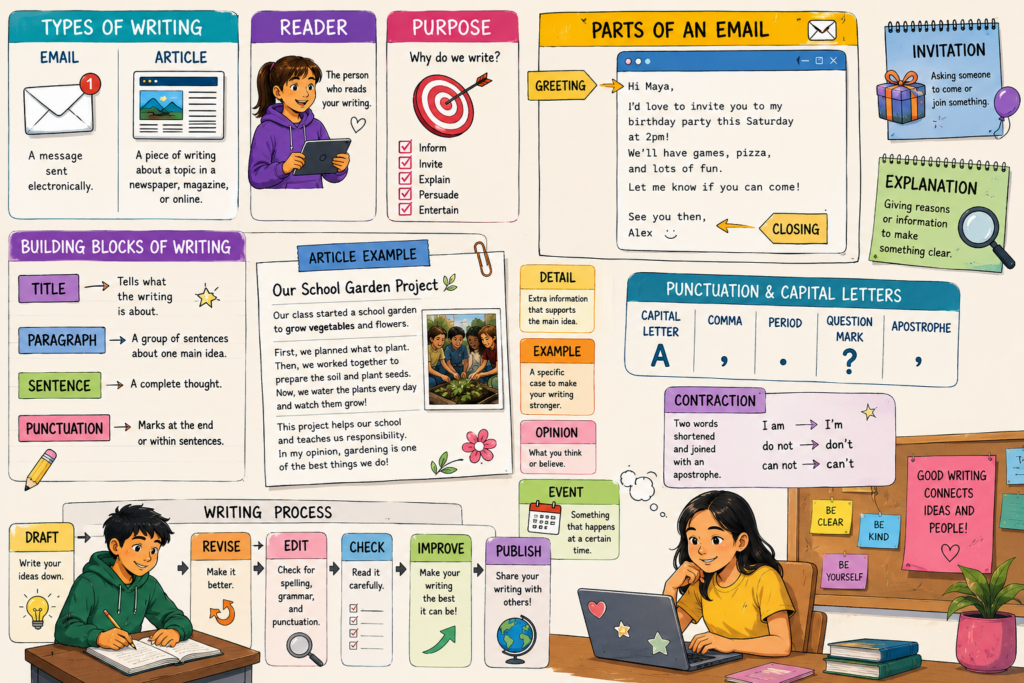
- article
- reader
- purpose
- greeting
- closing
- title
- paragraph
- sentence
- punctuation
- capital letter
- comma
- period
- question mark
- apostrophe
- contraction
- invitation
- explanation
- detail
- example
- opinion
- event
- draft
- revise
- edit
- check
- improve
- publish
Part 3: Grammar and Mechanics Input: Punctuation Traffic System (25 min)
The teacher explains mechanics as a “traffic system” for writing. If punctuation is missing, the reader does not know where to stop, pause, or ask a question.

Capital letters are used at the beginning of sentences, for names, places, days, months, and the pronoun “I.”
Examples:
Correct: “Hi Ana, I went to Quito last Saturday.”
Incorrect: “hi ana, i went to quito last saturday.”
Periods end complete ideas.
Example:
“We visited the museum. It was interesting.”
Question marks are used when asking.
Example:
“Can you come with us?”
Commas separate items in a list or create a natural pause.
Example:
“We played games, ate pizza, and watched a movie.”
Apostrophes are used in contractions.
Examples:
I’m = I am
can’t = cannot
don’t = do not
The teacher connects mechanics to text types:
An informal email needs:
- greeting
- friendly opening
- reason for writing
- details
- question or invitation
- closing
A short article needs:
- title
- opening sentence
- main information
- details or examples
- final comment or opinion
The teacher models both formats.
Informal email model:
Hi Leo,
How are you? I’m writing because our class is organizing a sports day on Friday. It will start at 10:00, and there will be games, music, and snacks. I think it will be fun. Can you come with us?
See you soon,
Mateo
Short article model:
A Fun Sports Day at School
Last Friday, our class organized a sports day. Students played football, basketball, and relay games. Many teachers helped with the activities. The event was exciting because everyone participated. In my opinion, we should organize it again next month.
Part 4: Email Domino Build (20 min)
Students work in teams. Each team receives “domino pieces” with parts of an informal email or short article. They must build the text in the correct order.
Email pieces:
- greeting
- opening question
- reason for writing
- two details
- question to the reader
- closing
Article pieces:
- title
- topic sentence
- first detail
- second detail
- opinion or conclusion
After building the text, the team reads it aloud and explains why that order works.
Gamification:
- 1 Krug for correct order
- 1 Krug for mechanics
- 1 Krug for clear reading
- 1 Krug for explaining the format
- bonus Krug for improving one sentence
SESSION 2: CONSTRUCTION – REINFORCEMENT (40 min)
Part 1 – Human Keyboard Mechanics Game (15 min)
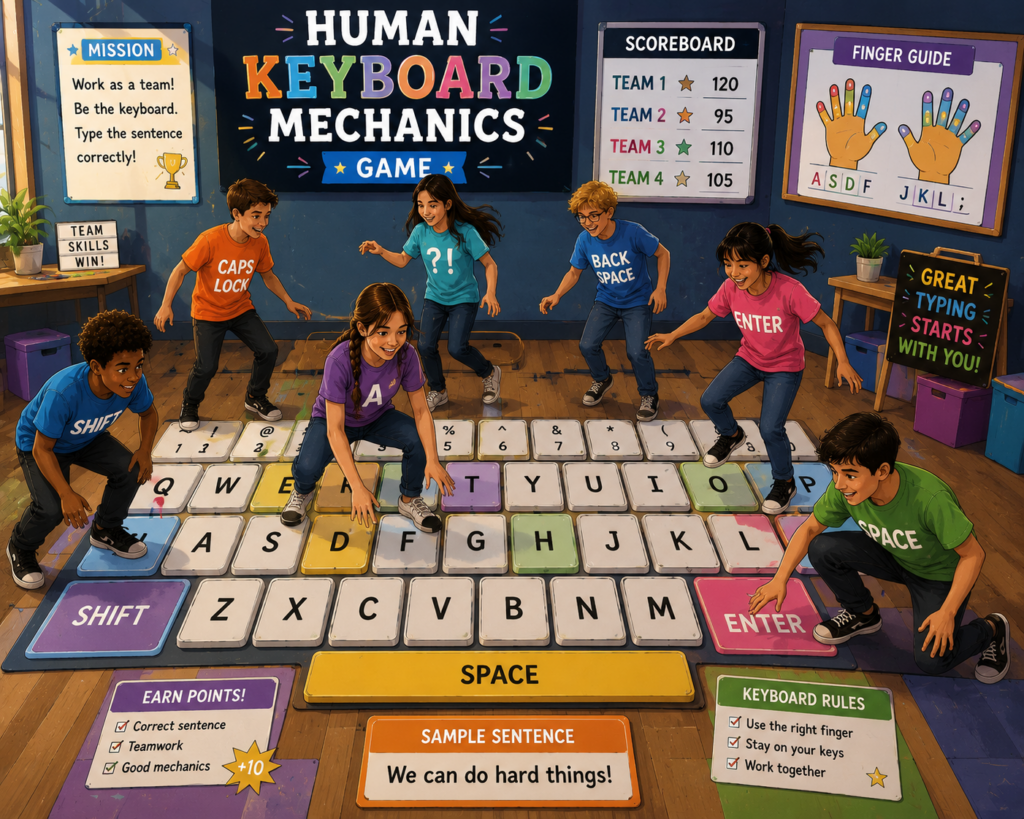
Students become “keyboard keys.” Some students are capital letters, commas, periods, question marks, apostrophes, and spaces. The teacher reads a messy sentence, and students physically move into place to fix it.
Messy sentences:
- hi camila how are you
- i went to cuenca last weekend
- can you help me with homework
- im sorry i forgot the notebook
- we played ate and laughed
Students then say the corrected sentence aloud.
Part 2 – Voice-to-Text Repair (15 min)
The teacher gives students a messy spoken message. Students must turn it into a short, clear written email opening.
Example spoken message:
“Hey I can’t go today I forgot my notebook and I need the homework can you send it please thanks.”
Improved email opening:
Hi Sara,
I’m sorry I can’t go today. I forgot my notebook. Can you send me the homework, please?
Students work in pairs and read their improved version aloud.
Part 3 – Exit Writer’s Check (10 min)
Each student says one writing rule before leaving.
Examples:
“An informal email needs a greeting.”
“A question needs a question mark.”
“A short article needs a title.”
“Names start with capital letters.”
SESSION 3: CONSOLIDATION (80 min)
Part 1 – Preparation: Mailbox or Magazine Choice (15 min)
Students choose one final product:
Option A: informal email of about 100 words
Option B: short article
They prepare a planning strip, not a full script.
Planning strip:
- reader
- purpose
- format
- main idea
- two details
- ending
Part 2 – Classroom Mailbox and Magazine Pop-Up (50 min)

The classroom becomes two creation areas:
Mailbox Area: students write informal emails.
Magazine Area: students write short articles.
Students draft, peer-check, revise, and submit. Then they do a short “writer’s walk.” They do not read the full text to everyone. Instead, each student shares:
- the purpose of the text
- one strong sentence
- one correction they made
- one thing they improved after feedback
This makes the consolidation active, not only silent writing.
Part 3 – Writer’s Reflection Circle (15 min)
Students answer orally:
“What did you revise?”
“What mistake did you correct?”
“What helped your writing improve?”
“What is one rule you will remember?”
RUBRIC: Writing Workshop
NEE – Agregar el tipo de adaptaciones curriculares
Principio II: Pautas 6.1 – 6.3 – 6.4
Principio III: Pautas 7.1 – 8.1 – 9.1
ALUMNO 1: Constante monitoreo. Dar tiempo adicional para el desarrollo de la actividad y se reduce el número de ejercicios o se modifican los ejercicios con un nivel de dificultad reducido, de acuerdo con sus necesidades académicas.
ALUMNO 2: Constante monitoreo, Dar tiempo adicional para el desarrollo de la actividad y se reduce el número de ejercicios o se modifican los ejercicios con un nivel de dificultad reducido, de acuerdo con sus necesidades académicas.
ALUMNO 3: Constante monitoreo. Corroborar que el contenido entregado en clase haya sido comprendido por la estudiante mediante retroalimentación.