
Advanced Writing

SKILLS
EFL.5.4.7. Use the process of prewriting, drafting, revising, peer editing and proofreading (i.e., the writing process) to produce well-constructed informational texts.
EFL.5.4.5. Justify and explain the rationale for a position on an argument, using persuasive language, tone, evidence and well-developed arguments through essays, editorials, movie and book reviews, position papers and brochures.
REAL-LIFE APPLICATION
Helps students write with greater academic control. They learn that strong essays require structure, evidence, formal register, and careful punctuation. Semicolons and colons are not decorative; they help writers connect complex ideas, introduce evidence, and create rhetorical flow. In real life, this supports academic essays, university applications, reports, debate preparation, and formal written communication.
LEARNING ACTIVITIES
SESSION 1 (80 min) ANTICIPATION
Part 1: Anticipation: Essay X-Ray (20 min)
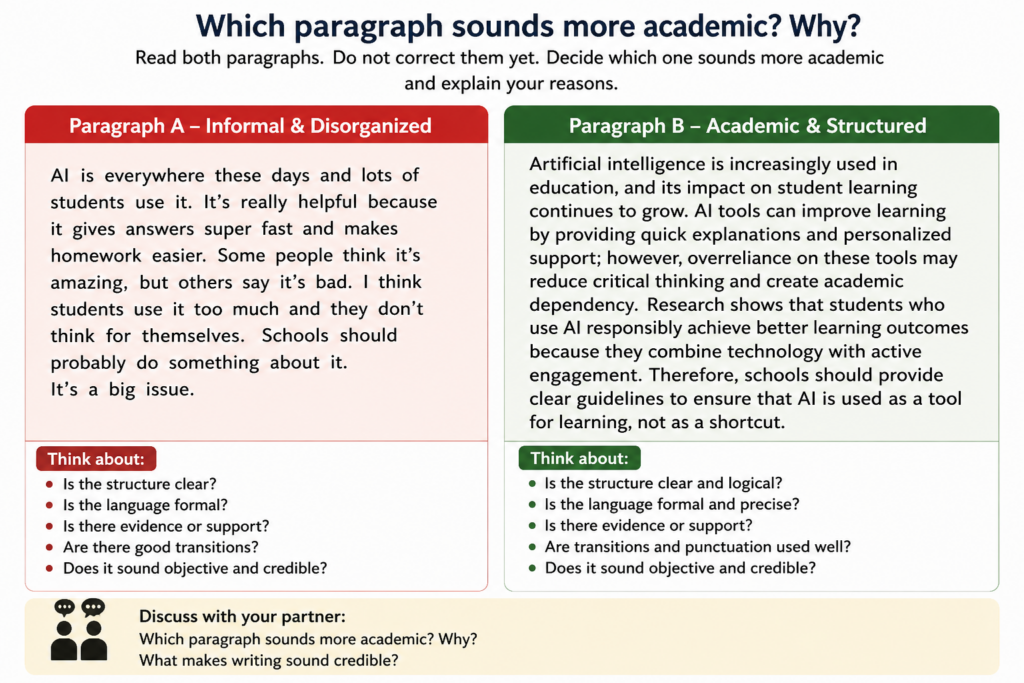
The teacher presents two short paragraphs on the same topic: one informal and disorganized, and one academic and structured. Students do not correct them immediately. Instead, they identify which paragraph sounds more academic and explain why. The teacher asks: What makes writing sound credible? Students discuss register, structure, evidence, and punctuation. This prepares them to see academic writing as a set of choices, not just grammar accuracy.
CONSTRUCTION
Part 2: Academic Vocabulary and Register Development (15 min)
The teacher introduces academic writing vocabulary and rhetorical terms. Students copy the vocabulary and identify which terms help with structure, which help with argument, and which help with style.
- thesis statement
- claim
- counterclaim
- evidence
- rationale
- implication
- coherence
- cohesion
- register
- rhetorical flow
- transition
- stance
- qualification
- concession
- rebuttal
- source integration
- formal tone
- precision
- ambiguity
- overgeneralization
- analytical paragraph
- concluding insight
Exercise: Classify the words into Structure, Argument, or Style.
Words:
thesis statement, counterclaim, evidence, coherence, register, rhetorical flow, concession, rebuttal, formal tone, precision, overgeneralization, concluding insight
Part 3: Advanced Punctuation Input: Semicolon, Colon, and Rhetorical Flow (25 min)
The teacher explains that students should use punctuation strategically. A semicolon links two independent clauses that are closely related: “AI can improve access to information; it can also weaken independent thinking.” A colon introduces evidence, an explanation, or a consequence: “The central problem is clear: students often use AI without evaluating its accuracy.” The teacher emphasizes that punctuation must improve argument flow.
Part 4: Thesis and Flow Workshop (20 min)
Students are given a broad essay topic: “Should AI be used in schools?” They write three possible thesis statements: one weak, one acceptable, and one strong. Then they choose the strongest and write two follow-up sentences using one semicolon and one colon. The teacher circulates and asks students to justify why their strongest thesis is specific, debatable, and formal.
SESSION 2: CONSTRUCTION – REINFORCEMENT (40 min)
Part 1 – Thesis Upgrade Lab (15 min)
Students receive weak thesis statements and improve them. The teacher reminds them that a B2 thesis should present a clear position and suggest the direction of the argument.
Exercise: Improve the thesis statements.
- AI is good for students.
- Social media is bad.
- Fake news is a problem.
- Students should learn more.
- Technology is important.
Part 2 – Evidence Integration Drill (15 min)
Students receive short evidence fragments and must integrate them into academic sentences using a colon or semicolon. The teacher explains that evidence should not be dropped randomly; it must be introduced and explained.
Part 3 – Academic Exit Line (10 min)
Each student writes one polished academic sentence about AI, media, or education using either a semicolon or a colon. The teacher chooses two examples and briefly discusses why they are effective or how they can be improved.
SESSION 3: CONSOLIDATION (80 min)

Part 1 – Preparation: Academic Essay Revision Board (15 min)
Students receive a short draft paragraphs that have a weak thesis, informal register, poor flow, and missing advanced punctuation. Their task is to act as academic editors. They must identify the main problem before revising. The teacher reminds them that academic writing improves through conscious choices: structure, register, evidence, punctuation, and coherence.

Part 2 – Revision Board Creation (40 min)
Students work in pairs to create a revision board with two columns: original version and improved version. They must improve the thesis, replace informal language, add one semicolon, add one colon, and explain why each change improves the text. This activity is different from a simple writing task because students must justify revision decisions as academic editors.
Example
🔴 Original Version
AI is kind of useful in school, but it can also be bad. Students use it because it is fast and easy. A lot of students don’t really think when they use it. This is a big problem.
🟢 Improved Version
Artificial intelligence can support education in several ways: it provides fast access to information and useful explanations. However, it must be used responsibly; students should not depend on it without critical thinking. Many learners rely on AI tools without evaluating the accuracy of the information, which creates a significant academic concern.
Justification of Changes (what students should explain)
1. Thesis improvement
Original: “AI is kind of useful… but it can also be bad.”
Improved: “Artificial intelligence can support education in several ways…”
→ The new thesis is more formal, specific, and academic.
2. Informal → Formal language
- “kind of useful” → “can support education”
- “bad” → “significant academic concern”
- “a lot of students” → “many learners”
→ The tone becomes more precise and appropriate for academic writing.
3. Use of colon (:)
“…in several ways: it provides fast access…”
→ The colon introduces specific examples that explain the main idea.
4. Use of semicolon (;)
“…must be used responsibly; students should not depend…”
→ The semicolon connects two related complete ideas, improving flow.
5. Clarity and coherence
→ The improved version connects ideas logically and avoids repetition.
Part 3 – Mini Essay Defense (25 min)
Each pair presents one revised sentence and explains the choice they made. They must answer: Why did you use a semicolon or colon here? Why is this version more academic? The teacher evaluates their ability to revise, explain, and apply rhetorical punctuation intentionally.
 RUBRIC:
Academic Essays
NEE – Agregar el tipo de adaptaciones curriculares
Principio II: Pautas 6.1 – 6.3 – 6.4
Principio III: Pautas 7.1 – 8.1 – 9.1
ALUMNO 1: Constante monitoreo. Dar tiempo adicional para el desarrollo de la actividad y se reduce el número de ejercicios o se modifican los ejercicios con un nivel de dificultad reducido, de acuerdo con sus necesidades académicas.
ALUMNO 2: Constante monitoreo, Dar tiempo adicional para el desarrollo de la actividad y se reduce el número de ejercicios o se modifican los ejercicios con un nivel de dificultad reducido, de acuerdo con sus necesidades académicas.
ALUMNO 3: Constante monitoreo. Corroborar que el contenido entregado en clase haya sido comprendido por la estudiante mediante retroalimentación.