
K-Learning Project

SKILLS
EFL.5.2.8. Influence an audience effectively through persuasion, argument or negotiation using conventions and features of English.
EFL.5.2.10. Develop an argument well enough to be followed by a peer audience without much difficulty in prepared presentations.


REAL-LIFE APPLICATION
This project helps students debate AI ethics with formal language and rhetorical control. Students learn to sustain a 60–90 second argument, respond to opposing views, and use passive and impersonal passive structures to sound objective and academic. In real life, this supports university debates, interviews, presentations, academic discussions, and responsible participation in public conversations about technology.
LEARNING ACTIVITIES
SESSION 1 (80 min) ANTICIPATION
Part 1: Anticipation: Ethics Motion Auction (20 min)
The teacher gives each group a fictional budget of 100 points. Several AI ethics debate motions are displayed. Groups “bid” on the motion they think is most urgent or controversial. After bidding, each group explains why they chose that motion. This activity activates ethical thinking and adds a fun competitive element without becoming a quiz.
Motions:
AI-generated content should be labeled by law.
Student data should not be used to train AI systems.
Schools should allow AI only for guided learning.
Deepfake technology should be strictly regulated.
AI should not be used to make decisions about people.
Companies should be punished when AI systems show bias.
AI tools should be banned from exams.
Governments should regulate AI platforms.
Human judgment should be required in AI decisions.
AI should be used to reduce educational inequality.
CONSTRUCTION
Part 2: Vocabulary for AI Ethics Debate (15 min)
The teacher introduces debate vocabulary and explains that BGU students must use vocabulary to build arguments, not only define terms.
- ethical concern
- accountability
- transparency
- regulation
- bias
- algorithmic bias
- surveillance
- privacy violation
- data protection
- consent
- manipulation
- misinformation
- deepfake
- automated decision-making
- human oversight
- public interest
- stakeholder
- consequence
- evidence-based argument
- counterargument
- rebuttal
- formal register
- impersonal passive
- ethical responsibility
- long-term impact
Part 3: Formal Passive and Impersonal Passive for Debate (25 min)
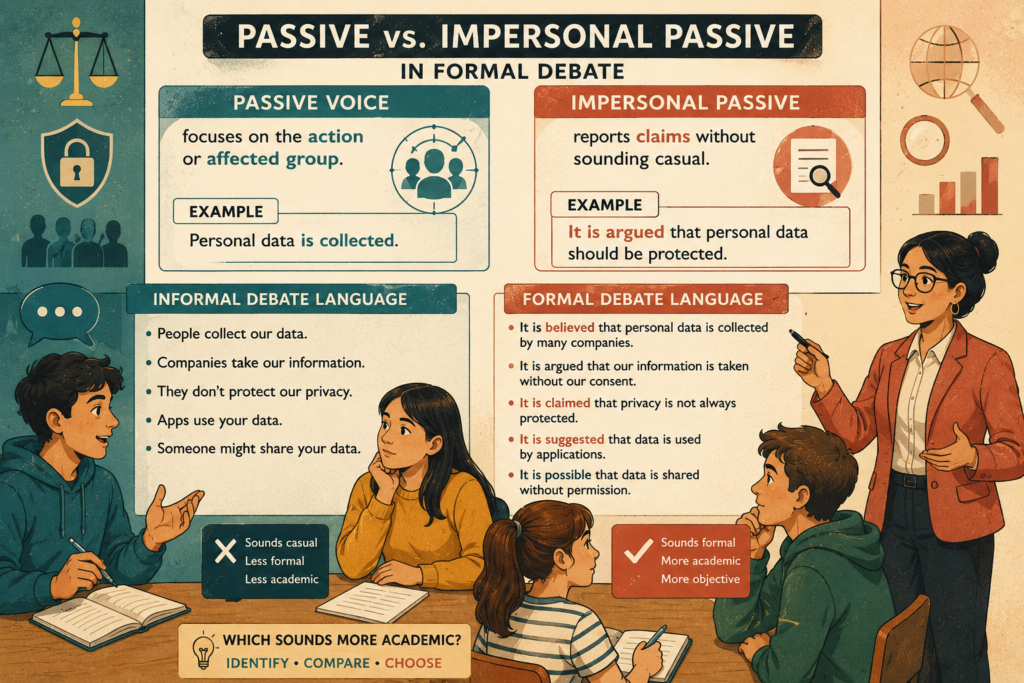
The teacher explains that formal debate often uses passive and impersonal passive structures to sound objective and evidence-based. Passive voice focuses on the action or affected group: “Personal data is collected.” Impersonal passive reports claims without sounding casual: “It is argued that personal data should be protected.” Students compare informal debate language with formal debate language and identify which sounds more academic.
Passive Voice PresentationPart 4: Rhetorical Stamina Ladder (20 min)
Students practice extending an argument step by step. First, they give a 15-second claim. Then they expand it to 30 seconds by adding a reason. Then they expand it to 60 seconds by adding an example, a passive structure, and a closing line. The teacher models how to use transitions: “The main concern is…,” “This matters because…,” “It has been suggested that…,” and “For this reason….”
Prompts:
- AI and privacy
- AI and homework
- AI and deepfakes
- AI and bias
- AI and school monitoring
- AI and misinformation
- AI and creativity
- AI and jobs
- AI and human judgment
- AI and education access
SESSION 2: CONSTRUCTION – REINFORCEMENT (40 min)
Part 1 – Rebuttal Tennis (15 min)
Students stand or sit in pairs. Student A gives a formal claim, and Student B must return a rebuttal using a passive or impersonal passive structure. The exchange continues for four turns. This is oral, fast, and fun because students must think quickly while maintaining formal register.
Claims:
- AI should be fully allowed in schools.
- Deepfakes should not be considered a serious threat.
- AI companies should not be responsible for user mistakes.
- Student data can be used if it improves learning.
- AI-generated essays should be accepted.
- Algorithms are objective.
- Privacy is less important than security.
- AI should replace human feedback.
- Censorship is necessary to control misinformation.
- AI regulation will limit innovation.
Useful rebuttal starters:
– “It could be argued that…”
– “That position may be challenged because…”
– “It has been suggested that…”
– “However, users may be affected when…”
– “This view should be reconsidered because…”
Part 2 – Debate Impact Cards (15 min)
Students receive impact cards and must connect them to an AI ethics motion. Each card requires them to explain who is affected and how. The teacher emphasizes that strong debates include consequences.
Impact cards:
Students’ privacy is reduced.
False information is believed.
Teachers cannot verify original work.
Creative work is copied.
Biased decisions are made.
Public trust is weakened.
Personal data is exposed.
Human judgment is replaced.
Learning becomes passive.
Accountability becomes unclear.
Task:
For each card, say one sentence using passive voice.
Example:
“Public trust is weakened when deepfakes are shared online.”
Part 3 – Formal Closing Line Drill (10 min)
Students write and say one strong closing line for a debate. It must use formal language and one passive or impersonal passive structure.
Examples:
“For this reason, AI systems should be regulated before more harm is caused.”
“It is widely argued that human judgment must be preserved in ethical decisions.”
SESSION 3: CONSOLIDATION (80 min)

Part 1 – Preparation: Formal Debate Brief (15 min)
Students prepare a debate brief for one AI ethics motion. They cannot write a full script. They may only write keywords under four headings: claim, evidence/example, passive structure, and rebuttal idea.
The teacher reminds them that they must speak for 60–90 seconds and respond to another speaker.
Part 2 – Formal Debate Arena (50 min)
Students participate in a structured debate arena. Two speakers present opposing sides of a motion. Each speaker must speak for 60–90 seconds and include at least four passive or impersonal passive structures. After both speeches, each speaker gives a short rebuttal. Audience members listen for strong arguments, formal passive structures, and ethical reasoning.
Part 3 – Audience Verdict and Reflection (15 min)
The audience votes for the stronger argument, not the opinion they personally prefer. They must justify their choice based on clarity, ethical reasoning, and formal language. The teacher closes by emphasizing that a strong debate is not about speaking louder; it is about sustaining a clear, ethical, and well-structured argument.
 RUBRIC:
AI Ethics Debate
NEE – Agregar el tipo de adaptaciones curriculares
Principio II: Pautas 6.1 – 6.3 – 6.4
Principio III: Pautas 7.1 – 8.1 – 9.1
ALUMNO 1: Constante monitoreo. Dar tiempo adicional para el desarrollo de la actividad y se reduce el número de ejercicios o se modifican los ejercicios con un nivel de dificultad reducido, de acuerdo con sus necesidades académicas.
ALUMNO 2: Constante monitoreo, Dar tiempo adicional para el desarrollo de la actividad y se reduce el número de ejercicios o se modifican los ejercicios con un nivel de dificultad reducido, de acuerdo con sus necesidades académicas.
ALUMNO 3: Constante monitoreo. Corroborar que el contenido entregado en clase haya sido comprendido por la estudiante mediante retroalimentación.