
Critical Listening

SKILLS
EFL.5.2.2 Identify the main idea and some details of recorded news reports, documentaries and interviews where visuals support the commentary.
EFL.5.2.5 Understand the main idea of radio and audio recordings on subjects of personal interest, provided speech is clear.
REAL-LIFE APPLICATION

This topic helps students understand complex academic audio more critically by identifying stance, certainty, hesitation, implication, bias, and speaker purpose. In academic and professional contexts, speakers often use cautious language, contrast markers, hedging, emphasis, and tone to communicate more than the literal words say. This skill is useful for university lectures, interviews, podcasts, conferences, documentaries, research presentations, debates, and B2-level listening exams where students must infer attitude, purpose, and implied meaning.
LEARNING ACTIVITIES
SESSION 1 (80 min) ANTICIPATION
Part 1: Academic Audio Observatory (20 min)
The teacher plays a short academic audio or teacher-read paragraph about a serious topic: AI in education, climate migration, digital wellbeing, public health communication, urban loneliness, or misinformation. Students listen once without taking detailed notes.
VIDEO: AI IN EDUCATION
They must answer only one question:
“What is the speaker’s stance?”
The teacher gives options:
supportive
cautious
skeptical
critical
balanced
neutral
Students then listen again and identify the evidence: a phrase, pause, contrast marker, certainty marker, or tone shift.
This activity is important because students need to move beyond “I understood the topic.” They must identify how the speaker positions themselves toward the topic.
Part 2: Vocabulary Activation: Stance Radar System (15 min)

• critical listening
• academic audio
• speaker stance
• speaker attitude
• tone
• intonation
• stress
• emphasis
• hesitation
• pause
• certainty
• uncertainty
• hedging
• nuance
• implication
• inference
• implied meaning
• bias
• framing
• purpose
• intention
• perspective
• evidence
• detail
• gist
• discourse marker
• contrast marker
• concession
• clarification
• limitation
• reliability
• credibility
• skepticism
• cautious support
• strong opposition
• balanced view
• implied criticism
• agreement
• disagreement
• interpretation
• evaluation
Students work with the vocabulary list above. The teacher gives each group a different layer of the Stance Radar. Students must select the words from the list that belong to their layer and explain why.
Then the teacher reads one short audio line:
“The results are promising, although the sample size was limited.”
Students identify:
• attitude: cautious support
• discourse marker: although
• limitation: sample size was limited
• implication: the results should not be treated as final
This shows students that vocabulary is not separate from listening; it gives them the language to explain what they hear.
Part 3: Extended Listening Input: From Comprehension to Interpretation
The teacher explains that critical listening in academic audio has four stages.

Stage 1: Gist
Students identify the general topic and purpose.
Example:
“The audio is about whether AI tools support learning.”
Stage 2: Detail
Students identify the supporting information.
Example:
“The speaker mentions feedback, writing support, and academic honesty.”
Stage 3: Stance
Students identify the speaker’s position.
Example:
“The speaker is cautiously supportive.”
Stage 4: Nuance and implication
Students identify subtle meaning.
Example:
“The speaker supports AI tools, but only if schools teach responsible use. The phrase ‘if used carefully’ suggests the speaker has concerns.”
The teacher should explain that academic speakers often avoid extreme statements. They may use cautious language such as:
may
might
could
appears to
seems to
is likely to
tends to
the evidence suggests
to some extent
it is possible that
These words are not weak language. In academic contexts, they often show precision and responsibility.
Part 4: Language Teaching Idea: Stance Equation
The teacher introduces a “stance equation”:
word choice + tone + discourse marker + evidence = speaker stance
Students apply it to short lines.
Example:
“The proposal is ambitious; however, implementation may be difficult.”
Word choice: ambitious, difficult
Discourse marker: however
Hedging: may
Stance: cautiously critical or balanced
Students learn that stance is not guessed from one word alone. It is built from multiple clues.
SESSION 2: CONSTRUCTION – REINFORCEMENT (40 min)
Part 1 – Bias and Framing Trail (15 min)

Students listen to two versions of the same message. One version is neutral; the other is emotionally framed.
Neutral:
“The school introduced new technology rules.”
Framed:
“The school imposed strict technology controls on students.”
Students identify which version is more neutral and which one reveals a stronger attitude. Then they explain the framing.
This activity helps students recognize that word choice can create bias even when the factual situation is similar.
Part 2 – Conference Audio Forensics (15 min)

Students listen to a short academic panel exchange. Each student has a forensic role:
- stance analyst
- certainty analyst
- discourse marker analyst
- implication analyst
- evidence analyst
After the second listening, each role reports one finding. The goal is not to summarize the whole audio, but to build a shared interpretation from different listening angles.
Part 3 – One-Minute Nuance Poll (10 min)
Students vote silently on the speaker’s stance using a quick poll: supportive, cautious, skeptical, critical, balanced, or neutral. Then they pair up with someone who chose a different stance and compare evidence. The teacher closes by highlighting that different interpretations are acceptable only when they are supported by audio evidence.
SESSION 3: CONSOLIDATION (80 min)
Part 1- Preparation: Critical Listening Brief Card (15 min)
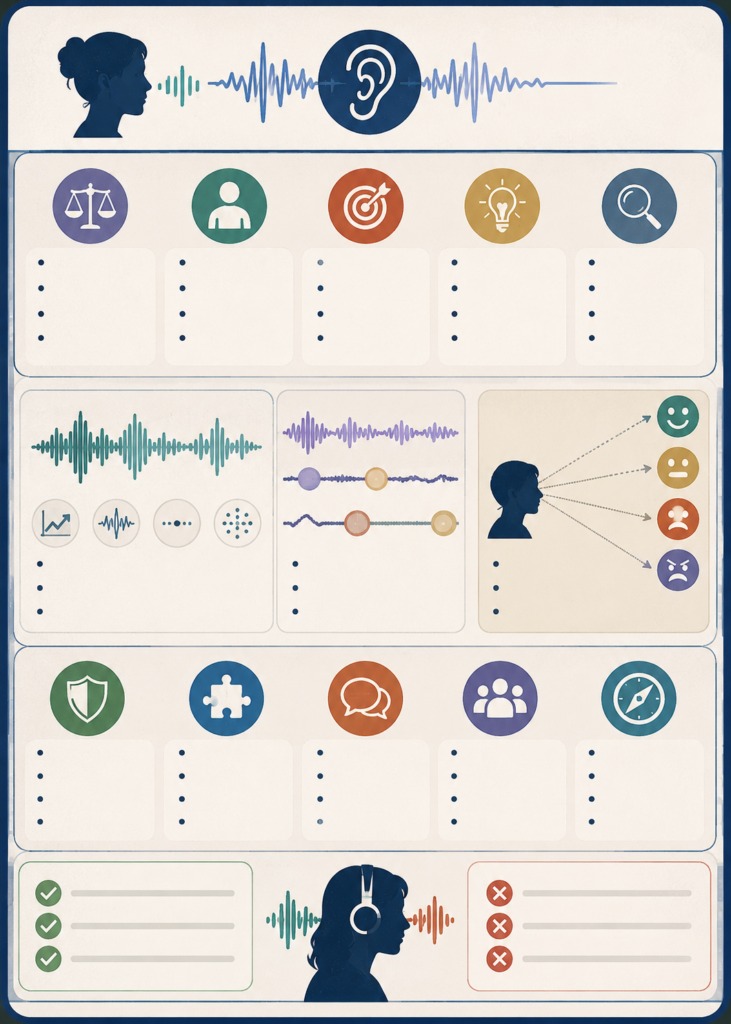
Students prepare a brief card with six labels:
- topic
- gist
- detail
- stance
- evidence
- implication
They cannot write full sentences before listening. The goal is to organize attention, not prepare a script.
Part 2 – Academic Audio Forensics Briefing (50 min)
Students listen to a 90-second academic audio twice. The audio can be a mini-lecture, interview, conference answer, or documentary-style commentary. Each group prepares a critical listening briefing.
The briefing must include:
• main topic
• speaker stance
• one important detail
• one tone or language clue
• one implied meaning
• one limitation or uncertainty
• one question for clarification
Example:
“The speaker discusses whether digital tools improve learning. The stance is cautiously supportive. One detail is that digital tools can provide quick feedback. However, the phrase ‘when used responsibly’ suggests that the speaker sees possible risks. The implied meaning is that technology alone is not enough. One limitation is that the speaker does not mention students without reliable internet access.”
Part 3 – Nuance Review Board (15 min)

Students become a review board and evaluate which group gave the strongest listening interpretation. They cannot vote for “best group” generally. They must vote under one specific category:
- strongest stance evidence
- clearest implied meaning
- best identification of uncertainty
- most precise academic language
- strongest clarification question
Each vote must include a reason.

RUBRIC: Critical Listening
NEE – Agregar el tipo de adaptaciones curriculares
Principio II: Pautas 6.1 – 6.3 – 6.4
Principio III: Pautas 7.1 – 8.1 – 9.1
ALUMNO 1: Constante monitoreo. Dar tiempo adicional para el desarrollo de la actividad y se reduce el número de ejercicios o se modifican los ejercicios con un nivel de dificultad reducido, de acuerdo con sus necesidades académicas.
ALUMNO 2: Constante monitoreo, Dar tiempo adicional para el desarrollo de la actividad y se reduce el número de ejercicios o se modifican los ejercicios con un nivel de dificultad reducido, de acuerdo con sus necesidades académicas.
ALUMNO 3: Constante monitoreo. Corroborar que el contenido entregado en clase haya sido comprendido por la estudiante mediante retroalimentación.