
Environmental Advocacy
SKILLS
EFL.5.2.8 Influence an audience effectively through persuasion, argument or negotiation using conventions and features of English. (Example: precise vocabulary, pronunciation, intonation, presentation strategies, etc.).
EFL.5.3.4 Find the most important information in print or online sources in order to support an idea or argument.
REAL-LIFE APPLICATION

This topic helps students discuss the future of environmental action with more precision. They learn to separate future processes from future outcomes: what people will be doing during implementation and what communities will have achieved by a deadline. This is useful for advocacy campaigns, policy proposals, sustainability presentations, academic discussions, Model UN-style tasks, youth leadership projects, and evidence-based argumentation.
LEARNING ACTIVITIES
SESSION 1 (80 min) ANTICIPATION
Part 1: Climate Futures Briefing (20 min)
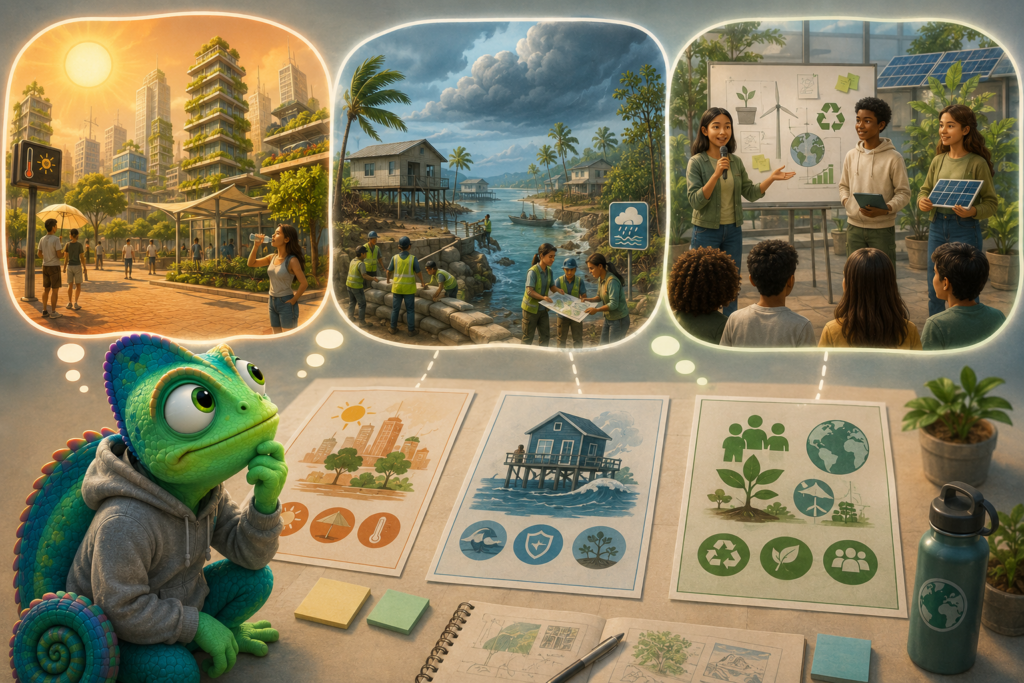
The teacher presents three visual future scenarios:
- A city adapting to extreme heat.
- A coastal community preparing for sea-level risk.
- A youth group presenting sustainable development proposals.
Students work in policy teams and answer:
What issue is visible?
Who is affected?
What will people be doing during the adaptation process?
What will have changed by 2035?
What evidence would make this proposal stronger?
The teacher models B2-level responses:
“By 2035, the city will have expanded shaded public areas.”
“During the adaptation phase, local leaders will be working with engineers and community members.”
“Youth advocates will be presenting evidence-based proposals to decision-makers.”
Part 2: Vocabulary Activation: Advocacy Investment Board (15 min)
Groups receive 100 imaginary advocacy credits. They invest credits in the words they think will make their future proposal stronger. To invest, they must use the word in a meaningful sentence.
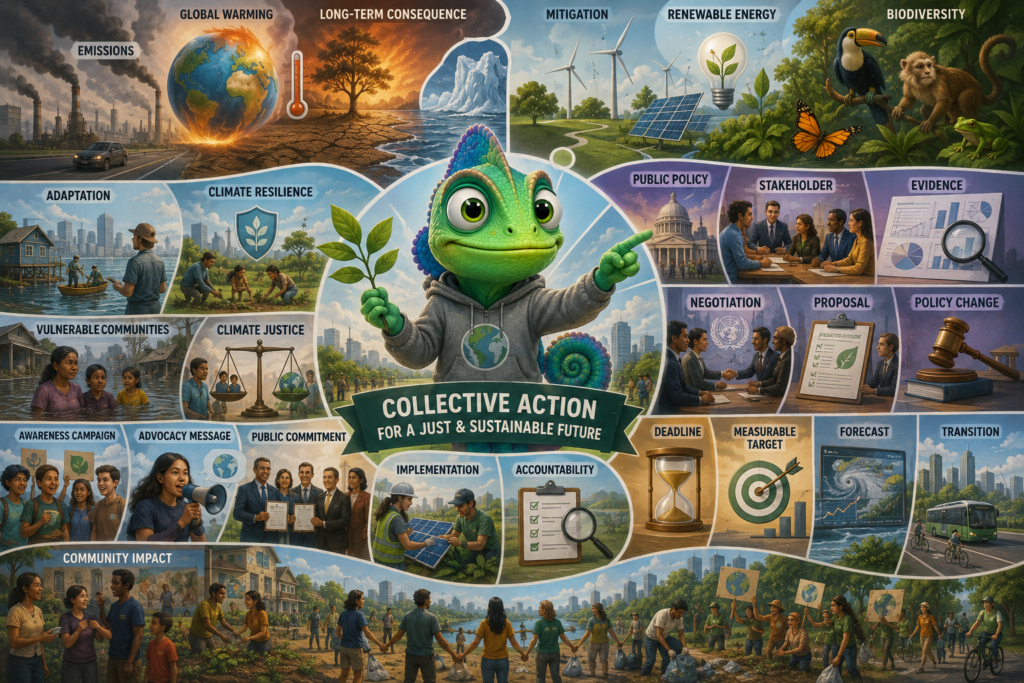
environmental advocacy
sustainable development
climate resilience
global warming
adaptation
mitigation
emissions
renewable energy
biodiversity
public policy
evidence
stakeholder
community impact
vulnerable communities
long-term consequence
implementation
deadline
measurable target
awareness campaign
public commitment
advocacy message
climate justice
negotiation
proposal
forecast
transition
resilience
accountability
policy change
collective action
Part 3: Grammar Input: Future Process vs. Future Result (25 min)
The teacher explains that environmental advocacy often needs two future perspectives.
Future Continuous describes future implementation. It shows what people, communities, organizations, or governments will be doing at a specific moment or during a future period.
Structure:
subject + will be + verb-ing
Examples:
“In 2035, cities will be redesigning public spaces for extreme heat.”
“During the campaign, youth leaders will be collecting community opinions.”
“At the next summit, delegates will be negotiating climate commitments.”
“Next year, researchers will be monitoring changes in local water access.”
Future Perfect describes future achievement. It shows what will be completed by a deadline.
Structure:
subject + will have + past participle
Examples:
“By 2035, the city will have expanded green public transport.”
“By the end of the pilot program, students will have collected community feedback.”
“By the next climate summit, the organization will have published its recommendations.”
“By 2040, several neighborhoods will have adopted climate-resilient designs.”
The teacher compares both forms in advocacy language:
Future Continuous:
“In 2030, the city will be implementing a heat-risk plan.”
This focuses on the process happening at that future time.
Future Perfect:
“By 2030, the city will have implemented the first stage of the heat-risk plan.”
This focuses on completion before or by the deadline.
The teacher emphasizes advocacy meaning:
Use Future Continuous when explaining implementation, monitoring, negotiation, research, transition, public discussion, or ongoing action.
Use Future Perfect when explaining targets, completed achievements, campaign outcomes, policy deadlines, or measurable results.
Part 4: Forecast Brief Builder (20 min)
Each group receives a sustainable development scenario and builds a short future forecast.
Scenarios:
- urban heat and public health
- water access in vulnerable communities
- sustainable transport
- climate education
- biodiversity restoration
- renewable energy transition
- food security
- misinformation about climate change
- responsible tourism
- climate-resilient housing
Groups must produce:
- one issue statement
- one Future Continuous sentence
- one Future Perfect sentence
- one stakeholder
- one expected impact
Example:
“The issue is urban heat. In 2035, city planners will be redesigning public spaces to protect residents. By 2040, the city will have created more shaded areas in vulnerable neighborhoods. The main stakeholders are local families, health workers, and city leaders.”
SESSION 2: CONSTRUCTION – REINFORCEMENT (40 min)
Part 1 – Stakeholder Forecast Table (15 min)
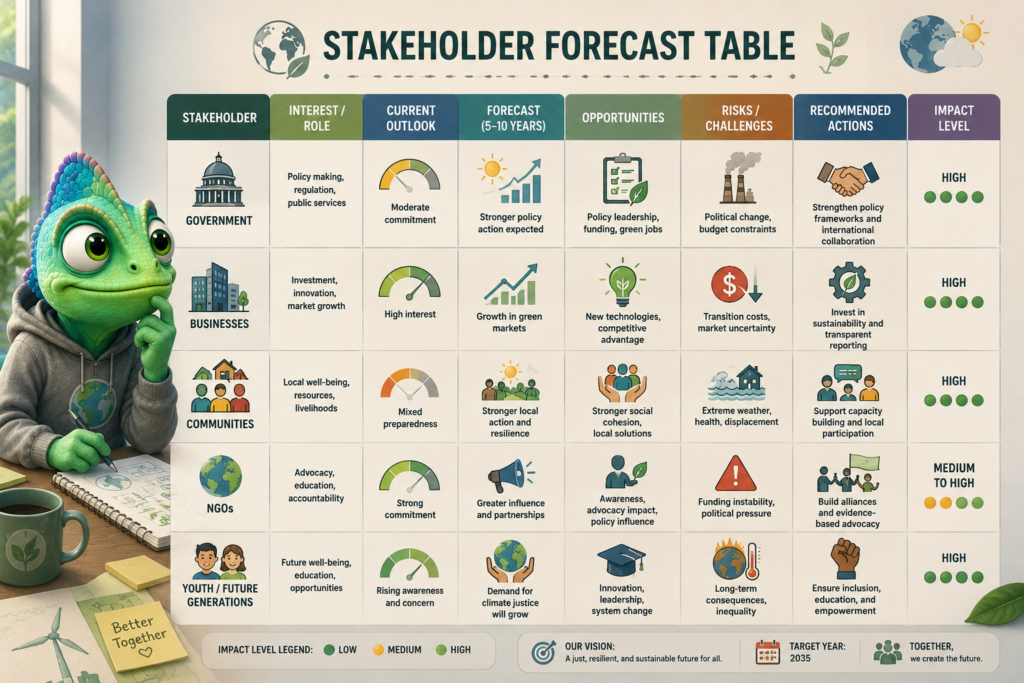
Groups receive one issue and four stakeholders. Each stakeholder must speak from their perspective using Future Continuous.
Example issue: water insecurity
Stakeholders:
student advocate
community leader
engineer
local government representative
Example sentences:
“Next year, student advocates will be raising awareness about water use.”
“Engineers will be testing low-cost water systems.”
“Local leaders will be organizing community meetings.”
Then the group adds one Future Perfect outcome:
“By the end of the project, the community will have tested two possible solutions.”
Part 2 – Deadline Challenge: Is It Realistic? (15 min)
The teacher reads Future Perfect claims. Students decide whether the deadline sounds realistic, too ambitious, or too vague. They must justify their answer.
Claims:
- “By tomorrow, the city will have solved air pollution.”
- “By 2030, the community will have planted 5,000 native trees.”
- “By next week, students will have changed national climate policy.”
- “By the end of the semester, the class will have created an awareness campaign.”
- “By 2040, public transport will have become cleaner in many cities.”
Students respond:
“This is unrealistic because…”
“This could be realistic if…”
“This deadline is too vague because…”
“This sounds possible because…”
Part 3 – Exit Policy Forecast (10 min)
Each student says one two-sentence forecast:
One Future Continuous sentence.
One Future Perfect sentence.
Example:
“During the next decade, cities will be investing in climate-resilient infrastructure. By 2040, some communities will have reduced their exposure to extreme heat.”
SESSION 3: CONSOLIDATION (80 min)
Part 1- Preparation: Climate Futures Cabinet Brief (15 min)
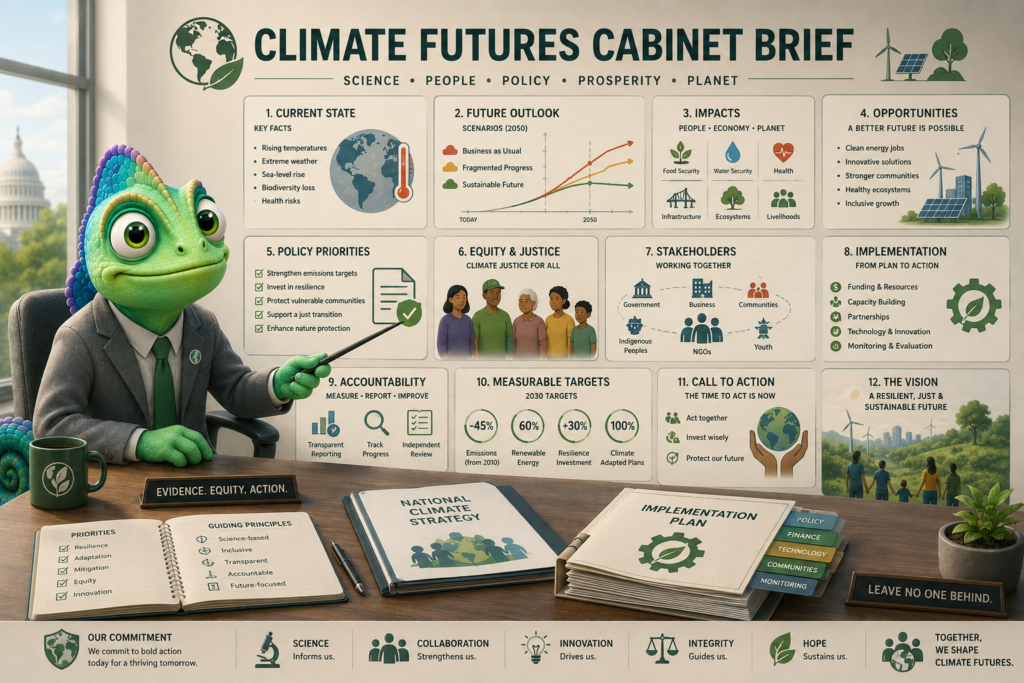
Students prepare a “cabinet brief” for a fictional climate futures meeting. They do not write a full script. They prepare keywords only.
Brief sections:
- issue
- stakeholder
- future process
- future completed result
- evidence
- recommendation
Required language:
“The issue we are addressing is…”
“During the implementation phase…”
“By…”
“The community will have…”
“This matters because…”
“We recommend…”
Part 2 – Climate Futures Cabinet Simulation (50 min)
Groups act as advisory teams to a climate futures cabinet. Each group presents one forecast proposal. The class acts as decision-makers who must decide which proposal is most realistic and impactful.
Roles:
- lead advocate
- evidence specialist
- stakeholder representative
- future forecast speaker
- cabinet questioner
Presentation requirements:
- one environmental issue
- one stakeholder group
- one Future Continuous sentence
- one Future Perfect sentence
- one evidence-based reason
- one recommendation
- one response to a cabinet question
Possible cabinet questions:
What will communities be doing during the first stage?
What will have changed by the deadline?
Who will be most affected?
What evidence supports your proposal?
What will happen if no action is taken?
How will this connect to sustainable development?
Part 3 – Cabinet Decision and Reflection (15 min)
Students vote for the most realistic proposal. They must justify their vote using at least one future form.
Examples:
“I voted for this proposal because by 2035 the city will have improved public transport.”
“This proposal is realistic because communities will be participating during the implementation process.”
RUBRIC: Environmental Advocacy
NEE – Agregar el tipo de adaptaciones curriculares
Principio II: Pautas 6.1 – 6.3 – 6.4
Principio III: Pautas 7.1 – 8.1 – 9.1
ALUMNO 1: Constante monitoreo. Dar tiempo adicional para el desarrollo de la actividad y se reduce el número de ejercicios o se modifican los ejercicios con un nivel de dificultad reducido, de acuerdo con sus necesidades académicas.
ALUMNO 2: Constante monitoreo, Dar tiempo adicional para el desarrollo de la actividad y se reduce el número de ejercicios o se modifican los ejercicios con un nivel de dificultad reducido, de acuerdo con sus necesidades académicas.
ALUMNO 3: Constante monitoreo. Corroborar que el contenido entregado en clase haya sido comprendido por la estudiante mediante retroalimentación.