
Media & AI

SKILLS
EFL.5.1.9 Communicate information and ideas effectively to diverse audiences using a variety of media and formats.
EFL.5.3.3. Determine the main conclusion in texts which clearly argue a point of view in order to make informed decisions about one’s own opinion and reaction to the text.


REAL-LIFE APPLICATION
This topic helps students analyze how media messages are constructed, reported, censored, or amplified by AI. Students learn to use reported speech to summarize statements, questions, claims, warnings, denials, and suggestions in a more formal and accurate way. In real life, this skill is useful when discussing news, quoting experts, summarizing interviews, evaluating censorship, and explaining how AI affects public opinion, privacy, creativity, and democracy.
LEARNING ACTIVITIES
SESSION 1 (80 min) ANTICIPATION
Part 1: Censored Feed Analysis (20 min)

The teacher presents a mock social media feed with three blurred or removed posts. Students do not know why the posts were removed. In groups, they discuss the guiding question: When is censorship protection, and when is it control? Each group creates two hypotheses using academic language. The teacher guides the conversation toward media censorship, public safety, misinformation, and freedom of expression.
CONSTRUCTION
Part 2: Vocabulary Development (15 min)
The teacher introduces topic vocabulary with short realistic examples. Students are asked to use the vocabulary to discuss media and AI critically..
- censorship
- content moderation
- misinformation
- disinformation
- algorithmic bias
- AI-generated content
- deepfake
- public opinion
- freedom of expression
- surveillance
- privacy
- propaganda
- source credibility
- media outlet
- fact-checking
- manipulation
- accountability
- transparency
- digital rights
- automated decision-making
- platform regulation
- ethical concern
- public interest
- biased coverage
- viral content
The teacher models examples: “Algorithmic bias can affect what information people see,” “A deepfake may be used to manipulate public opinion,” and “Censorship is sometimes defended as content moderation.” Students choose eight words and write one precise sentence for each.
Part 3: Grammar Input: Reported Speech with Reporting Verbs (25 min)
Direct and Reported Speech (Tenses)The teacher explains that reported speech must go beyond “said.” Students learn how reporting verbs change meaning and tone. The teacher presents examples: “The journalist claimed that AI was influencing public opinion,” “The activist warned that censorship could silence minority voices,” “The company denied that personal data had been misused,” and “Experts suggested that AI regulation should be strengthened.” The teacher highlights reported statements, reported questions, and reporting verbs: claim, warn, suggest, deny, argue, admit, explain, ask, wonder, and question.
Part 4: Source-to-Report Transformation (20 min)
Students receive a short set of fictional interview quotes about AI and censorship. They transform the direct quotes into a formal media summary using reported speech. They must choose reporting verbs carefully, depending on the speaker’s intention.
Source-to-Report Transformation
SESSION 2: CONSTRUCTION – REINFORCEMENT (40 min)
Part 1 – Reporting Verb Precision Lab (15 min)
Students receive a list of direct quotes and must choose the most accurate reporting verb. The goal is not only grammar accuracy, but meaning precision. The teacher explains that claim, admit, deny, warn, suggest, and argue are not interchangeable.
Exercise: Choose the best reporting verb and rewrite the sentence.
Reporting verbs: warned, denied, suggested, admitted, claimed, argued
- “AI-generated news can mislead voters.”
- “Our platform did not censor political opinions.”
- “We should label AI-generated content clearly.”
- “Some automated decisions were unfair.”
- “Social media companies have too much power.”
- “Deepfakes may damage public trust.”
Part 2 – Reported Questions Micro-Interview (15 min)
Students write three interview questions for an expert about AI and censorship. Then they exchange questions with a partner and report them formally. The teacher emphasizes word order in reported questions.
Reported Questions Micro-Interview
Part 3 – One-Minute Editorial Claim (10 min)
Students write one formal sentence that reports an opinion about AI or censorship. They must use one reporting verb and one topic vocabulary word. A few students read their sentence aloud, and the teacher corrects tense backshift, pronoun changes, and reporting verb use..
SESSION 3: CONSOLIDATION (80 min)
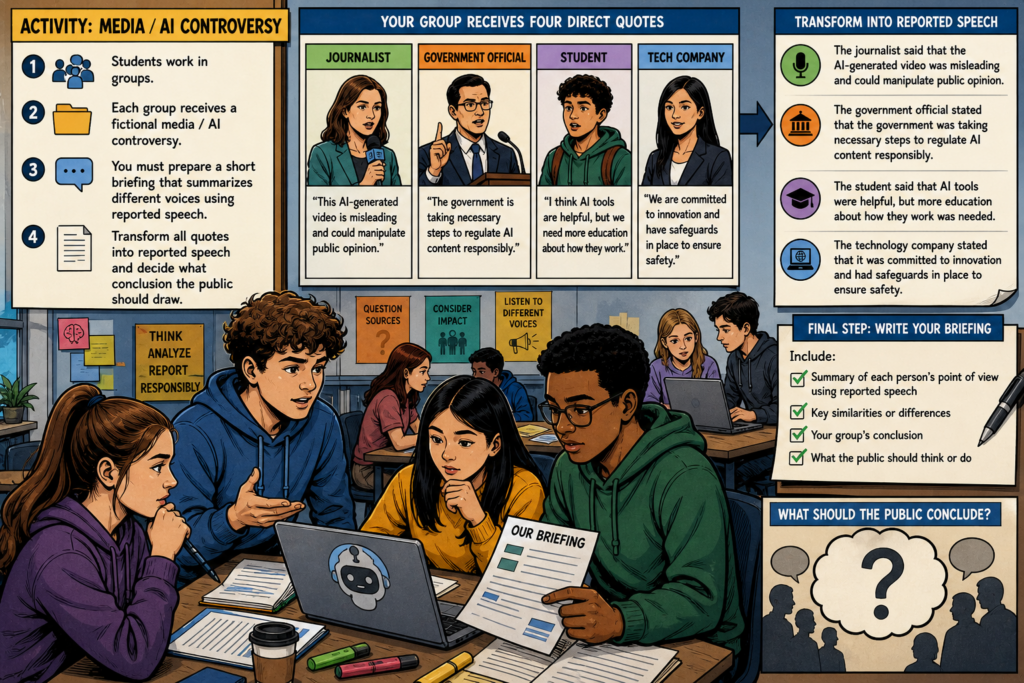
Part 1 – Preparation: Media Accountability Briefing (15 min)
Students work in groups and receive a fictional media/AI controversy. They must prepare a short briefing that summarizes different voices using reported speech. Each group receives four direct quotes: one from a journalist, one from a government official, one from a student, and one from a technology company. Students must transform all quotes into reported speech and decide what conclusion the public should draw.
Controversy options:
- An AI tool created fake news during an election.
- A platform removed posts about a protest.
- A school used AI to monitor student behavior.
- A company used personal data to train an AI system.
- A deepfake video damaged a public figure’s reputation.
Part 2 – Media Accountability Briefing (50 min)
Each group presents a 3-minute media briefing. They must report what different stakeholders said or asked, explain the ethical concern, and state a conclusion. This is different from a debate or role-play because students are acting as analysts who synthesize information rather than defending only one position. They must use at least six reported speech structures, including two reported questions and three different reporting verbs.
Model:
The journalist claimed that the video had influenced public opinion.
The company denied that personal data had been used without permission.
Students asked whether their privacy was being protected.
The group concluded that AI regulation should be strengthened
Part 3 – Audience Accuracy Check (15 min)
Listeners complete an accuracy check while groups present. They write one reported statement they heard, one reported question they heard, and one vocabulary word used correctly. The teacher closes by explaining that reported speech helps us summarize complex media information without distorting meaning.
 RUBRIC:
Media AI
NEE – Agregar el tipo de adaptaciones curriculares
Principio II: Pautas 6.1 – 6.3 – 6.4
Principio III: Pautas 7.1 – 8.1 – 9.1
ALUMNO 1: Constante monitoreo. Dar tiempo adicional para el desarrollo de la actividad y se reduce el número de ejercicios o se modifican los ejercicios con un nivel de dificultad reducido, de acuerdo con sus necesidades académicas.
ALUMNO 2: Constante monitoreo, Dar tiempo adicional para el desarrollo de la actividad y se reduce el número de ejercicios o se modifican los ejercicios con un nivel de dificultad reducido, de acuerdo con sus necesidades académicas.
ALUMNO 3: Constante monitoreo. Corroborar que el contenido entregado en clase haya sido comprendido por la estudiante mediante retroalimentación.