
K-Learning Project

SKILLS
EFL.5.2.7. Present information clearly and effectively in a variety of oral forms for a range of audiences and purposes. (Example: summarizing, paraphrasing, personal narratives, research reports, essays, articles, posters, charts and other graphics, etc.)
EFL.5.2.8. Influence an audience effectively through persuasion, argument or negotiation using conventions and features of English. (Example: precise vocabulary, pronunciation, intonation, presentation strategies, etc.).

REAL-LIFE APPLICATION

This project helps students prepare for advanced academic and professional communication by asking them to research a global trend, synthesize credible information, present a persuasive 90–120 second argument, and respond to a challenge question. This is useful for university-style presentations, scholarship interviews, Model UN-style tasks, research fairs, leadership projects, formal debates, and future work contexts where students must explain complex information clearly, persuasively, and responsibly.
LEARNING ACTIVITIES
SESSION 1 (80 min) ANTICIPATION
Part 1: Trend Forecast Trail (20 min)
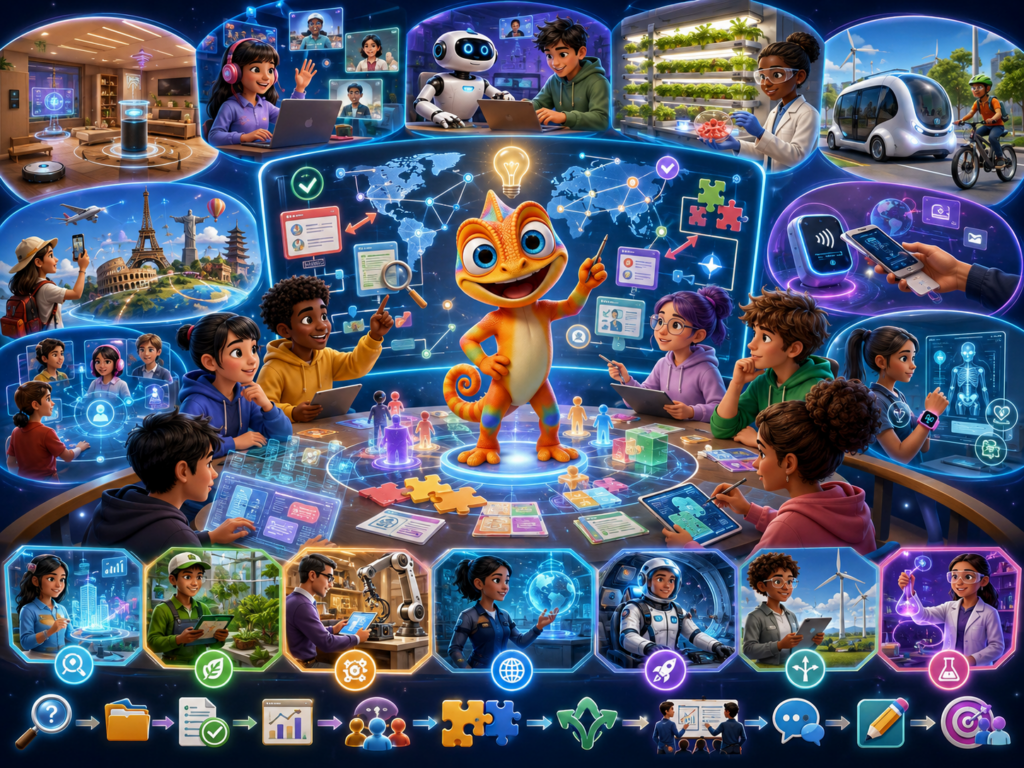
The teacher presents a visual trail of global trends, each represented by a symbolic image: AI governance, aging populations, water security technology, urban loneliness, automation, misinformation, micro-credentials, remote work migration, space economy, and global mental health trends.

Students choose one trend and answer:
- What is changing globally?
- Who is affected?
- What tension or problem does the trend create?
- What question could we investigate?
- What kind of evidence would help us understand it?
The teacher should push students away from broad topics and toward researchable questions.
Too broad:
“Artificial intelligence.”
Better:
“How might AI governance affect trust in digital education?”
Too broad:
“Jobs.”
Better:
“How might automation change the skills young people need for future employment?”
This opening sets the academic tone of the project. Students learn that a persuasive research presentation begins with a precise question, not a general theme.
Part 2: Vocabulary Activation: Trend Object Match (15 min)
Students place vocabulary into motion by walking to different stakeholder zones: students, families, governments, companies, workers, communities, schools, and future generations. The teacher calls out a trend, and students move to the stakeholder they believe is most affected.
- academic research project
- global trend
- research question
- thesis
- claim
- evidence
- source credibility
- synthesis
- stakeholder
- implication
- recommendation
- limitation
- counterargument
- forecast
- impact
- policy
- innovation
- demographic change
- AI governance
- automation
- remote work
- urban loneliness
- water security
- misinformation
- micro-credentials
- public health
- space economy
- digital exclusion
- ethical concern
- measurable outcome
- persuasive stamina
- formal register
- delivery
- challenge question
- audience adaptation
- argue
- synthesize
- evaluate
- defend
- recommend
- justify
- clarify
- refine
Example trend: automation
A student may move to workers and say:
“Workers are key stakeholders because automation may change the skills they need.”
Another student may move to schools and say:
“Schools are also stakeholders because education systems must prepare students for changing work.”
This activity makes vocabulary analytical. Students are not memorizing terms; they are using words to map real-world impact.
Part 3: What Makes a 90–120 Second Academic Research Presentation Persuasive? (30 min)
The teacher explains that this final K-Learning project is a short academic research performance. Students must speak long enough to develop an argument, but not so long that the message becomes unfocused. The time limit creates stamina and precision.

A strong research presentation includes:
- Hook: a sentence that makes the trend feel urgent or relevant.
- Research question: the specific question guiding the project.
- Source synthesis: a connection between at least two sources.
- Stakeholder impact: who is affected and how.
- Recommendation: a realistic action, policy, or response.
- Limitation or caution: what the research does not fully prove.
- Closing claim: a final persuasive message.
The teacher explains the difference between information and argument:
Information only tells the audience about a trend.
Example:
“Automation is changing jobs.”
Argument explains why the trend matters and what should be done.
Example:
“Automation is changing jobs; therefore, schools should strengthen problem-solving and digital skill development so students can adapt to future employment demands.”
The teacher should also explain persuasive stamina. At BGU level, stamina means maintaining structure, formal tone, evidence, pace, and audience awareness for 90–120 seconds. Students should not read. They should use keywords, visuals, and practiced transitions.
Useful academic frames:
“The trend I investigated is…”
“My research question focuses on…”
“The sources suggest that…”
“Whereas one source emphasizes…, another highlights…”
“This matters for…”
“One limitation is…”
“My recommendation is…”
“The key point is not only…, but also…”
Part 4: Grammar / Language Teaching Idea: Evidence-to-Argument Engine (15 min)
The teacher gives students a four-part engine:
Source evidence → interpretation → stakeholder impact → recommendation
Example:
Source evidence: Remote work has increased in many sectors.
Interpretation: Work is no longer tied to one physical location.
Stakeholder impact: Young workers may need stronger self-management and digital communication skills.
Recommendation: Schools should train students in remote collaboration and independent project management.
Students practice turning evidence into argument. This method teaches grammar, cohesion, and reasoning through transformation. It prevents students from dropping a fact into a presentation without explaining its meaning.
SESSION 2: CONSTRUCTION – REINFORCEMENT (40 min)
Part 1 – Evidence Pressure Chamber (15 min)
Students bring or receive one evidence point. The class tests it through three pressure questions:
Is it credible?
Is it relevant?
Is it persuasive?
If the evidence survives all three, the speaker can use it in the final project. If not, the student must revise or replace it.
Example:
Evidence: “A social media post says robots will take all jobs.”
Evaluation:
It is not credible enough. It is too general and unsupported. It could be used as an example of public fear, but not as academic evidence.
This activity trains students to defend source quality, not only collect information.
Part 2 – Stakeholder Hot Seat (15 min)

One student presents a trend from the perspective of a stakeholder. The class guesses the stakeholder and asks one challenge question.
Example:
Student speaks as a city leader:
“We need to respond to urban loneliness because public spaces can influence social connection.”
Challenge question:
“What evidence shows that public spaces affect social connection?”
The student must answer with evidence or a logical explanation. This prepares students for the final project’s audience interaction component.
Part 3 – 60-Second Peer Refinement Huddle (10 min)

Students work in pairs. Speaker A gives a 60-second draft of the project. Speaker B gives feedback using three prompts:
The clearest idea was…
The evidence needs…
The recommendation could be stronger if…
Then they switch roles. This closing task gives practical feedback before the final performance.
SESSION 3: CONSOLIDATION (80 min)
Part 1-Preparation: Research Launch Brief Card (15 min)
Students prepare a brief card with only keywords:
- hook
- research question
- source pattern
- stakeholder
- recommendation
- limitation
- closing
The teacher should remind students that the card is not a script. It is a launch sequence. Each keyword helps them remember the next part of the presentation.
Part 2 – Global Trends Research Launch Briefing (50 min)

Students deliver a 90–120 second academic research briefing. The classroom becomes a global trends briefing event, but the visual concept should feel like a public research launch rather than a normal presentation.
Format:
- Student presents the research project.
- Audience listens for source synthesis and recommendation.
- One student asks a challenge question.
- Speaker answers using evidence or reasoning.
Presentation requirements:
- clear research question
- one global trend
- at least two source references or evidence points
- one synthesis statement
- one stakeholder impact explanation
- one recommendation
- one limitation or caution
- 90–120 seconds
- response to one challenge question
Example structure:
“The trend I investigated is automation and future employment. My research question asks how automation may affect the skills young people need. The sources suggest that automation will not only replace some routine tasks, but also create demand for digital and problem-solving skills. This matters for students because future jobs may require flexibility and continuous learning. One limitation is that trends vary by country and industry. My recommendation is that schools should include more project-based digital collaboration so students can practice adaptable skills.”
Part 3 – Research Impact Review Board (15 min)
Students act as an audience review board. They do not simply vote for “best presentation.” They evaluate impact using four lenses:
- strongest research question
- strongest evidence synthesis
- most realistic recommendation
- clearest response to challenge question
Each student gives one short peer comment using a formal frame:
- “The recommendation was realistic because…”
- “The synthesis was clear because…”
- “The challenge response was effective because…”
- “The presentation could improve by…”

RUBRIC:
Unit3 KLearning Project
NEE – Agregar el tipo de adaptaciones curriculares
Principio II: Pautas 6.1 – 6.3 – 6.4
Principio III: Pautas 7.1 – 8.1 – 9.1
ALUMNO 1: Constante monitoreo. Dar tiempo adicional para el desarrollo de la actividad y se reduce el número de ejercicios o se modifican los ejercicios con un nivel de dificultad reducido, de acuerdo con sus necesidades académicas.
ALUMNO 2: Constante monitoreo, Dar tiempo adicional para el desarrollo de la actividad y se reduce el número de ejercicios o se modifican los ejercicios con un nivel de dificultad reducido, de acuerdo con sus necesidades académicas.
ALUMNO 3: Constante monitoreo. Corroborar que el contenido entregado en clase haya sido comprendido por la estudiante mediante retroalimentación.