
Ethical Dilemmas

SKILLS
EFL.5.1.1. Display an understanding of the relationship between the practices and perspectives of different cultures by recognizing and sharing cross-cultural experiences and ideas.
EFL.5.1.10. Take initiative in a discussion in a positive way by being sensitive to the nuances of peers’ comments, reactions and responses (both verbal and nonverbal).


REAL-LIFE APPLICATION
This topic helps students analyze ethical dilemmas connected to society, politics, technology, media, and human rights. Students learn to express complex issues using passive voice and impersonal passives, which are common in formal reports, news, academic texts, and public discussions. In real life, this helps them discuss controversial topics more objectively, report information without sounding too personal, and support opinions with ethical reasoning.
LEARNING ACTIVITIES
SESSION 1 (80 min) ANTICIPATION
Part 1: Silent Ethical Gallery (20 min)
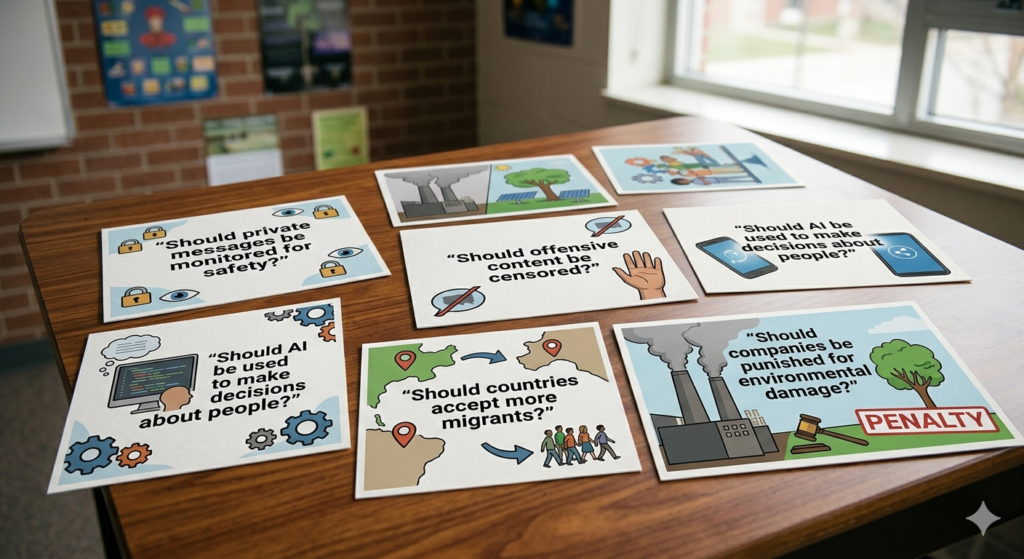
The teacher displays five dilemma cards around the room: “Should private messages be monitored for safety?”, “Should offensive content be censored?”, “Should AI be used to make decisions about people?”, “Should countries accept more migrants?”, and “Should companies be punished for environmental damage?” Students walk silently, read the cards, and place a small mark next to the dilemma they consider most urgent. Then they discuss in groups why that issue matters and who is affected. The teacher connects their ideas to socio-political ethics.
CONSTRUCTION
Part 2: Vocabulary Development (15 min)
The teacher introduces academic vocabulary for ethical discussion:
- ethical dilemma
- censorship
- discrimination
- immigration
- globalization
- privacy
- surveillance
- accountability
- human rights
- public interest
- social responsibility
- bias
- justice
- inequality
- transparency
- regulation
- policy
- consequence
- stakeholder
- controversy
The teacher explains that students must use these words to build arguments, not only define them. Students select six words and write one issue-based sentence for each.
Part 3: Grammar Input: Passive Voice + Impersonal Passives (25 min)
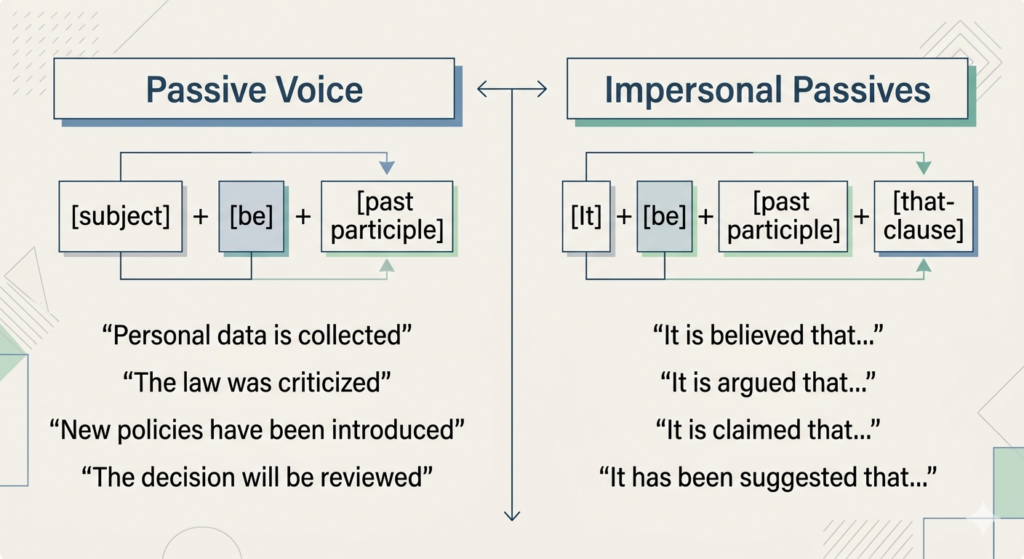
The teacher explains that passive voice is useful in formal English because it focuses on actions, results, and affected groups. Examples include: “Personal data is collected,” “The law was criticized,” “New policies have been introduced,” and “The decision will be reviewed.” Then the teacher introduces impersonal passives used in formal reporting: “It is believed that…,” “It is argued that…,” “It is claimed that…,” and “It has been suggested that….” Students analyze how these structures create a formal and objective tone.
Part 4: Formal Reframing Practice (20 min)
Students transform informal opinion sentences into formal ethical statements. For example, “People say social media controls teenagers” becomes “It is claimed that teenagers are influenced by social media.” “The government ignored the problem” becomes “The problem was ignored by the authorities.”
Students work individually first and then compare answers. The teacher focuses on accuracy and tone.
- People think schools treat some students unfairly.
- Many people say social media spreads fake news.
- Some people believe rules are not followed equally.
- People say teachers ignore some problems.
- Many people think students are judged too quickly.
- Some people believe private information is not safe online.
- People say bullying is not taken seriously.
- Many people think the system protects some people more than others.
- Some people believe students are not listened to enough.
- People say decisions are made without thinking about the consequences.
SESSION 2: CONSTRUCTION – REINFORCEMENT (40 min)
Part 1 – Newsroom Rewriting Challenge (15 min)
Students receive informal statements about socio-political issues and rewrite them as formal news-style statements using passive voice or impersonal passives.
Example: “Many people think AI is unfair” becomes “It is believed that AI systems may be biased.” This activity is different from simple sentence correction because students must change tone, structure, and register.

Part 2 – Ethical Evidence Cards (15 min)
Students receive short evidence cards with invented but realistic information, such as “A policy affected low-income families,” “A post was removed after complaints,” or “A decision was made without public consultation.” Students must write one passive sentence and one impersonal passive sentence for each card. The teacher checks whether the structure sounds formal and accurate.
Part 3 – Position Line (10 min)
The teacher reads one statement: “It is argued that censorship can protect society.” Students stand on a line from agree to disagree and give one sentence explaining their position using passive or impersonal passive structure. This prepares them for Friday’s graded oral activity.
SESSION 3: CONSOLIDATION (80 min)
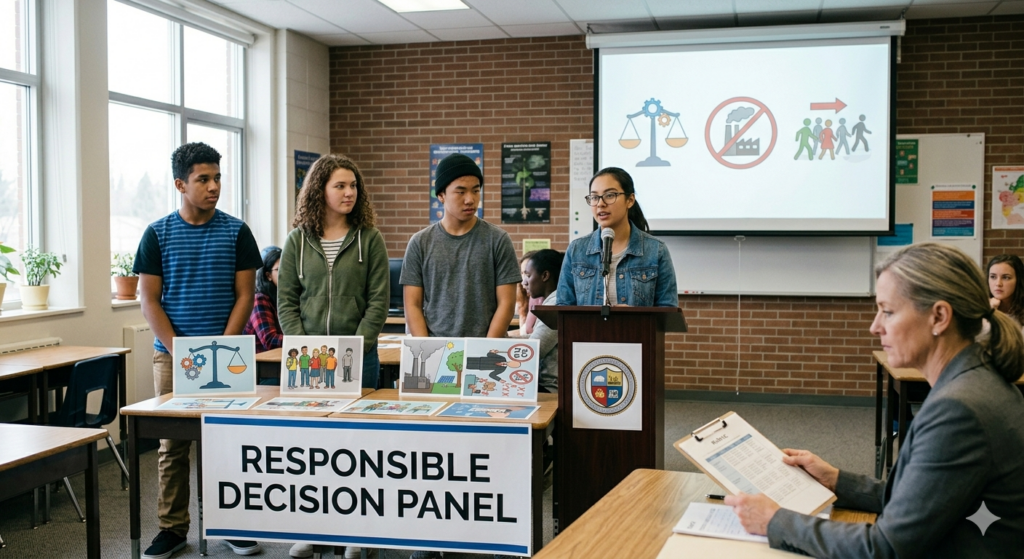
Part 1 – Preparation: Ethics Hearing Panel (15 min)
Students prepare for an “Ethics Hearing Panel.” Each group receives one dilemma:
– censorship
– immigration
– AI bias
– environmental accountability
– privacy vs. safety
They prepare a short position using at least three passive or impersonal passive structures. The teacher reminds students that they must sound formal, respectful, and evidence-based.
Part 2 – Ethics Hearing Panel (50 min)
Each group presents its position to the class as if they were speaking before a committee. One student introduces the issue, another explains who is affected, another presents the ethical concern, and another proposes a responsible decision. They must use expressions such as “It is believed that…,” “It has been suggested that…,” “People are affected when…,” and “The policy should be reviewed.” The teacher evaluates grammar accuracy, argumentation, formal tone, and interaction.
Part 3 – Panel Reflection (15 min)
After the presentations, students write a short listener reflection: “Which argument was the most convincing and why?” The teacher uses this closing moment to reinforce that passive structures help speakers sound formal and objective when discussing complex ethical issues.
 RUBRIC:
Ethical Dilemmas Rubrics
NEE – Agregar el tipo de adaptaciones curriculares
Principio II: Pautas 6.1 – 6.3 – 6.4
Principio III: Pautas 7.1 – 8.1 – 9.1
ALUMNO 1: Constante monitoreo. Dar tiempo adicional para el desarrollo de la actividad y se reduce el número de ejercicios o se modifican los ejercicios con un nivel de dificultad reducido, de acuerdo con sus necesidades académicas.
ALUMNO 2: Constante monitoreo, Dar tiempo adicional para el desarrollo de la actividad y se reduce el número de ejercicios o se modifican los ejercicios con un nivel de dificultad reducido, de acuerdo con sus necesidades académicas.
ALUMNO 3: Constante monitoreo. Corroborar que el contenido entregado en clase haya sido comprendido por la estudiante mediante retroalimentación.