
Complex Thought

SKILLS
EFL.5.1.9 Communicate information and ideas effectively to diverse audiences using a variety of media and formats.
EFL.5.1.11. Apply self-correcting and self-monitoring strategies in social and classroom interactions by adjusting presentation and language production to effectively express opinions and make evaluations. (Example: asking questions, starting over, rephrasing, exploring alternative pronunciations, etc.)


REAL-LIFE APPLICATION

This topic helps students express precise, mature, and analytical ideas when interpreting visual communication. In real life, students constantly see persuasive images in campaigns, news, social media, public messages, product advertising, political communication, and institutional announcements. By learning cleft sentences and varied structures, they can explain exactly what an image emphasizes, what it hides, what assumption it creates, and how it influences an audience. This skill is useful for academic writing, visual analysis, media literacy, persuasive speeches, public campaigns, and formal discussions.
LEARNING ACTIVITIES
SESSION 1 (80 min) ANTICIPATION
Part 1: Anticipation: Visual Evidence Freeze (20 min)
The teacher shows a powerful campaign image for only 15 seconds, then removes it.

Students write down the first three things they remember. Then the image is shown again, and students compare memory with evidence.
This activity helps students understand that visual persuasion often works quickly. People remember certain details more than others, and those details shape interpretation. The teacher asks:
What did you remember first?
Was it a person, color, object, or emotion?
What did you not notice the first time?
What does this reveal about visual focus?
How could a campaign designer control what the audience remembers?
The teacher then introduces cleft sentences as a way to name the focus:
“It was the empty street that I remembered first.”
“What the image made me notice was the contrast between light and darkness.”
Part 2: Vocabulary Activation: Assumption Walk (15 min)
Students examine how one image can create assumptions. The teacher places four signs in different areas:
audience emotion evidence ethical concern
Students decide which sound best matches the visual message and explain why using vocabulary from the list.
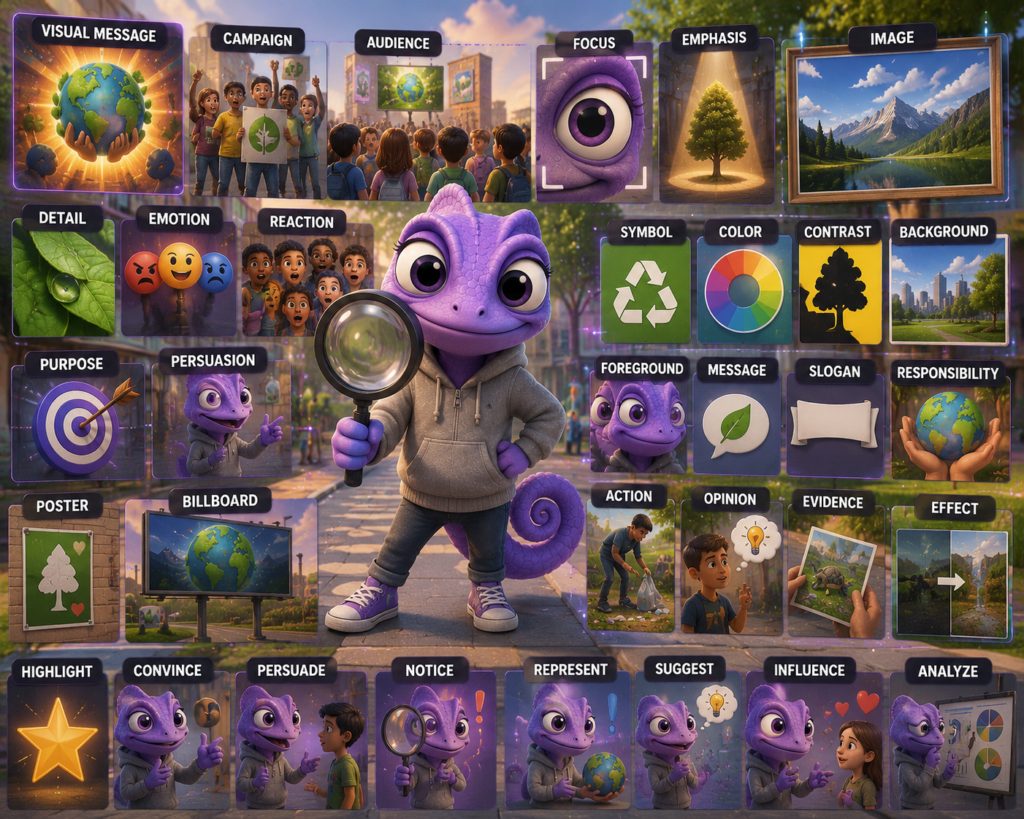
visual persuasion
rhetorical effect
audience
assumption
interpretation
emphasis
focus
credibility
emotion
evidence
manipulation
ethical concern
campaign strategy
visual contrast
composition
framing
symbolism
context
implication
target audience
persuasive purpose
social impact
responsibility
narrative
ambiguity
effectiveness
evaluate
emphasize
challenge
question
influence
reframe
representation
public message
The teacher should encourage students to use at least one visual word and one persuasion word in each explanation.
Part 3: Grammar Input: Cleft Sentences for Precise Analytical Thought (30 min)
The teacher explains that cleft sentences are useful when a writer or speaker wants to control the audience’s attention. In visual analysis, this matters because not all details are equally important. Some details create emotion. Some provide evidence. Some reveal bias. Some hide responsibility.

Normal sentence:
“The photo creates urgency because of the dark background.”
Cleft sentence:
“It is the dark background that creates urgency.”
The cleft version is more focused because it highlights the exact visual element responsible for the effect.
Main structures:
It + be + focused element + that / who + rest of sentence
Examples:
“It is the absence of people that makes the image disturbing.”
“It was the final frame that changed the meaning of the campaign.”
“It is the viewer’s assumption that the image challenges.”
What + clause + be + focused idea
Examples:
“What makes the poster persuasive is its use of contrast.”
“What the campaign fails to explain is who is responsible.”
“What the audience remembers is the emotional image, not the data.”
More advanced use:
It is not ______ that matters most, but ______.
Example:
“It is not the slogan that matters most, but the image behind it.”
What the image does is + base verb phrase.
Example:
“What the image does is challenge the viewer’s sense of responsibility.”
The teacher should explain that cleft sentences are not only “advanced grammar.” They are thinking tools. They help students avoid general statements like:
“The image is strong.”
Instead, they produce precise analysis:
“What makes the image strong is the contrast between the smiling child and the polluted background.”
Part 4: Grammar Teaching Idea: Visual Annotation Overlay (15 min)
The teacher projects a campaign image and creates an annotation overlay. Each annotation must become a cleft sentence.
Annotation 1: strongest detail
“It is the broken mirror that suggests social division.”
Annotation 2: emotional effect
“What creates discomfort is the empty space around the person.”
Annotation 3: missing information
“What the image does not show is the cause of the problem.”
Annotation 4: audience assumption
“It is the viewer’s assumption that the campaign challenges.”
Students then create their own annotation overlays on printed images or digital screenshots. They write short labels first, then transform them into cleft sentences. This teaches grammar as a tool for visual reasoning.
SESSION 2: CONSTRUCTION – REINFORCEMENT (40 min)
Part 1 – Ethical Persuasion Line (15 min)

The room becomes a line from “responsible persuasion” to “manipulative persuasion.” The teacher shows campaign images or describes visual scenarios. Students stand on the line according to their judgment and defend their position with cleft sentences.
Example:
“What concerns me is the use of fear without a clear solution.”
“It is the lack of evidence that makes the message questionable.”
“What makes it responsible is that it shows both the problem and a possible action.”
This activity is mature and analytical because students evaluate ethics, not only grammar.
Part 2 – Structure Variety Duel (15 min)
Pairs receive a basic idea and must express it in three different ways:
- simple analytical sentence
- It-cleft
- What-cleft
Example idea:
“The campaign needs context.”
Simple:
“The campaign needs more context to avoid misunderstanding.”
It-cleft:
“It is context that the campaign needs most.”
What-cleft:
“What the campaign needs most is context.”
Then students decide which version works best in:
a speech
an essay
a social media caption
a formal analysis
This helps students connect structure with audience and register.
Part 3 – Exit Precision Sentence (10 min)
Each student says one sentence using this structure:
“What makes the message persuasive is…”
“It is not ______ but ______ that…”
“What the image fails to show is…”
SESSION 3: CONSOLIDATION (80 min)
Part 1- Preparation: Gallery of Assumptions (15 min)

Students choose one campaign-style image and prepare five analytical keywords:
focus
audience
emotion
evidence
assumption
They may not write a full script. The goal is to speak from structured thinking rather than memorized paragraphs.
Part 2 – Gallery of Assumptions: Visual Analysis Performance (50 min)
This consolidation is designed as a moving interpretation challenge, not a traditional presentation. Images are displayed in different areas. Each group stands beside one image and becomes its “interpretation team.” Visitors ask questions and challenge their reading of the image.
Each team must explain:
What the image emphasizes
What the audience may assume
What detail creates emotion
What is missing or unclear
Whether the image persuades responsibly
Required structures:
“It is ______ that…”
“What the image emphasizes is…”
“What the audience might assume is…”
“What the campaign fails to show is…”
“It is not ______ but ______ that…”
Audience challenge questions:
What makes you think that?
What visual evidence supports your idea?
Could another audience interpret it differently?
What is missing from the image?
Is the image persuasive or manipulative?
This activity integrates grammar, media literacy, visual analysis, and oral interaction. It also encourages students to defend ideas with evidence.
Part 3 – Final Reflection: Precision Changed My Interpretation (15 min)
Students complete a short oral reflection:
“One detail I did not notice at first was…”
“What changed my interpretation was…”
“What makes visual persuasion powerful is…”
“What I need to improve in my analytical speaking is…”
RUBRIC: Complex Thought
NEE – Agregar el tipo de adaptaciones curriculares
Principio II: Pautas 6.1 – 6.3 – 6.4
Principio III: Pautas 7.1 – 8.1 – 9.1
ALUMNO 1: Constante monitoreo. Dar tiempo adicional para el desarrollo de la actividad y se reduce el número de ejercicios o se modifican los ejercicios con un nivel de dificultad reducido, de acuerdo con sus necesidades académicas.
ALUMNO 2: Constante monitoreo, Dar tiempo adicional para el desarrollo de la actividad y se reduce el número de ejercicios o se modifican los ejercicios con un nivel de dificultad reducido, de acuerdo con sus necesidades académicas.
ALUMNO 3: Constante monitoreo. Corroborar que el contenido entregado en clase haya sido comprendido por la estudiante mediante retroalimentación.