
Speculating on History

SKILLS
EFL.5.2.11 Express opinions on abstract topics and concrete topics while describing one’s reactions and others’ opinions.
EFL.5.3.3 Determine the main conclusion in texts which clearly argue a point of view in order to make informed decisions about one’s own opinion and reaction.


REAL-LIFE APPLICATION
This topic helps students analyze global decisions critically and responsibly. Past modals allow students to discuss what leaders should have done, what must have been true based on evidence, and what might have caused certain consequences. In real life, this supports academic discussion, historical analysis, debate, civic awareness, and critical thinking about public decisions.

LEARNING ACTIVITIES
SESSION 1 (80 min) ANTICIPATION
Part 1: Anticipation: Global Decision Evidence Wall (20 min)
The teacher displays evidence cards around the room: a delayed response, a censored report, a failed negotiation, an ignored warning, a discriminatory policy, or a public protest. Students walk around and write one possible explanation for each. The teacher asks: How can we speculate responsibly about the past without inventing facts? This frames the difference between evidence-based speculation and unsupported opinion.
Evidence cards:
- A warning was sent before a disaster.
- A public protest grew rapidly.
- A peace agreement was rejected.
- A policy excluded a minority group.
- A government restricted public information.
- A company hid environmental damage.
- A country delayed humanitarian aid.
- A school system denied access to certain groups.
- A leader ignored expert advice.
- A law was changed after public pressure.
CONSTRUCTION
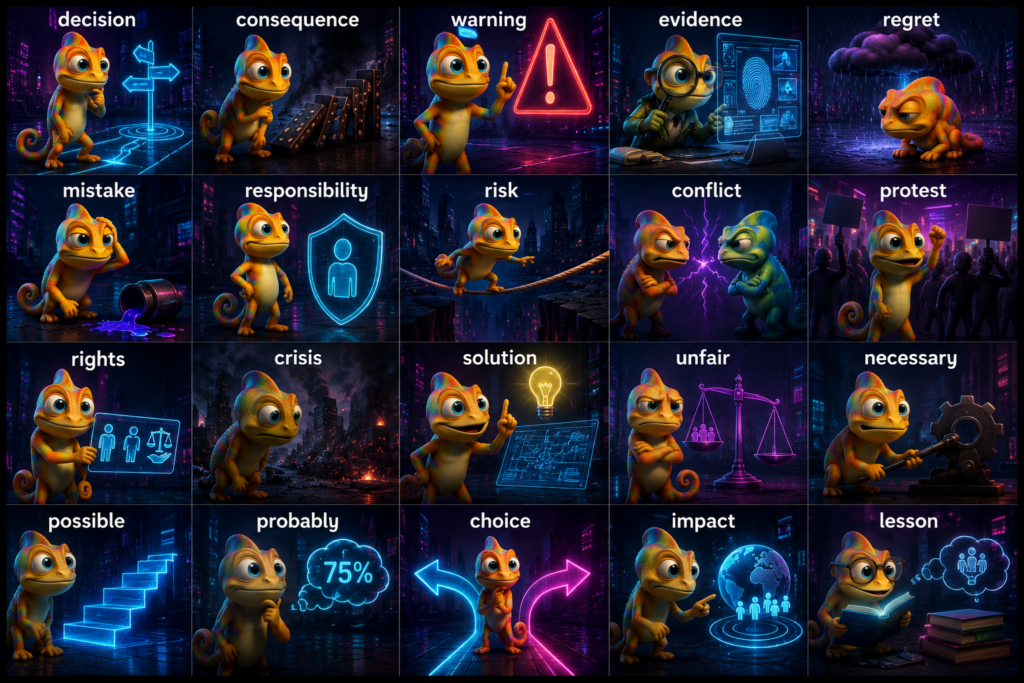
Part 2: Vocabulary for Global Decision Analysis (15 min)
The teacher introduces vocabulary that supports historical speculation and critical analysis.
- global decision
- policy failure
- diplomatic negotiation
- public pressure
- humanitarian crisis
- civil rights
- expert warning
- institutional failure
- public accountability
- political consequence
- ethical responsibility
- historical evidence
- social unrest
- long-term impact
- unintended consequence
- reform
- intervention
- censorship
- migration
- conflict resolution
- public trust
- collective responsibility
- leadership failure
- risk assessment
- moral obligation
Part 3: Grammar Input: Past Modals for Historical Speculation (25 min)
The teacher explains that past modals allow speakers to judge or infer past events with different levels of certainty.

should have + past participle = criticism or missed responsibility
Example: Leaders should have responded earlier.
should not have + past participle = criticism of a wrong action
Example: Authorities should not have censored information.
must have + past participle = strong deduction based on evidence
Example: The decision must have caused public anger.
might have / may have / could have + past participle = possible explanation
Example: The policy might have increased inequality.
Exercise: Complete each sentence with an appropriate past modal and justify the choice orally.
1. The government had expert warnings; it ______ acted before the crisis.
2. The protest involved thousands of people; the issue ______ been serious.
3. The report was hidden from the public; authorities ______ censored it to avoid criticism.
4.The policy excluded a minority group; it ______ been approved without proper ethical review.
5. The peace talks failed; negotiators ______ considered alternative proposals.
6.The environmental damage was visible; the company ______ ignored safety standards.
7. The reform happened only after pressure; leaders ______ responded earlier.
8. The law created inequality; it ______ been passed in that form.
9. The crisis spread quickly; authorities ______ underestimated the risk.
10. The decision damaged public trust; officials ______ communicated more transparently.
Part 4: Speculation Accuracy Ladder (20 min)
Students practice ranking speculation from strong evidence to possibility to criticism. The teacher gives one decision, and students must create three sentences: one with must have, one with might have, and one with should have. Then they explain which sentence is strongest and why.
Decisions:
- A government ignored a health warning.
- A country restricted voting rights.
- A company hid pollution data.
- A leader rejected peace talks.
- A school system excluded girls.
- A law was changed after protests.
- A country delayed humanitarian aid.
- A government censored newspapers.
- A committee ignored expert advice.
- A policy increased inequality.
Example:
“The government must have known the risk.”
“The government might have feared public panic.”
“The government should have informed citizens earlier.”
SESSION 2: CONSTRUCTION – REINFORCEMENT (40 min)
Part 1 – Historical Press Conference (15 min)

Students work in groups of three: journalist, historian, and government representative. The journalist asks critical questions, the historian speculates using evidence, and the representative responds defensively but formally. Students rotate roles after one round. This is oral and interactive, not a written worksheet.
Question prompts:
- Why was the warning ignored?
- Why was the policy approved?
- Why were people excluded?
- Why was the report hidden?
- Why were negotiations rejected?
- Why was the response delayed?
- Why was the law changed later?
- Why were experts not heard?
- Why was public trust damaged?
- Why were communities not consulted?
Required responses:
It must have…
It might have…
They should have…
They should not have…
Part 2 – Decision Ranking Debate (15 min)
Students receive ten global decision cards and rank them from “most avoidable” to “least avoidable.” They must justify at least two choices using past modals. The teacher emphasizes that a strong argument distinguishes between certainty, possibility, and moral judgment.
Decision cards:
- Ignoring expert warnings
- Delaying humanitarian aid
- Censoring public information
- Excluding groups from education
- Rejecting peace negotiations
- Allowing environmental damage
- Passing discriminatory laws
- Ignoring public protests
- Failing to protect workers
- Using force instead of dialogue
Part 3 – One-Minute Speculation Brief (10 min)
Each student gives a short oral brief about one historical decision. They must include one should have sentence and one must have or might have sentence. The teacher corrects structure and pushes students to explain evidence.
SESSION 3: CONSOLIDATION (80 min)
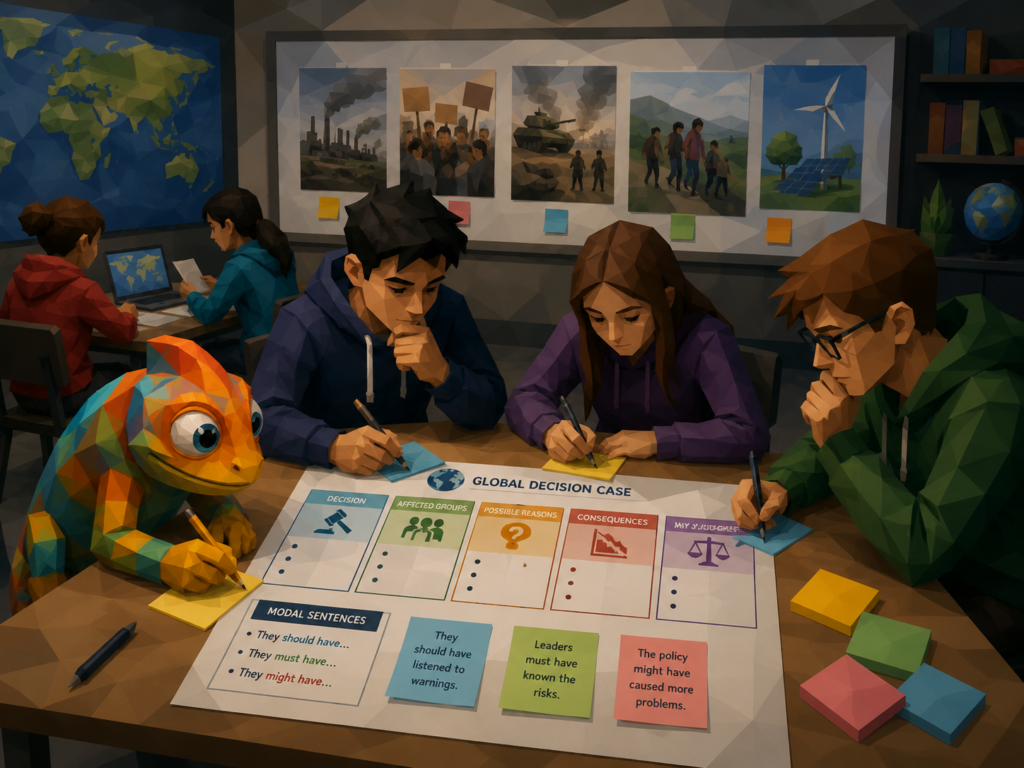
Part 1 – Preparation: Global Decision Inquiry Forum (15 min)
Students choose one global decision case and prepare keywords only. They must identify the decision, affected groups, possible reasons, consequences, and one judgment. They must use at least three past modal structures.
Case options:
- A government ignored disaster warnings.
- Leaders rejected peace negotiations.
- A policy excluded a minority group.
- Public information was censored.
- Environmental warnings were ignored.
- A country delayed humanitarian aid.
- A school system excluded girls.
- A law caused discrimination.
- A company hid harmful information.
- A reform was delayed until protests increased.
Part 2 – Global Decision Inquiry Forum (50 min)
Students participate in an inquiry forum. Each speaker presents a 60–90 second analysis of one past decision. Then two classmates ask questions as inquiry panel members. The speaker must answer using past modals and evidence-based reasoning. The goal is not to guess randomly, but to speculate responsibly using clues, consequences, and ethical judgment.
Required structure:
Identify the decision.
Explain who was affected.
Use one should have / should not have.
Use one must have.
Use one might have / could have.
Answer one follow-up question.
Part 3 – Evidence-Based Reflection (15 min)
Students choose one speaker whose speculation was convincing. They explain why using this frame: “The argument was convincing because the speaker used evidence to show that…” The teacher closes by highlighting that historical speculation must be careful, ethical, and supported.
 RUBRIC:
Speculating on History
NEE – Agregar el tipo de adaptaciones curriculares
Principio II: Pautas 6.1 – 6.3 – 6.4
Principio III: Pautas 7.1 – 8.1 – 9.1
ALUMNO 1: Constante monitoreo. Dar tiempo adicional para el desarrollo de la actividad y se reduce el número de ejercicios o se modifican los ejercicios con un nivel de dificultad reducido, de acuerdo con sus necesidades académicas.
ALUMNO 2: Constante monitoreo, Dar tiempo adicional para el desarrollo de la actividad y se reduce el número de ejercicios o se modifican los ejercicios con un nivel de dificultad reducido, de acuerdo con sus necesidades académicas.
ALUMNO 3: Constante monitoreo. Corroborar que el contenido entregado en clase haya sido comprendido por la estudiante mediante retroalimentación.