
Peer Reviewing

SKILLS
EFL.5.4.7 Use the process of prewriting, drafting, revising, peer editing and proofreading to produce well-constructed informational texts.
EFL.5.2.15 Engage in an extended conversation on most general topics and keep it going by expressing and responding to suggestions, opinions, attitudes, advice, and feelings.
REAL-LIFE APPLICATION
This topic prepares students to review written work critically and professionally. At B2 level, peer review should go beyond saying “good” or “bad.” Students must evaluate clarity, argument, evidence, register, style, and punctuation. Dashes and parentheses help writers control tone and emphasis, which is important in essays, reports, proposals, and academic writing.
LEARNING ACTIVITIES
SESSION 1 (80 min) ANTICIPATION
Part 1: Anticipation: Editorial Board Simulation (20 min)
The teacher gives groups two short writing samples: one with vague ideas and weak style, and one with clearer organization and punctuation. Students act as an editorial board and decide which text is closer to publication. They must explain their decision using academic criteria: clarity, coherence, register, evidence, and style.
Evaluation questions:
Is the main idea clear?
Is the tone formal enough?
Does the writer support the argument?
Are transitions effective?
Does punctuation improve the flow?
Is any sentence too vague?
Is any idea repeated?
Is the conclusion strong?
Is the feedback specific?
What revision would improve the text most?
CONSTRUCTION
Part 2: Vocabulary for Critical Peer Review (15 min)
The teacher introduces vocabulary for advanced peer review.
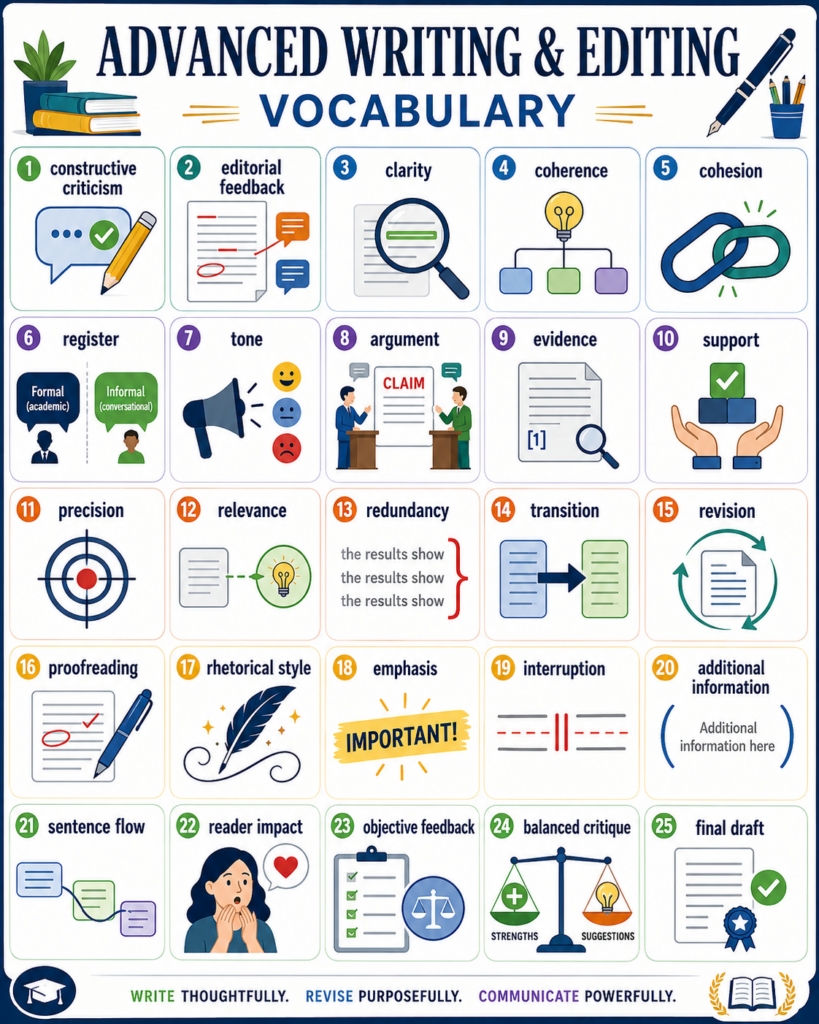
constructive criticism
editorial feedback
clarity
coherence
cohesion
register
tone
argument
evidence
support
precision
relevance
redundancy
transition
revision
proofreading
rhetorical style
emphasis
interruption
additional information
sentence flow
reader impact
objective feedback
balanced critique
final draft
Part 3: Punctuation Input: Dashes and Parentheses for Style (25 min)
The teacher explains

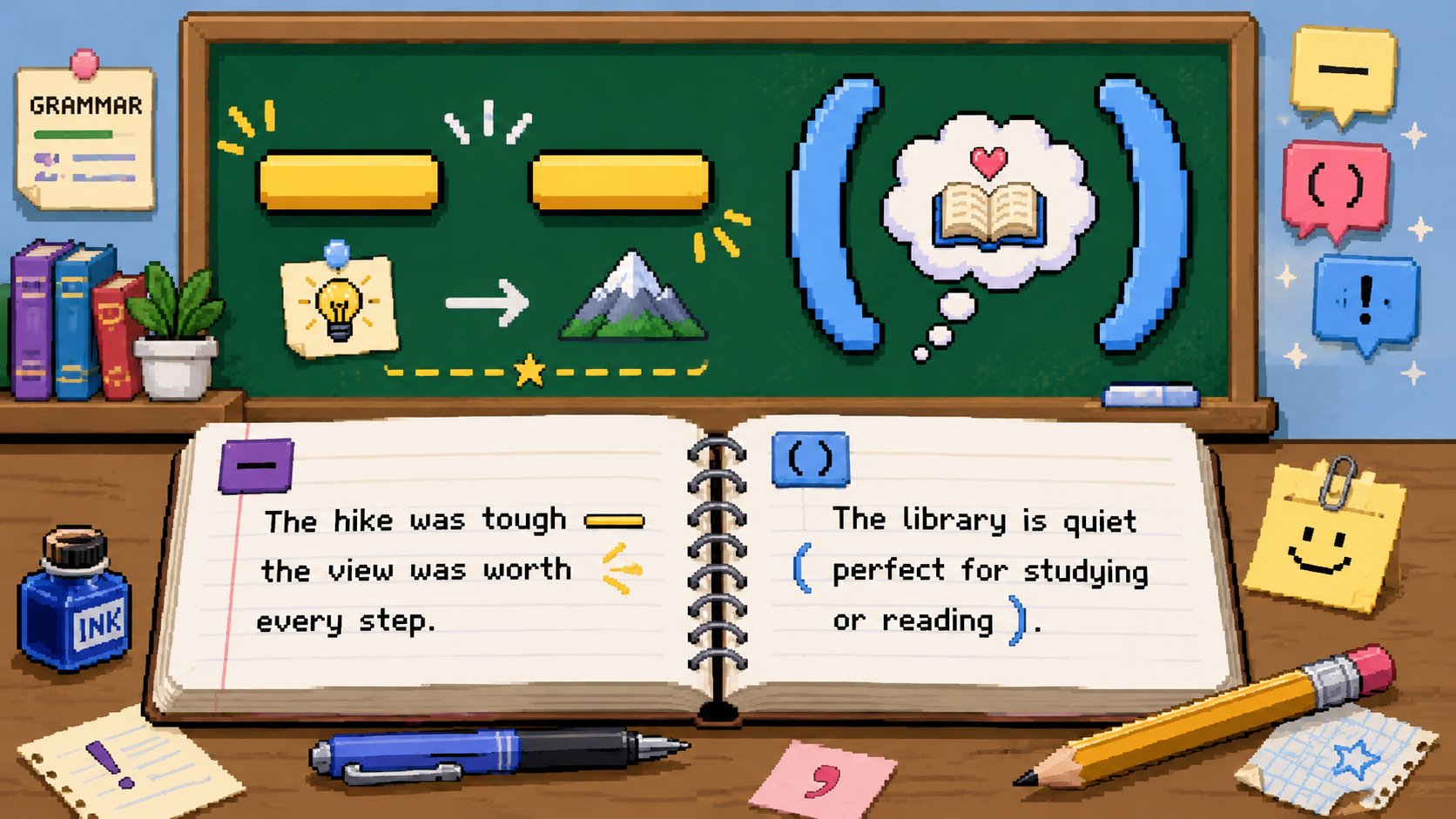
Dashes and parentheses are punctuation tools for style, not just grammar. Dashes create emphasis, contrast, interruption, or dramatic clarification. Parentheses add extra information, examples, or clarification without interrupting the main sentence strongly.
Examples:
The argument needs stronger evidence — not more opinions.
The argument needs stronger evidence (especially in the second paragraph).
The dash gives stronger emphasis. Parentheses make the comment more secondary.
Exercise: Choose the best punctuation and explain why.
- The thesis is clear ___ but the evidence is limited.
- The paragraph needs one key element ___ a stronger example.
- The conclusion ___ which is currently too short ___ should connect back to the thesis.
- The writer makes an interesting claim ___ however, it needs support.
- The tone is mostly formal ___ except for two expressions.
- The second paragraph has a strong idea ___ the one about consumer rights.
- The argument is persuasive ___ if the reader accepts the example.
- The text has one major weakness ___ lack of evidence.
- The final sentence is effective ___ it leaves the reader with a clear message.
- The introduction ___ although engaging ___ does not present a specific thesis.
Part 4: Feedback Trial: Defend Your Comment (20 min)
Students write feedback on a short draft. Then they must “defend” their comment to another group by explaining why the feedback is useful. This makes peer review more critical and oral.
Feedback tasks:
- Identify one strong point.
- Identify one unclear idea.
- Suggest one improvement.
- Add one dash for emphasis.
- Add one parenthesis for clarification.
- Explain how punctuation improves style.
- Check if the register is formal.
- Check if evidence is sufficient.
- Check if the conclusion is complete.
- Decide which revision is most urgent.
SESSION 2: CONSTRUCTION – REINFORCEMENT (40 min)
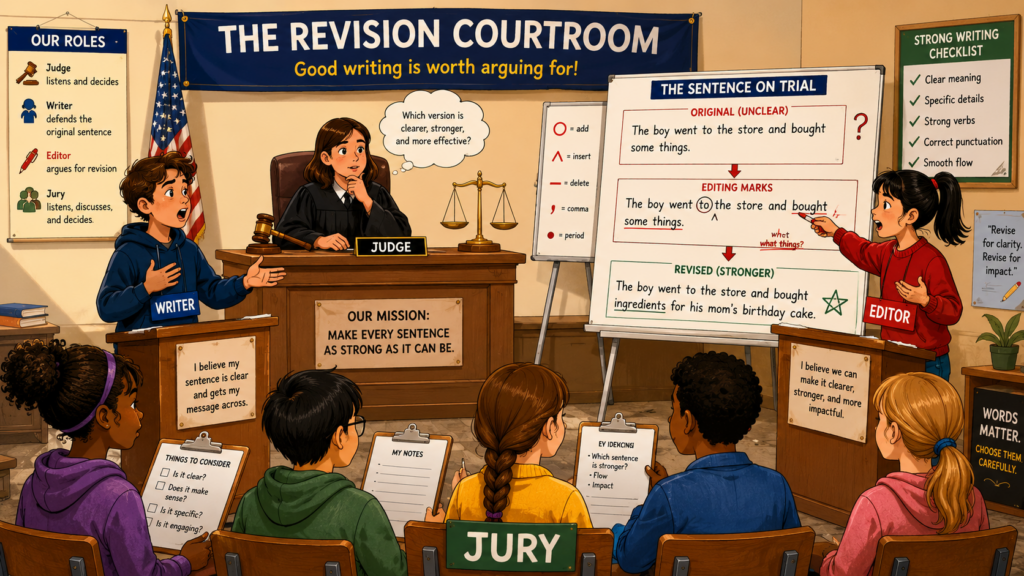
Part 1 – The Revision Courtroom (15 min)
Students act out a mock trial where one sentence is “accused” of being unclear or weak. One student is the writer, one is the editor, one is the judge, and others are the jury. The editor argues why the sentence needs revision; the writer defends the original version; the judge decides the best revision.
Sentence cases:
- This issue is bad and should be fixed.
- The business has problems with clients and other things.
- The argument is good because it is important.
- Students should learn more stuff about rights.
- The company did not do the right thing.
- This paragraph talks about legal problems.
- The conclusion is nice and clear.
- Technology affects people in many ways.
- The evidence is okay.
- The writer gives some examples.
Part 2 – Punctuation Debate Sprint (15 min)
Students receive sentences and debate whether a dash or parentheses creates a better effect. They must justify the choice orally.
Exercise: Choose dash or parentheses and explain.
- The argument has one weakness lack of evidence.
- The writer’s example the one about legal rights is relevant.
- The conclusion is clear but it needs stronger impact.
- The tone is formal except for one phrase.
- The essay needs revision not a completely new topic.
- The thesis should be more specific especially in relation to rights.
- The second paragraph is effective it connects evidence to the claim.
- The draft includes useful vocabulary such as accountability and responsibility.
- The introduction is engaging although slightly informal.
- The strongest idea is simple entrepreneurship requires legal awareness.
Part 3 – Editor’s Voice Note (10 min
Students record or perform a 30-second oral editorial comment. They must include one strength, one revision suggestion, and one punctuation recommendation.
Frame:
“One strength of your draft is…”
“One part I would revise is…”
“I suggest using a dash/parentheses because…”
SESSION 3: CONSOLIDATION (80 min)
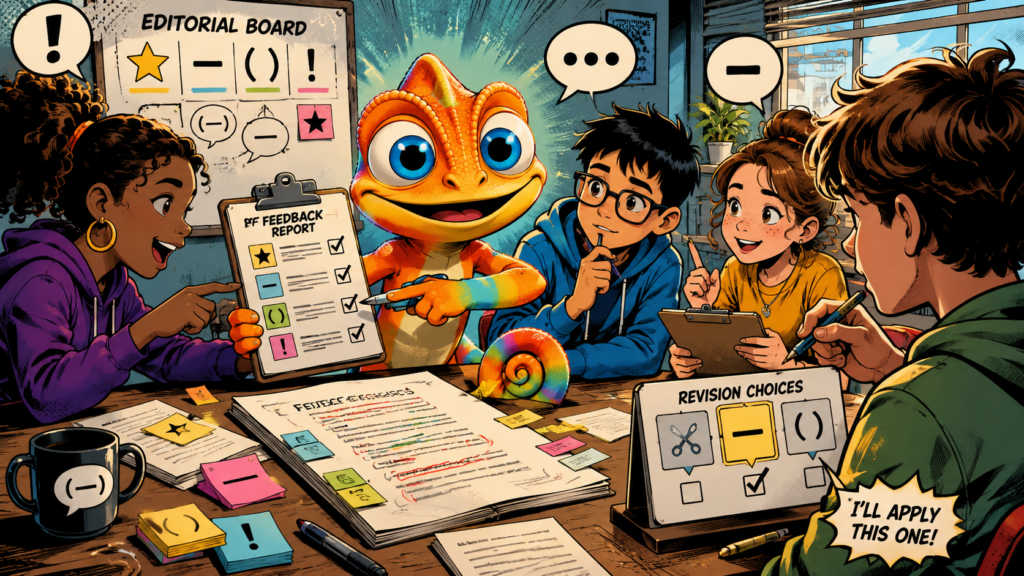
Part 1 – Preparation: Editorial Board Review Panel (15 min)
Students prepare to review a peer’s draft as an editorial board. Each group assigns roles: content editor, language editor, punctuation editor, and presenter. They prepare notes only, not a full script.
Roles:
- Content editor: checks argument and evidence.
- Language editor: checks register and clarity.
- Punctuation editor: checks dashes and parentheses.
- Presenter: summarizes feedback respectfully.
Part 2 – Editorial Board Review Panel (50 min)
Each group reviews one draft and presents a professional feedback report to the writer. The writer listens, asks one clarification question, and chooses one revision to apply. This is interactive because students must discuss, justify, and respond professionally, not just exchange papers.
Required feedback:
- one strength
- one content suggestion
- one language/register suggestion
- one punctuation suggestion using dash or parentheses
- one explanation of why the revision improves the text
Part 3 – Revision Pitch (15 min)
Each writer gives a short revision pitch explaining what they will change and why. The teacher closes by emphasizing that good peer review is precise, respectful, and useful for real improvement.
 RUBRIC:
Peer Reviewing
NEE – Agregar el tipo de adaptaciones curriculares
Principio II: Pautas 6.1 – 6.3 – 6.4
Principio III: Pautas 7.1 – 8.1 – 9.1
ALUMNO 1: Constante monitoreo. Dar tiempo adicional para el desarrollo de la actividad y se reduce el número de ejercicios o se modifican los ejercicios con un nivel de dificultad reducido, de acuerdo con sus necesidades académicas.
ALUMNO 2: Constante monitoreo, Dar tiempo adicional para el desarrollo de la actividad y se reduce el número de ejercicios o se modifican los ejercicios con un nivel de dificultad reducido, de acuerdo con sus necesidades académicas.
ALUMNO 3: Constante monitoreo. Corroborar que el contenido entregado en clase haya sido comprendido por la estudiante mediante retroalimentación.