
Global Nuances

SKILLS
EFL.5.1.4. Identify and interpret how cultural and language patterns in English are used when exchanging ideas on familiar topics according to a B1.2 level. (Example: slang, idioms, humor, levels of formality, etc.).
EFL.5.2.15. Engage in an extended conversation on most general topics and keep it going by expressing and responding to suggestions, opinions, attitudes, advice, feelings, etc.
REAL-LIFE APPLICATION
This topic helps students understand that advanced communication depends on nuance, register, tone, and cultural awareness. In professional or academic dialogue, the goal is not only to speak correctly, but to choose language that sounds respectful, diplomatic, and appropriate. Students practice responding spontaneously, softening disagreement, clarifying meaning, and adapting regional or colloquial expressions into professional English. In real life, this supports interviews, international projects, meetings, negotiations, university discussions, and global communication.
LEARNING ACTIVITIES
SESSION 1 (80 min) ANTICIPATION
Part 1: The Same Words, Different Meanings (20 min)
The teacher writes or projects five expressions that can sound different depending on context:
- “That’s interesting”
- “I’ll think about it”
- “With all due respect”
- “That’s bold”
- “Let’s circle back.”
Students discuss whether each expression sounds positive, negative, neutral, or indirect. The teacher asks: Why do people sometimes say one thing but mean another? This prepares students to analyze pragmatics, not just vocabulary.
CONSTRUCTION
Part 2: Nuance and Colloquialism Bank (15 min)
The teacher introduces a bank of regional colloquialisms, workplace expressions, and diplomatic phrases. Students do not simply translate them. They identify meaning, register, and professional equivalent.
- fair enough
- I’m not buying it
- that’s a stretch
- touch base
- circle back
- take it with a grain of salt
- read the room
- on the same page
- cut to the chase
- get the ball rolling
- table the issue
- play it by ear
- I see where you’re coming from
- with all due respect
- that may be a concern
- I’d like to push back on that
- could you elaborate?
- let me rephrase that
- I’m not entirely convinced
- we may need to reconsider
- that sounds reasonable
- I would frame it differently
- there may be room for improvement
- I appreciate the point, however…
- could we clarify the priority?
The teacher explains that some expressions are colloquial, some are professional, and some can sound polite but actually introduce disagreement. Students classify ten expressions as casual, neutral, or professional.
Part 3: Pragmatic Meaning Input (25 min)
The teacher explains that nuance is the difference between literal meaning and intended meaning. For example, “That’s interesting” may mean genuine interest, hesitation, or polite disagreement depending on tone. “With all due respect” often introduces disagreement, even if it sounds polite. The teacher models how intonation, pause, facial expression, and context change meaning.
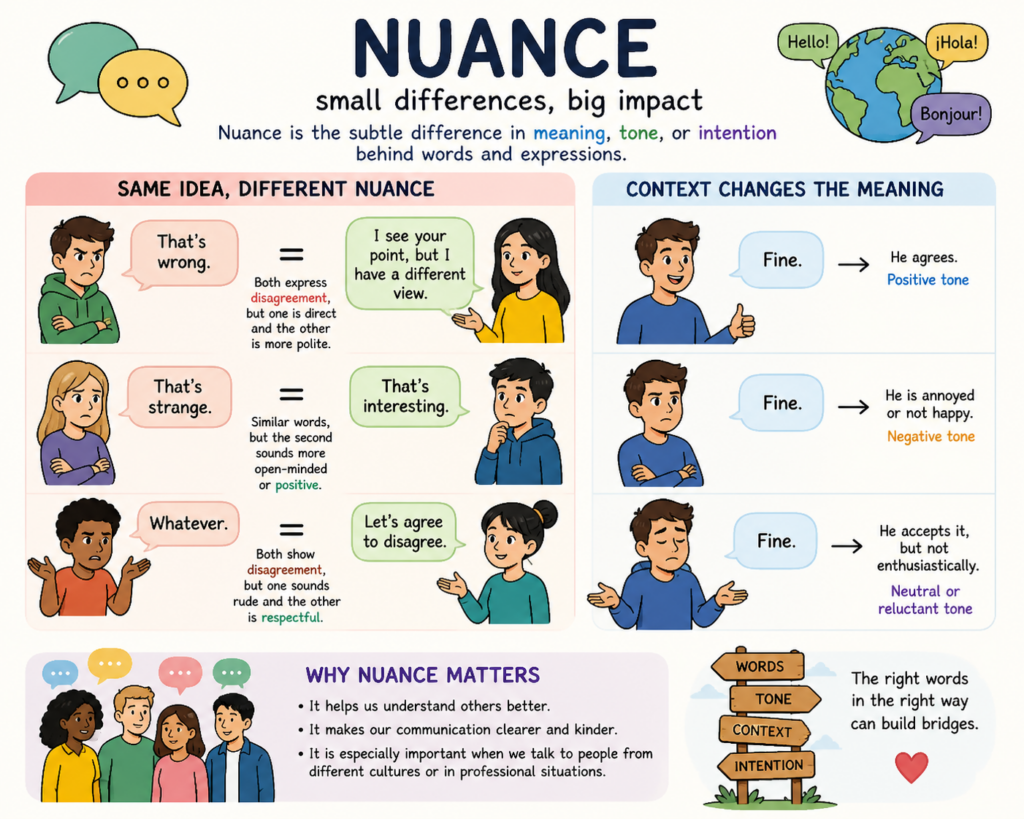
Nuance is the subtle difference in meaning, tone, register, or intention behind language. At a B2 level, students should understand that communication is not only about vocabulary accuracy, but also about how language sounds in context.
For example:
“That idea is wrong.”
This sounds direct and possibly rude.
“I would frame that idea differently.”
This communicates disagreement, but in a more professional and diplomatic way.
Both express disagreement, but they create different effects on the listener.
Another example:
“Fine.”
Depending on tone, this can mean agreement, frustration, or passive disagreement.
“That’s an interesting proposal.”
In a professional context, this may show interest, but it can also politely signal doubt.
Nuance is important because in global communication, people from different regions may interpret tone, humor, indirectness, and formality differently. A strong speaker knows how to adjust language depending on audience, purpose, and context.
Students practice interpreting implied meaning in short exchanges:
Exercise: Identify the implied meaning.
“That’s interesting…” said slowly after hearing a risky idea.
“With all due respect, I see it differently.”
“Let’s circle back to that later.”
“I’m not entirely convinced.”
“That’s a stretch.”
“I see where you’re coming from, but…”
“We may need to reconsider the timeline.”
“Could you elaborate on that?”
“Let’s cut to the chase.”
“I’d like to push back on that.”
Part 4: Register Conversion Lab (20 min)
Students transform casual or regionally informal expressions into professional dialogue language. The teacher explains that this is not about eliminating personality; it is about adapting language to context. Students work in groups and then perform two upgraded lines orally.

SESSION 2: CONSTRUCTION – REINFORCEMENT (40 min)
Part 1 – Diplomatic Disagreement Duel (15 min)
Students form two lines facing each other. One student presents a strong opinion, and the partner must disagree diplomatically without sounding rude. After each round, one line moves so students get a new partner. The teacher listens for tone, softening phrases, and turn-taking. This activity is oral, fast, and highly interactive.
Exercise: Disagree diplomatically with these statements.
- “AI should replace teachers completely.”
- “Social media has no educational value.”
- “Students should never use slang in English.”
- “Everyone understands English the same way.”
- “Professional communication should always be direct.”
- “Cultural differences do not affect conversations.”
- “If someone is offended, it is always their problem.”
- “Formal English is more important than natural English.”
- “Regional expressions are not useful.”
- “Misunderstandings are usually caused by bad grammar.”
Part 2 – Interruption and Recovery Drill (15 min)
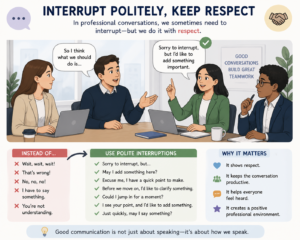
Students practice professional interruption and recovery. The teacher explains that in spontaneous professional dialogue, speakers sometimes need to interrupt, but they must do so politely. Students practice entering a conversation, asking for clarification, and returning the floor.
Statements:
“AI should replace teachers completely.” “Social media has no educational value.” “Students should never use slang in English.” “Everyone understands English the same way.” “Professional communication should always be direct.” “Cultural differences do not affect conversations.” “If someone is offended, it is always their problem.” “Formal English is more important than natural English.” “Regional expressions are not useful.” “Misunderstandings are usually caused by bad grammar.”
Part 3 – Two-Minute Meeting Snapshot (10 min)
Students work in groups of three and improvise a two-minute professional dialogue. One student is the facilitator, one presents an idea, and one asks clarifying questions. The dialogue must include one colloquial expression, one professional equivalent, and one diplomatic disagreement.
SESSION 3: CONSOLIDATION (80 min)
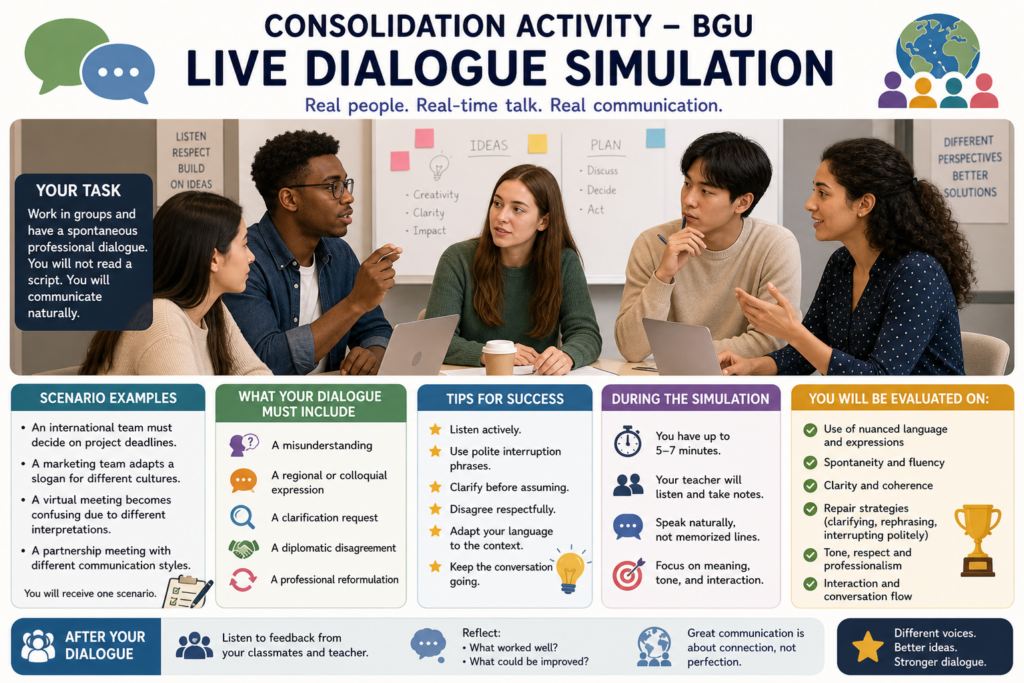
Part 1 – Preparation: Cross-Cultural Professional Dialogue Simulation (15 min)
Students receive a professional scenario involving international communication. They prepare goals, possible misunderstandings, and useful expressions. The teacher reminds them that they cannot write a full script. They may write only key phrases because the task is spontaneous dialogue.
Scenario options:
An international student project team disagrees about deadlines.
A marketing team must adapt a slogan for different cultures.
A school partnership meeting includes people with different communication styles.
A student ambassador must clarify a misunderstood expression.
A global youth panel discusses whether slang should be used in formal spaces.
A multicultural team must decide how direct feedback should be.
A virtual meeting becomes confusing because one phrase is interpreted differently.
A professional group must decide whether informal English is acceptable in presentations.
A debate team prepares for an international competition.
A university interview requires polite disagreement and clarification.
Part 2 – Live Dialogue Simulation (50 min)
Groups perform a spontaneous professional dialogue. The performance must include one misunderstanding, one regional or colloquial expression, one clarification request, one diplomatic disagreement, and one professional reformulation. The teacher evaluates nuance, tone, fluency, repair strategies, and interaction. This is not a memorized presentation; it is an oral simulation where students must respond in real time.
Part 3 – Feedback Triangle (15 min)
After each performance, three listeners give fast feedback: one comments on clarity, one comments on tone, and one comments on the most effective expression. The teacher closes by explaining that advanced communication depends on how meaning is managed, not only on how many words are spoken.
 RUBRIC:
Global Nuances
NEE – Agregar el tipo de adaptaciones curriculares
Principio II: Pautas 6.1 – 6.3 – 6.4
Principio III: Pautas 7.1 – 8.1 – 9.1
ALUMNO 1: Constante monitoreo. Dar tiempo adicional para el desarrollo de la actividad y se reduce el número de ejercicios o se modifican los ejercicios con un nivel de dificultad reducido, de acuerdo con sus necesidades académicas.
ALUMNO 2: Constante monitoreo, Dar tiempo adicional para el desarrollo de la actividad y se reduce el número de ejercicios o se modifican los ejercicios con un nivel de dificultad reducido, de acuerdo con sus necesidades académicas.
ALUMNO 3: Constante monitoreo. Corroborar que el contenido entregado en clase haya sido comprendido por la estudiante mediante retroalimentación.