
Historical Rights

SKILLS
EFL.5.2.11 Express opinions on abstract and concrete topics while describing reactions to them and others’ opinions.
EFL.5.2.15 Engage in an extended conversation on most general topics and keep it going by expressing and responding to opinions, attitudes, advice, and feelings.

REAL-LIFE APPLICATION
This topic helps students analyze how historical rights decisions continue to shape society today. The third conditional allows them to discuss regrets, missed opportunities, and alternative past outcomes. Mixed conditionals help them explain how different past actions could have changed present realities. In real life, this supports debate, historical analysis, civic reflection, ethical discussion, and academic speaking.
LEARNING ACTIVITIES
SESSION 1 (80 min) ANTICIPATION
Part 1: “History on Trial” Provocation (20 min)
The teacher presents controversial historical rights questions around the room. Students choose one and prepare a quick opinion. The teacher asks: “What present problem might exist because the past was handled poorly?” Students discuss in groups and identify causes, consequences, and affected communities. This opens the topic through critical thinking before grammar instruction.
Provocation cards:
- What if voting rights had been expanded earlier?
- What if education had been protected as a universal right sooner?
- What if discriminatory laws had been abolished earlier?
- What if Indigenous communities had been listened to?
- What if women’s rights had been recognized sooner?
- What if workers’ safety had been prioritized earlier?
- What if freedom of expression had been protected consistently?
- What if historical injustices had been acknowledged publicly?
- What if children’s rights had been enforced earlier?
- What if cultural identity had been respected by institutions?
CONSTRUCTION
Part 2: Vocabulary for Rights and Historical Consequence (15 min)
The teacher introduces vocabulary for analytical discussion.
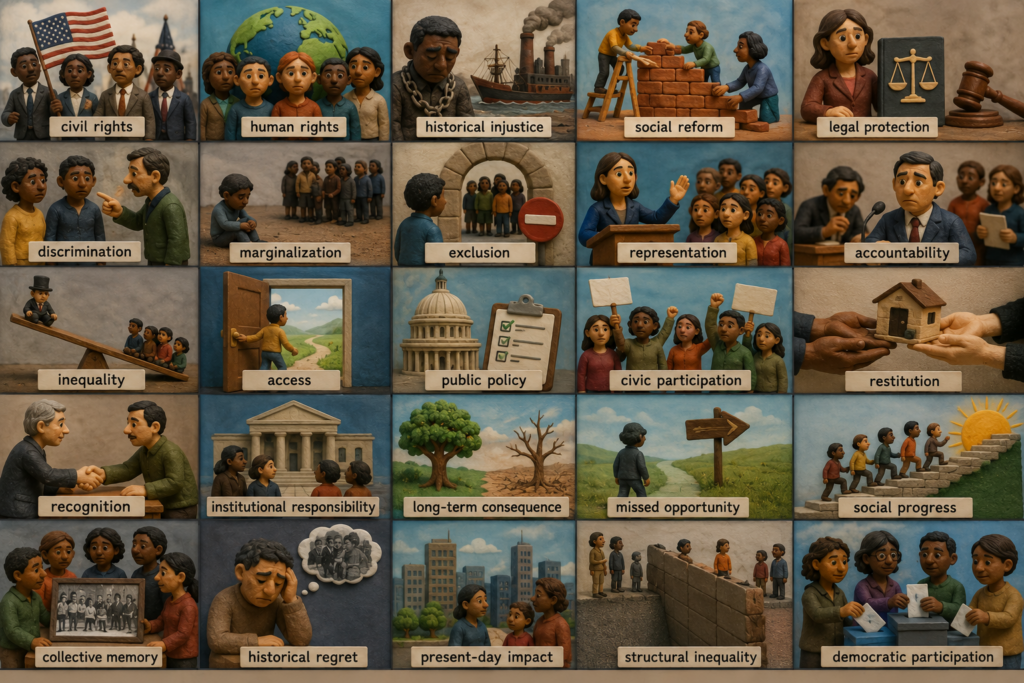
- civil rights
- human rights
- historical injustice
- social reform
- legal protection
- discrimination
- marginalization
- exclusion
- representation
- accountability
- inequality
- access
- public policy
- civic participation
- restitution
- recognition
- institutional responsibility
- long-term consequence
- missed opportunity
- social progress
- collective memory
- historical regret
- present-day impact
- structural inequality
- democratic participation
Part 3: Grammar Input: Third Conditional for Historical Regret (25 min)
The teacher explains the third conditional:
Third Conditional
The third conditional is used to analyze unreal past situations and their imagined past results. It is especially useful for discussing historical regrets.
Form: If + past perfect, would + have + past participle.
Examples:
- “If I had studied harder, I would have passed the exam.”
- “If discriminatory laws had been abolished earlier, many communities would have experienced greater protection.”
This structure does not change history; it helps evaluate decisions and consequences.
Expand the third conditional sentence
Part 4: Mixed Conditional Debate Builder (20 min)
The teacher explains that mixed conditionals connect an unreal past with a present result.
Structure: If + past perfect, would + base verb.
Example: “If education had been equal in the past, more people would have access to opportunities today.”
Students use this structure to explain present consequences of historical decisions.
Historical Decisions for Mixed Conditionals
- Governments delayed equal access to education.
- Some societies limited voting rights.
- Leaders ignored discrimination for many years.
- Workers were not given legal protection.
- Indigenous communities were not consulted.
- Women were excluded from leadership roles.
- Freedom of expression was restricted.
- Public institutions ignored cultural identity.
- Children’s rights were not protected early enough.
- Environmental damage was not controlled.
- Schools separated students by race or social class.
- Some communities were denied access to land.
- Governments failed to recognize historical injustice.
- Laws protected only certain groups.
- Social reforms were delayed
Example Use
If governments had delayed equal access to education less, more people would have better opportunities today.
If voting rights had been expanded earlier, democracy would be stronger today.
SESSION 2: CONSTRUCTION – REINFORCEMENT (40 min)
Part 1 – Counterfactual Courtroom (15 min)
Students receive historical rights claims and must respond as “historical analysts.”
One student says the original problem, and another responds with a third conditional. This makes grammar oral and analytical.
Claims:
- Many people were denied voting rights.
- Workers were not protected.
- Women were excluded from leadership.
- Indigenous communities were ignored.
- Children had limited access to education.
- Discriminatory laws were accepted.
- Public debate was censored.
- Cultural traditions were dismissed.
- Communities were not consulted.
- Historical abuses were hidden.
Part 2 – Present Impact Challenge (15 min)
Students must connect past injustice to present impact using mixed conditionals. The teacher gives a past situation, and students must say a present result.
Prompts:
- unequal education
- limited voting rights
- discrimination
- lack of worker protection
- ignored Indigenous voices
- restricted expression
- weak legal protection
- social exclusion
- lack of accountability
- cultural erasure
Response frame:
“If _ had been addressed earlier, _ would be/would have __ today.”
Part 3 – One-Minute Historical Analyst (10 min)
Students choose one issue and speak for one minute using one third conditional and one mixed conditional. The teacher listens for accuracy, coherence, and formal tone.
SESSION 3: CONSOLIDATION (80 min)
Part 1 – Preparation: Historical Rights Brief (15 min)
Students prepare a debate brief on one historical rights issue. They may use keywords only, not a script. Their brief must include a historical problem, one third conditional regret, one mixed conditional present impact, and one position about why the issue still matters.
Issue options:
- Voting rights
- Equal education
- Workers’ rights
- Women’s rights
- Indigenous rights
- Freedom of expression
- Anti-discrimination laws
- Children’s rights
- Cultural recognition
- Environmental rights as human rights
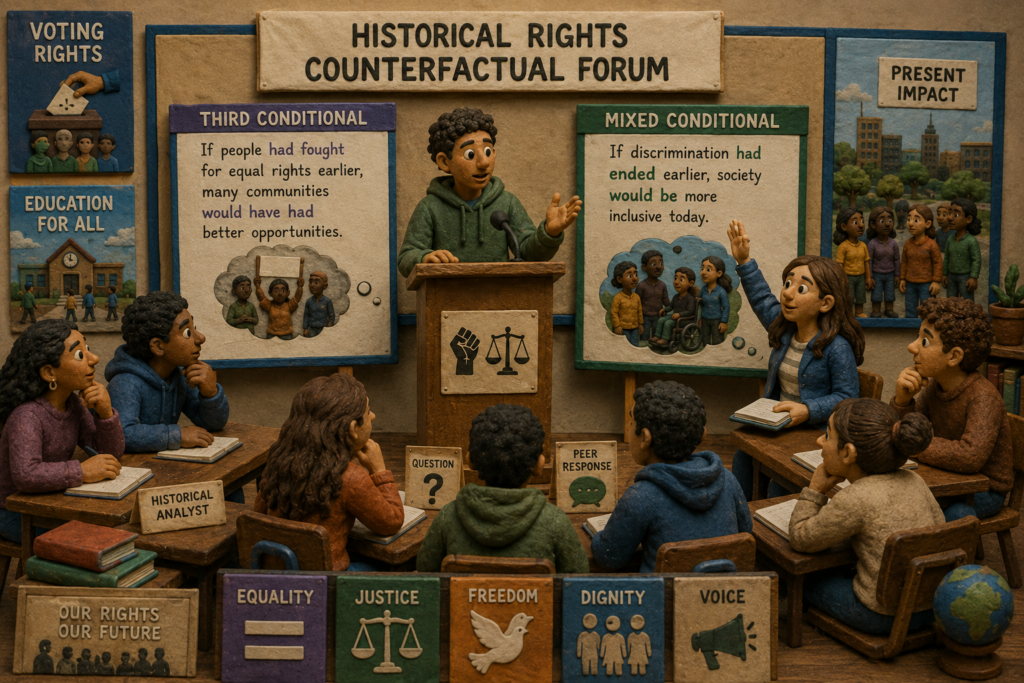
Part 2 – Historical Rights Counterfactual Forum (50 min)
Students participate in a forum. Each student gives a 60–90 second statement as a historical rights analyst. They must explain what happened, what could have happened differently, and how the present would be different today. After speaking, they answer one question from a peer. This is an oral academic activity, not a written essay or simple presentation.
Required structure
- one third conditional
- one mixed conditional
- one rights-related vocabulary word
- one explanation of present impact
- one peer response
Part 3 – Forum Reflection: “Most Powerful Counterfactual” (15 min)
Students choose the strongest counterfactual they heard and explain why it was convincing.
The teacher closes by emphasizing that conditionals help speakers analyze responsibility, consequence, and historical impact.
 RUBRIC:
Historical Rights Rubrics
NEE – Agregar el tipo de adaptaciones curriculares
Principio II: Pautas 6.1 – 6.3 – 6.4
Principio III: Pautas 7.1 – 8.1 – 9.1
ALUMNO 1: Constante monitoreo. Dar tiempo adicional para el desarrollo de la actividad y se reduce el número de ejercicios o se modifican los ejercicios con un nivel de dificultad reducido, de acuerdo con sus necesidades académicas.
ALUMNO 2: Constante monitoreo, Dar tiempo adicional para el desarrollo de la actividad y se reduce el número de ejercicios o se modifican los ejercicios con un nivel de dificultad reducido, de acuerdo con sus necesidades académicas.
ALUMNO 3: Constante monitoreo. Corroborar que el contenido entregado en clase haya sido comprendido por la estudiante mediante retroalimentación.