
Persuasive Tools

SKILLS
EFL.5.1.9 Communicate information and ideas effectively to diverse audiences using a variety of media and formats.
EFL.5.1.11 Apply self-correcting and self-monitoring strategies in social and classroom interactions by adjusting presentation and language production to effectively express opinions and make evaluations.


REAL-LIFE APPLICATION

This topic helps students sound more precise, formal, and persuasive in academic and public communication. At B2 level, students should not only state an opinion; they should structure it, emphasize key claims, recognize counterarguments, and show logical relationships between ideas.
Inversion helps students highlight strong claims.
LEARNING ACTIVITIES
SESSION 1 (80 min) ANTICIPATION
Part 1: Public Statement Pressure Test — 20 min
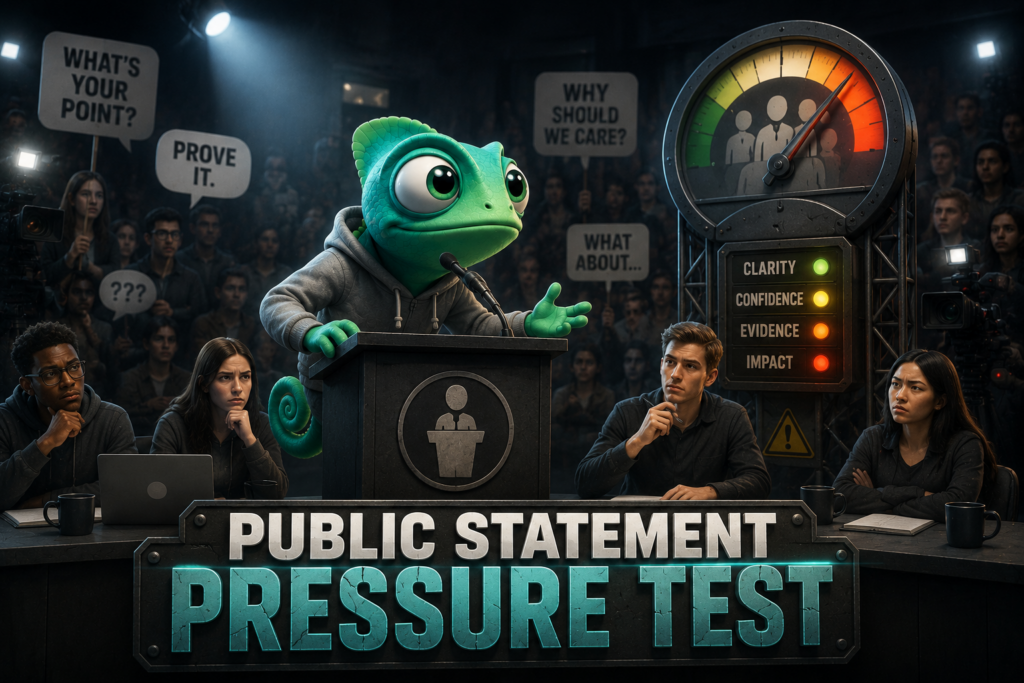
The teacher shows three public statements on the same issue.
Statement A:
“Students need safer public spaces.”
Statement B:
“Students need safer public spaces. Consequently, the city should redesign dangerous areas.”
Statement C:
“Rarely do young people receive enough attention in urban planning. Notwithstanding budget limitations, safer public spaces must become a priority.”
Students analyze:
- Which statement sounds most formal?
- Which one sounds most persuasive?
- Which one would work in a speech?
- Which one would work in a report?
- Which one sounds too dramatic for casual conversation?
This prepares students to think about register, audience, and rhetorical control.
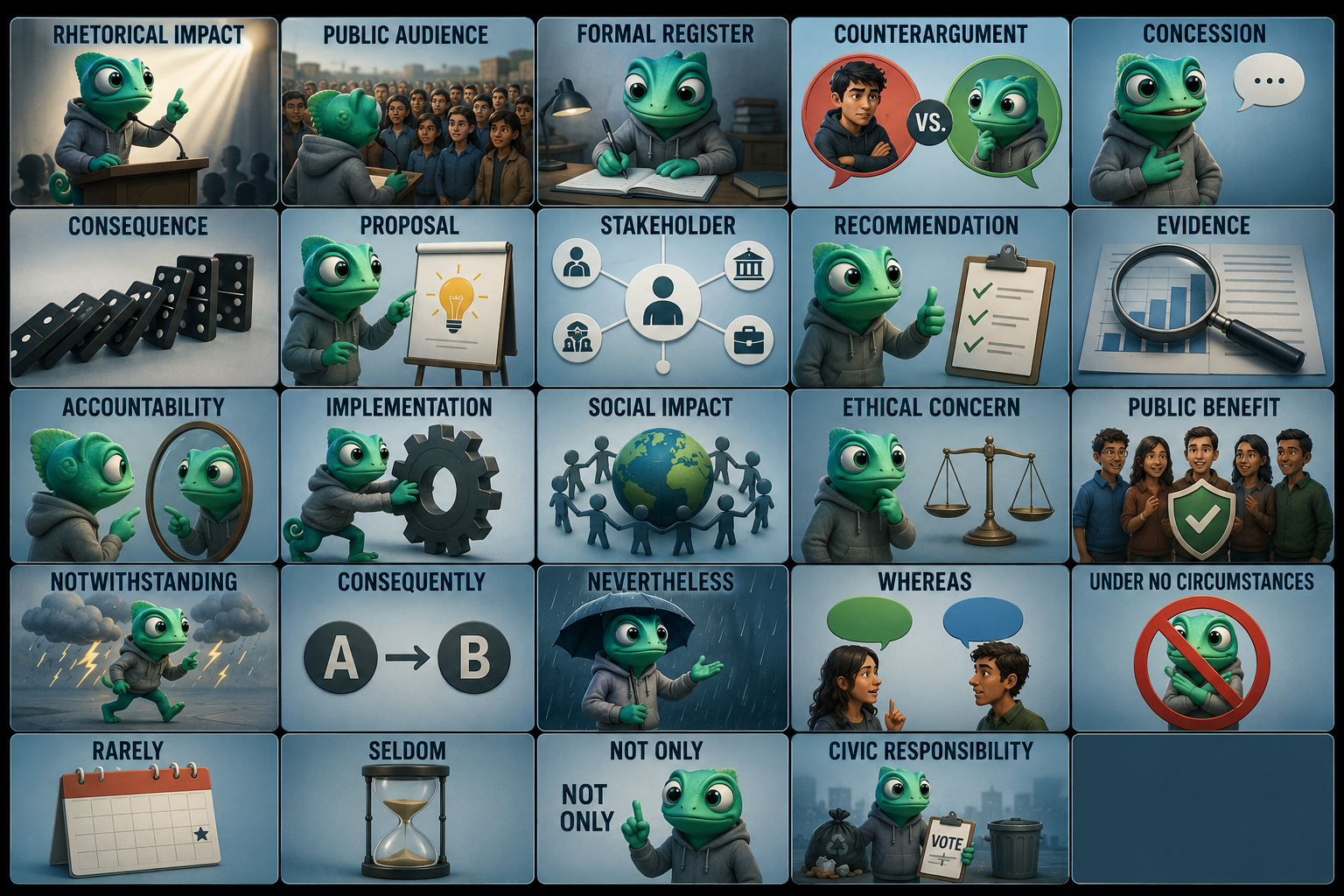
Part 2: Vocabulary Activation: Advocacy Investment Board — 15 min
Groups receive 100 imaginary advocacy credits. They invest in words that would strengthen a persuasive proposal. To invest, they must use the word in a meaningful sentence.
rhetorical impact
public audience
formal register
counterargument
concession
consequence
proposal
stakeholder
accountability
implementation
social impact
ethical concern
public benefit
notwithstanding
consequently
nevertheless
rarely
seldom
not only
civic responsibility
under no circumstances
evidence
whereas
recommendation
Part 3: Grammar Input: Rhetorical Weight Machine — 25 min
The teacher explains that advanced persuasion depends on controlling rhetorical weight. Some sentences are neutral. Some sound formal. Some sound powerful. Some sound too dramatic. students need to choose the correct level for the audience.

Neutral:
“We should protect digital privacy.”
More formal:
“Digital privacy should be protected because students share personal information online.”
Emphatic:
“Under no circumstances should students’ private data be treated carelessly.”
The teacher explains inversion:
When a sentence begins with a negative or restrictive expression, English often changes the order of subject and auxiliary.
Basic structure:
Negative or restrictive expression + auxiliary + subject + main verb
Examples:
Never should schools ignore student wellbeing.
Rarely do public campaigns succeed without clear evidence.
Seldom do policies work when people do not understand them.
Under no circumstances should private data be shared carelessly.
Not only does this proposal protect students, but it also educates families.
If there is no auxiliary, use do / does / did.
Normal:
“Public campaigns rarely succeed without clear goals.”
Inversion:
“Rarely do public campaigns succeed without clear goals.”
Connector explanation:
Notwithstanding is formal and means despite. It is useful when acknowledging an obstacle without abandoning the argument.
Example:
“Notwithstanding the cost, the project remains necessary.”
Consequently shows a result or logical consequence.
Example:
“The campaign reached many students. Consequently, awareness increased.”
The teacher should warn students not to overuse inversion. It is powerful because it is rare. If every sentence uses inversion, the writing becomes unnatural.
Part 4: Rhetorical Risk Meter — 20 min
Students place sentences on a rhetorical risk meter:
too weak
appropriate
strong
too dramatic
Sentences:
“Students should recycle.”
“Rarely has the school seen such a serious crisis.”
“Under no circumstances should students be ignored.”
“Not only does this proposal reduce waste, but it also teaches responsibility.”
“Never has a school failed so completely.”
Students revise the sentences for different audiences:
students
parents
school leaders
city authorities
social media audience
SESSION 2: CONSTRUCTION – REINFORCEMENT (40 min)
Part 1 – Counterargument Gate — 15 min
Students choose one proposal and face an objection.
Proposal:
The school should reduce printed materials.
Objection:
Some students learn better with paper.
Response:
“Notwithstanding this concern, the school could reduce unnecessary printing while still providing paper for students who need it.”
Students practice with other objections:
The project is too expensive.
Students may not participate.
Parents may disagree.
The change may take too long.
The rule may be difficult to enforce.
Part 2 – Consequently Chain Reaction — 15 min

Groups build a cause-effect chain from a problem to a consequence.
Example:
Problem: students share private data online
Cause: they do not understand privacy settings
Immediate consequence: their information becomes vulnerable
Long-term consequence: they may lose control over personal information
Final sentence:
“Students often ignore privacy settings; consequently, their personal data becomes vulnerable.”
Part 3 – Exit Formal Line — 10 min
Each student says one formal persuasive sentence:
“Notwithstanding…, …”
“Consequently, …”
“Rarely do…”
“Under no circumstances should…”
SESSION 3: CONSOLIDATION (80 min)
Part 1- Mini-Editorial Planning — 15 min

Students choose a public-interest issue:
digital privacy
AI transparency
safe routes to school
youth access to sports
urban green spaces
responsible tourism
healthy public spaces
misinformation
They prepare a five-part plan:
claim
evidence
counterargument
connector
recommendation
Part 2 – Mini-Editorial + Oral Defense — 50 min
Students write a short persuasive mini-editorial of 130–160 words and then defend one sentence orally.
Writing requirements:
one clear claim
one example or evidence point
one inversion sentence
one sentence with notwithstanding
one sentence with consequently
one final recommendation
Oral defense:
Students choose one sentence from their editorial and explain:
Why did I use this connector?
Why did I use inversion here?
What effect should this sentence have on the audience?
Part 3 – Editorial Reflection — 15 min
Students exchange mini-editorials and give feedback using these frames:
“The strongest persuasive sentence is…”
“The connector works because…”
“The inversion is effective because…”
“One sentence could be clearer if…”

RUBRIC: Persuasive Tools
NEE – Agregar el tipo de adaptaciones curriculares
Principio II: Pautas 6.1 – 6.3 – 6.4
Principio III: Pautas 7.1 – 8.1 – 9.1
ALUMNO 1: Constante monitoreo. Dar tiempo adicional para el desarrollo de la actividad y se reduce el número de ejercicios o se modifican los ejercicios con un nivel de dificultad reducido, de acuerdo con sus necesidades académicas.
ALUMNO 2: Constante monitoreo, Dar tiempo adicional para el desarrollo de la actividad y se reduce el número de ejercicios o se modifican los ejercicios con un nivel de dificultad reducido, de acuerdo con sus necesidades académicas.
ALUMNO 3: Constante monitoreo. Corroborar que el contenido entregado en clase haya sido comprendido por la estudiante mediante retroalimentación.