
Research Reporting

SKILLS
EFL.5.2.7. Present information clearly and effectively in a variety of oral forms for a range of audiences and purposes. (Example: summarizing, paraphrasing, personal narratives, research reports, essays, articles, posters, charts and other graphics, etc.)
EFL.5.4.7. Use the process of prewriting, drafting, revising, peer editing and proofreading to produce well-constructed informational texts.

REAL-LIFE APPLICATION

This topic helps students use English for serious academic communication: reading complex information, selecting evidence, synthesizing sources, and writing formal reports or essays that are clear, organized, and credible. These skills are useful for research projects, university preparation, scholarship applications, science fairs, policy proposals, Model UN-style work, formal presentations, and any task where students must support a position with evidence instead of opinion alone.
LEARNING ACTIVITIES
SESSION 1 (80 min) ANTICIPATION
Part 1: Anticipation: Dense Source Triage (20 min)
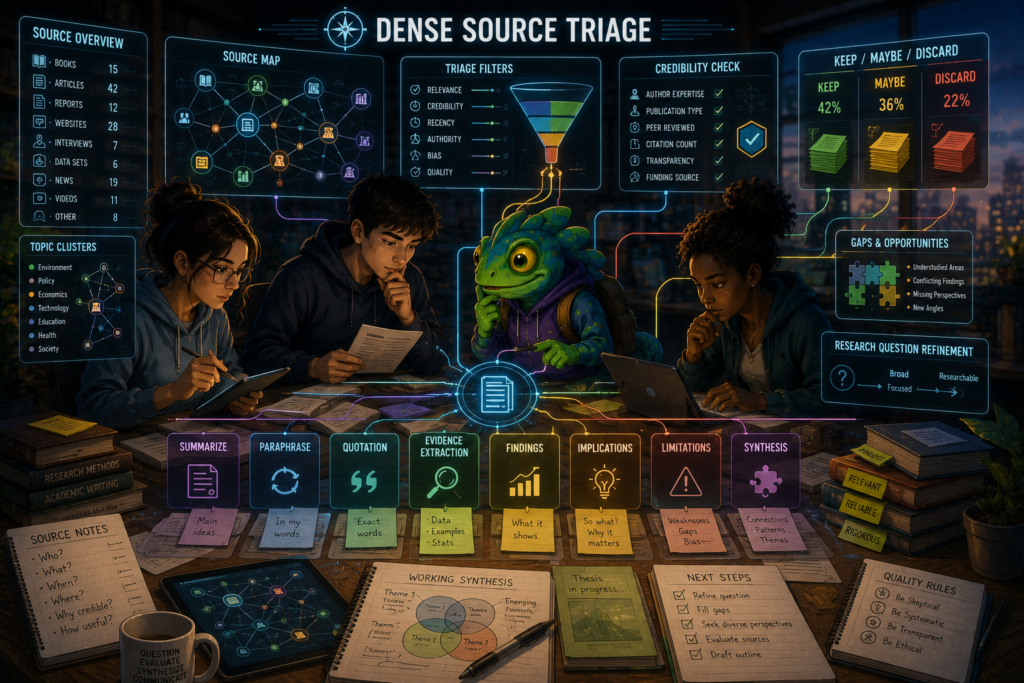
The teacher gives groups three short dense source extracts about a fresh topic.
Suggested topics:
urban noise and learning
public health communication
digital reading and attention
responsible tourism
youth access to public spaces
misinformation in health trends.
Students do not summarize the sources immediately. First, they triage them. Each source must be placed into one of three categories:
Central source: essential for the report or essay
Supporting source: useful but not the main foundation
Background source: helpful for context but not central
Students must justify their decision by answering:
What is the source mainly claiming?
What evidence does it offer?
How directly does it answer the research question?
Does it support, complicate, or challenge the other sources?
This activity helps students understand that research writing begins with judgment. Not every source has the same value, and strong writers decide how each source should be used.
Part 2: Vocabulary Activation: Source Authority Auction (15 min)
Groups receive 100 “academic credibility credits.” They must invest their credits in vocabulary words that would make a research report stronger. To invest in a word, they must use it in a meaningful research sentence.
Example:
“We invest in limitation because a strong report should recognize what the source does not prove.”
“We invest in synthesis because the essay should connect sources instead of listing them.”
“We invest in credibility because weak sources can damage the argument.”
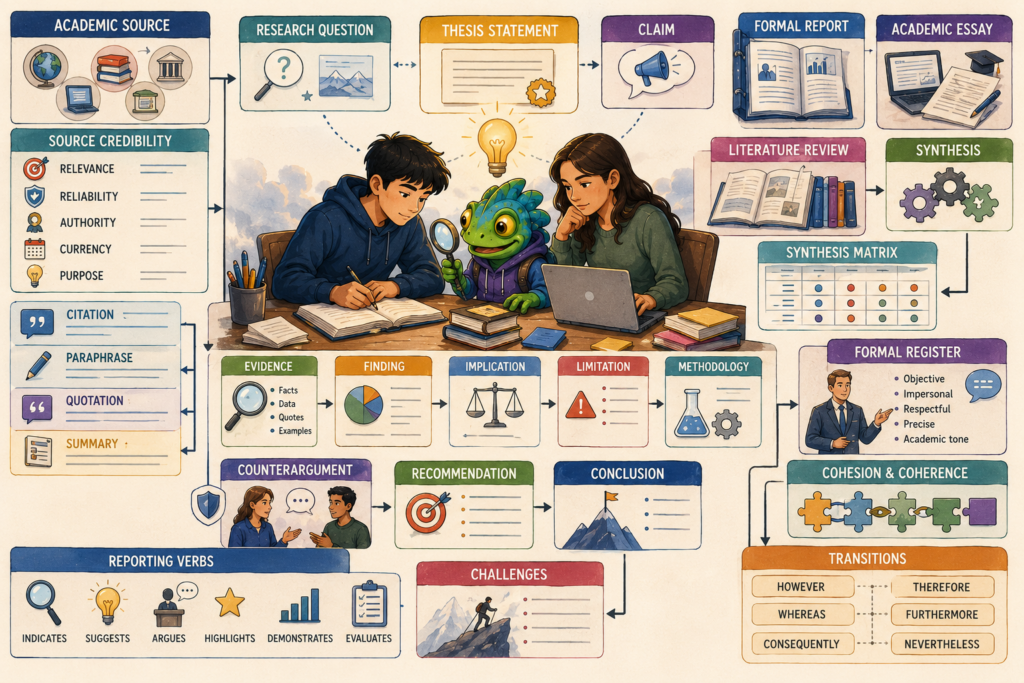
academic source
research question
thesis statement
formal report
academic essay
synthesis
synthesis matrix
literature review
claim
evidence
finding
implication
limitation
methodology
source credibility
relevance
reliability
citation
paraphrase
quotation
summary
counterargument
recommendation
conclusion
reporting verb
formal register
cohesion
coherence
transition
however
whereas
consequently
therefore
furthermore
nevertheless
indicates
suggests
argues
highlights
demonstrates
challenges
evaluates
This activity makes students think about the function of academic vocabulary. Words such as limitation, implication, claim, and methodology are not decorative; they help students explain research quality and academic reasoning.
Part 3: Extended Language Input: From Dense Reading to Formal Reporting (30 min)
The teacher explains that dense academic sources are challenging because they often contain long sentences, abstract vocabulary, and multiple ideas in one paragraph. Students should not try to translate every word. Instead, they should read with a purpose.

The teacher introduces a five-step process:
Step 1: Find the research question connection.
Students ask: “Why am I reading this source?” If the source does not help answer the research question, it should not dominate the report.
Step 2: Identify the claim.
The claim is the main idea or position. It is different from an example or statistic.
Step 3: Extract useful evidence.
Evidence can be a statistic, example, expert explanation, comparison, or finding.
Step 4: Identify the limitation.
A source may be useful but incomplete. It may focus on one context, one group, one method, or one side of the issue.
Step 5: Synthesize.
Synthesis means putting sources into conversation. Students do not write: “Source A says… Source B says… Source C says…” forever. Instead, they write by idea or theme.
Weak source-by-source writing:
“Source A discusses digital reading. Source B discusses attention. Source C discusses study habits.”
Stronger synthesis:
“Taken together, the sources suggest that digital reading affects learning not only because of screen use, but also because of attention habits and task design.”
The teacher then explains the difference between a formal report and an academic essay.
A formal report usually has sections such as purpose, findings, recommendations, and conclusion. It is practical and solution-oriented.
An academic essay usually has a thesis, body paragraphs, evidence, analysis, and conclusion. It is argument-oriented.
Students should understand that both require formal tone, clear organization, evidence, and revision.
Part 4: Grammar / Language Teaching Idea: Source Weaving Board (15 min)
Students use a “source weaving board.” Each source is represented by a colored thread. Each theme is represented by a hook. Students must connect source threads to themes.
Themes may include:
cause
effect
solution
limitation
recommendation
counterargument
After placing the threads, students produce academic sentences.
Examples:
“Both Source A and Source B suggest that attention is affected by learning conditions.”
“Whereas Source A emphasizes environmental factors, Source C focuses on student habits.”
“Source B complicates this argument by showing that technology can support learning when tasks are structured.”
This method teaches grammar, connectors, and synthesis visually. Students see that academic language is a way of weaving ideas together.
SESSION 2: CONSTRUCTION – REINFORCEMENT (40 min)
Part 1 – Report vs. Essay Fork (15 min)
The teacher presents different academic tasks. Students stand on one side of the room for report and another side for essay. Then they justify the choice.
Tasks:
Recommend changes to a school reading program.
Argue whether digital reading improves learning.
Present findings from a student survey.
Defend a position on urban noise and concentration.
Summarize research and propose a practical solution.
Students explain:
“This should be a report because it requires findings and recommendations.”
“This should be an essay because it asks us to defend a position.”
This helps students understand format before writing, which prevents them from mixing report sections with essay argument structure.
Part 2 – Synthesis Line-Up Challenge (15 min)

Students receive sentence strips from a weak source-by-source paragraph. They must reorder and rewrite the paragraph so that it is organized by idea.
Weak order:
Source A says digital reading can distract students.
Source B says students need guidance.
Source C says attention depends on task design.
Improved synthesis:
“The sources suggest that digital reading is not automatically harmful or helpful. Instead, its effect depends on guidance, task design, and student habits.”
Students then explain which sentence became the topic sentence and which sentences became support.
Part 3 – Peer Reviewer’s Two-Minute Memo (10 min)
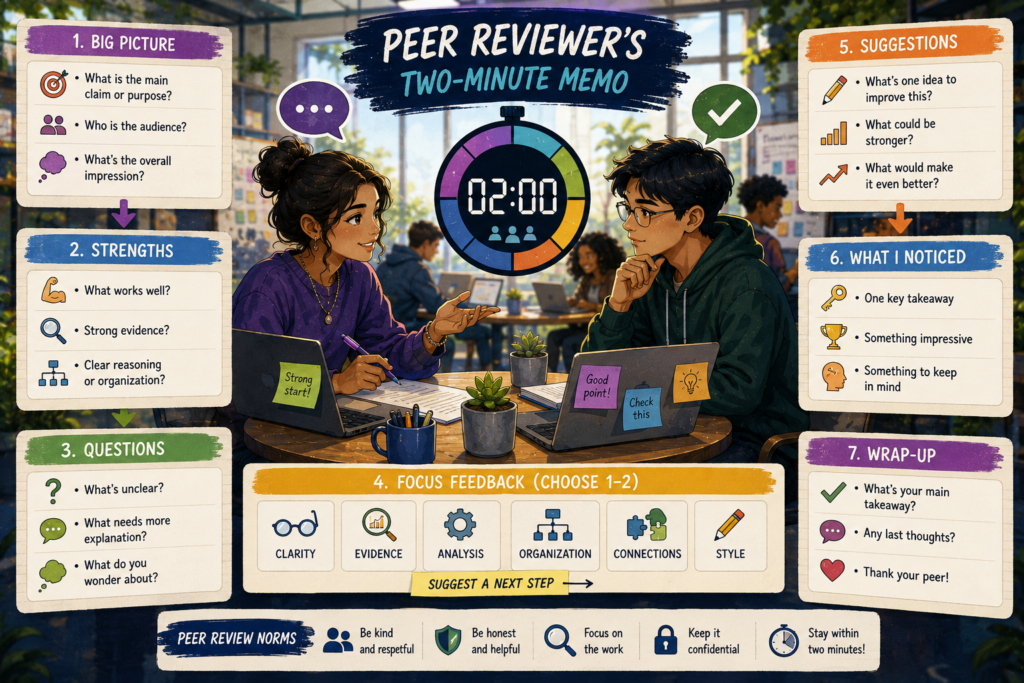
Instead of an exit sentence, students write a two-minute memo to a partner. The memo must include:
one strength in the partner’s synthesis
one question about source use
one suggestion for clearer formal tone
The partner reads it and chooses one revision action for the next class.
SESSION 3: CONSOLIDATION (80 min)
Part 1- Preparation: Research Brief Folder (15 min)
Students prepare a research brief folder. It may be physical or digital. It must include:
research question
three source notes
one synthesis matrix
one claim or report purpose
one limitation
one recommendation or thesis
one revision target
Students may use keywords and source notes, but they should not write a full script. The goal is to prepare thinking evidence before production.
Part 2 – Research Hearing Audio Brief (50 min)

This consolidation is not a normal presentation or debate. Students create a short formal audio brief as if they were submitting a research update to a panel. They can record it or perform it live.
Brief requirements:
state the research question
identify the strongest source pattern
synthesize at least two sources
mention one limitation
state either a recommendation or thesis
use formal academic language
Example:
“Our research question focuses on how urban noise affects student concentration. The sources suggest that noise influences learning not only through distraction, but also through stress and reduced attention. Whereas one source emphasizes environmental design, another highlights student wellbeing. A limitation is that the available evidence focuses on short-term effects. Therefore, our recommendation is to test quiet zones before applying a larger policy.”
After each audio brief, one listener asks a question about evidence, limitation, or recommendation. The presenting student or group must answer using source-based reasoning.
Part 3 – Source Integrity Badge Review (15 min)
Students award peer badges based on evidence of research quality:
Strongest Source Connection
Clearest Formal Tone
Best Limitation Statement
Most Useful Recommendation
Best Research Question
To award a badge, students must give a reason, not only a name.
Example:
“I give this group the Best Limitation Statement badge because they explained that their sources did not include long-term data.”

RUBRIC: Research Reporting
NEE – Agregar el tipo de adaptaciones curriculares
Principio II: Pautas 6.1 – 6.3 – 6.4
Principio III: Pautas 7.1 – 8.1 – 9.1
ALUMNO 1: Constante monitoreo. Dar tiempo adicional para el desarrollo de la actividad y se reduce el número de ejercicios o se modifican los ejercicios con un nivel de dificultad reducido, de acuerdo con sus necesidades académicas.
ALUMNO 2: Constante monitoreo, Dar tiempo adicional para el desarrollo de la actividad y se reduce el número de ejercicios o se modifican los ejercicios con un nivel de dificultad reducido, de acuerdo con sus necesidades académicas.
ALUMNO 3: Constante monitoreo. Corroborar que el contenido entregado en clase haya sido comprendido por la estudiante mediante retroalimentación.