
Interactive Mastery

SKILLS
EFL.5.2.7 Present information clearly and effectively in a variety of oral forms for a range of audiences and purposes.
EFL.5.2.15 Engage in an extended conversation on most general topics and keep it going by expressing and responding to suggestions, opinions, attitudes, advice, feelings, etc.
REAL-LIFE APPLICATION

This topic helps students sustain advanced spoken interaction in situations where they must think, respond, negotiate, and adapt in real time. At B2 level, students need to do more than answer questions; they need to manage longer turns, respond to challenge questions, invite quieter speakers, interrupt politely, repair misunderstandings, synthesize viewpoints, and guide a discussion toward a decision. These skills are useful for speaking exams, interviews, academic discussions, university seminars, leadership activities, group projects, debates, and future professional collaboration.
LEARNING ACTIVITIES
SESSION 1 (80 min) ANTICIPATION
Part 1: Dialogue Under Pressure (20 minutes)
The teacher gives students a short conversation that begins well but becomes difficult. For example, one speaker dominates, another does not participate, one idea is unclear, and the group has not reached a decision.
We need to choose one policy for future skills. I think AI literacy is obviously the best option because everything is changing, and students need to understand technology.
B: Maybe, but public speaking is also important because students need to explain their ideas clearly.
A: Yes, but AI is more urgent. If students do not learn AI now, they will fall behind. The school should focus on workshops, rules, and projects about AI.
C: I think there is another point, but…
A: Also, AI connects with research, writing, creativity, and future jobs. So it makes sense to choose it.
B: I understand, but your idea is not completely clear. Are you saying AI should be a subject, a workshop, or a school rule?
C: That is what I was wondering too.
A: I mean all of that, kind of. The school just needs to do something with AI.
B: Then we have not really decided. We need one clear policy.
C: So… what are we choosing?
A: AI literacy, probably.
B: I am not sure yet
Students identify the problem:
Who controlled the conversation too much?
Who needed to be invited to speak?
Where did the discussion lose focus?
Which phrase could repair the problem?
How could the group reach a decision?
The teacher explains that advanced interaction is not simply “talking a lot.” A strong speaker must help the conversation function. Sometimes this means speaking longer. Sometimes it means inviting another speaker. Sometimes it means interrupting politely. Sometimes it means summarizing and moving the group forward.
Part 2: Vocabulary Activation: Strategic Dialogue Control Panel (15 minutes)

• interactive mastery
• spontaneous dialogue
• strategic turn-taking
• long turn
• collaborative discussion
• clarification
• polite interruption
• conversation repair
• follow-up question
• stance
• response
• synthesis
• evidence
• counterpoint
• challenge question
• compromise
• negotiation
• decision-making
• disagreement
• agreement
• hesitation
• fluency
• coherence
• relevance
• register
• contribution
• transition
• redirection
• summary
• conclusion
• implication
• perspective
• audience awareness
• timing
• participation
• adapt
• clarify
• challenge
• synthesize
• redirect
• justify
• negotiate
• conclude
Students work with the vocabulary list and connect words to speaking functions. The teacher should require each group to demonstrate at least three words in short spoken examples. For instance, if a group chooses “redirection,” they must say a phrase such as, “That is an interesting point, but we should return to the main question.”
This activity prepares students for the final task because it connects vocabulary to real conversation moves. Students learn that interaction language has a purpose: to clarify, challenge, synthesize, redirect, negotiate, or conclude.
Part 3: Extended Explanation: What Makes Advanced Interaction Successful?
(30 min)
The teacher explains that interactive mastery has six main elements.

First, students need long-turn control. A long turn should have structure. Students should not speak in disconnected ideas. A strong long turn includes a position, a reason, an example, and a final implication.
Example:
“I believe public speaking should be part of school education because students need confidence in academic and professional contexts. For example, presentations help students organize ideas and respond to questions. However, students should receive training before being evaluated. Therefore, public speaking should be taught gradually.”
Second, students need strategic turn-taking. They must know when to enter, when to hold the floor, and when to give the turn to someone else.
Examples:
“Can I add something here?”
“I would like to respond to that point.”
“What is your view on this?”
“I have spoken about the benefits, but maybe you can explain the limitations.”
Third, students need conversation repair. Misunderstanding is normal. A B2 speaker should not panic. They should clarify, rephrase, or ask for repetition.
Examples:
“Let me rephrase that.”
“That is not exactly what I meant.”
“Could you clarify your point?”
“I think we may be talking about two different aspects.”
Fourth, students need respectful challenge. Advanced interaction includes disagreement, but disagreement must be controlled and respectful.
Examples:
“I see your point, but I would question whether…”
“That argument is reasonable; however…”
“A possible counterpoint is…”
“I agree to some extent, although…”
Fifth, students need synthesis. In group discussion, the strongest speaker is not always the person with the most ideas. Often, the strongest speaker is the one who connects ideas.
Examples:
“If we combine both points, we could say that…”
“So, your point focuses on cost, while mine focuses on access.”
“The common idea here is that students need more support.”
Sixth, students need decision management. A collaborative task should not end with random opinions. Students need to compare options and reach a conclusion.
Examples:
“Based on our discussion, the strongest option seems to be…”
“Although both options are useful, the second one is more realistic.”
“Shall we choose this option as our final decision?”
Part 4: Language Teaching Idea: The Dialogue Engine (15 min)
The teacher presents interaction as an engine with five parts:
Fuel = ideas and evidence
Steering = turn-taking phrases
Brakes = clarification and repair
Gears = transitions and synthesis
Destination = decision or conclusion
Students receive phrases and decide which part of the engine they belong to. Then they use the phrase in a short academic dialogue. This method helps students understand that dialogue language is functional. Every phrase should do something: move the conversation, slow it down, redirect it, connect ideas, or finish the task.
SESSION 2: CONSTRUCTION – REINFORCEMENT (40 min)
Part 1 – Dialogue Pressure Test (15 min)

Groups discuss a decision task. Every two minutes, the teacher introduces a pressure card.
Pressure cards:
One speaker disagrees strongly.
One participant has not spoken.
The evidence is unclear.
The group is running out of time.
The discussion has gone off topic.
The group needs a compromise.
Students must adapt the conversation using strategic phrases. This activity is valuable because real interaction is unpredictable. Students need to practice staying calm and functional when the conversation becomes difficult.
Part 2 – Stance Shift Dialogue (15 min)

Students begin with a strong assigned opinion. During the discussion, partners introduce evidence or counterarguments. The speaker must decide whether to maintain, soften, or modify the original stance.
Example:
Initial stance: “AI should be banned from all assignments.”
Possible modified stance:
“I still believe AI should be controlled, but I can see that guided use may help students learn responsibly.”
This activity teaches students that mature dialogue is not about “winning.” It is about thinking, listening, adjusting, and responding intelligently.
Part 3 – Peer Interaction Pulse Check (10 min)
Students complete a quick group pulse check using three prompts:
One phrase that helped our dialogue was…
One moment where we lost focus was…
One strategy we will use in the final task is…
This closing task helps students diagnose interaction quality and prepare for Friday without repeating a formulaic ending.
SESSION 3: CONSOLIDATION (80 min)
Part 1- Preparation: Interaction Strategy Card (15 min)
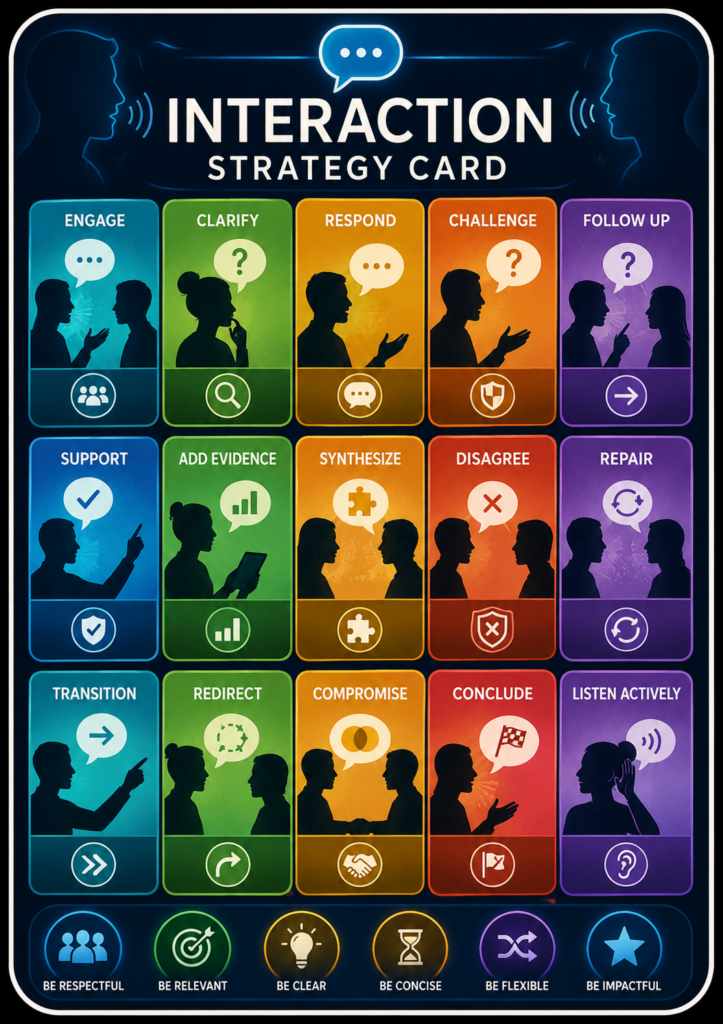
Students prepare a strategy card with six keywords only:
position
evidence
counterpoint
clarification
synthesis
decision
They cannot write a script. The card is designed to help students remember the interaction moves they need during the performance.
Part 2 – Final Interactive Mastery Simulation (50 min)
Students complete a B2-level collaborative speaking task in pairs or groups of three. The task should require decision-making, not only opinion sharing.
Possible tasks:
Decide how a school should prepare students for future work: entrepreneurship, AI literacy, public speaking, or research skills.
Decide which student wellbeing policy would be most effective: later start time, counseling access, reduced homework, or peer mentoring.
Decide the most responsible rule for AI in school: full ban, guided use, teacher approval, or project-based use.
Decide the best format for final assessment: exam, portfolio, oral defense, or project showcase.
Performance requirements:
Each student gives one structured long turn.
Each student responds to another speaker’s idea.
The group uses at least one clarification question.
The group uses at least one respectful challenge.
The group synthesizes two ideas.
The group reaches a final decision.
This activity works as the consolidation because students must demonstrate long-turn stamina and interaction control at the same time.
Part 3 – Review Board: Interaction Evidence (15 min)
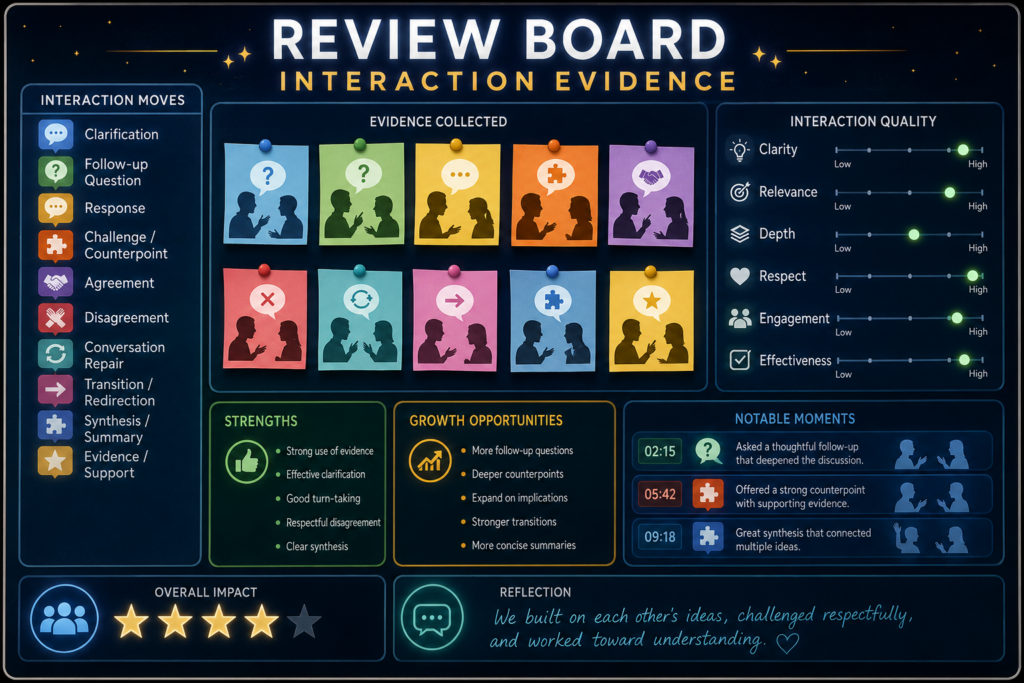
The audience or observers do not give general comments like “good job.” They identify specific evidence of interaction mastery.
Review categories:
- best clarification
- strongest synthesis
- most respectful challenge
- best long turn structure
- clearest final decision
Students must justify their review: “The strongest synthesis happened when the speaker connected wellbeing and academic performance in one final idea.”
RUBRIC:
Interactive Mastery
NEE – Agregar el tipo de adaptaciones curriculares
Principio II: Pautas 6.1 – 6.3 – 6.4
Principio III: Pautas 7.1 – 8.1 – 9.1
ALUMNO 1: Constante monitoreo. Dar tiempo adicional para el desarrollo de la actividad y se reduce el número de ejercicios o se modifican los ejercicios con un nivel de dificultad reducido, de acuerdo con sus necesidades académicas.
ALUMNO 2: Constante monitoreo, Dar tiempo adicional para el desarrollo de la actividad y se reduce el número de ejercicios o se modifican los ejercicios con un nivel de dificultad reducido, de acuerdo con sus necesidades académicas.
ALUMNO 3: Constante monitoreo. Corroborar que el contenido entregado en clase haya sido comprendido por la estudiante mediante retroalimentación.