
Possessives
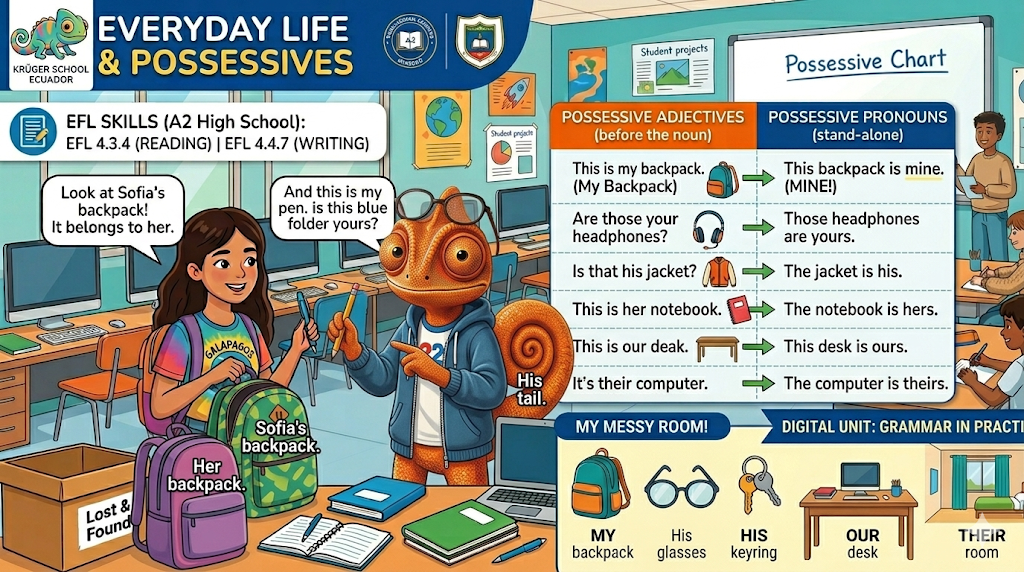
SKILLS
EFL 4.1.2 Recognize and demonstrate an appreciation of some commonalities and distinctions across cultures… in terms of daily routines.
EFL 4.3.4 Find specific predictable information in everyday material.
EFL 4.4.7 Write short responses to a given prompt using vocabulary and grammatical structures learned in class.
REAL-LIFE APPLICATION
In the real world, we constantly need to clarify ownership to avoid confusion, return lost items, and talk about our relationships or belongings. Whether saying “That’s my phone” or “Is this jacket yours?”, mastering possessives allows students to navigate daily interactions, respect boundaries, and describe their world accurately.
LEARNING ACTIVITIES
SESSION 1 (80 min) ANTICIPATION
Part 1 – Whose is it ?( 10-15 minutes)
Anticipation Activity:
“Whose Is It?” (10–15 mins)
- Objective: To spark curiosity and introduce the concept of ownership.
- Instructions: 1. Have students look around their digital or physical classroom. 2. Hold up a random object (e.g., a pen, a notebook) belonging to a student. Ask: “Is this my pen?” 3. Guide them to answer: “No, it’s [Name]’s pen.” 4. Write these contrast examples on the board: My pen vs. It is mine.
CONSTRUCTION
Part 2: Vocabulary Development (15 min)
The teacher explicitly introduces key vocabulary needed for the lesson, ensuring students clearly understand meaning and use. The words include:
Backpack (noun)
Headphones (noun)
Keyring (noun)
To belong to (verb phrase) – e.g., This belongs to me.
Messy room (noun phrase) – Great context for daily life.
Can I borrow …?
Can you lend me…?
Part 3: Grammar Introduction using Presentation (20 min)
Grammar Introduction: Adjectives vs. Pronouns (20 mins)
- Concept: Possessive Adjectives go before the noun. Possessive Pronouns replace the noun (usually at the end of the sentence).
“Find Someone Who…” (Digital Version)
- Instruction: Give students a digital list of 5 facts (e.g., …likes pizza, …wakes up at 6 AM).
- Task: Students must transform these into Wh- questions (e.g., “What do you like to eat?” or “When do you wake up?”).
- Interaction: They use the chat or breakout rooms to ask classmates and record names.
| Subject | Possessive Adjective (+ Noun) | Possessive Pronoun (Stand-alone) |
| I | This is my backpack. | This backpack is mine. |
| You | Where are your headphones? | Are these headphones yours? |
| He / She | It is his/her keyring. | The keyring is his/hers. |
| We | This is our room. | The room is ours. |
| They | It is their house. | The house is theirs. |
Grammar Practice Activity (35 mins)
Activity Name: Digital Interactive Fill-In & Transform.
Instructions:
Part 1 (15 mins): Students complete a 10-question digital worksheet (Google Forms or LiveWorksheets) choosing between my/mine, your/yours, etc.
Part 2 (20 mins): “Sentence Transformer.” In pairs via breakout rooms or chat, Student A writes a sentence with an adjective (“This is my phone”), and Student B must rewrite it using a pronoun (“This phone is mine”). They must complete 5 rounds each.
SESSION 2: CONSTRUCTION – REINFORCEMENT (40 min)
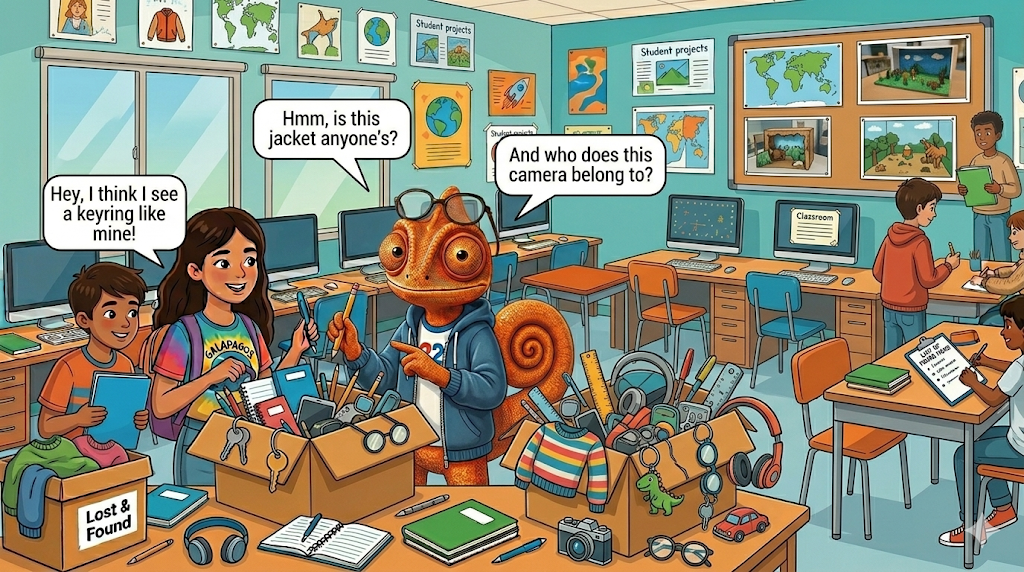
Next-Day Activity: “The Lost & Found Desk” (Fun & Creative)
- Instructions:
- Tell students they are working at a hotel or school “Lost & Found” department.
- Provide a digital slide with images of 5 lost items (e.g., a messy backpack, broken headphones, a cool keyring) labeled with fictional owners’ names (e.g., Carlos, Maria, The Twins).
- Task: Students must write a short dialogue (6–8 lines) or a paragraph resolving who the items belong to.
- Example Prompt: “Excuse me, is this backpack yours?” “No, it’s not mine. It’s hers (Maria’s).”
- Have 3–4 pairs volunteer to read their dialogue out loud.
SESSION 3: CONSOLIDATION (80 min)
Part 1 – ( 2 x 40min)
Period 1: Portfolio Production (40 mins)
- Task: “My Everyday Spaces” Comic Strip or Digital Poster (Can use Canva or Google Slides).
- Instructions: 1. Students upload 3 images or draw 3 scenes of their daily life (their bedroom, their family kitchen, their school desk). 2. For each image, they must write 2 sentences: one using a possessive adjective and one using a possessive pronoun. 3. Example: Scene 1 (Bedroom): “This is my bed. The messy desk is mine too.”
Period 2: Presentation & Quiz (40 mins) - Peer Review / Presentation (20 mins): Students share their digital posters in groups of three. They must ask each other one question about ownership (e.g., “Is that computer yours or your brother’s?”).
- Quick Digital Quiz (20 mins): A 15-question multiple-choice quiz on platforms like Kahoot, Quizizz, or Google Forms to formally grade their understanding of the grammar mechanics.
NEE – Agregar el tipo de adaptaciones curriculares
Principio II: Pautas 6.1 – 6.3 – 6.4
Principio III: Pautas 7.1 – 8.1 – 9.1
ALUMNO 1: Constante monitoreo. Dar tiempo adicional para el desarrollo de la actividad y se reduce el número de ejercicios o se modifican los ejercicios con un nivel de dificultad reducido, de acuerdo con sus necesidades académicas.
ALUMNO 2: Constante monitoreo, Dar tiempo adicional para el desarrollo de la actividad y se reduce el número de ejercicios o se modifican los ejercicios con un nivel de dificultad reducido, de acuerdo con sus necesidades académicas.
ALUMNO 3: Constante monitoreo. Corroborar que el contenido entregado en clase haya sido comprendido por la estudiante mediante retroalimentación.