
Time expressions
SKILLS
Communication and Cultural Awareness: EFL 3.1.1 Ask and answer questions about people’s names, age, and whereabouts… and extend to routine times.
Oral Communication: EFL 3.2.14 Express basic needs and point of view using simple words and phrases.
Reading: EFL 3.3.1 Understand most of the details of short, simple texts.
Writing: EFL 3.4.1 Make a simple learning log or diary entries about daily routines using time expressions.
REAL-LIFE APPLICATION
In the real world, time expressions are the “glue” of scheduling and storytelling. Without them, students can’t tell a friend when to meet for ice cream, explain their daily TikTok/gaming routines, or talk about what they did yesterday versus what they will do tomorrow. It moves them from speaking in isolated words to actually sequencing their lives.
LEARNING ACTIVITIES
SESSION 1 (80 min) ANTICIPATION
Part 1 – ( 10-15 minutes)
Anticipation Activity:
The Mixed-Up Day”
- Objective: Notice the necessity of time order.
- Instructions:
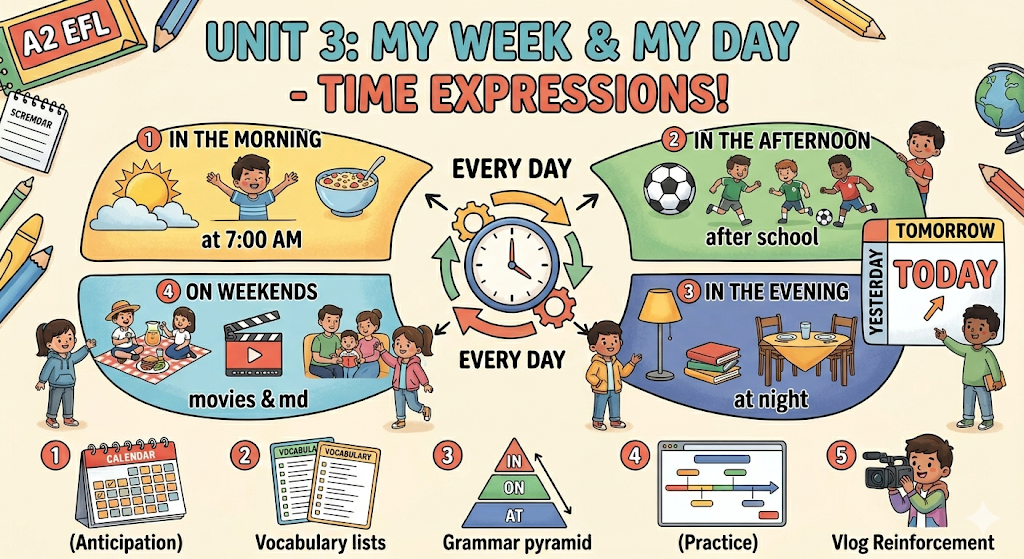
- Display 5 unnumbered digital flashcards of a daily routine out of order (e.g., I go to sleep, I eat breakfast, I arrive at school).
- Ask students to scramble and rewrite them in order on a digital jamboard/padlet.
- Introduce the magic words: “To make this clear, we need Time Expressions.”
https://share.gemini.google/TMT4IXRk74Dw
CONSTRUCTION
Part 2: Vocabulary Development (15 min)
The teacher explicitly introduces key vocabulary needed for the lesson, ensuring students clearly understand meaning and use. The words include:
In the morning / afternoon / evening (Parts of the day)
Every day (Frequency)
At [time] (Specific points, e.g., at 7:00)
Before / After (Sequencing events)
Yesterday (Past reference)
On weekends (Habits)
Part 3: Grammar Introduction using Presentation (20 min)
Grammar Introduction:
Focus: Prepositions of time (In, On, At) and basic sequence adverbs (First, Then, After that).
Instructions:
- Direct Instruction (10 mins): Present a simple visual pyramid showing AT (precise time/night), ON (days/dates), and IN (months/years/parts of day).
- Concept Check (10 mins): Run a quick 5-question digital poll (Mentimeter/Kahoot) where students fill in the blank: “I watch TV ___ the afternoon.”
Grammar Practice Activity (25 mins)
- Activity: “My Perfect Digital Timeline”
- Instructions:
- Students use a template (Google Slides or Canva) to create a 4-step timeline of their ideal Saturday.
- They must write 4 sentences using at least three vocabulary words and two prepositions correctly (e.g., “First, I wake up at 10:00. After that, I play video games in the afternoon.”).
- Pair-share in breakout rooms to read timelines aloud.
SESSION 2: CONSTRUCTION – REINFORCEMENT (40 min)
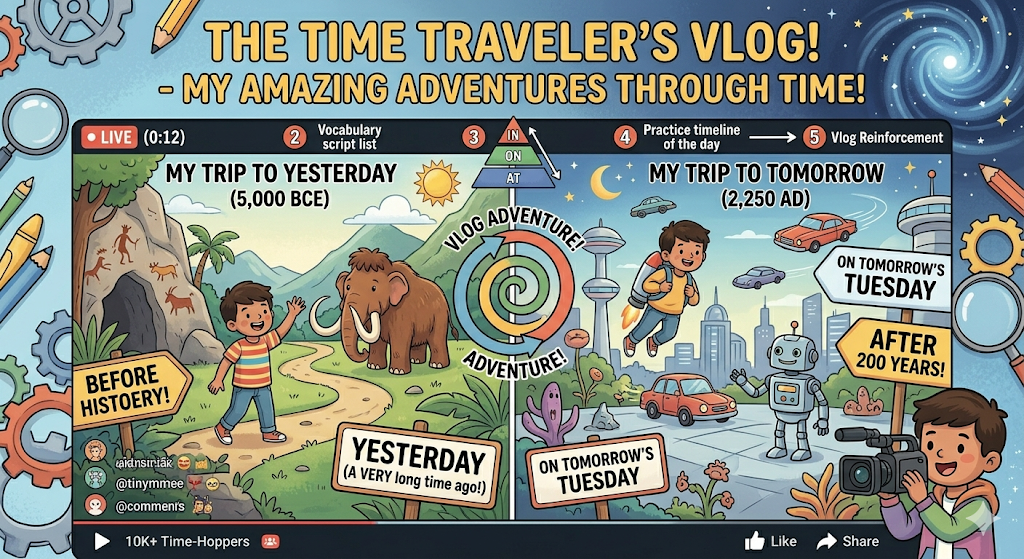
The Time Traveler’s Vlog- (40 mins)
- Activity: Scripting and recording a mini-vlog.
- Instructions:
- Setup (10 mins): Students pretend they are time travelers who visited “Yesterday” or are describing a typical day in the year 2050.
- Drafting (15 mins): Write a 5-sentence script using a mix of past and present time expressions (yesterday, every day, in the morning).
- Production (15 mins): Use Flip (Flipgrid) or a phone to record a quick 30-to-60-second video reading their script.
SESSION 3: CONSOLIDATION (80 min)
Part 1 – ( 2 x 40min)
Assessment Activity
- Period 1: The Reading & Writing Portfolio (40 mins)
- Part A (20 mins): A digital quiz (Google Forms) featuring a short reading comprehension text about a teenager’s routine. Includes 5 multiple-choice questions focusing on when events happen and 5 fill-in-the-blank grammar questions (in/on/at).
- Part B (20 mins): Short writing response. Students write a paragraph (40–50 words) describing their favorite school day, strictly graded on the correct usage of at least 4 different time expressions.
- Period 2: Interactive Speaking Peer-Review (40 mins)
- Task (25 mins): Live “Find Someone Who” digital mixer. Students are given a checklist (e.g., Find someone who studies at night / Find someone who wakes up before 6:00 AM). They must interview classmates in English using breakout rooms or a class walk-about.
- Wrap-up & Self-Reflection (15 mins): Students submit their interview findings and fill out a quick digital exit ticket rating their own confidence with the unit’s skills.
NEE – Agregar el tipo de adaptaciones curriculares
Principio II: Pautas 6.1 – 6.3 – 6.4
Principio III: Pautas 7.1 – 8.1 – 9.1
ALUMNO 1: Constante monitoreo. Dar tiempo adicional para el desarrollo de la actividad y se reduce el número de ejercicios o se modifican los ejercicios con un nivel de dificultad reducido, de acuerdo con sus necesidades académicas.
ALUMNO 2: Constante monitoreo, Dar tiempo adicional para el desarrollo de la actividad y se reduce el número de ejercicios o se modifican los ejercicios con un nivel de dificultad reducido, de acuerdo con sus necesidades académicas.
ALUMNO 3: Constante monitoreo. Corroborar que el contenido entregado en clase haya sido comprendido por la estudiante mediante retroalimentación.