
Media & Communication
SKILLS
EFL.5.1.4 Identify and interpret how cultural and language patterns in English are used when exchanging ideas on familiar topics according to a B1 level
EFL.5.4.6 Produce emails and blog posts describing personal experiences and feelings


REAL-LIFE APPLICATION
TThis topic helps students analyze how media and communication shape identity and decision-making in digital spaces. They learn to discuss what people are able to do online, what they are required to do, and what they should avoid in order to protect their digital presence. In daily life, this helps them reflect on their social media behavior. In personal development, it promotes responsibility and self-awareness. In academic and social contexts, it helps them communicate critically and safely in online environments.
LEARNING ACTIVITIES
SESSION 1 (80 min) ANTICIPATION
Part 1 (20 min)

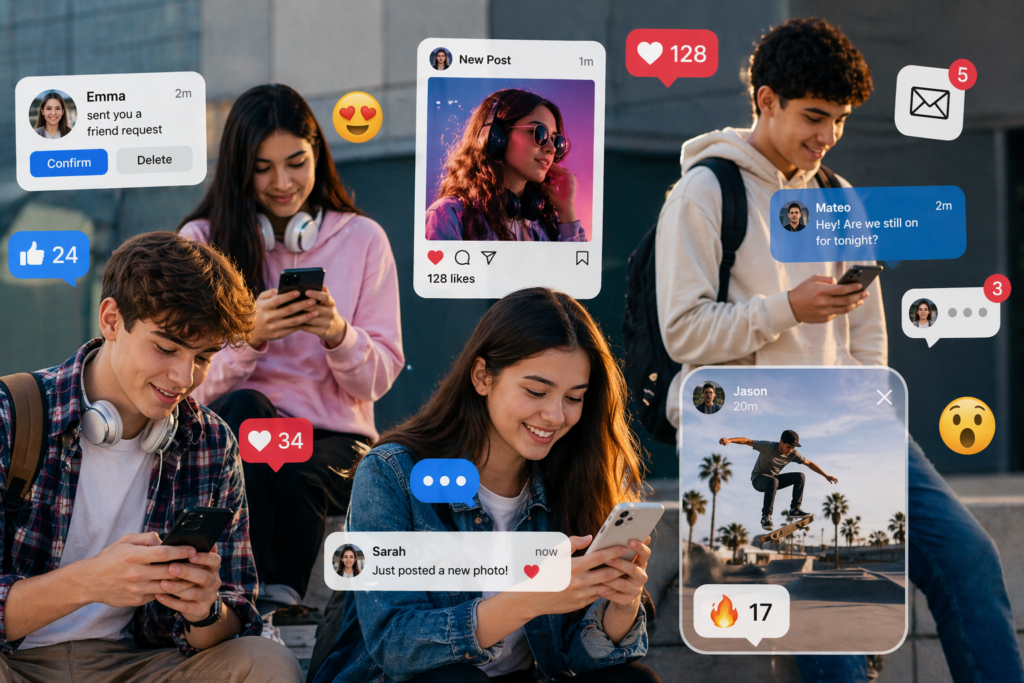
The teacher projects the image and asks the question: How does social media affect the way people present themselves? Students write an individual response for two minutes and then discuss in small groups. Each group identifies both positive and negative aspects of online communication. The teacher leads a short plenary discussion and guides students to the idea that every online action leaves a digital footprint and influences reputation.
CONSTRUCTION
Part 2: Vocabulary Development (15 min)
The teacher introduces key vocabulary: Media & Communication Vocabulary List
The teacher explains each term with a realistic example and asks students to write one original sentence for three of the words. Students then compare answers in pairs.
Part 3: Grammar Development(20 min)
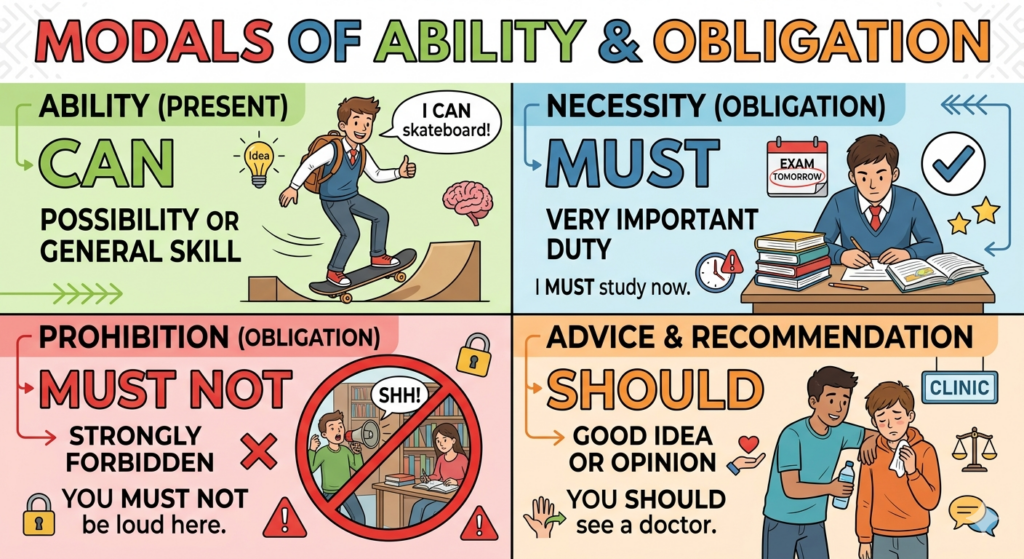
The teacher introduces the target modals through real digital scenarios. The board includes examples such as: You can create content and connect with others online. You must protect your personal data. You must not post private information carelessly. Teenagers should think critically before sharing content. The teacher explains that can expresses ability or possibility, must expresses strong obligation, and must not expresses prohibition. The teacher may also briefly introduce should as recommendation if useful for comparison, while keeping ability and obligation as the main focus.
Part 4: Guided Practice (25 min)
Students work with a case-based chart. They are given digital situations such as: A student wants to post a classmate’s photo without permission or A teenager receives a message from a stranger. For each case, students write what the person can, must, or must not do. The teacher circulates, asks follow-up questions, and encourages more precise reasoning.
SESSION 2: CONSTRUCTION – REINFORCEMENT (40 min)
Part 1 –Media Analysis (10 min)
The teacher presents short screenshots or mock social media posts. Students analyze them and identify possible risks or responsible actions. This keeps the activity visual and contextual without repeating previous topic structures.

Part 2 – Digital Advice Carousel (15 min)
Students rotate through different stations or sheets posted around the room. Each station contains a digital dilemma, such as oversharing, cyberbullying, or unsafe passwords. Students write one piece of advice or one rule using modal verbs at each station. This gives them repeated but varied practice in a more dynamic format.
Part 3 – Short Written Response (15 min)
Students write a short paragraph answering the question: What must teenagers do to create a positive digital footprint? They must use at least three modal verbs and four vocabulary words. The teacher reviews selected answers with the class.
SESSION 3: CONSOLIDATION (80 min)

Part 1 – Review Activation (10 min)
The teacher begins with a brief review on the board using prompts such as: What can people do on social media? What must they do to stay safe? What must they not do? Students answer orally with full sentences. This activates vocabulary and grammar before the formal assessment.
Part 2 – Quiz (25 min)
Students complete an individual quiz that includes multiple choice, sentence correction, short response items, and vocabulary identification. The quiz is designed to evaluate grammar accuracy and understanding of digital communication concepts. The teacher collects it as part of the final grade.
QUIZ: MODALS IN THE DIGITAL WORLD
Part 3 – Application Task (30 min)
Students write a short text of 100–120 words with the title: How to Build a Responsible Digital Identity. They must explain what young people can do online, what they must do to protect themselves, and what they must avoid. The response must include at least six vocabulary words and at least five sentences with modal verbs. The teacher reminds students that the text must be clear, organized, and realistic.
Part 4 – Reflection and Feedback (15 min)
Students exchange their texts and underline modal verbs and vocabulary in each other’s work. They identify one strong point and one suggestion for improvement. The teacher closes by reinforcing that digital communication is not only a language topic, but also a real-life responsibility.
 RUBRIC: Responsible Digital Identity Rubric
NEE – Agregar el tipo de adaptaciones curriculares
Principio II: Pautas 6.1 – 6.3 – 6.4
Principio III: Pautas 7.1 – 8.1 – 9.1
ALUMNO 1: Constante monitoreo. Dar tiempo adicional para el desarrollo de la actividad y se reduce el número de ejercicios o se modifican los ejercicios con un nivel de dificultad reducido, de acuerdo con sus necesidades académicas.
ALUMNO 2: Constante monitoreo, Dar tiempo adicional para el desarrollo de la actividad y se reduce el número de ejercicios o se modifican los ejercicios con un nivel de dificultad reducido, de acuerdo con sus necesidades académicas.
ALUMNO 3: Constante monitoreo. Corroborar que el contenido entregado en clase haya sido comprendido por la estudiante mediante retroalimentación.