
Writing Workshop

SKILLS
EFL.5.4.6 Produce emails and blog posts describing personal experiences and feelings.
EFL.5.4.8 Create an effective voice, using a variety of writing styles appropriate to different audiences, purposes and settings, and adjust these styles as necessary.


REAL-LIFE APPLICATION

This topic helps students write with purpose and audience awareness. They learn how to draft informal emails and short articles while controlling mechanics, tone, structure, paragraphing, and word count. This is useful for exam writing tasks, school publications, digital communication, project reflections, online posts, and academic writing preparation.
LEARNING ACTIVITIES
SESSION 1 (80 min) ANTICIPATION
Part 1: Writing Task Intake Desk (20 min)
The teacher presents different writing requests as if they arrived at a writing center. Students decide the format, audience, tone, and content needed.
Writing requests:
- Write to a friend about a school event.
- Write an article about a student campaign.
- Ask a classmate for advice.
- Report a recent class activity.
- Invite a friend to a workshop.
- Write an article about a teenage trend.
Students answer:
“What format is needed?”
“Who is the audience?”
“What tone should we use?”
“What information must be included?”
“What would make this text effective?”
The teacher emphasizes that strong writers make decisions before drafting.
Part 2: Vocabulary Activation: Writer’s Toolbox Relay (15 min)
Students place expressions on a “register thermometer” from very casual to appropriate informal/semi-formal writing. They must justify their choices orally.

- audience
- purpose
- tone
- register
- format
- paragraph
- headline
- opening
- closing
- draft
- revision
- feedback
- mechanics
- punctuation
- capitalization
- coherence
- connector
- detail
- example
- opinion
- informal email
- short article
- reader
- message
- word count
- edit
- proofread
- publish
Part 3: Grammar and Mechanics Input: Sentence Surgery Protocol (25 min)
The teacher explains that mechanics are not decoration. Mechanics control meaning, clarity, and professionalism.
The teacher shows a weak paragraph:
“last week our class had a writing workshop it was useful because we learned emails articles and punctuation i liked the activity but it was difficult”
Students identify the problems:
- no capital letter at the beginning
- no sentence boundaries
- missing commas
- no clear paragraph flow
- weak organization
Improved version:
“Last week, our class had a writing workshop. It was useful because we learned how to write emails, articles, and clear sentences. I liked the activity, but it was difficult at first.”

The teacher explains sentence boundaries:
A sentence must express a complete idea.
Complete:
“I enjoyed the article.”
“The workshop helped me improve my punctuation.”
Fragment:
“Because it was useful.”
“When we finished the draft.”
Run-on:
“I wrote the email it was too long.”
Corrected:
“I wrote the email, but it was too long.”
“I wrote the email. It was too long.”
The teacher explains connectors for short articles and emails:
Addition:
also, and, in addition
Sequence:
first, then, after that, finally
Contrast:
but, however
Reason:
because
Result:
so, as a result
Opinion:
I think, in my opinion
The teacher connects register to format:
Informal email:
friendly, personal, direct, includes greeting and closing.
Short article:
clear title, more public audience, topic introduction, details, and conclusion.
Part 4: Draft Diagnosis Clinic (20 min)
Groups receive short weak drafts. They diagnose what is missing before rewriting.
Diagnosis categories:
- unclear purpose
- wrong format
- missing greeting or title
- weak punctuation
- no paragraphing
- too informal
- no supporting details
- unclear ending
- repeated ideas
- no revision
Groups repair only one section and present their improvement orally.
Gamification:
- 1 Krug for correct diagnosis
- 1 Krug for clear repair
- 1 Krug for explaining the reason
- 1 Krug for mechanics accuracy
- bonus Krug for improving tone
SESSION 2: CONSTRUCTION – REINFORCEMENT (40 min)
Part 1 – Headline vs. Subject Line Duel (15 min)
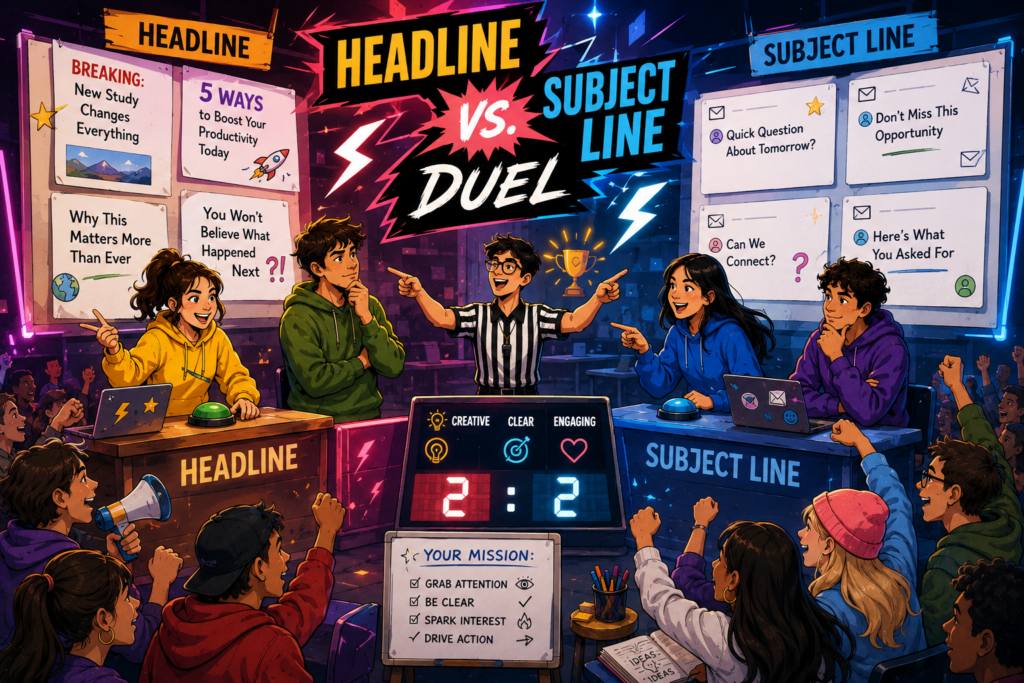
Students receive writing topics and must decide if they need an email subject-style idea or an article headline. Then they create one.
Topics:
- school trip
- sports day
- asking for help
- thanking a friend
- recycling campaign
- new club
- inviting a friend
- missing homework
- health challenge
- student achievement
Examples:
Email subject idea: “About Friday’s project”
Article headline: “Students Launch a New Recycling Challenge”
Students explain why their choice fits the format.
Part 2 – Peer Conference Speed Edit (15 min)
Students exchange drafts or draft plans. They have two minutes per partner and must ask:
“What is your purpose?”
“Who is your reader?”
“What is your strongest sentence?”
“What mechanics issue should you check?”
“What will you revise?”
Students rotate twice. The goal is oral revision before final writing.
Part 3 – Exit Revision Decision (10 min)
Each student says one revision decision.
Examples:
“I will add a clearer title.”
“I will check my commas.”
“I will make my closing friendlier.”
“I will divide my article into two paragraphs.”
SESSION 3: CONSOLIDATION (80 min)
Part 1 – Preparation: Digital Submission Queue (15 min)
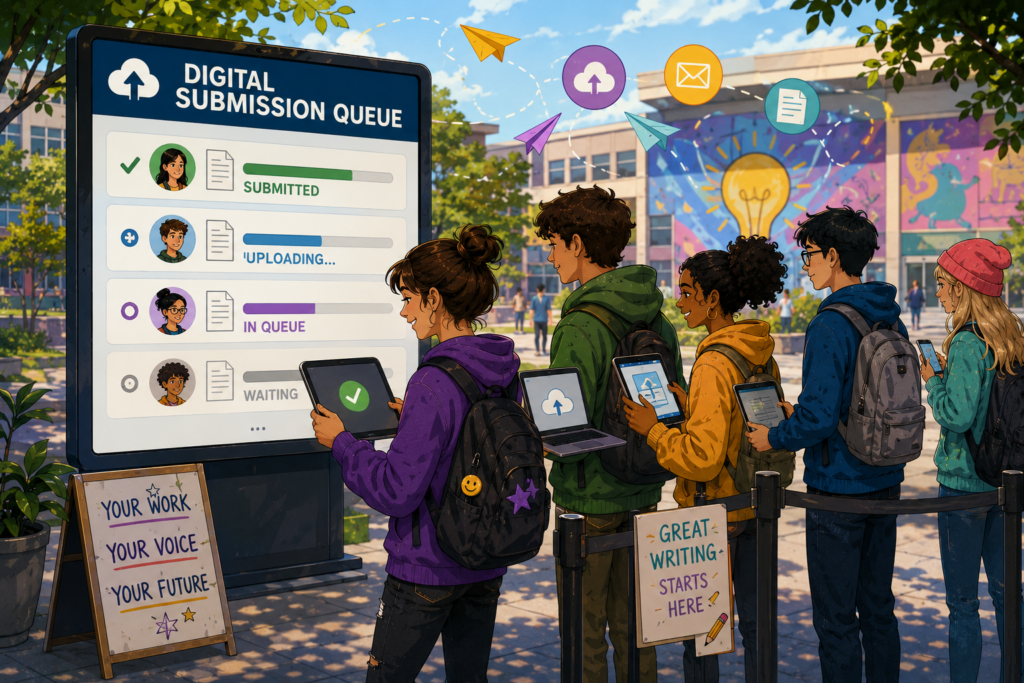
Students prepare one final writing task.
Option A: informal email of 90–110 words
Option B: short article
They prepare only a writing plan:
- audience
- purpose
- format
- main idea
- details
- tone
- mechanics focus
Part 2 – Digital Submission Queue Simulation (50 min)
The classroom works like a writing submission system. Students move through four desks:
Desk 1: Planning Check
Student explains purpose and reader.
Desk 2: Mechanics Check
Peer checks punctuation, capitalization, and sentence boundaries.
Desk 3: Style Check
Peer checks tone and format.
Desk 4: Final Submission
Student reads one strong sentence aloud and submits the final draft.
Roles:
- writer
- mechanics editor
- style editor
- final reviewer
This consolidation is interactive because students must explain their writing decisions orally before submitting.
Part 3 – Writer’s Debrief (15 min)
Students reflect orally:
“What did you change from draft to final version?”
“What mechanics mistake did you notice?”
“What helped your text sound clearer?”
“What would you improve next time?”
RUBRIC: Writing Workshop
NEE – Agregar el tipo de adaptaciones curriculares
Principio II: Pautas 6.1 – 6.3 – 6.4
Principio III: Pautas 7.1 – 8.1 – 9.1
ALUMNO 1: Constante monitoreo. Dar tiempo adicional para el desarrollo de la actividad y se reduce el número de ejercicios o se modifican los ejercicios con un nivel de dificultad reducido, de acuerdo con sus necesidades académicas.
ALUMNO 2: Constante monitoreo, Dar tiempo adicional para el desarrollo de la actividad y se reduce el número de ejercicios o se modifican los ejercicios con un nivel de dificultad reducido, de acuerdo con sus necesidades académicas.
ALUMNO 3: Constante monitoreo. Corroborar que el contenido entregado en clase haya sido comprendido por la estudiante mediante retroalimentación.