
Education Systems

SKILLS
EFL.5.2.11 Express opinions on abstract and concrete topics while describing reactions to them and others’ opinions.
EFL.5.3.3 Determine the main conclusion in texts which clearly argue a point of view in order to make informed decisions about one’s own opinion and reaction.


REAL-LIFE APPLICATION
This topic helps students discuss education systems and career pathways in a more analytical way. Students learn to explain how earlier experiences influenced later decisions. The Past Perfect Simple helps them sequence events clearly, especially when discussing education choices, training experiences, career decisions, internships, and personal learning histories.
LEARNING ACTIVITIES
SESSION 1 (80 min) ANTICIPATION
Part 1: Education Pathway Dilemma Room (20 min)
The teacher presents short student profiles around the room. Each profile describes a student who must choose between an academic pathway, a vocational pathway, or a mixed pathway. Groups move around, analyze the profiles, and recommend one pathway. The teacher asks: “What had the student already experienced before making this choice?” This leads naturally into Past Perfect Simple.
Student profiles:
- A student had enjoyed science and wanted to study medicine.
- A student had repaired phones with a relative and liked practical tasks.
- A student had written strong essays and wanted university research.
- A student had helped in a family restaurant and wanted culinary training.
- A student had designed posters and wanted digital media.
- A student had enjoyed debates and wanted law.
- A student had built small robots and wanted engineering.
- A student had volunteered in a kindergarten and wanted education.
- A student had sold handmade products and wanted entrepreneurship.
- A student had studied biology and enjoyed laboratory practice.
CONSTRUCTION
Part 2: Vocabulary for Education Pathways (15 min)
The teacher introduces vocabulary for a more mature discussion of education systems.
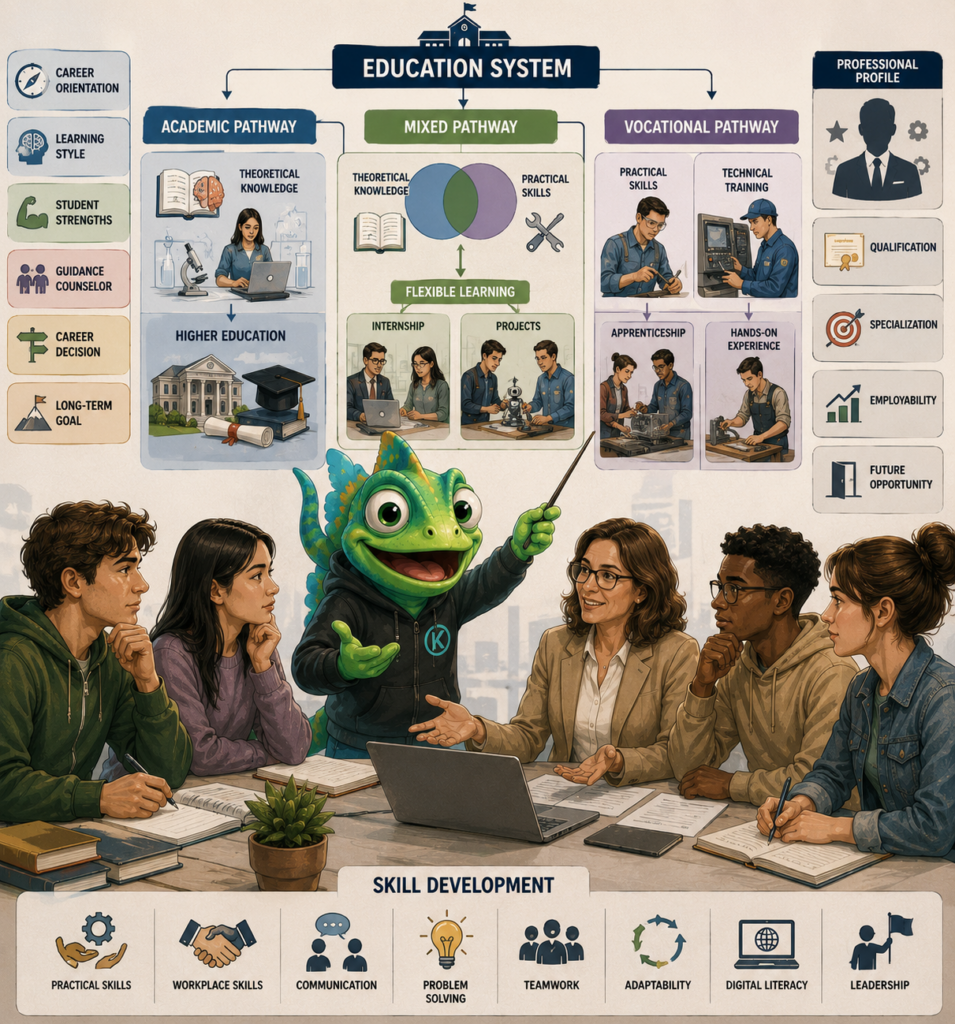
- education system
- academic pathway
- vocational pathway
- mixed pathway
- technical training
- theoretical knowledge
- practical skills
- career orientation
- higher education
- internship
- apprenticeship
- professional profile
- qualification
- specialization
- employability
- learning style
- hands-on experience
- research-based learning
- workplace skills
- career decision
- long-term goal
- student strengths
- guidance counselor
- future opportunity
- skill development
Model sentences:
“A vocational pathway develops practical skills and workplace experience.”
“An academic pathway often prepares students for higher education and research.”
“A mixed pathway can combine theoretical knowledge with hands-on experience.”
Part 3: Grammar Input: Past Perfect Simple for Sequencing Decisions (25 min)
Explanation

Past Perfect Simple
The Past Perfect Simple helps us show that one past action happened before another past action.
Structure:
subject + had + past participle
Example:
After Daniel had completed an internship, he decided to study technical engineering.
This means Daniel completed the internship first. Then, because of that experience, he made the decision to study technical engineering.
In education topics, this structure is useful because students often make choices based on previous experiences.
More examples:
She chose vocational training because she had worked in her family’s restaurant.
He selected an academic pathway after he had enjoyed research projects.
They felt prepared because they had practiced in a workshop before.
Part 4: Pathway Advisory Lab (20 min)
Students work in advisory teams. Each team receives a student profile and must recommend a pathway. They must explain what the student had already done before the decision and why that matters. This activity combines grammar, speaking, and decision-making.
Advisory profiles:
- A student had won a science fair and wanted laboratory work.
- A student had worked with tools and enjoyed fixing machines.
- A student had written articles for a school magazine.
- A student had volunteered in a hospital.
- A student had created social media designs.
- A student had helped manage a small family business.
- A student had studied programming tutorials online.
- A student had practiced public speaking.
- A student had completed a cooking workshop.
- A student had researched environmental problems.
Speaking frame:
“Because the student had…, we recommend…”
“Before choosing this pathway, the student had already…”
“This experience showed that…”
SESSION 2: CONSTRUCTION – REINFORCEMENT (40 min)
Part 1 – Career Counselor Hot Seat (15 min)
One student sits as the “career counselor.” Another student presents a profile. The counselor asks two questions and gives advice using Past Perfect Simple. Then students rotate roles. This makes the grammar oral and interactive.
Question prompts:
- What had the student enjoyed before?
- What skills had the student developed?
- What project had the student completed?
- What course had the student taken?
- What experience had influenced the decision?
- What career had the student considered?
- What information had the student collected?
- What pathway had the student preferred?
- What challenge had the student faced?
- What goal had the student identified?
Part 2 – Education System Challenge Board (15 min)
Students compare academic and vocational learning by placing examples under the correct category. Then they explain their choices orally using topic vocabulary.
Examples:
- laboratory research
- machine repair
- essay writing
- workplace training
- exam preparation
- internship experience
- theoretical reading
- product design
- university preparation
- technical certification
Students must say:
“This example connects to vocational learning because…”
“This example connects to academic learning because…”
“This could be both because…”
Part 3 – Advisory Exit Line (10 min)
Each student gives one final recommendation using Past Perfect Simple.
Examples:
“Because she had completed a workshop, I recommend vocational training.”
“Because he had enjoyed research, I recommend an academic pathway.”
SESSION 3: CONSOLIDATION (80 min)
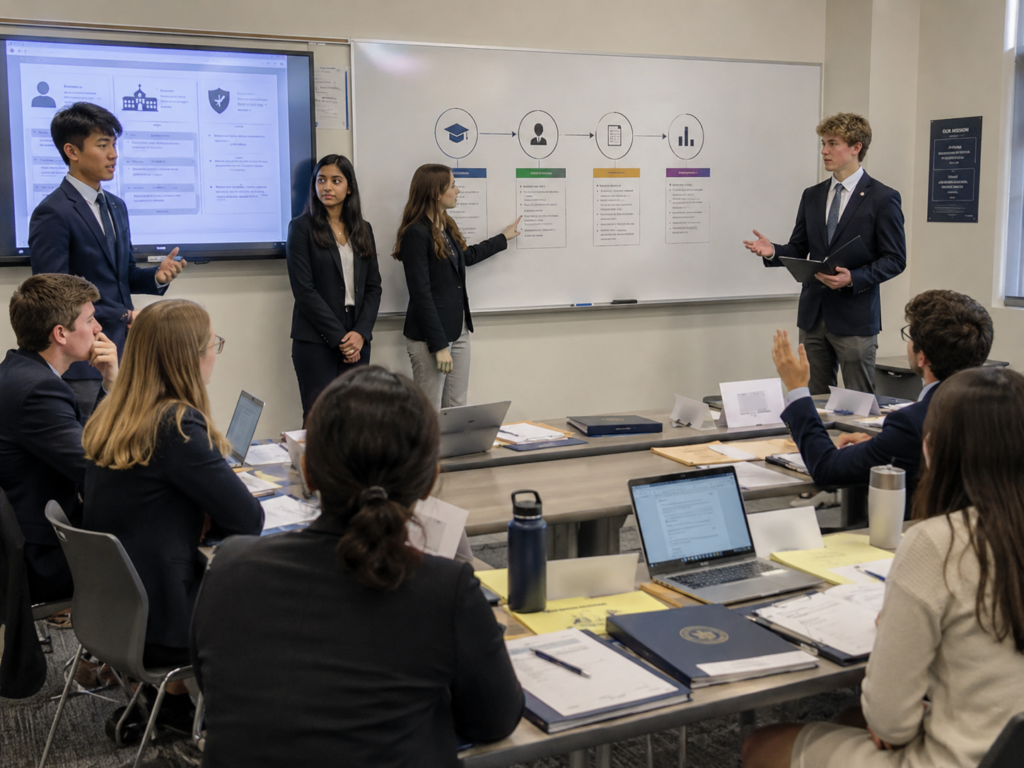
Part 1 – Preparation: Education Pathway Advisory Board (15 min)
Students prepare to participate in an advisory board. Each group receives one student case. They cannot write a full script. They prepare keywords under: previous experience, strengths, recommended pathway, and reason.
Cases:
- A student had completed a robotics project but also enjoyed math theory.
- A student had worked in a bakery and wanted to start a business.
- A student had written essays and wanted to study social sciences.
- A student had volunteered in a hospital and enjoyed biology.
- A student had repaired computers and researched software.
- A student had joined debate club and liked reading laws.
- A student had practiced design and wanted a creative career.
- A student had helped teach younger students.
- A student had studied environmental issues and liked fieldwork.
- A student had sold products online and wanted marketing.
Part 2 – Advisory Board Simulation (50 min)
Groups act as education advisors. One student presents the case, two students explain the student’s previous experiences using Past Perfect, and one student gives the final recommendation. After the presentation, classmates ask one question as the “family” or “school board.” This is interactive because students must advise, justify, question, and respond.
Required structure:
- Present the student profile.
- Explain what the student had done before.
- Recommend academic, vocational, or mixed pathway.
- Justify the recommendation.
- Answer one question.
Board questions:
- Why is this pathway better than the other one?
- What had the student already learned?
- What skill had the student developed?
- What career could this pathway support?
- Is the student more practical or theoretical?
- Could a mixed pathway work better?
- What risk should the student consider?
- What opportunity does this pathway provide?
- What evidence supports your recommendation?
- What should the student do next?
Part 3 – Final Decision Round (15 min)
The class votes for the strongest advisory recommendation. Students must justify their vote with one sentence using Past Perfect Simple.
 RUBRIC:
Education Systems
NEE – Agregar el tipo de adaptaciones curriculares
Principio II: Pautas 6.1 – 6.3 – 6.4
Principio III: Pautas 7.1 – 8.1 – 9.1
ALUMNO 1: Constante monitoreo. Dar tiempo adicional para el desarrollo de la actividad y se reduce el número de ejercicios o se modifican los ejercicios con un nivel de dificultad reducido, de acuerdo con sus necesidades académicas.
ALUMNO 2: Constante monitoreo, Dar tiempo adicional para el desarrollo de la actividad y se reduce el número de ejercicios o se modifican los ejercicios con un nivel de dificultad reducido, de acuerdo con sus necesidades académicas.
ALUMNO 3: Constante monitoreo. Corroborar que el contenido entregado en clase haya sido comprendido por la estudiante mediante retroalimentación.