
K-Learning Project
SKILLS
EFL.5.1.3 Find parallels between Ecuadorian cultural and political referents and those of other countries by talking about holidays, symbols, customs and schooling.
EFL.5.2.7 Present information clearly in a variety of oral forms for a range of audiences and purposes.
REAL-LIFE APPLICATION
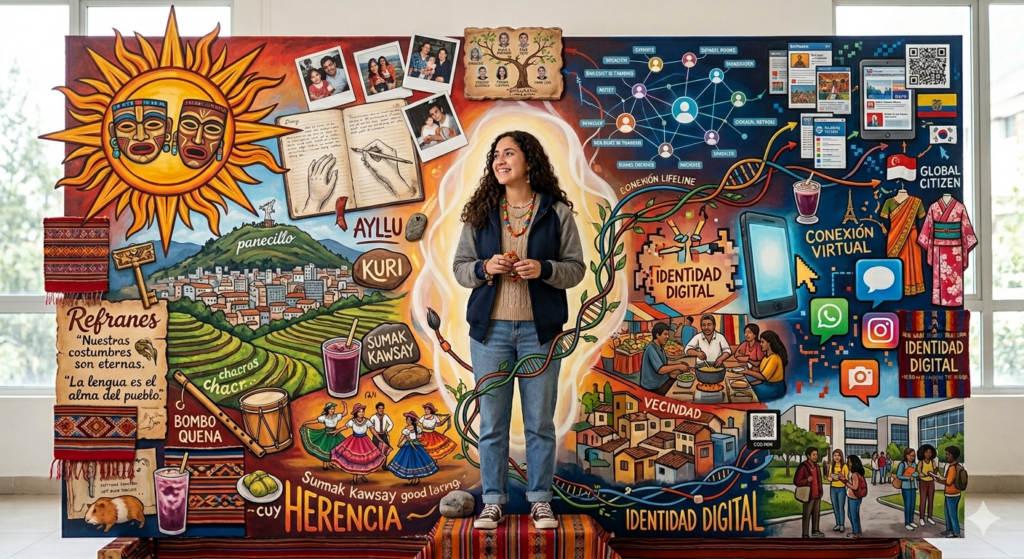
This project helps students develop the ability to speak clearly and confidently about personal identity, cultural heritage, and the experiences that shape them. Students learn to connect individual identity with family, community, traditions, and social influences. In real life, this supports academic presentations, interviews, personal introductions, and intercultural communication. It also helps students express who they are with reflection, respect, and purpose.
LEARNING ACTIVITIES
SESSION 1 (80 min) ANTICIPATION
Part 1: Identity Layers Analysis (20 min)
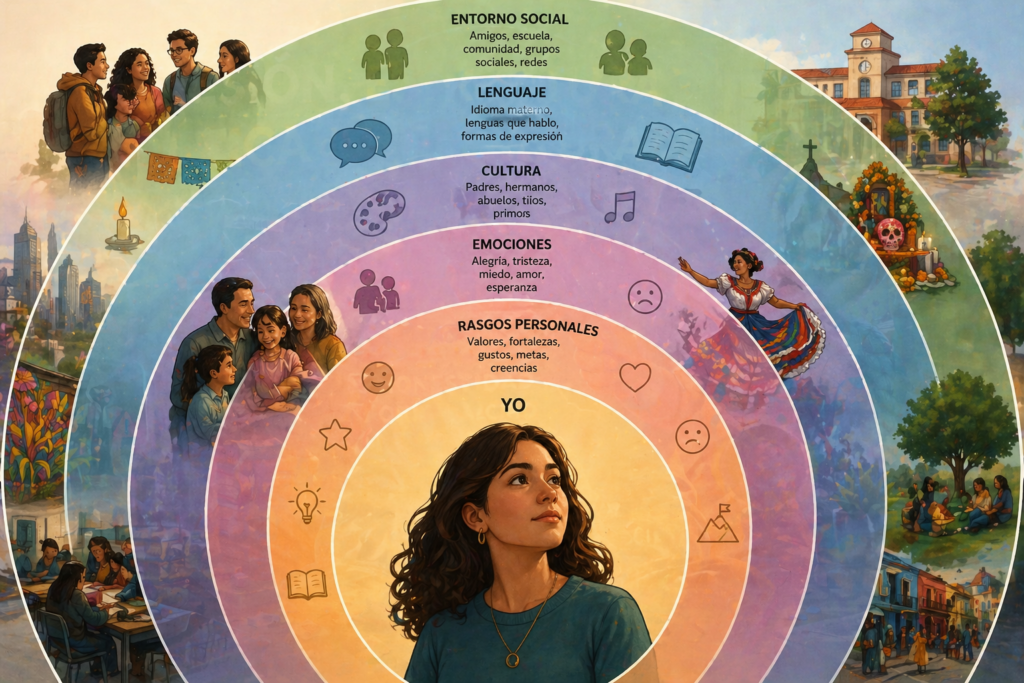
The teacher presents an image showing different layers of identity: personal traits, emotions, family, culture, language, traditions, and social environment. Students respond to the question: Which parts of your identity come from you, and which parts come from your culture or society? Students first write a short individual response and then discuss in groups. The teacher guides the conversation toward the idea that identity is both personal and cultural.
CONSTRUCTION
Part 2: Vocabulary for Reflective Speaking (15 min)
The teacher introduces vocabulary that helps students speak with more depth:
- identity
- cultural heritage
- background
- belonging
- values
- roots
- tradition
- influence
- community
- perspective
- memory
- respectful
- meaningful
- personal growth
- cultural connection
- self-image
- family legacy
- diversity
- customs
- worldview.
The teacher explains that students should not only name a tradition, but also explain its meaning. Students choose at least six words to include in their speech.
Part 3: Speech Structure: Claim, Evidence, Reflection (20 min)
The teacher explains that a strong 45–60 second speech should not sound like a list. Students learn a three-part structure: claim, evidence, and reflection. The claim answers who they are. The evidence gives examples from personality, experiences, or cultural heritage. The reflection explains why these elements matter. The teacher models a short example and highlights how each part helps the speaker sound organized and intentional.
Part 4: Speech Planning Lab (25 min)
Students create a structured speaking outline instead of writing a full script. Their outline must include one identity claim, two supporting details, one cultural heritage example, and one final reflection. The teacher encourages students to avoid generic ideas and use specific examples from their lives. Students rehearse in pairs and receive quick feedback on clarity, depth, and organization.
Example Speaking Outline
Identity claim:
My identity has been shaped by my family values, my love for learning, and my Ecuadorian culture.
Supporting detail 1:
I am a responsible person because my family has always taught me to respect others and keep my promises.
Supporting detail 2:
I am also curious because I enjoy asking questions, learning new things, and understanding different points of view.
Cultural heritage example:
One tradition that represents me is Día de los Difuntos. In my family, we eat guaguas de pan and colada morada, and this tradition helps us remember people we love.
Final reflection:
These experiences are important because they remind me where I come from and help me understand the kind of person I want to become.
SESSION 2: CONSTRUCTION – REINFORCEMENT
(40 min)
Part 1 – Strong Opening Practice (10 min)
Students write and practice two possible opening lines for their speech. The teacher explains that the first sentence should capture attention and introduce identity clearly.
Examples include: My identity has been shaped by my family, my choices, and my culture.
Another example is: I understand who I am through the traditions and values I carry with me.
Part 2 – Speaking Clinic: Voice, Pace, and Transitions (15 min)
The teacher focuses on presentation skills. Students practice using transitions:
- such as first
- another important part of my identity is
- this matters because, and finally.
They also practice pacing, pausing, and emphasizing key words. The teacher models the difference between reading a text and speaking to an audience.
Part 3 – Peer Coaching (15 min)
Students present a 30-second draft to a partner. The listener gives feedback using three questions:
Is the identity clear?
Is the cultural heritage example specific?
Is the speech easy to follow?
Students then revise their notes. This activity prepares them for the final presentation while keeping the focus on improvement, not memorization.
SESSION 3: CONSOLIDATION (80 min)

Part 1 – Final Rehearsal (15 min)
Students review their speaking outline and rehearse once individually or with a partner. The teacher reminds them that they may use keywords, but they should avoid reading a full script. Students check that their speech includes personal identity, cultural heritage, at least one specific example, and a final reflection.
Part 2 – Sustained Speech Presentation (50 min)
Students deliver a 45–60 second sustained speech titled My Identity and Cultural Heritage. Each student must explain who they are, describe one personal or cultural influence, and reflect on why it matters. The speech should include clear organization, appropriate vocabulary, and confident delivery. The teacher evaluates not only language accuracy, but also the student’s ability to communicate meaning, identity, and cultural awareness.
Part 3 – Audience Reflection and Closure (15 min)
After the presentations, students complete a short listener reflection. They write one idea they found meaningful from another student’s speech and one cultural similarity or difference they noticed. The teacher closes by emphasizing that speaking about identity is not just an English activity; it is a way to understand oneself and others with respect.
 RUBRIC:
KLearning Speech Rubric
NEE – Agregar el tipo de adaptaciones curriculares
Principio II: Pautas 6.1 – 6.3 – 6.4
Principio III: Pautas 7.1 – 8.1 – 9.1
ALUMNO 1: Constante monitoreo. Dar tiempo adicional para el desarrollo de la actividad y se reduce el número de ejercicios o se modifican los ejercicios con un nivel de dificultad reducido, de acuerdo con sus necesidades académicas.
ALUMNO 2: Constante monitoreo, Dar tiempo adicional para el desarrollo de la actividad y se reduce el número de ejercicios o se modifican los ejercicios con un nivel de dificultad reducido, de acuerdo con sus necesidades académicas.
ALUMNO 3: Constante monitoreo. Corroborar que el contenido entregado en clase haya sido comprendido por la estudiante mediante retroalimentación.