
Giving Advice

SKILLS
EFL.5.2.12 Use appropriate vocabulary, expressions, language, routines and interaction styles in formal and informal social or academic situations by asking permission, thanking someone, apologizing to friends, giving advice, making a suggestion, etc.
EFL.5.2.15 Engage in an extended conversation on most general topics and keep it going by expressing and responding to suggestions, opinions, attitudes, advice, feelings, etc.
REAL-LIFE APPLICATION

This topic helps students communicate with maturity in formal and semi-formal situations. They learn how to apologize responsibly, make suggestions without sounding rude, thank people specifically, disagree politely, and keep a conversation going. This is useful for FCE-style speaking tasks, interviews, teamwork, formal school events, presentations, academic discussions, and future professional communication.
LEARNING ACTIVITIES
SESSION 1 (80 min) ANTICIPATION
Part 1: Communication Emergency Buttons (20 min)
The teacher shows an image of two students doing a speaking exam with an examiner and a timer. Students observe the scene and answer:

What are the students doing?
What skills do they need besides grammar?
How do they keep the conversation going?
What should they say if they disagree?
What should they say if they make a mistake?
The teacher introduces the idea:
In FCE-style speaking, students are not only graded on correct grammar. They also need interaction skills: responding, inviting the partner to speak, suggesting, agreeing, disagreeing politely, thanking, and repairing communication.
Model exchange:
A: I think we should choose the study club idea.
B: I see your point, but perhaps the speaking workshop would help more students.
A: That’s a good suggestion. Why do you think it would be more useful?
B: Because students need more oral practice.
A: Thank you for explaining your point.
CONSTRUCTION
Part 2: Vocabulary Activation: Register Thermometer (15 min)
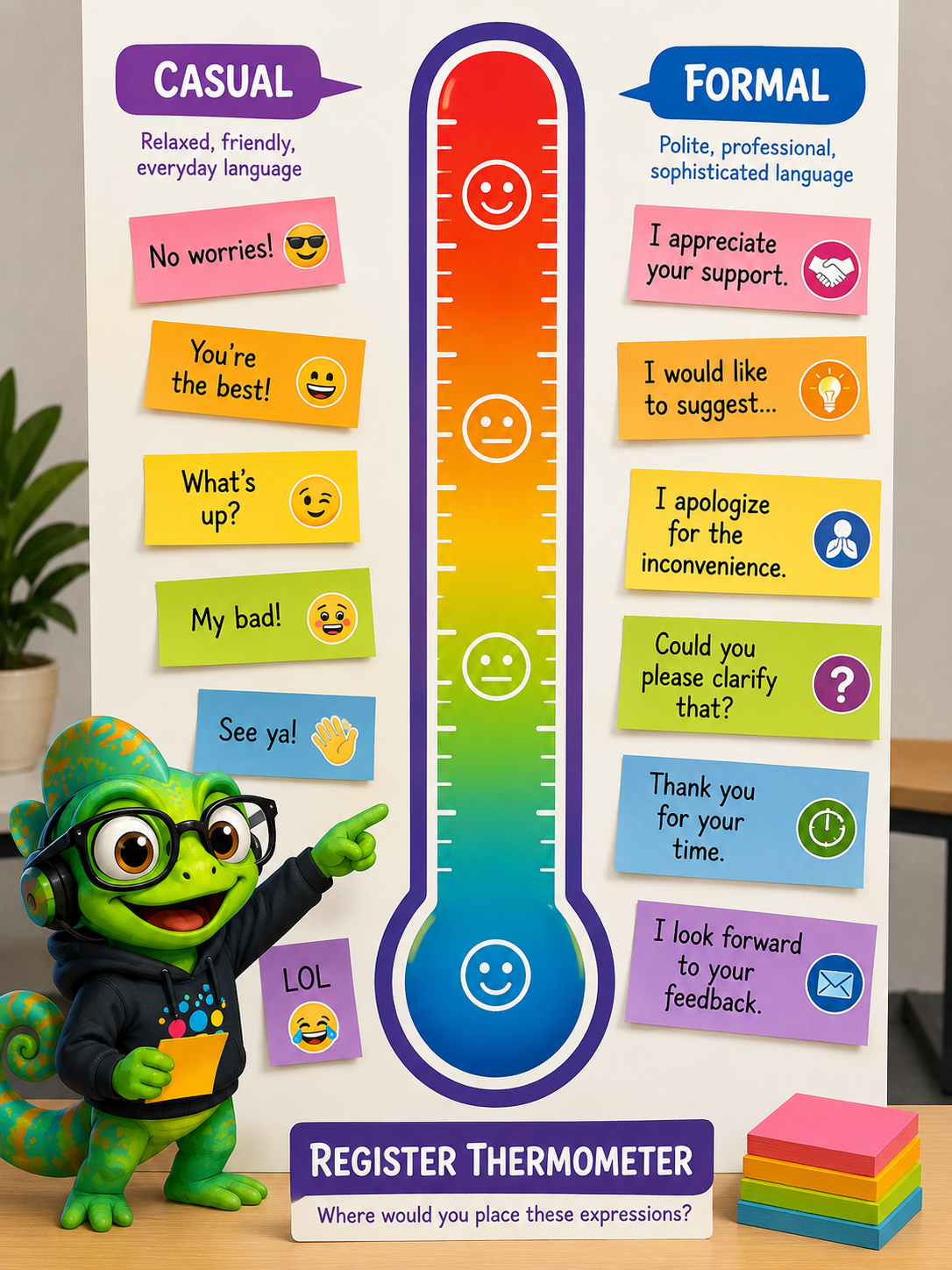
Students place expressions on a “register thermometer” from casual to formal. The teacher gives expressions orally or projected visually. Students decide where each expression belongs and explain why.
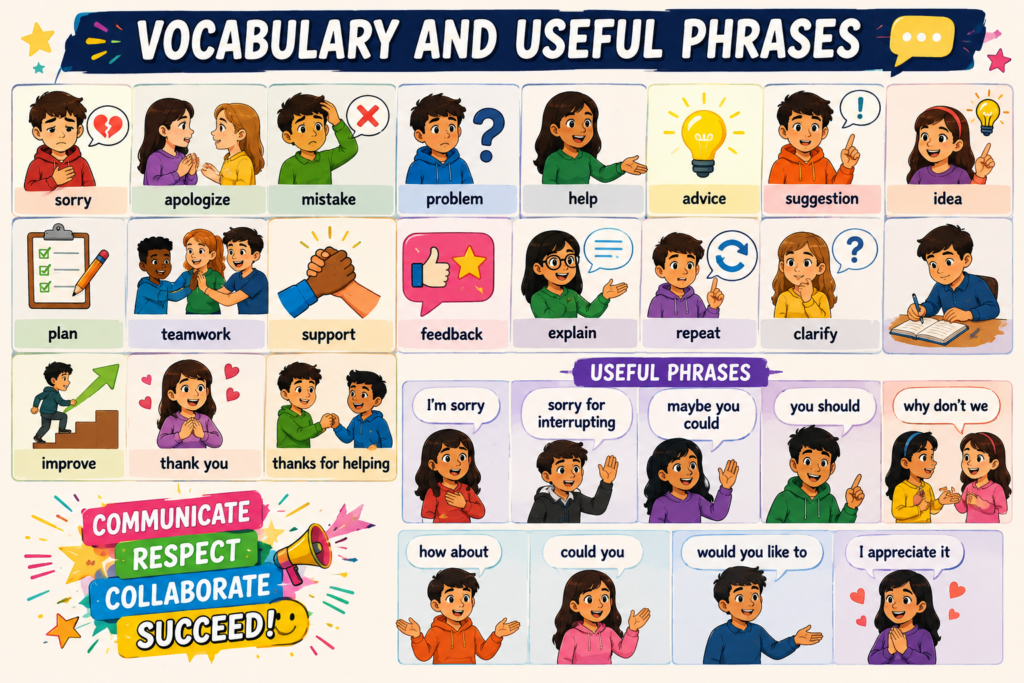
Vocabulary and useful phrases:
- apologize
- suggest
- recommend
- appreciate
- clarify
- interrupt
- support
- feedback
- proposal
- option
- alternative
- decision
- agreement
- disagreement
- formal tone
- respectful response
- turn-taking
- clarification
- contribution
- solution
- I apologize for
- I’m sorry about
- I would suggest
- Perhaps we could
- It might be better to
- I see your point
- Thank you for clarifying
- I appreciate your feedback
- Could you explain that?
- May I add something?
Examples of register discussion:
“Thanks” is casual or neutral.
“Thank you for clarifying” is more formal.
“Do this” is too direct.
“I would suggest trying this option” is more polite.
Part 3: Grammar and Interaction Input: Transcript Upgrade Method (25 min)
The teacher gives students a weak FCE-style dialogue. Students do not start with isolated rules. They annotate the dialogue and improve it.
Weak dialogue:
A: I think this one.
B: No. Bad idea.
A: Why?
B: Because no.
A: Okay.
B: Thanks.
Upgraded dialogue:
A: I think the study club could be useful because students need regular practice.
B: I see your point, but I would suggest the speaking workshop because it prepares students for oral exams.
A: That’s a good point. Could you explain how it would work?
B: Of course. Students would practice in pairs and receive feedback.
A: Thank you for clarifying. I think we could combine both ideas.
The teacher explains the key interaction styles.
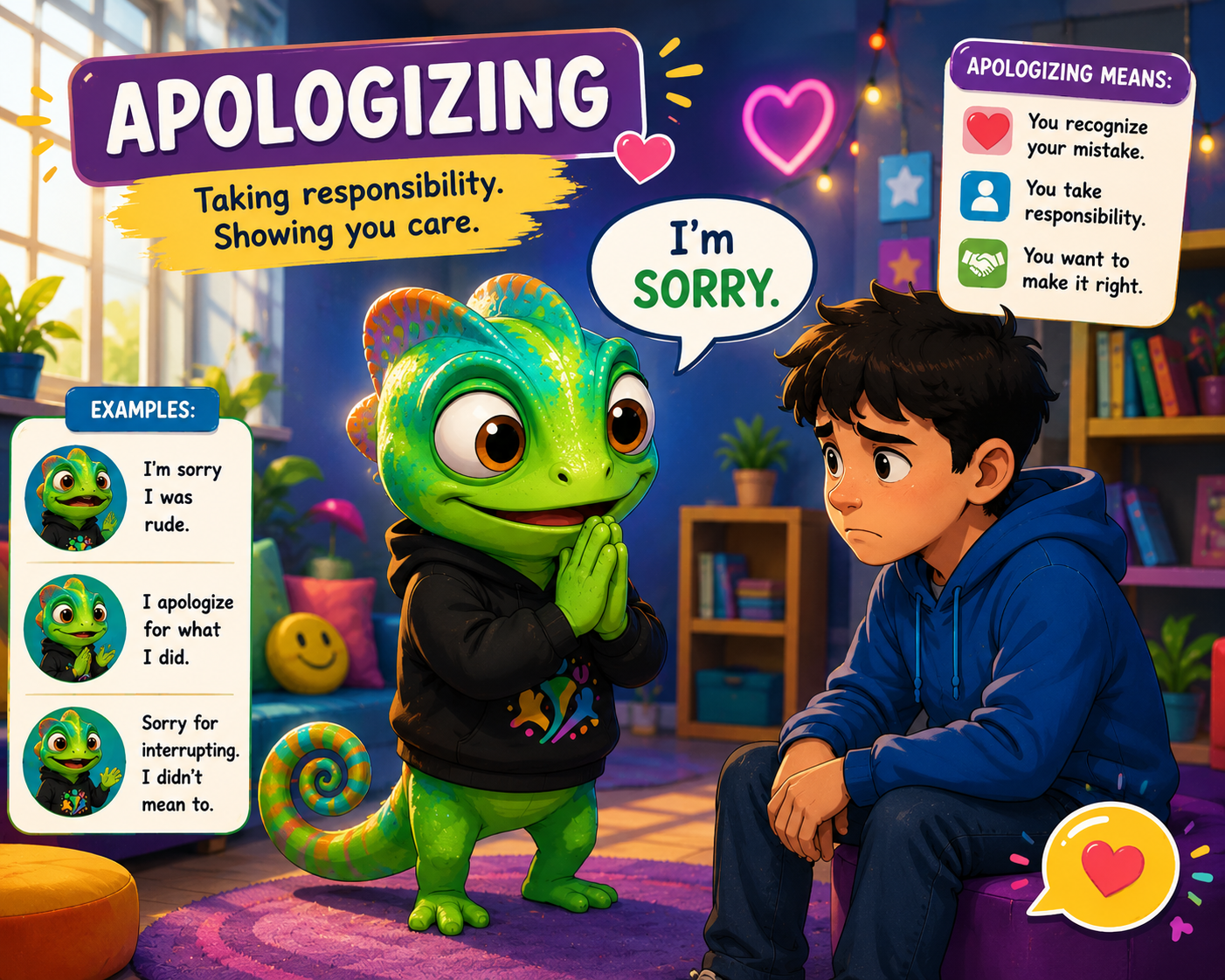
Formal and semi-formal apologizing:
Use when you made a mistake, interrupted, missed a deadline, misunderstood, or caused a problem.
Structures:
I apologize for + noun / verb-ing.
I apologize for the confusion.
I apologize for interrupting.
I’m sorry about + noun.
I’m sorry about the delay.
I’m sorry that + clause.
I’m sorry that I misunderstood your point.
A strong formal apology includes repair:
I apologize for missing the meeting. I will send my part today.
I’m sorry about the confusion. Let me clarify my idea.
Formal suggesting:
Use when giving advice, proposing a solution, or contributing to group decisions.
Structures:
I would suggest + verb-ing / noun.
I would suggest practicing in pairs.
Perhaps we could + base verb.
Perhaps we could choose the most realistic option.
It might be a good idea to + base verb.
It might be a good idea to ask for feedback.
We may want to consider + noun / verb-ing.
We may want to consider a different approach.
Formal thanking:
Use when someone helps, clarifies, gives feedback, contributes, or listens.
Structures:
Thank you for + noun / verb-ing.
Thank you for your feedback.
Thank you for explaining your point.
I appreciate + noun.
I appreciate your support.
I appreciate your suggestion.
That was helpful because…
That was helpful because it clarified the problem.
Polite disagreement:
Instead of saying “No” or “That’s wrong,” students should respond diplomatically.
Useful phrases:
I see your point, but…
I understand your idea, but…
That could work, although…
I agree partly, but…
Perhaps another option would be…
FCE prep note:
In FCE (First Certificate in English) speaking tasks, students should not dominate the conversation. They should invite the partner to speak, respond to ideas, and build the conversation.
Useful turn-taking phrases:
What do you think?
Would you agree?
May I add something?
Could you explain your idea?
Shall we choose one option?
Let’s compare both options.
Part 4: Candidate Interaction Lab (20 min)
Students work in pairs as FCE candidates. Each pair receives a decision prompt. They must speak for one minute and include:
- one suggestion
- one polite disagreement
- one thank-you expression
- one follow-up question
Prompts:
- Choose the best way to help students prepare for oral exams.
- Choose the best activity to improve teamwork.
- Choose the best workshop for teenagers.
- Choose the best school campaign for respect.
- Choose the best way to welcome new students.
- Choose the best method to reduce exam stress.
- Choose the best digital tool for studying.
- Choose the best way to solve group conflicts.
- Choose the best classroom rule for communication.
- Choose the best English practice activity.
Gamification:
Pairs earn Krugsfor:
- formal suggestion
- polite disagreement
- turn-taking
- thanking or acknowledging
- speaking naturally without reading
SESSION 2: CONSTRUCTION – REINFORCEMENT (40 min)
Part 1 – Interaction Chess (15 min)
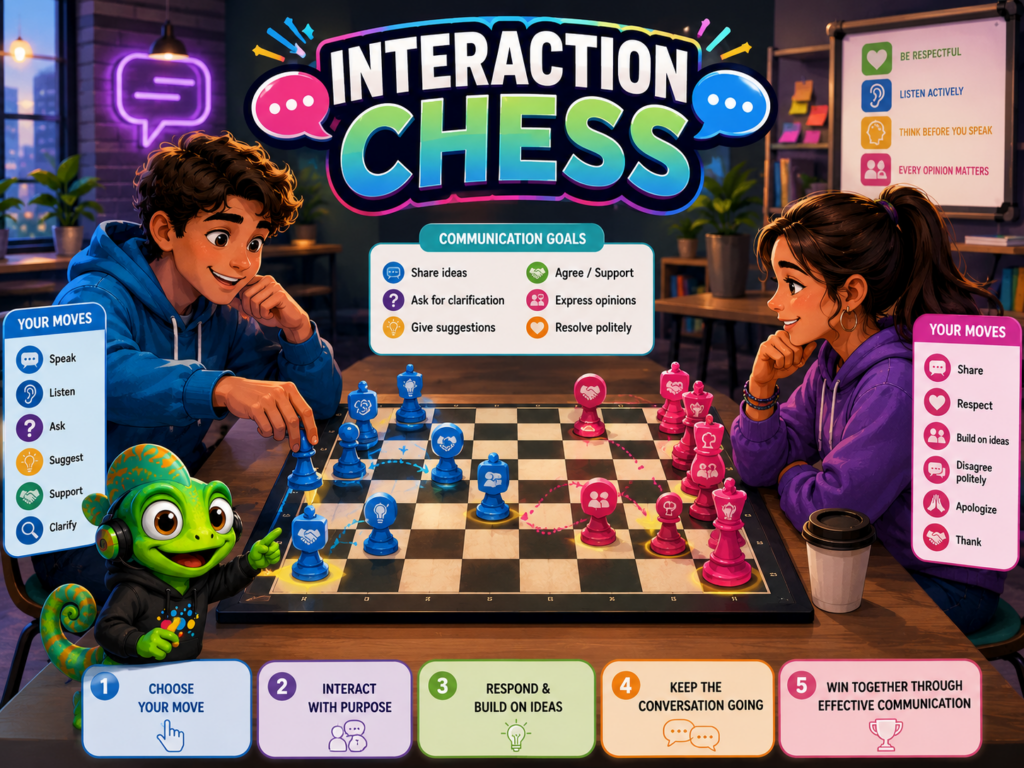
Students play a speaking game where every conversational move has a purpose. The teacher projects the move types:
- suggest
- agree
- disagree politely
- ask for clarification
- thank
- apologize
- invite partner to speak
- summarize
Pairs receive a problem and must make at least five “moves” in order.
Problem example:
“Your group has only ten minutes to finish a presentation, but the conclusion is weak.”
Possible interaction:
A: I would suggest improving the conclusion first.
B: I see your point, but perhaps we should also check the examples.
A: Could you clarify which example is weakest?
B: The second one.
A: Thank you for clarifying. Let’s fix that one quickly.
Part 2 – Formality Switch Drill (15 min)
The teacher gives direct or informal sentences. Students transform them orally into formal or semi-formal interaction language.
Sentences:
- “You’re wrong.”
- “Do this.”
- “Sorry.”
- “Thanks.”
- “Explain.”
- “I don’t like your idea.”
- “That’s confusing.”
- “You talk too much.”
- “I forgot.”
- “Let’s use my answer.”
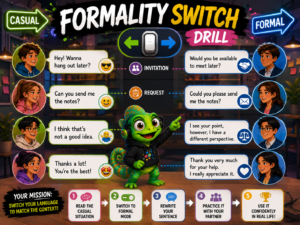
Improved examples:
“I see your point, but I have a different opinion.”
“I would suggest trying this option.”
“I apologize for the mistake.”
“Thank you for your support.”
“Could you clarify your point?”
“I understand your idea, but perhaps we could adjust it.”
Part 3 – Exit FCE Phrase (10 min)
Each student says one useful FCE-style phrase and explains when to use it.
Examples:
“I would suggest…” is useful when giving advice politely.
“I see your point, but…” is useful when disagreeing respectfully.
“Thank you for clarifying” is useful when someone explains an idea.
SESSION 3: CONSOLIDATION (80 min)
Part 1 – Preparation: FCE Interaction Bootcamp (15 min)
Students prepare for a performance-based FCE interaction challenge. They do not write a script. They prepare a phrase toolkit with:
- two suggestions
- one apology
- two thank-you expressions
- two polite disagreement phrases
- two turn-taking phrases
Required language:
“I would suggest…”
“Perhaps we could…”
“I apologize for…”
“Thank you for…”
“I see your point, but…”
“What do you think?”
Part 2 – FCE Interaction Booths (50 min)
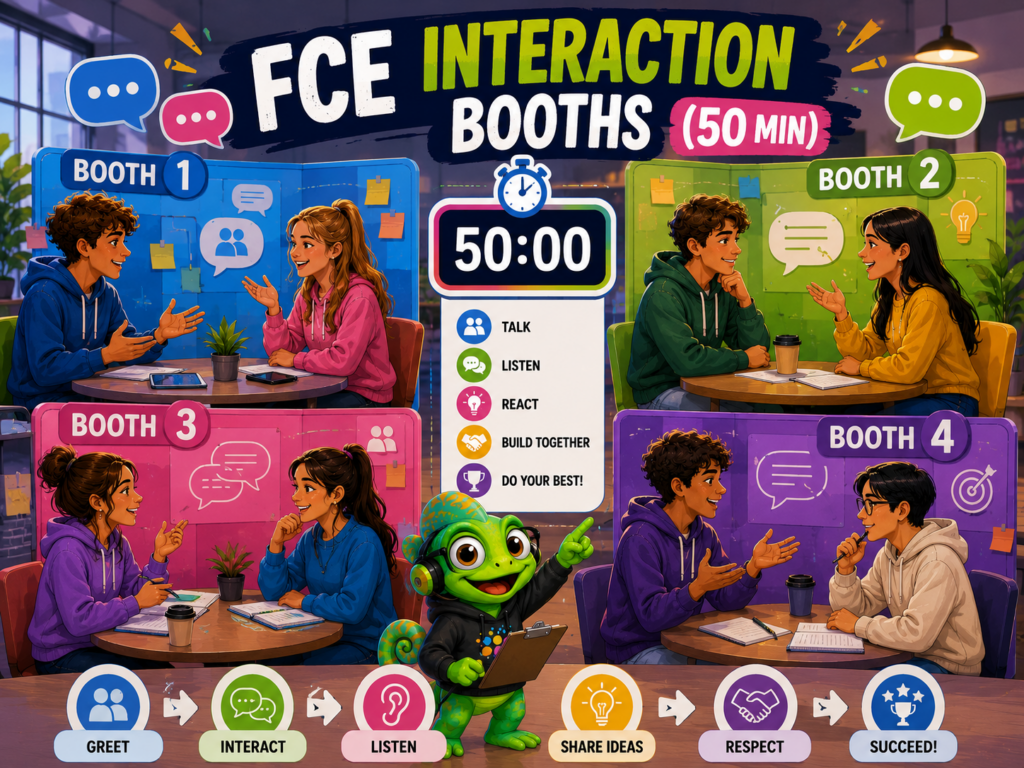
The classroom becomes an exam practice environment. Pairs enter a “speaking booth” in front of a small group. They receive one prompt and speak for two minutes.
This is not a debate, tribunal, museum, quest, or council. It is an exam-style collaborative interaction booth with peer observation.
Roles:
- Candidate A
- Candidate B
- examiner
- interaction observer
- language observer
Task format:
The examiner reads a situation. Candidates discuss options and try to reach a decision.
Example prompt:
“Your school wants to help students improve English speaking. Discuss these options and decide which one would be most useful: conversation club, speaking games, pronunciation workshop, peer interviews, short presentations.”
Candidates must:
- make suggestions
- respond to partner ideas
- ask at least one question
- disagree politely if necessary
- thank or acknowledge the partner
- reach a final decision
Observer checklist:
Did they invite each other to speak?
Did they make suggestions politely?
Did they respond to ideas?
Did they avoid rude disagreement?
Did they reach a decision?
Part 3 – Feedback and Reflection Circle (15 min)
Students give feedback using polite interaction language.
Required feedback frames:
“Thank you for…”
“I would suggest improving…”
“One strong point was…”
“Perhaps you could…”
“I appreciated…”
Examples:
“Thank you for speaking clearly.”
“I would suggest asking your partner more questions.”
“One strong point was your formal language.”
“Perhaps you could use more polite disagreement phrases.”

RUBRIC:
Giving_Advice
NEE – Agregar el tipo de adaptaciones curriculares
Principio II: Pautas 6.1 – 6.3 – 6.4
Principio III: Pautas 7.1 – 8.1 – 9.1
ALUMNO 1: Constante monitoreo. Dar tiempo adicional para el desarrollo de la actividad y se reduce el número de ejercicios o se modifican los ejercicios con un nivel de dificultad reducido, de acuerdo con sus necesidades académicas.
ALUMNO 2: Constante monitoreo, Dar tiempo adicional para el desarrollo de la actividad y se reduce el número de ejercicios o se modifican los ejercicios con un nivel de dificultad reducido, de acuerdo con sus necesidades académicas.
ALUMNO 3: Constante monitoreo. Corroborar que el contenido entregado en clase haya sido comprendido por la estudiante mediante retroalimentación.