
Sustainability
SKILLS
EFL.5.2.13 Deal with practical, everyday communication demands within familiar contexts, effectively and without undue effort.
EFL.5.3.4 Find the most important information in print or online sources in order to support an idea or argument.


REAL-LIFE APPLICATION
This topic helps students discuss sustainability with more mature reasoning. They learn to distinguish predictions, intentions, and scheduled actions when talking about climate behavior, carbon footprint, transportation, consumption, and school-level environmental solutions. This is useful for campaign planning, academic presentations, environmental discussions, student leadership projects, and real decision-making.
LEARNING ACTIVITIES
SESSION 1 (80 min) ANTICIPATION
Part 1: Carbon Footprint Reality Check (20 min)
The teacher presents four visual profiles of fictional students. Each profile is shown with icons, not text.
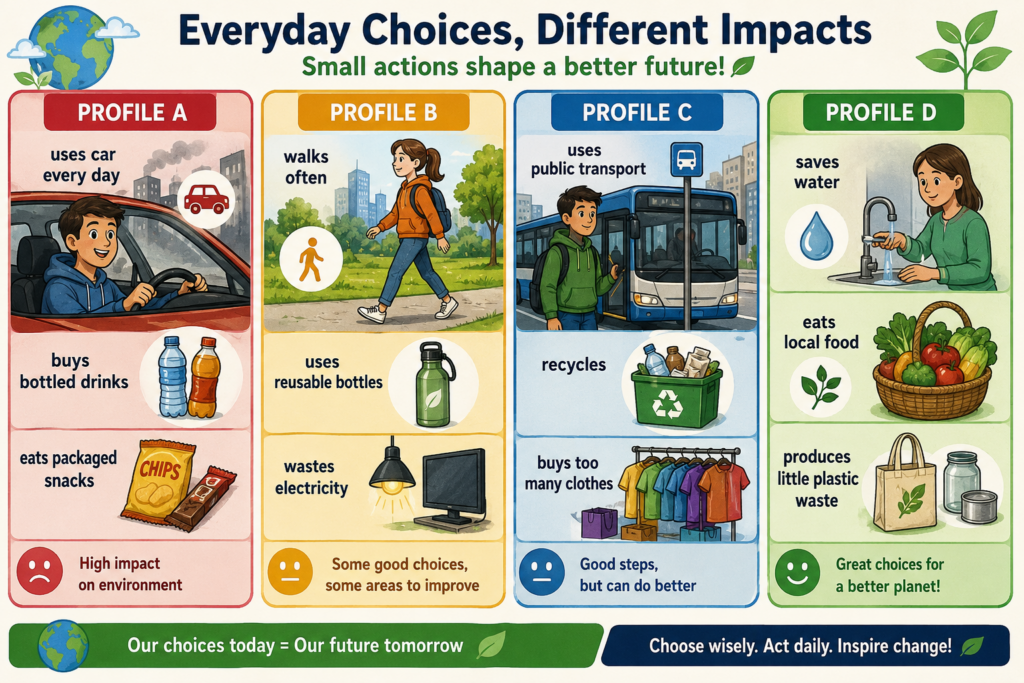
Students work in groups and decide:
Who has the highest carbon footprint?
Who will need to change the most?
Who is going to improve fastest?
What action is already scheduled or easy to organize?
They must justify their answers orally.
Example:
“Profile A will probably have the highest carbon footprint because the student uses a car every day.”
“Profile B is going to improve if the student turns off lights.”
“Profile D is joining the school eco-campaign next week.”
CONSTRUCTION
Part 2: Vocabulary for Sustainability and Carbon Footprint (15 min)
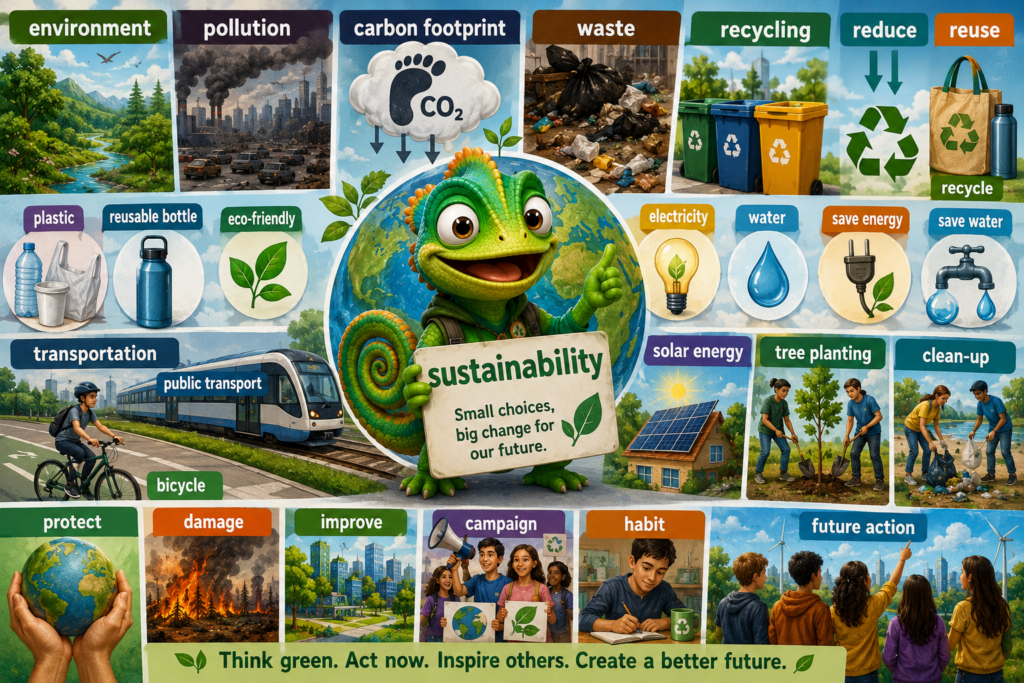
The teacher introduces vocabulary for environmental analysis. Students classify terms into problem, cause, consequence, and solution.
- sustainability
- carbon footprint
- greenhouse gases
- pollution
- climate change
- consumption
- transportation
- energy use
- water waste
- food waste
- plastic waste
- fast fashion
- recycling
- renewable energy
- public transport
- local products
- reusable materials
- environmental impact
- eco-friendly habit
- reduction strategy
- awareness campaign
- individual action
- collective action
- measurable goal
- realistic solution
- prediction
- intention
- arrangement
- consequence
- commitment
PROBLEM
CAUSE
SOLUTION
CONSEQUENCE
Part 3: Grammar Input: Choosing the Correct Future Form (25 min)
The teacher explains that future forms are not interchangeable. Each one communicates a different intention.
Will is used for predictions, promises, spontaneous decisions, or general future consequences.
Examples:
“Global temperatures will continue rising if emissions do not decrease.”
“I will support the campaign.”
“Students will save energy if classrooms have clear rules.”
“Plastic waste will become worse if habits do not change.”
Going to is used for intentions, plans, or conclusions based on present evidence.
Examples:
“Our group is going to design a carbon footprint survey.”
“The school is going to reduce paper use.”
“Look at the trash after lunch. This problem is going to get worse.”
“I am going to change how I travel to school.”
Present Continuous is used for fixed arrangements or scheduled future actions.
Examples:
“We are presenting the campaign on Friday.”
“The environmental committee is meeting tomorrow.”
“Our class is measuring classroom waste next week.”
“The students are interviewing the cafeteria manager at 10 a.m.”
The teacher emphasizes the meaning difference:
“Students will recycle more.”
This is a prediction.
“Students are going to recycle more.”
This is a plan or intention.
“Students are recycling paper tomorrow morning.”
This is a scheduled arrangement.
Exercise: Choose the best future form.
- Based on the amount of trash today, the school ______ produce too much waste this week.
- Our team ______ interview students about plastic use tomorrow.
- I believe more people ______ use public transport in the future.
- We ______ create a carbon footprint survey for our class.
- The eco-club ______ meeting at 2 p.m.
- If electricity is wasted, the school ______ pay more.
- I ______ reduce my plastic use starting this week.
- The students ______ presenting their proposal on Friday.
- This campaign ______ help if students participate.
- Look at those full trash bins. Food waste ______ become a serious problem.
Part 4: Carbon Footprint Negotiation Table (20 min)
Students work in groups as a school sustainability committee. Each group receives a limited budget of 100 eco-credits. They must choose only three actions from a list.
Actions:
- install classroom recycling points
- reduce printed worksheets
- organize bike-to-school day
- create reusable bottle campaign
- plant trees
- monitor classroom electricity use
- reduce food waste
- organize a no-plastic lunch day
- create a digital awareness campaign
- measure class carbon footprint
Students must negotiate and justify their choices using future forms.
Required language:
- “We will choose this because…”
- “We are going to focus on…”
- “We are launching this action on…”
- “This will reduce…”
- “This is going to help because…”
SESSION 2: CONSTRUCTION – REINFORCEMENT (40 min)
Part 1 – Future Form Pressure Interview (15 min)
Students work in pairs. One student is an environmental journalist. The other is a school sustainability leader. The journalist asks fast but clear questions.
Questions:
- What will happen if students do not reduce waste?
- What are you going to change this month?
- What is your group doing tomorrow?
- Will the school use less paper in the future?
- Are you going to measure your carbon footprint?
- What is the eco-club presenting on Friday?
- Will students accept the campaign?
- What are you going to do if the plan fails?
- Are you meeting with another group next week?
- What will be the biggest challenge?
Students switch roles.
Part 2 – Claim, Evidence, Future Action (15 min)
The teacher gives environmental claims. Groups must add one future consequence and one future action.
Claim:
“Students use too many plastic bottles.”
Future consequence:
“Plastic waste will increase.”
Future action:
“We are going to start a reusable bottle campaign.”
Claims:
- Students waste paper.
- Many lights stay on after class.
- Plastic bottles are used every day.
- Food is thrown away after lunch.
- Students come by car too often.
- Water is wasted in bathrooms.
- Recycling bins are not used correctly.
- Fast fashion creates waste.
- Students do not know their carbon footprint.
- The school needs more green spaces.
Part 3 – Exit Prediction + Plan (10 min)
Each student gives two sentences:
- one prediction with will
- one plan with going to or Present Continuous
Examples:
“Students will reduce waste if the campaign is clear.”
“My group is going to present a recycling plan tomorrow.”
SESSION 3: CONSOLIDATION (80 min)
Part 1 – Preparation: Sustainability Proposal Brief (15 min)
Students prepare for a short proposal defense. Each group chooses one school sustainability issue and designs a practical solution.
They prepare notes under:
- problem
- evidence or observation
- prediction with will
- intention with going to
- fixed arrangement with Present Continuous
- expected impact
They cannot write a full script.
Part 2 – Sustainability Proposal Defense (35 min)
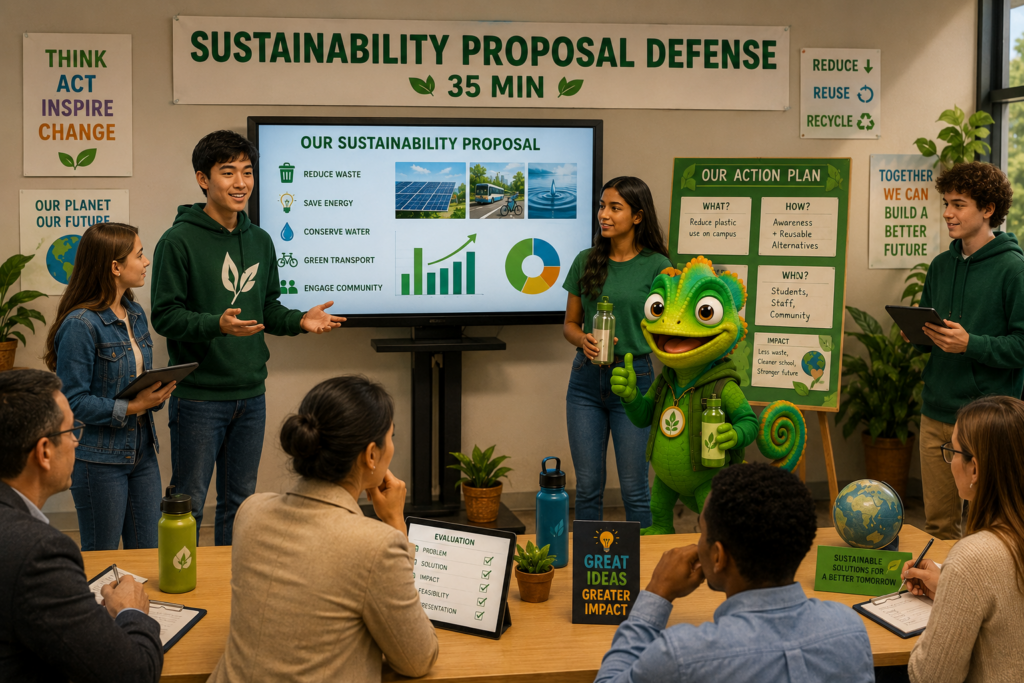
Groups present a 2-minute proposal to the class. The class acts as the school sustainability review board
Required language:
- “One problem is…”
- “This will affect…”
- “We are going to…”
- “We are presenting / measuring / interviewing / launching…”
- “Our solution will…”
- “This is realistic because…”
Audience members ask one challenge question.
Possible questions:
- How will this reduce carbon footprint?
- What are you going to do first?
- When are you launching the action?
- What will happen if students do not participate?
- How are you going to measure the result?
- Who is helping with the project?
- What will be difficult?
- What are you changing after feedback?
- Why will this solution work?
- What is your strongest evidence?
Part 3 – Short Final Test: Future Forms + Sustainability (30 min)
h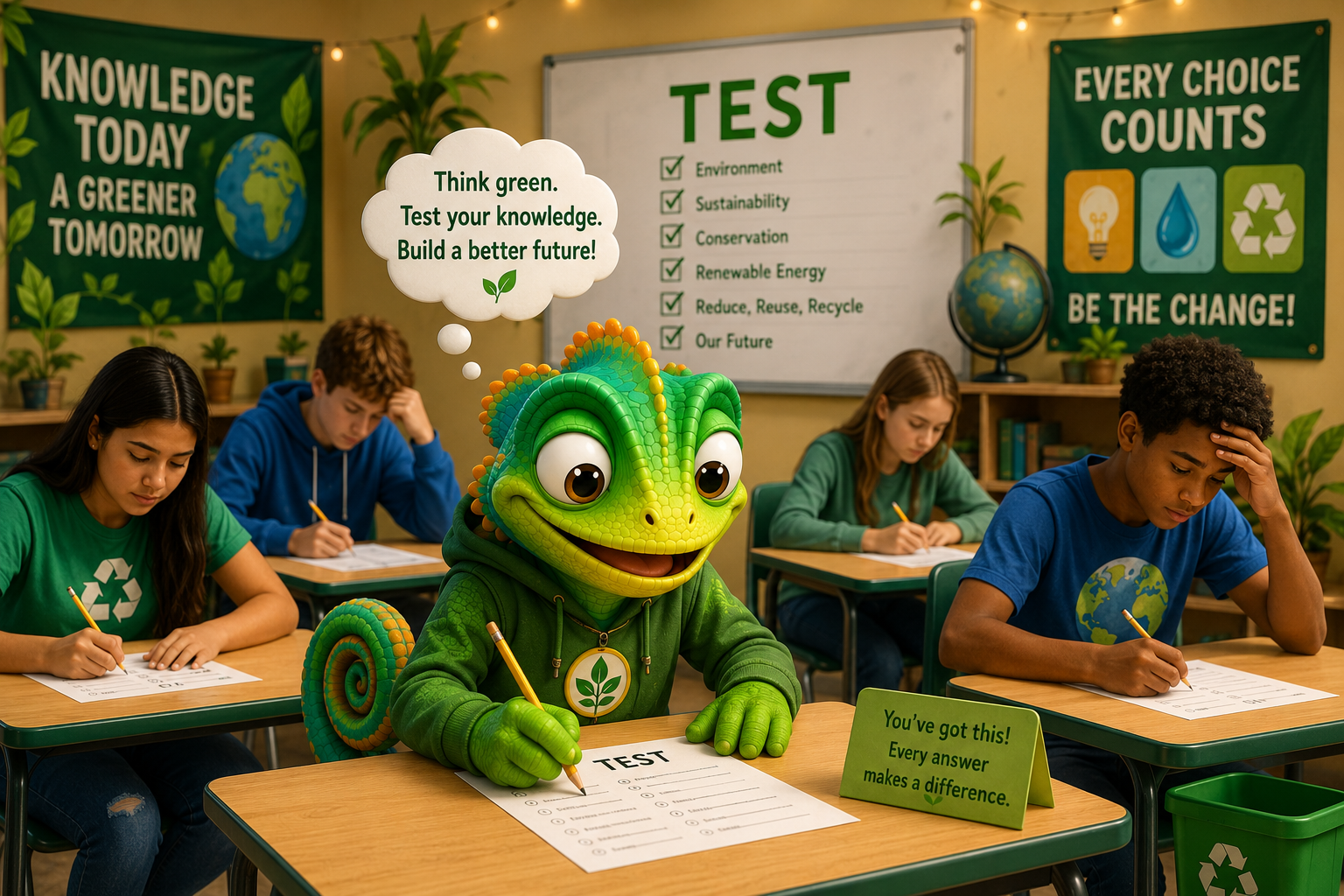
This topic uses a final test as consolidation. The test should be short, focused, and practical.

RUBRIC: Sustainability Future
NEE – Agregar el tipo de adaptaciones curriculares
Principio II: Pautas 6.1 – 6.3 – 6.4
Principio III: Pautas 7.1 – 8.1 – 9.1
ALUMNO 1: Constante monitoreo. Dar tiempo adicional para el desarrollo de la actividad y se reduce el número de ejercicios o se modifican los ejercicios con un nivel de dificultad reducido, de acuerdo con sus necesidades académicas.
ALUMNO 2: Constante monitoreo, Dar tiempo adicional para el desarrollo de la actividad y se reduce el número de ejercicios o se modifican los ejercicios con un nivel de dificultad reducido, de acuerdo con sus necesidades académicas.
ALUMNO 3: Constante monitoreo. Corroborar que el contenido entregado en clase haya sido comprendido por la estudiante mediante retroalimentación.