
Global Travel

SKILLS
EFL.5.2.13 Deal with practical, everyday communication demands within familiar contexts, effectively and without undue effort. (Example: meeting people, extending and accepting invitations, exchanging information, giving reasons, asking and answering questions about routines and preferences, etc.)
EFL.5.2.11 Express opinions on abstract topics, such as film and music, and concrete topics, such as personal experiences, while describing one’s reactions to them and others’ opinions.


REAL-LIFE APPLICATION

This topic helps students explain travel logistics and travel problems in a clear, neutral, and professional way. The passive voice is common in airport announcements, hotel communication, customer service, travel complaints, and incident reports. Students learn how to describe what happened without sounding too emotional or accusatory. This is useful when asking for help, reporting a problem, requesting compensation, or explaining a travel experience in an international context.
LEARNING ACTIVITIES
SESSION 1 (80 min) ANTICIPATION
Part 1: Travel Crisis Dashboard (20 min)
The teacher projects a realistic airport logistics image or a simulated “travel crisis dashboard” with icons for delayed flights, missing luggage, changed reservations, missed connections, and passenger complaints. Students work in groups and decide which problem is most urgent.
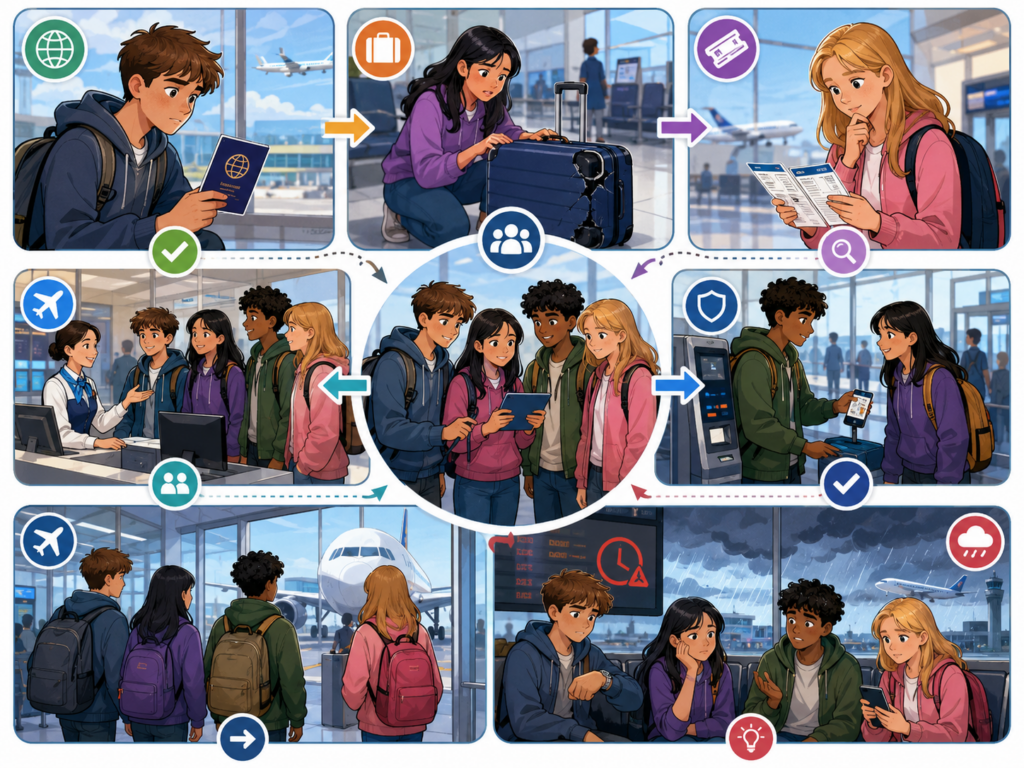
The teacher asks:
“What was affected?”
“What was changed?”
“What was delayed?”
“What was lost?”
“What should be solved first?”
Students respond orally using passive voice when possible.
Examples:
- “The flight was delayed.”
- “The luggage was misplaced.”
- “The hotel reservation was changed.”
- “The passengers were not informed.”
The teacher explains that passive voice helps sound more objective and professional in formal travel situations.
CONSTRUCTION
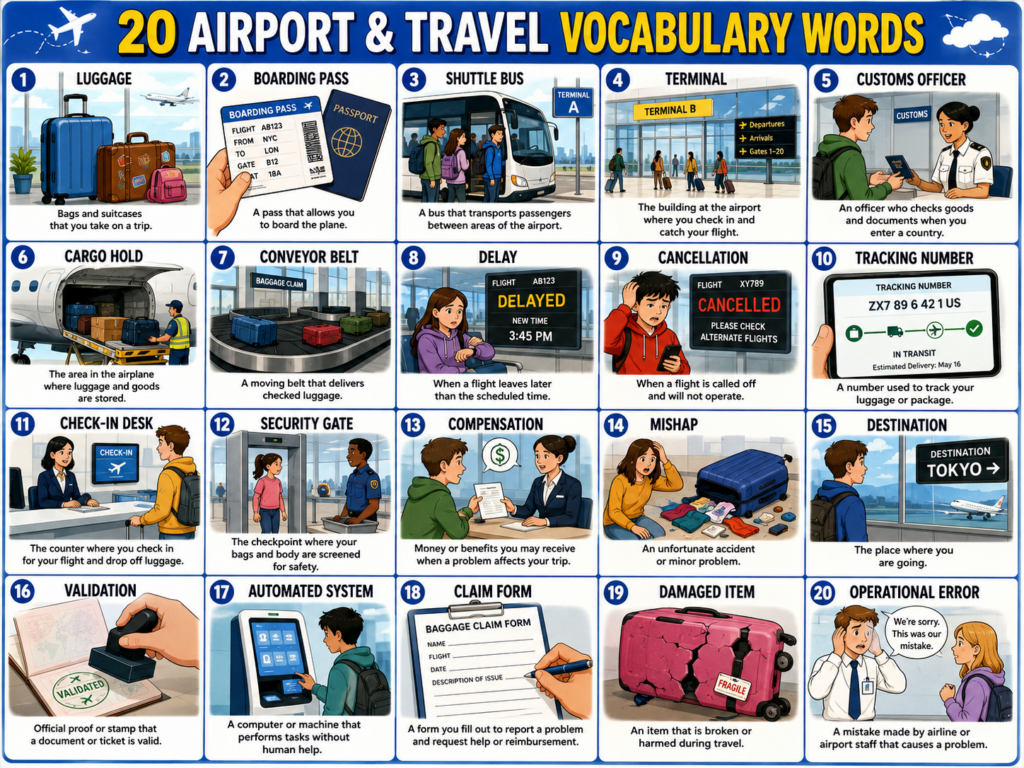
Part 2: Vocabulary for Travel Logistics (15 min)
The teacher introduces vocabulary for travel processes, incidents, and customer service. Students classify the words into “procedure,” “problem,” and “solution.”
- itinerary
- boarding gate
- check-in procedure
- baggage claim
- luggage tag
- connection flight
- cancellation
- delay
- overbooking
- reservation
- confirmation email
- travel insurance
- customs
- immigration
- passenger assistance
- refund
- compensation
- complaint
- incident report
- logistics
- rerouted
- processed
- confirmed
- cancelled
- delayed
- misplaced
- delivered
- assisted
- informed
Model sentences:
“Passengers are informed through airport announcements.”
“Reservations are confirmed by email.”
“The connection flight was missed.”
“The luggage was misplaced during the transfer.”
Part 3: Grammar Input: Passive Voice for Professional Travel Communication (25 min)
The teacher explains that the Passive Voice is essential in travel because the person performing the action is either obvious, unknown, or unimportant.

The passive voice
The passive voice changes the focus of the sentence. Active voice focuses on who did the action. Passive voice focuses on what happened, what was affected, or what result was produced.
Active voice:
“The airline cancelled the flight.”
Passive voice:
“The flight was cancelled.”
The passive voice is useful in travel communication because it sounds more neutral and professional. It helps students explain problems without immediately blaming someone.
Direct and emotional:
“They lost my suitcase.”
More formal and neutral:
“My suitcase was misplaced.”
Direct and emotional:
“They changed our reservation.”
More formal and neutral:
“Our reservation was changed.”
Present Simple Passive is used for normal procedures, systems, and rules.
Structure: subject + am / is / are + past participle
Examples:
“Passports are checked before international flights.”
“Boarding passes are scanned at the gate.”
“Reservations are confirmed by email.”
“Luggage is weighed at the check-in counter.”
“Passengers are informed through the airport screens.”
Past Simple Passive is used for completed travel incidents, changes, or problems.
Structure: subject + was / were + past participle
Examples:
“The flight was delayed because of bad weather.”
“The passengers were informed too late.”
“The hotel reservation was changed.”
“The bags were sent to the wrong terminal.”
“The connection flight was missed.”
The teacher explains negative and question forms.
Negative form:
“The reservation was not confirmed.”
“The passengers were not informed.”
“The luggage is not checked at the gate.”
Question form:
“Was the flight delayed?”
“Were the passengers informed?”
“Is the reservation confirmed?”
“Are the tickets sent by email?”
The teacher explains “by”:
Use “by” only when the agent is important.
“The reservation was changed by the travel agency.”
“The passengers were assisted by airport staff.”
Do not use “by” when the agent is obvious or not important.
“The flight was delayed.”
“The luggage was misplaced.”
“The tickets were confirmed.”
Exercise: Rewrite the sentences in passive voice.
- The airline cancelled the flight.
- The airport staff checked the passports.
- The travel agency booked the hotel rooms.
- The system confirmed the reservation.
- The airline delayed the connection flight.
- The staff informed the passengers.
- The airport sent the luggage to another terminal.
- The hotel changed our reservation.
- The website processed the refund.
- The assistant created an incident report.
Part 4: Passenger Response Lab (20 min)
Students work in pairs. One student is a passenger and the other is a travel support agent. The passenger gives an emotional complaint. The support agent must transform the complaint into a professional passive sentence and offer a solution.
Passenger complaints:
- “They lost my bag!”
- “They cancelled my flight!”
- “They changed my reservation!”
- “They sent us to the wrong gate!”
- “They didn’t inform us!”
- “They overbooked the hotel!”
- “They didn’t process my refund!”
- “They changed my seat!”
- “They delayed the connection!”
- “They delivered my luggage late!”
Example:
Passenger: “They lost my bag!”
Agent: “Your bag was misplaced during the transfer. An incident report will be created.”
SESSION 2: CONSTRUCTION – REINFORCEMENT (40 min)
Part 1 – Incident Reconstruction Lab (15 min)
The teacher gives each group a mixed sequence of travel events. Students must organize the sequence and report it using passive voice.
Scenario:
A school group traveled from Quito to Bogotá. The first flight was delayed. The connection was missed. Two suitcases were sent to another city. The hotel reservation was changed. The group was assisted at the airport.
Students reconstruct the incident orally.
Expected sentences:
- “The first flight was delayed.”
- “The connection was missed.”
- “Two suitcases were sent to another city.”
- “The hotel reservation was changed.”
- “The group was assisted at the airport.”
Part 2 – Formal vs. Informal Travel Complaint (15 min)
Students compare informal and formal travel language. The teacher reads informal sentences, and students upgrade them into professional passive voice.
Informal sentences:
- “They messed up my booking.”
- “They lost our luggage.”
- “They changed the gate again.”
- “They didn’t send the confirmation.”
- “They cancelled everything.”
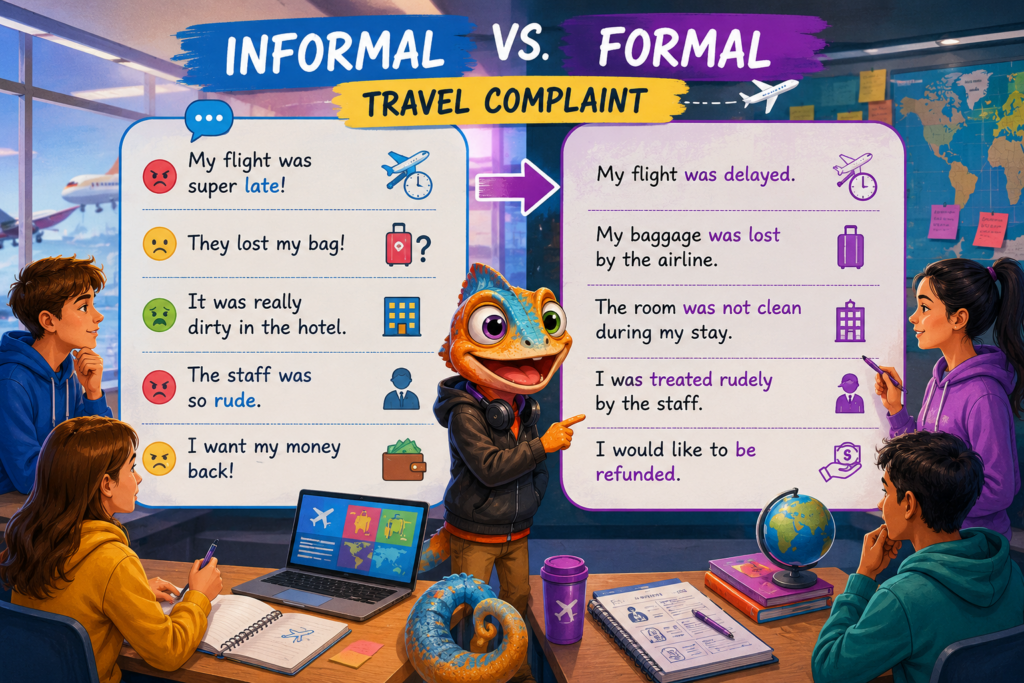
Possible upgraded versions:
“My booking was changed incorrectly.”
“Our luggage was misplaced.”
“The boarding gate was changed again.”
“The confirmation was not sent.”
“The reservation was cancelled.”
Students then discuss:
Which version sounds more professional?
Which version would be better in an email complaint?
Which version sounds more emotional?
Part 3 – Exit Support Line (10 min)
Each student gives one short customer service response using passive voice.
Examples:
“Your refund was processed yesterday.”
“Your reservation is confirmed.”
“Your luggage was delivered to the hotel.”
“Passengers are informed through email and announcements.”
SESSION 3: CONSOLIDATION (80 min)
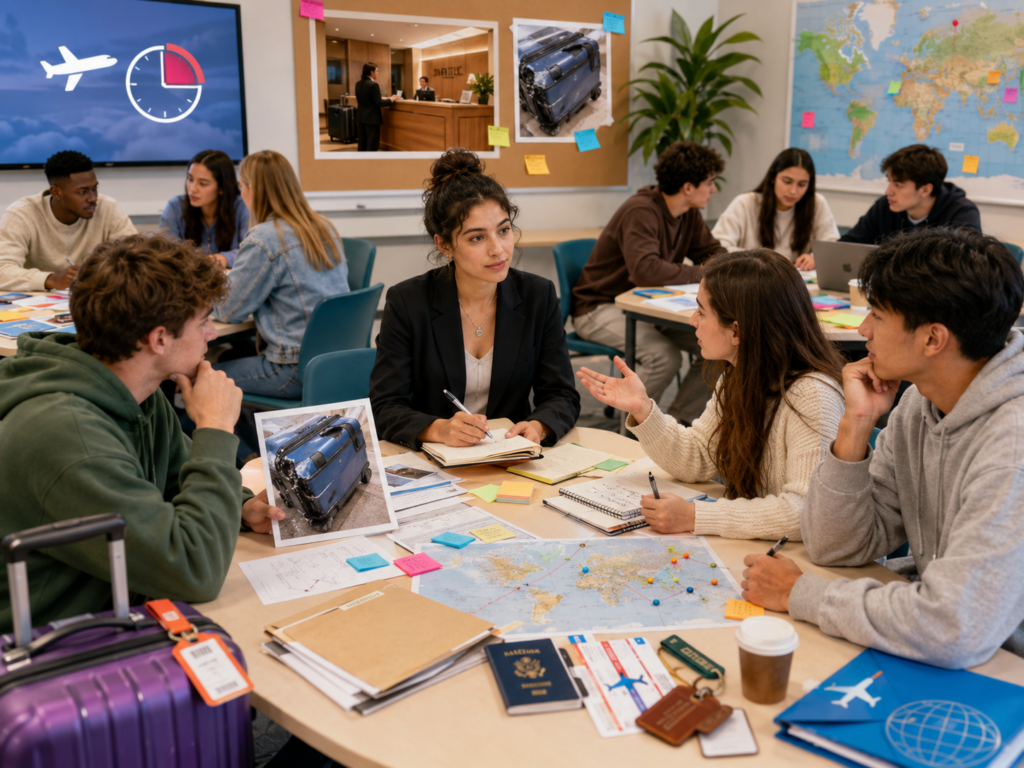
Part 1 – Preparation: Travel Ombudsman Case File (15 min)
Students prepare for a travel ombudsman simulation. An ombudsman is a neutral person who listens to complaints and helps solve problems. Each group receives one case file and prepares notes, not a full script.
Case files:
- A family’s luggage was misplaced during a connection.
- A student’s reservation was cancelled without notice.
- A group’s flight was delayed and the connection was missed.
- A hotel was overbooked and passengers were sent to another hotel.
- A refund was not processed after a cancellation.
- Boarding passes were not accepted at the gate.
- Passengers were not informed about a gate change.
- A suitcase was delivered three days late.
- A tour was cancelled because of weather.
- A confirmation email was not received.
Required language:
- What happened?
- Who was affected?
- What was done?
- What solution should be offered?
- How should the situation be explained professionally?
Part 2 – Travel Ombudsman Simulation (50 min)
Groups act out a formal complaint resolution meeting. Roles:
- traveler
- airline or hotel representative
- ombudsman
- evidence recorder
The traveler explains the problem. The airline or hotel representative explains what happened using passive voice. The ombudsman asks questions and proposes a fair solution. The evidence recorder writes five key passive sentences on a visible board or shared document.
Required language:
“The flight was…”
“The reservation was…”
“The passengers were…”
“The luggage was…”
“The refund is…”
“The case was…”
“The solution was…”

Example dialogue:
Traveler: “My luggage was misplaced during the connection.”
Representative: “The bag was sent to another terminal by mistake.”
Ombudsman: “Was the passenger informed immediately?”
Representative: “No, the passenger was informed later.”
Ombudsman: “A delivery service should be offered, and the passenger should be updated by email.”
Gamification:
Each group starts with 100 trust points.
They gain points for:
- correct passive voice
- professional tone
- clear explanation
- realistic solution
- respectful interaction
They lose points for:
- blaming without explanation
- unclear grammar
- lack of solution
- interrupting others
- avoiding the required vocabulary
Part 3 – Final Case Vote and Reflection (15 min)
The class votes for the group that gave the most professional and fair solution. Students must explain their vote using passive voice.
Examples:
“I voted for this group because the problem was explained clearly.”
“The solution was presented professionally.”
“The passenger was treated respectfully.”
“The incident was described with enough detail.”
The teacher closes by emphasizing that passive voice helps people communicate clearly in real travel situations, especially when discussing logistics, mistakes, complaints, and solutions.
 RUBRIC: Global Travel Passive Voice
NEE – Agregar el tipo de adaptaciones curriculares
Principio II: Pautas 6.1 – 6.3 – 6.4
Principio III: Pautas 7.1 – 8.1 – 9.1
ALUMNO 1: Constante monitoreo. Dar tiempo adicional para el desarrollo de la actividad y se reduce el número de ejercicios o se modifican los ejercicios con un nivel de dificultad reducido, de acuerdo con sus necesidades académicas.
ALUMNO 2: Constante monitoreo, Dar tiempo adicional para el desarrollo de la actividad y se reduce el número de ejercicios o se modifican los ejercicios con un nivel de dificultad reducido, de acuerdo con sus necesidades académicas.
ALUMNO 3: Constante monitoreo. Corroborar que el contenido entregado en clase haya sido comprendido por la estudiante mediante retroalimentación.