
Reading Analysis

SKILLS
EFL.5.3.2 Identify and use reading strategies to make informative and narrative texts comprehensible and meaningful. (Example: skimming, scanning, previewing, reading for main ideas and details, using structural and context clues, cognates, format, sequence, etc.)
EFL.5.3.9 Skim and scan reference materials, in print or online, in order to identify information that might be of practical use for one’s own research and academic needs.
REAL-LIFE APPLICATION

This topic helps students read strategically for academic and real-life purposes. They learn to preview a text, identify its purpose, locate relevant information quickly, and decide which details matter. This is useful when students read articles for projects, compare sources, study biographies, research school topics, prepare presentations, or answer exam-style reading questions.
LEARNING ACTIVITIES
SESSION 1 (80 min) ANTICIPATION
Part 1: Editorial First Look (20 min)
The teacher projects three different text openings:
- an informative text
- a biography
- a news article
Students have only 45 seconds per text. They cannot read everything. They must answer:
What type of text is it?
What is the topic?
What is the writer probably trying to do?
What information seems important?
Which text would be useful for research?
The teacher introduces the reading purpose:
Readers do not always read the same way.
The strategy depends on the question.
If the task asks for the topic, use skimming.
If the task asks for a name, date, number, or place, use scanning.
If the task asks for a conclusion or opinion, read the relevant paragraph more carefully.
Part 2: Vocabulary Activation: Reading Strategy Marketplace (15 min)
Students receive 100 imaginary “reading points.” They must invest in the vocabulary they think will help them understand texts faster. To invest in a word, they must explain how it helps reading.
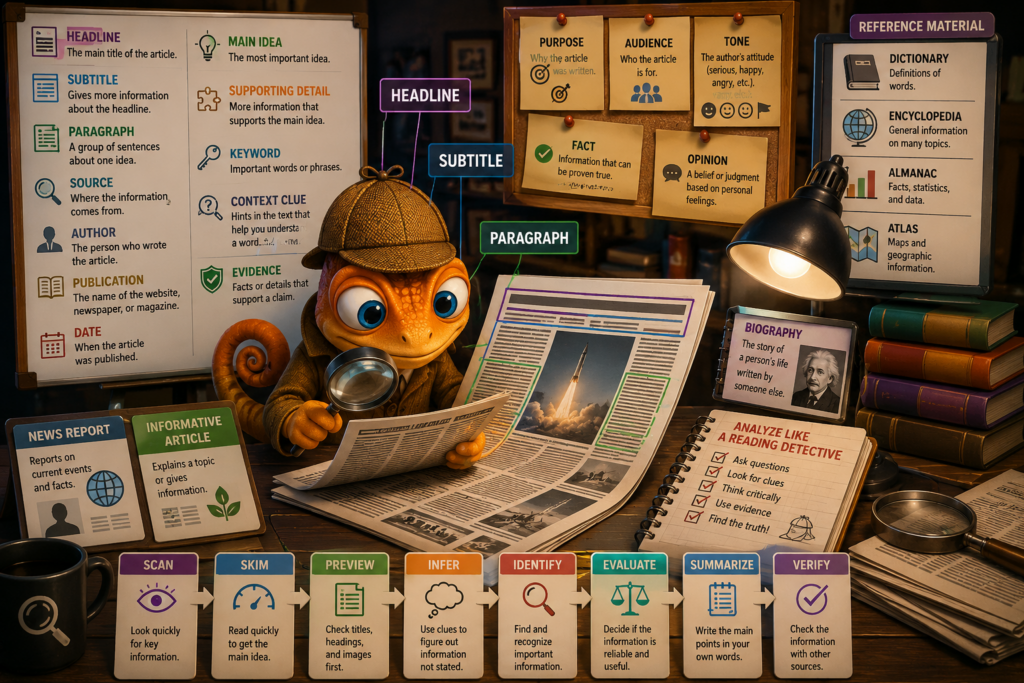
- headline
- subtitle
- paragraph
- source
- author
- publication
- date
- main idea
- supporting detail
- keyword
- context clue
- evidence
- purpose
- audience
- tone
- conclusion
- fact
- opinion
- sequence
- reference material
- biography
- news report
- informative article
- scan
- skim
- preview
- infer
- identify
- evaluate
- summarize
- verify
Part 3: Reading Strategy Input: Text X-Ray Method (25 min)
The teacher explains skimming and scanning through the Text X-Ray Method.

Step 1: Surface scan
Look at the title, author, date, image, section headings, first paragraph, and layout.
Purpose:
To identify the type of text and predict the content.
Step 2: Main idea skim
Read the first lines, repeated words, topic sentences, and final paragraph.
Purpose:
To understand what the text is mainly about.
Step 3: Detail scan
Search for names, dates, places, numbers, statistics, and keywords from the question.
Purpose:
To locate precise information without reading the entire text.
Step 4: Evidence check
Read the sentence before and after the answer.
Purpose:
To avoid choosing information without context.
The teacher explains the difference between text types:
- An informative text explains a topic. It usually includes definitions, examples, facts, and explanations.
- A biography tells the life story of a person. It usually includes early life, challenges, achievements, dates, and impact.
- A news article reports a recent or relevant event. It usually includes who, what, where, when, why, and sometimes how.
Part 4: Language Teaching Idea: Question-to-Text Mapping (20 min)
This section teaches the “grammar” of reading questions. Students learn that question words tell them what kind of information to scan for.
Who = person
Where = place
When = date or time
How many = number
Why = reason
What happened = event
What is the main idea = skim
Which statement is true = scan and compare
What does the word mean = use context
What is the writer’s purpose = skim and infer
The teacher gives ten questions. Students underline the question word and say what they need to find.
Examples:
“When did the campaign begin?” → scan for date
“Who created the project?” → scan for person
“What is the main idea?” → skim
“Why did the problem increase?” → scan for reason, then read around it
Students then apply the system to a short article.
SESSION 2: CONSTRUCTION – REINFORCEMENT (40 min)
Part 1 – Evidence Locator Sprint (15 min)
Students receive a short text and a list of search targets. They must scan quickly and write only the paragraph number where the information appears.
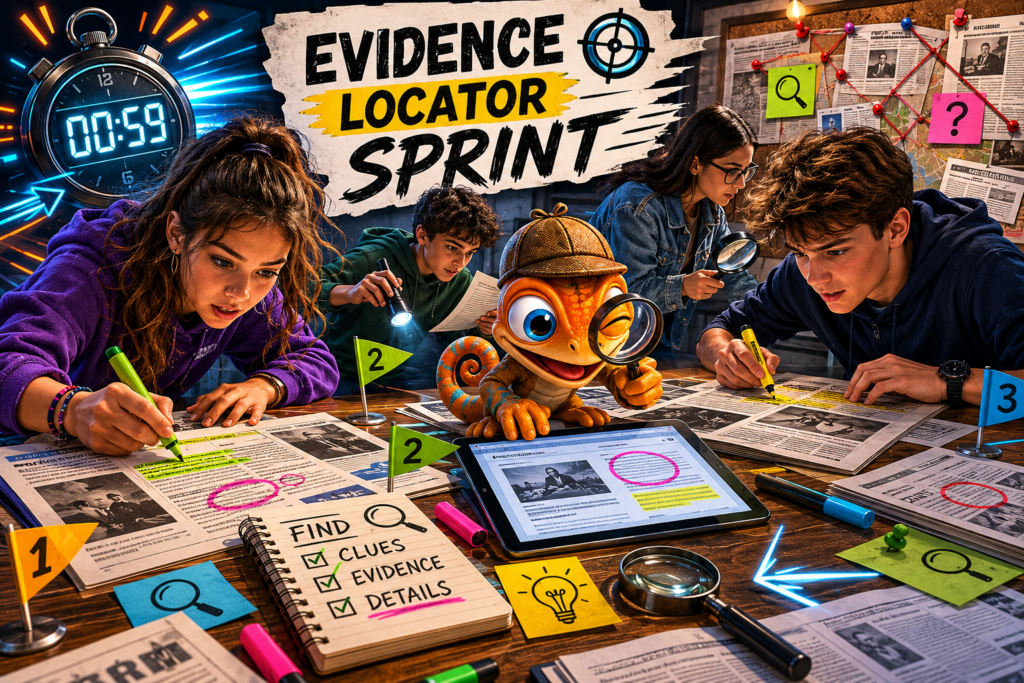
Targets:
- a date
- a person
- a place
- a number
- a problem
- a cause
- a result
- an example
- a quote or opinion
- a conclusion
Students then explain:
“I found the cause in paragraph 2.”
“The number appears in paragraph 3.”
“The conclusion is at the end.”
Part 2 – Main Idea Compression Drill (15 min)
Students skim a short article and reduce it three times:
Version 1: main idea in 15 words
Version 2: main idea in 10 words
Version 3: main idea in 5 words
Example:
15 words: “The article explains how students reduced plastic waste by using reusable bottles at school.”
10 words: “Students reduced plastic waste with reusable bottles.”
5 words: “Students reduced plastic waste.”
This helps students separate main idea from details.
Part 3 – Exit Strategy Choice (10 min)
Each student receives one reading task and says which strategy is best.
Examples:
“Find the year the person was born.” → scanning
“Understand what the article is mainly about.” → skimming
“Find how many people participated.” → scanning
“Decide the writer’s purpose.” → skimming and inference
SESSION 3: CONSOLIDATION (80 min)

Part 1 – Preparation: Editorial Intelligence Sheet (15 min)
Students prepare for a reading analysis simulation. Each group receives one text. They prepare an intelligence sheet with:
- text type
- topic
- purpose
- main idea
- three scanned details
- one useful quote or sentence
- one question for the class
Required language:
“The text is a…”
“The purpose is to…”
“The main idea is…”
“We scanned for…”
“One useful detail is…”
“This text would be useful for…”
Part 2 – Editorial Intelligence Briefing (50 min)
Students act as reading analysts. They present a short briefing about their text. This is not a debate, museum, TV broadcast, or council. It is an editorial briefing where students explain how the text works and what information is useful.
Roles:
- text type analyst
- main idea analyst
- evidence scanner
- vocabulary/context clue analyst
- briefing speaker
Briefing requirements:
identify the text type
explain the main idea
identify the purpose
present three scanned details
explain one context clue
explain which reading strategy helped most
ask the class one comprehension question
Example:
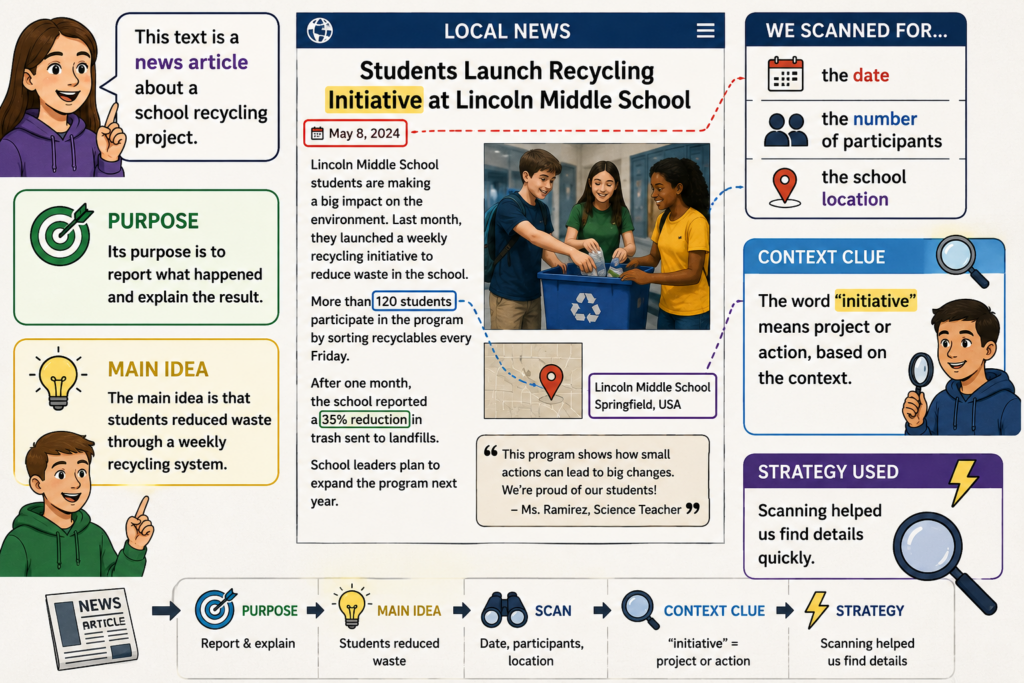
“This text is a news article about a school recycling project. Its purpose is to report what happened and explain the result. The main idea is that students reduced waste through a weekly recycling system. We scanned for the date, the number of participants, and the school location. The word ‘initiative’ means project or action, based on the context. Scanning helped us find details quickly.”
Part 3 – Editorial Debrief Reflection (15 min)
Students vote for:
- clearest main idea
- best evidence scanning
- best explanation of text purpose
- best context clue explanation
- best academic briefing
Students explain their vote orally:
“I voted for this group because they used evidence clearly.”
“Their main idea was concise.”
“They explained the purpose of the article well.”
RUBRIC:
Reading Analysis
NEE – Agregar el tipo de adaptaciones curriculares
Principio II: Pautas 6.1 – 6.3 – 6.4
Principio III: Pautas 7.1 – 8.1 – 9.1
ALUMNO 1: Constante monitoreo. Dar tiempo adicional para el desarrollo de la actividad y se reduce el número de ejercicios o se modifican los ejercicios con un nivel de dificultad reducido, de acuerdo con sus necesidades académicas.
ALUMNO 2: Constante monitoreo, Dar tiempo adicional para el desarrollo de la actividad y se reduce el número de ejercicios o se modifican los ejercicios con un nivel de dificultad reducido, de acuerdo con sus necesidades académicas.
ALUMNO 3: Constante monitoreo. Corroborar que el contenido entregado en clase haya sido comprendido por la estudiante mediante retroalimentación.